What’s Included in an Exhaust Manifold Replacement
Many car owners wonder about What’s Included in an Exhaust Manifold Replacement. It can seem like a tricky job for folks who aren’t mechanics. You might worry about special tools or hard steps.
But don’t stress! We’ll break it down nice and easy. This guide shows you exactly what goes into fixing your exhaust manifold.
You’ll see it’s not as complicated as it first appears.
Understanding Exhaust Manifold Replacement Basics
Replacing an exhaust manifold might seem like a big job, but it’s a common repair that keeps your car running smoothly. An exhaust manifold is a vital part of your car’s exhaust system. It collects gases from each cylinder and sends them to the exhaust pipe.
When it’s damaged or leaking, you might notice loud noises, a drop in performance, or even check engine lights. Knowing What’s Included in an Exhaust Manifold Replacement helps you understand the process and what to expect from a mechanic. This section will cover the main parts and purpose of this repair, setting the stage for a deeper look at the actual replacement steps and associated components.
The Role of the Exhaust Manifold
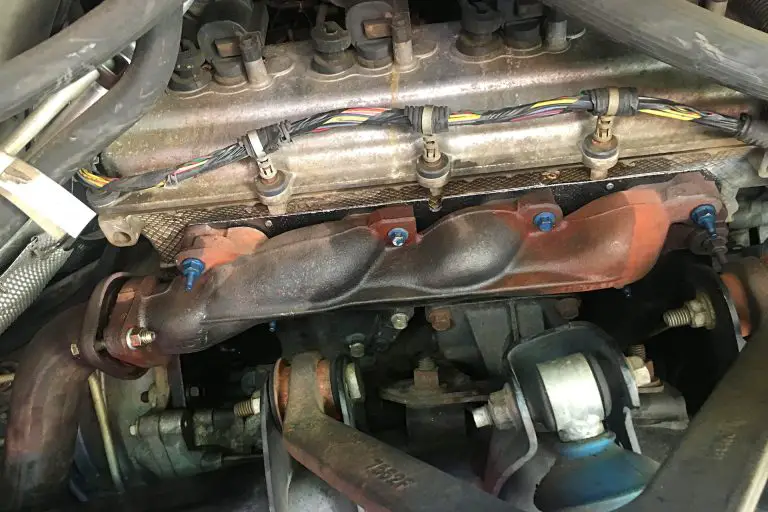
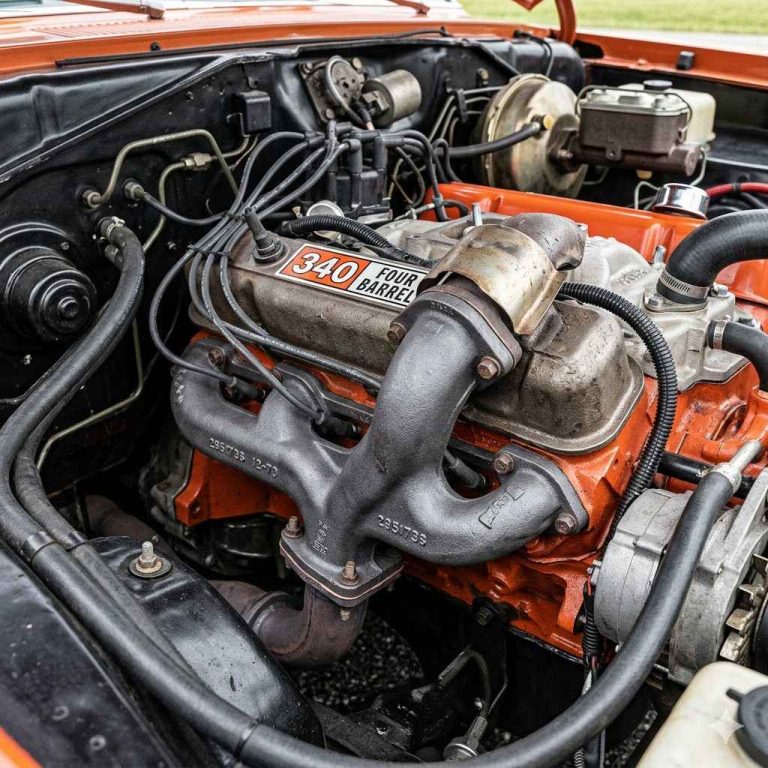
The exhaust manifold acts like a funnel for your engine’s exhaust gases. It’s usually a cast iron or stainless steel component bolted directly to the cylinder head. Each cylinder has an exhaust port, and the manifold connects these ports.
This unified flow then directs the exhaust gases away from the engine.
Its design is crucial for efficient engine operation. A well-functioning manifold helps manage exhaust back pressure, which affects engine power and fuel economy. A leak or crack can disrupt this balance, leading to various problems.
Common Reasons for Replacement
Exhaust manifolds can fail for several reasons. Cracks often form due to extreme temperature changes. The metal expands when hot and contracts when cold.
Over time, this repeated stress can cause the manifold to crack.
Another common issue is a broken or loose bolt. Exhaust manifold bolts are exposed to heat and vibration. They can rust, break, or strip, leading to leaks.
Warping can also occur, preventing the manifold from sealing properly against the cylinder head or gasket.
Signs of a Failing Exhaust Manifold
A common sign is a loud ticking or puffing noise, especially when the engine is cold. This is often exhaust gas escaping through a crack or leak. You might also notice a burning smell, or even see soot around the manifold.
Reduced engine power and poor fuel efficiency are other indicators. The check engine light can also come on, often showing codes related to exhaust leaks or oxygen sensor performance.

What’s Included in an Exhaust Manifold Replacement Process
When you’re looking into What’s Included in an Exhaust Manifold
Gaining Access to the Exhaust Manifold
Accessing the exhaust manifold can sometimes be the most time-consuming part. On many vehicles, the manifold is located at the front or side of the engine. However, sometimes it’s tucked away, especially on V-engines where each bank has its own manifold.
You might need to remove other parts to get to it. This could include heat shields, intake components, or even engine mounts. The goal is to create enough space to work comfortably and safely.
Removing the Old Exhaust Manifold
Once you can reach it, the manifold is typically held in place by several bolts. These bolts are often exposed to high heat and moisture, making them prone to rust and seizing. Mechanics use specialized tools like penetrating oil and sometimes heat to loosen stubborn bolts.
Care must be taken when removing these bolts. If one breaks off in the cylinder head, it can turn a straightforward job into a more complex one. Extracting broken bolts requires specific tools and techniques.
New Gaskets and Hardware
A crucial part of What’s Included in an Exhaust Manifold Replacement is using new gaskets and hardware. The exhaust manifold gasket seals the connection between the manifold and the cylinder head. It prevents exhaust gases from escaping.
Old gaskets can become brittle and compressed over time, losing their sealing ability. Using a new gasket ensures a tight seal and prevents leaks. Similarly, new bolts and nuts are recommended.
Old hardware might be weakened by heat and corrosion, and new parts ensure a secure fit.
Exhaust Manifold Gasket Types
There are a few common types of exhaust manifold gaskets.
- Metal gaskets are often made of steel or composite materials. They are designed to withstand high temperatures and pressures.
- Multi-layer steel (MLS) gaskets are very common in modern vehicles. They consist of several layers of steel with special coatings. These offer excellent sealing and durability.
- Sometimes, a form-in-place gasket (FIPG) is used, which is a special liquid sealant applied to the mating surface.
The choice of gasket depends on the vehicle manufacturer’s specifications and the original equipment. Using the correct type is vital for a successful repair.
Installing the New Exhaust Manifold
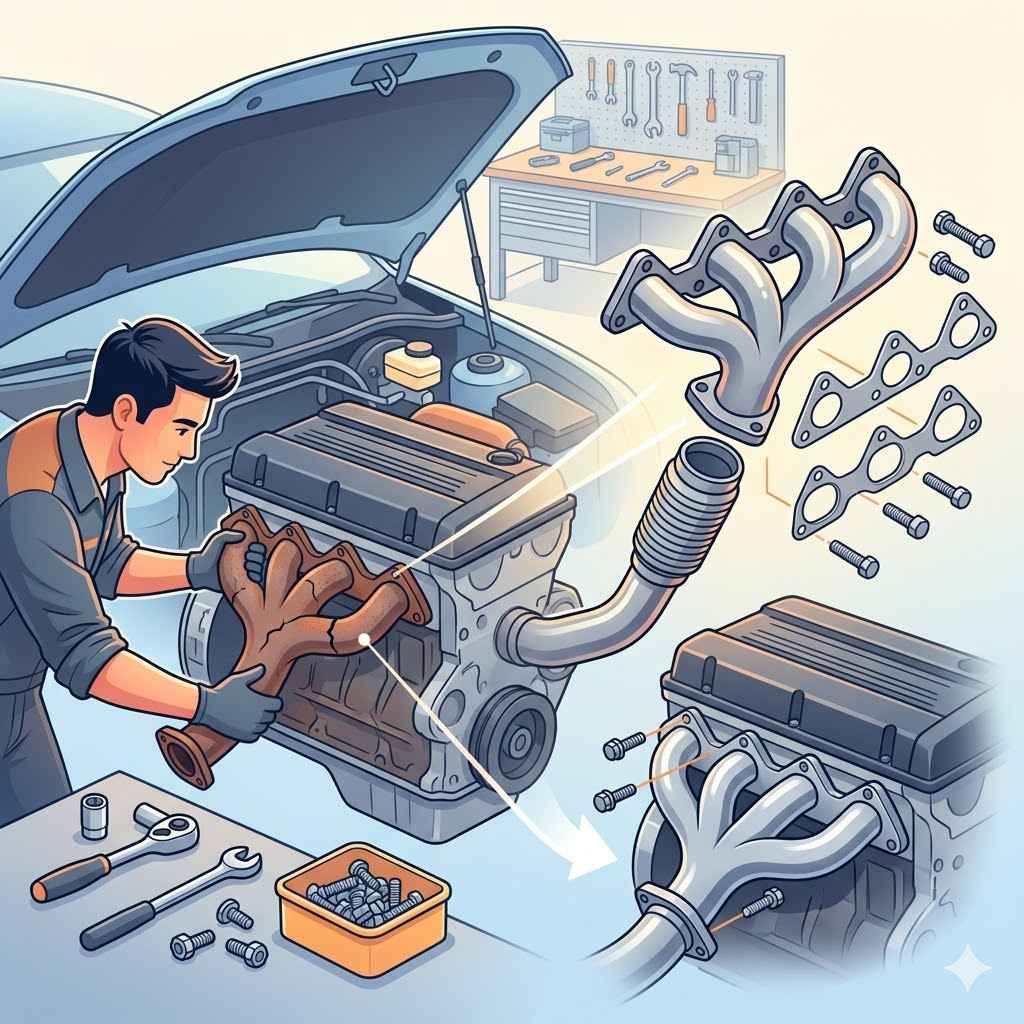
After cleaning the cylinder head mating surface thoroughly, the new manifold and gasket are put in place. The new bolts are then installed and tightened in a specific sequence and to a specific torque. This is to ensure the manifold seals evenly against the cylinder head and to prevent warping the new manifold.
Mechanics follow a pattern, often starting from the center and working outwards, tightening bolts incrementally. This even pressure distribution is key to achieving a leak-free seal.
Reassembly and Testing
Once the new manifold is securely in place, any components that were removed for access are reinstalled. This includes heat shields, intake parts, and any sensors that might have been in the way.
After everything is back together, the engine is started. The mechanic will listen for any unusual noises and check for exhaust leaks. A visual inspection for soot or smoke around the new manifold is also performed.
Sometimes, a smoke test is used to definitively find any hidden leaks.
Potential Challenges and What to Watch For
While What’s Included in an Exhaust Manifold Replacement is a common repair, there are challenges that can arise. These often involve seized bolts, rusted components, or damage to the cylinder head. Being aware of these potential issues helps set realistic expectations for the repair time and cost.
This section will explore common problems mechanics encounter, the tools and techniques used to overcome them, and why sometimes a minor repair can become more involved. Understanding these potential hurdles is key to being an informed car owner.
Seized or Broken Exhaust Manifold Studs and Bolts
This is one of the most frequent problems. Exhaust studs are metal pins that the nuts thread onto, while bolts screw directly into the cylinder head. Both are subject to extreme heat cycles and corrosion.
When attempting to remove them, they can become so stuck that they snap. This leaves a portion of the stud or bolt in the cylinder head. Extracting these requires specialized tools like stud extractors, left-hand drill bits, or even welding a nut onto the broken piece to get leverage.
A statistics from a reputable automotive repair association shows that approximately 40% of exhaust manifold
Damaged Cylinder Head Mating Surface
The surface on the cylinder head where the manifold bolts needs to be perfectly flat for a good seal. If the old manifold was severely cracked or leaking, or if bolts were forced too hard, the cylinder head surface can become warped or damaged.
In some cases, the damage is minor and can be repaired by carefully grinding or resurfacing the area. However, severe damage might require a more extensive repair or even replacement of the cylinder head, which significantly increases the repair cost.
Corroded or Damaged Exhaust System Components
While not directly part of the manifold replacement, other exhaust system parts can be corroded or damaged, especially if they are old. The pipes connecting to the manifold, the catalytic converter, or the muffler might be rusted through or have leaks.
During the manifold replacement, a mechanic might discover these issues. If a pipe is too rusted to properly reconnect, it will need to be replaced or repaired. This can add to the overall bill.
Access Issues and Time Complexity
As mentioned before, getting to the manifold can be tough. Some vehicles are designed with very tight engine bays. This makes it difficult for mechanics to reach bolts or work efficiently.
What might seem like a few hours of work can stretch longer if the mechanic has to remove a lot of other components. Factors like the type of engine (V6, V8, inline-4), the vehicle’s make and model, and the condition of the fasteners all influence the time it takes.
When to Consider Upgrades
Sometimes, instead of replacing a manifold with a stock part, owners consider aftermarket performance manifolds, often called headers. These are typically made of stainless steel and have a different tube design.
While headers can improve engine performance, they are not always a direct bolt-on replacement and may require modifications to other exhaust parts. They are also generally more expensive than OEM (Original Equipment Manufacturer) manifolds. For a standard repair, sticking to OEM or equivalent quality parts is usually the best approach.
The Cost and Components of an Exhaust Manifold Replacement
Understanding What’s Included in an Exhaust Manifold Replacement also means considering the financial aspect. The total cost is a combination of parts and labor. The price of the exhaust manifold itself can vary, but it’s only one piece of the puzzle.
You also need to account for gaskets, bolts, and the mechanic’s time. This section will break down the typical costs involved, what drives those costs, and why it’s important to get a detailed quote that specifies all the parts and labor involved in the job.
Cost of the Exhaust Manifold
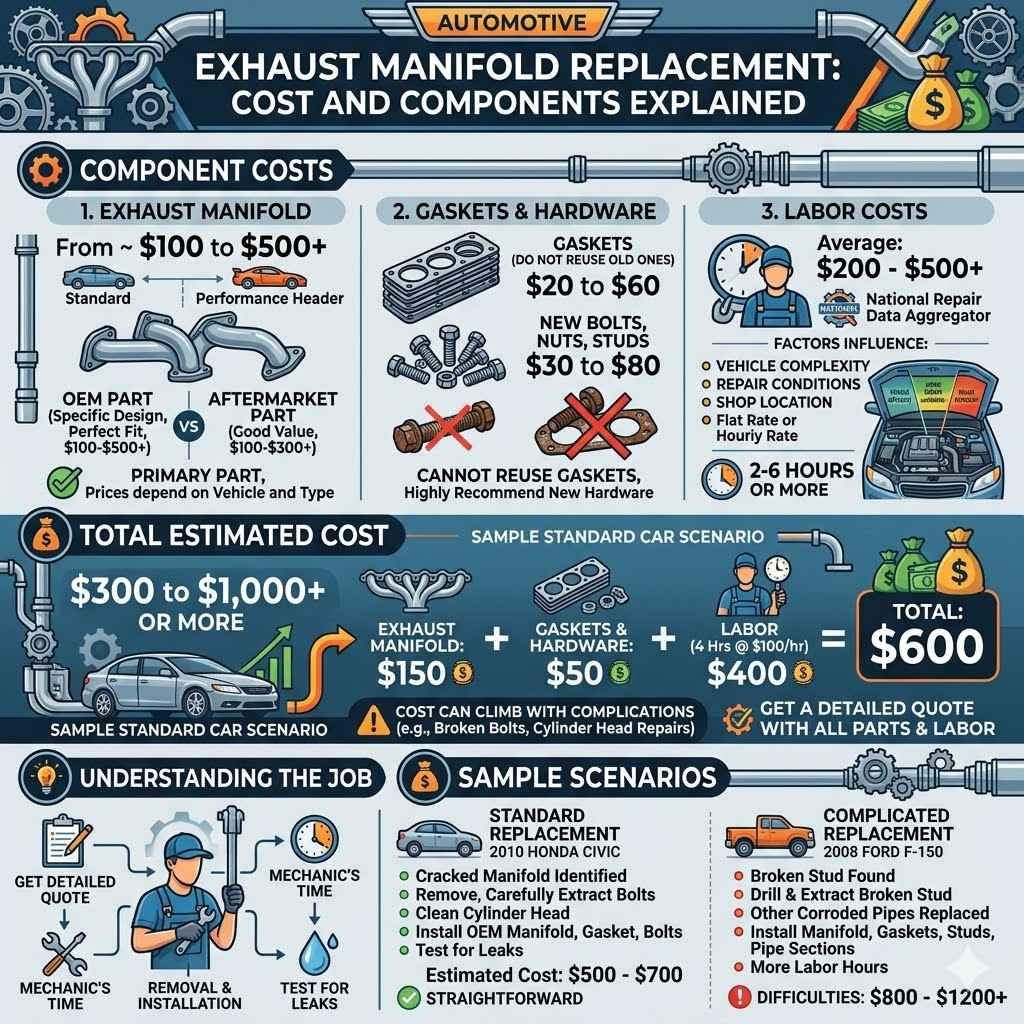
The exhaust manifold is the primary part. Prices can range from around $100 to $500 or more, depending on the vehicle and whether you opt for an OEM part or an aftermarket equivalent. Performance headers can cost significantly more, often starting at $300 and going up to $1000+.
OEM parts are designed specifically for your car model, ensuring a perfect fit. Aftermarket parts can offer good value but might require slight modifications. Always check reviews and compatibility before purchasing.
Cost of Gaskets and Hardware
You cannot reuse old exhaust manifold gaskets. They are designed for a single use and will likely fail if reinstalled. The cost for a set of exhaust manifold gaskets typically ranges from $20 to $60.
New bolts, nuts, and studs are also highly recommended, especially if the old ones are rusted or damaged. This hardware might add another $30 to $80 to the total parts cost. Some vehicles have specialized, high-strength fasteners that can be more expensive.
Labor Costs
Labor is often the largest part of the total bill. The hourly rate for a mechanic varies by region and shop. The time required for an exhaust manifold replacement can range from 2 to 6 hours, sometimes more if complications arise.
A shop might quote you a flat rate for the job, or they might bill by the hour. It’s wise to get an estimate before work begins. The complexity of your vehicle’s engine bay and the condition of existing parts greatly influence labor time.
Based on national averages from automotive repair data aggregators, the average labor cost for an exhaust manifold replacement falls between $200 and $500. This figure can increase significantly for luxury or performance vehicles.
Total Estimated Cost
Putting it all together, the total cost for What’s Included in an Exhaust Manifold Replacement can range from $300 to $1000 or even more. A common scenario for a standard car might be:
- Exhaust Manifold: $150
- Gaskets and Hardware: $50
- Labor (4 hours at $100/hour): $400
- Total: $600
However, if bolts break or cylinder head repairs are needed, the cost can easily climb to $1000+. Always ask for a detailed breakdown of parts and labor from your mechanic.
Sample Scenario Breakdown
Scenario 1: Standard Replacement
- Mechanic identifies a cracked exhaust manifold on a 2010 Honda Civic.
- The technician removes the old manifold, carefully extracts all original bolts, and cleans the cylinder head surface.
- A new OEM manifold, gasket, and a full set of replacement bolts are installed.
- All removed components are reinstalled, and the engine is tested for leaks.
- Estimated Cost: $500 – $700
Scenario 2: Complicated Replacement
- Mechanic finds a broken stud on a 2008 Ford F-150’s exhaust manifold.
- Several hours are spent carefully drilling and extracting the broken stud without damaging the cylinder head.
- While the manifold is off, other corroded exhaust pipe connections are found to be leaking and are replaced.
- A new manifold, gaskets, studs, and pipe sections are installed.
- Estimated Cost: $800 – $1200+
Frequently Asked Questions
Question: How long does an exhaust manifold replacement typically take?
Answer: The time can vary widely, but a straightforward replacement usually takes between 2 to 6 hours. This depends on the vehicle’s make and model, and whether any bolts break or other complications arise.
Question: Can I replace an exhaust manifold myself?
Answer: Yes, if you have mechanical experience and the right tools. However, it can be challenging due to seized bolts and the need for precise torque application. If you’re not comfortable, it’s best left to a professional.
Question: What are the common signs that my exhaust manifold needs replacing?
Answer: Common signs include a loud ticking or puffing noise from the engine, a burning smell, reduced engine performance, and illuminated check engine lights.
Question: Is it worth replacing a cracked exhaust manifold?
Answer: Yes, it is generally worth replacing. A cracked manifold can lead to poor fuel economy, reduced power, and potentially allow dangerous exhaust fumes into the cabin.
Question: How much does an exhaust manifold replacement typically cost?
Answer: The cost can range from $300 to $1000 or more, depending on the vehicle, the parts used, and labor rates. Complications like broken bolts can increase the price.
Final Thoughts
Knowing What’s Included in an Exhaust Manifold Replacement gives you a clear picture of the repair. It involves removing the old part, replacing the gasket, installing a new manifold, and using fresh hardware. The process can involve challenges like rusted bolts, but skilled mechanics have the tools to handle them.
Expect costs to cover parts and labor, with potential increases for complications. A successful replacement restores your car’s performance and quiet operation.