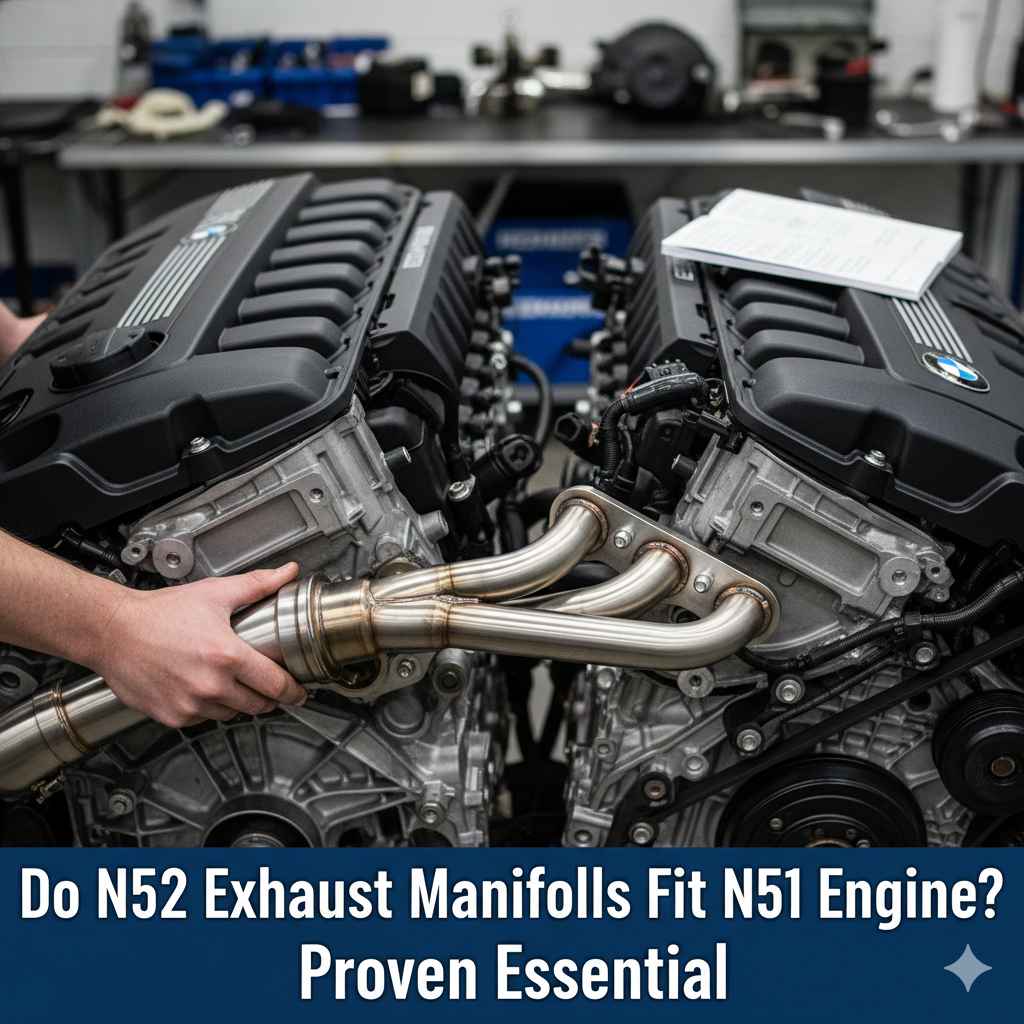
Do N52 Exhaust Manifolds Fit N51 Engine

Do N52 Exhaust Manifolds Fit N51 Engine: Proven Essential

The short answer is generally yes, N52 exhaust manifolds can physically fit an N51 engine, but significant differences in emissions equipment, particularly the secondary air injection ports and the required catalytic converters, mean direct swaps are often impractical or illegal without extensive modification. Always verify part numbers for your specific model year.

Welcome! If you own a BMW with an N51 or N52 engine, you’ve probably looked at upgrading or replacing exhaust parts and noticed the engine codes sound very similar. It is easy to confuse these two popular BMW powerplants, leading to a very common question: Will the exhaust manifold from an N52 fit my N51 engine?

This confusion is frustrating because getting the wrong part means wasted money and a headache under your car. Don’t worry; we are going to break down the differences clearly. We’ll look at the physical fit and the crucial emissions systems that separate these engines. By the end of this guide, you will know exactly what you need for a perfect, safe exhaust upgrade. Let’s demystify these matching but separate exhaust designs.

Understanding the N51 vs. N52: Why the Confusion Exists

The N51 and N52 engines are fantastic inline-six engines from BMW. They share a lot of DNA, which is why their exhaust components often look similar. However, there is one massive, defining difference that affects the exhaust manifold directly: emissions.

The N52 is the standard engine, used widely across many BMW models. The N51, on the other hand, is the SULEV (Super Ultra Low Emission Vehicle) version, primarily sold in specific, stricter markets like California. This SULEV requirement forces the N51 to have extra hardware bolted directly to the exhaust manifold.

Key Differences in the Engine Blocks

While both are naturally aspirated and share similar displacement (typically 3.0L), their operation handles exhaust gases differently:

  • N52: Standard emissions controls.
  • N51: SULEV compliance requires an aggressive approach to cleaning up exhaust gases immediately.

These emission requirements dictate the shape and features found on the exhaust manifold itself. This is where the difference in fitment truly comes into play.

Understanding the N51 vs. N52

Expand your knowledge about Exhaust Manifolds with this article. Proven Answers: Essential V6 Manifolds

The Physical Fit: Can They Bolt On?

When we talk about physical fit, we are asking if the bolts line up and if the manifold physically seats correctly against the cylinder head. For the N51 and N52, the good news is that the core bolt pattern for attaching the manifold to the cylinder head is often identical, or extremely similar.

Understanding Bolt Patterns

Because the basic architecture of the head casting is shared, the flange where the manifold bolts on usually matches. This means that if you held an N52 manifold up to an N51 head (and vice versa), the stud holes would likely align.

However, alignment isn’t the whole story. The complexity arises when you look at the other end of the manifold—where it connects to the rest of the exhaust system (the downpipe or mid-pipe).

Flange Shape and Diameter Differences

Even if the engine block bolt pattern matches, the outlet flange—the connection point for the rest of the exhaust—may differ slightly in shape or diameter between N51 and N52 applications depending on the specific vehicle model and year. Always verify the connecting pipe flange size and orientation.

The Crucial Factor: Secondary Air Injection (SAI) Ports

This is, by far, the biggest hurdle when attempting to swap an N52 manifold onto an N51 engine. The N51’s strict SULEV requirements necessitate a Secondary Air Injection (SAI) system. This system injects fresh air directly into the exhaust stream near the catalytic converter when the engine is cold, helping the catalysts heat up faster to reduce smog-forming emissions quickly.

This injection point requires a port or pipe runner built directly into the surface of the exhaust manifold itself.

Comparing Manifold Features

Here is a simple breakdown of what you will see:

FeatureN51 Manifold (SULEV)N52 Manifold (Standard)
Secondary Air Injection (SAI) PortRequired; features a distinct port/nipple for the air hose.Usually absent or blocked, depending on the casting run.
Catalytic Converter LocationOften has integrated primary cats close to the manifold due to SAI needs.Primary catalyst often located further down the pipe or integrated differently.
Gasket SurfaceMust perfectly seal the SAI passage if present.Simpler sealing surface.

If you try to install an N52 manifold onto an N51 engine, you will face two immediate problems:

  1. Missing SAI Port: The N51 ECU expects an SAI signal and a functioning system. If the manifold lacks the port where the pump injects air, the system will fail its emissions check, and you will likely get a Check Engine Light (CEL) immediately.
  2. Emissions Violation: Even if you bypassed the light, your vehicle would no longer meet SULEV standards, which can be illegal for road use in certain regions.

Conversely, if you install an N51 manifold (with the SAI port) onto an N52 engine, the port will simply be an unused opening. While physically safe, it complicates the system unless you are actively converting the N52 to SULEV specifications, which is rarely advisable for a beginner.

Dive deeper into Exhaust Manifolds by checking out this article. Proven Costs To Replace Exhaust Manifolds

The Exhaust Downpipe Connection

The second major difference is the connection point leading away from the manifold, often leading to the primary catalytic converters. Because of the SAI integration and different catalyst placements, the downstream flanges used to connect the manifold to the rest of the exhaust system can differ between N51 and N52 applications.

Even if the engine head bolts match, if the outlet flange configuration is different (e.g., a 2-bolt flange vs. a 3-bolt flange, or a difference in pipe diameter), the N52 manifold will not connect cleanly to your existing N51 mid-pipe.

Action Item: Verifying Part Numbers

The safest way to approach this is by comparing the OEM part numbers for your specific vehicle. BMW often uses very similar parts across different engines but changes the trailing digits based on emissions standards.

How to Check: Visit a reputable online parts dealer (like those stocking genuine BMW or high-quality aftermarket parts) and enter the last 7 digits of your car’s VIN. Compare the resulting manifold part numbers for the N51 and N52 models related to your chassis (E90, E82, etc.).

You will often find that the N51 manifold has a unique suffix suffix denoting the SULEV compliance hardware included.

Step-by-Step: Replacing the Exhaust Manifold Safely

Whether you choose an N51 manifold or an N52 manifold (assuming you have confirmed it’s the right part for your engine), the replacement process is intensive. Since you are focusing on beginner advice, always prioritize safety and proper procedure.

Tools and Materials Needed

Before you start, gather everything. Working on exhaust manifolds often involves dealing with rusted, seized bolts.

  • New Exhaust Manifold (Confirmed correct for N51 or N52)
  • New Manifold Gaskets (Required for sealing)
  • New Hardware (It is highly recommended to replace all old studs/bolts)
  • High-Temperature Anti-Seize Compound
  • Torque Wrench (Essential for proper tightening)
  • Standard Metric Socket Set (10mm, 13mm, 16mm are common)
  • Wrenches (Box-end or adjustable)
  • Penetrating Oil (Like PB Blaster or Kroil)
  • Jack Stands and Hydraulic Jack (Never work under a car supported only by a jack)
  • Safety Glasses and Gloves

Find out more about Exhaust Manifolds by exploring this related topic. Proven Essential Jeep WJ Manifolds

Procedure for Removal and Installation

This process is complex and requires good access to the underside and the top of the engine bay (depending on access). Safety note: Ensure the engine is cool before starting.

  1. Safety First: Park the car on a level surface. Engage the parking brake. Chock the rear wheels. Safely lift the front of the car using a jack and secure it firmly on high-quality jack stands. Always consult stable lifting points recommended by NHTSA guidelines for vehicle stability.
  2. Disconnect Accessories: In the engine bay, you may need to remove engine covers, air boxes, or power steering components to access the top studs of the manifold. Disconnect any wiring harnesses leading to oxygen sensors located near the manifold.
  3. Apply Penetrating Oil: Liberally spray all exhaust manifold studs/bolts with penetrating oil. Let it soak for at least 30 minutes, or ideally, spray them the day before you plan to work on the car.
  4. Disconnect Downpipe: Working underneath the car, carefully unbolt the manifold flange from the downpipe or primary catalytic converter section. This joint is often rusty.
  5. Remove Old Hardware: Starting from the center of the manifold and working outwards, slowly loosen the nuts/bolts holding the manifold to the head. If studs spin or snap, do not panic; this is common. You may need specialized bolt extractors if they break flush.
  6. Remove Old Manifold: Gently wiggle the old manifold free. Be careful not to damage the exposed threads on the cylinder head.
  7. Clean the Surface: Use a plastic scraper or a very fine Scotch-Brite pad (never use metal wire brushes on aluminum heads) to gently clean all old gasket material from the cylinder head surface. The surface must be perfectly flat.
  8. Prepare the New Manifold: Apply a thin coat of anti-seize compound to the exposed threads of the new hardware (or the studs you reused). Place the new gasket onto the new manifold.
  9. Installation and Tightening: Carefully place the new manifold onto the head, aligning it with the studs. Start threading the nuts/bolts by hand. Get them all started loosely before tightening anything.
  10. Torque Sequence: This step is critical. Tighten the fasteners in a specific pattern (usually center-outward) using your torque wrench to the manufacturer’s specified foot-pounds (ft-lbs). Improper torque leads to leaks or broken studs.
  11. Reconnect and Reassemble: Reattach the downpipe to the manifold outlet flange. Reconnect oxygen sensors and any components you removed from the engine bay.
  12. Final Checks: Double-check that all nuts are torqued and nothing is interfering with the new manifold or pipes.
  13. Test Run: Lower the car. Idle the engine and listen carefully for any exhaust leaks (a hissing sound). A small amount of steam/smoke initially is normal as any residual oil burns off.

Expand your knowledge about Exhaust Manifolds with this article. Proven Cost: Essential Exhaust Manifold Repair

When an N52 Manifold Swap Might Be Considered (Advanced)

While we strongly advise beginners against it, experienced DIYers or dedicated tuners might attempt an N52 manifold swap onto an N51 if their goal is performance maximization or eliminating SULEV requirements entirely. This is complex and generally requires more than just swapping the part.

Scenario 1: Total Emissions Delete

If you are racing the car or running it off-road, you might wish to eliminate the SAI system entirely. To successfully use a standard N52 manifold on an N51:

  • You must block the port on the cylinder head where the SAI tube connects, as the N52 manifold won’t have the corresponding port.
  • The Engine Control Unit (ECU) must be reprogrammed (tuned) to ignore the missing SAI components to prevent constant CELs. This requires specialized tuning software and knowledge.

Scenario 2: Aftermarket Headers

Often, the desire to swap manifolds comes from wanting aftermarket headers for better flow.

Many aftermarket performance header manufacturers produce distinct versions: one for the N51 (with SAI provision) and one for the N52 (without SAI provision). If you buy a set of N52 performance headers, they will likely not fit your N51 unless they are explicitly advertised as “SULEV compatible” or feature the necessary air injection port.

This reinforces the key message: Always confirm the part is listed specifically for your engine code (N51 or N52) and note whether it is for an SULEV configuration.

Performance Implications of Using the Wrong Manifold

Using a manifold that doesn’t match your engine’s emission profile is not just a bolt-on issue; it affects performance, longevity, and legality.

1. Check Engine Light (CEL) Nightmare

As detailed above, an N52 manifold lacks the SAI port required by the N51’s ECU. The car constantly monitors the SAI system for pressure and flow. Removing or omitting the required hardware almost guarantees a permanent CEL code (often P0410 or related codes).

2. Poor Cold Start Emissions

The N51 is tuned to rely heavily on the quick activation of the SAI system during warmup. If the manifold doesn’t support this, the engine runs dirtier until the conventional catalyst finally heats up. This reduces performance marginally during these warm-up phases and causes noticeable pollution.

Expand your knowledge about Exhaust Manifolds with this article. How Many Exhaust Manifolds Are On A 2006 Chrysler Pacific? Essential

3. Exhaust Flow Inefficiency

Tuning for performance involves balancing exhaust pulse timing. While the flow characteristics of the primary runners might be similar, any required modifications to the manifold casting (like the intrusion of the SAI pipe) can slightly alter exhaust gas scavenging, potentially leading to very minor, yet measurable, performance losses compared to the optimally designed manifold for that specific engine.

Expert Tips for Buying Manifolds (N51/N52)

When sourcing a replacement or upgrade manifold, use these guidelines to avoid purchasing the wrong component:

  1. Always Use VIN: When ordering from a main dealer or checking OEM cross-references, the single most reliable tool is your Vehicle Identification Number (VIN).
  2. Inspect Photos Closely: If buying used or aftermarket, demand high-resolution photos of the manifold surface, specifically looking for any protruding nipples or ports where an air hose would attach. This indicates an SAI-equipped (N51) manifold.
  3. Factor in Cat Location: Decide if you are keeping your factory catalysts. If you are installing a performance header that moves the main catalytic converter further down the exhaust run, you will need a corresponding downpipe section to match the N52 manifold’s exit flange, even if the N51 head bolts match.
  4. New Hardware is Non-Negotiable: Exhaust manifold hardware is subjected to extreme heat cycles, making it brittle and prone to snapping upon removal. Budget for new studs and nuts; it saves hours of extraction time later.
Expert Tips for Buying Manifolds (N51/N52)

Frequently Asked Questions (FAQ) – N51/N52 Exhaust Swap

Q1: Will an N52 manifold physically bolt onto my N51 cylinder head?

A: Physically, yes, the bolt pattern on the cylinder head is usually identical, allowing the manifold to sit flush. However, the crucial difference is the emissions hardware ports.

Q2: If I use an N52 manifold on my N51, what part will fail first?

A: Your emissions monitoring system (ECU) will immediately detect the missing Secondary Air Injection (SAI) input, resulting in a Check Engine Light (CEL) with detailed SAI error codes.

Q3: Are N51 and N52 mid-pipes (the pipe after the manifold) interchangeable?

A: Rarely. Because the manifold outlet flange and the location of the primary catalytic converters often differ between the SULEV (N51) and standard (N52) setups, the pipes leading away from the manifold are usually not direct substitutes.

Q4: Can I just plug the SAI port if I use an N52 manifold on an N51?

A: You can plug the source of the air (the pipe coming from the pump), but the ECU still expects the SAI valve to activate and deliver pressure through the manifold. Plugging the port on the engine head is the only way to stop the physical connection, but the tune must still address the missing components.

Q5: I want to install performance headers. Should I buy N51 or N52 headers for my N51 engine?

A: Always purchase headers explicitly listed for the N51 engine if you intend to keep your vehicle street-legal and avoid CELs, as these will include the necessary port for the Secondary Air Injection system.

Similar Posts