BBC Exhaust Manifold Port Size Explained Simply

BBC Exhaust Manifold Port Size Explained Simply

Figuring out the right port size for your BBC exhaust manifold can feel tricky when you’re starting out. There are lots of numbers and details that don’t always make sense. But don’t worry, it’s not as hard as it sounds!

We’ll break down everything you need to know about BBC Exhaust Manifold Port Size Explained in a way that’s easy to follow. Let’s get your engine running its best.

Understanding BBC Exhaust Manifold Port Size

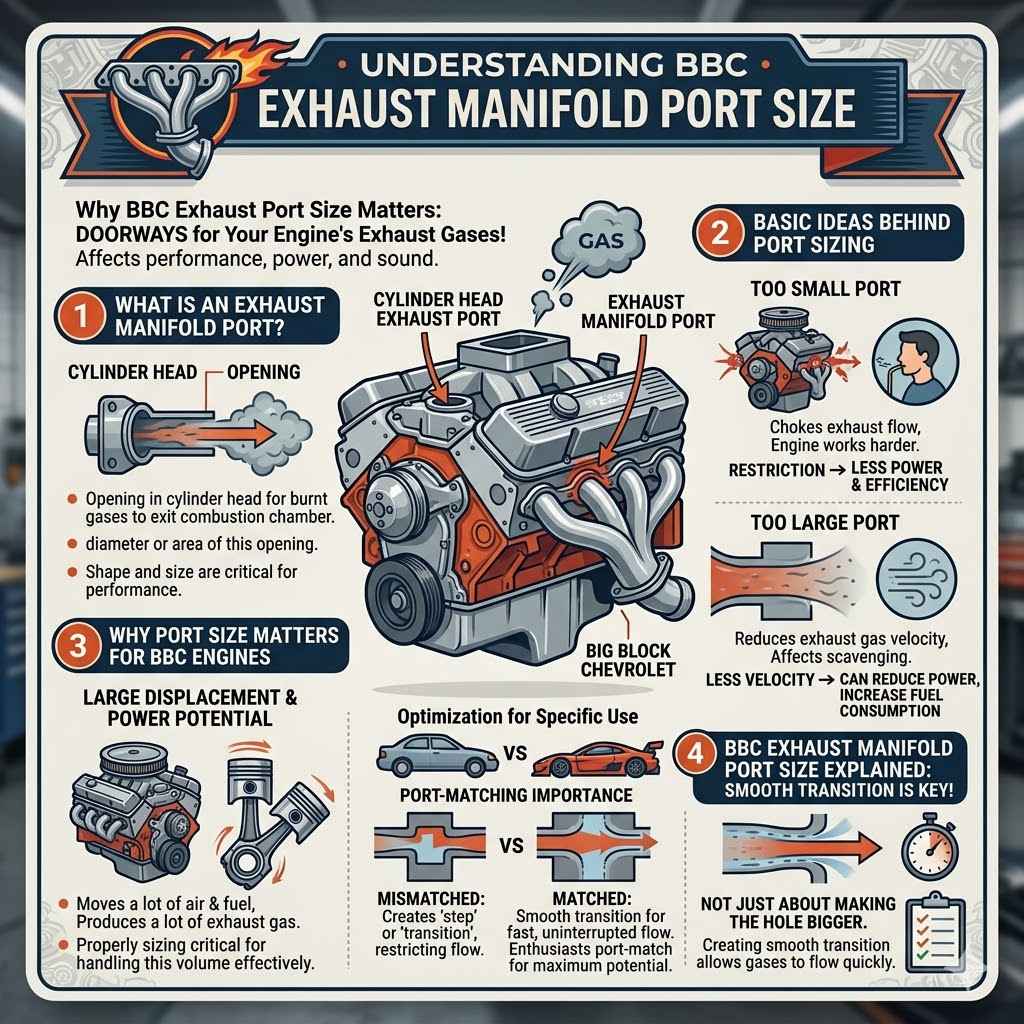
This section looks at why the size of the exhaust ports on a BBC (Big Block Chevrolet) engine’s manifold matters a lot. Think of these ports as the doorways for your engine’s exhaust gases. Getting the size just right means your engine can breathe out efficiently.

This directly affects how well your engine performs, how much power it makes, and even how it sounds. We will explore the basic ideas behind port sizing and why it’s a key part of engine tuning.

What is an Exhaust Manifold Port?

An exhaust manifold port is the opening in the cylinder head of an engine where the burnt gases exit from the combustion chamber. These gases then travel through the exhaust manifold, which collects them from all cylinders and directs them towards the rest of the exhaust system. The shape and size of these ports are very important for engine performance.

Port size is essentially the diameter or the area of this opening. If a port is too small, it can choke the exhaust flow. This means the engine has to work harder to push the gases out.

Imagine trying to exhale through a tiny straw; it’s difficult and slow. For an engine, this restriction can lead to less power and efficiency.

On the other hand, if a port is too large, it can also cause problems. A port that’s too big might not create enough exhaust gas velocity. Velocity is important because it helps to scavenge, or pull, the exhaust gases out of the cylinder more effectively.

Without good velocity, some exhaust gases can remain in the cylinder, mixing with the new fuel and air charge. This can reduce the power output and increase fuel consumption.

  • The primary function of an exhaust port is to allow burnt gases to escape the engine.
  • Port size directly impacts the engine’s ability to breathe, affecting power and efficiency.
  • Both too small and too large ports can create performance issues for the engine.

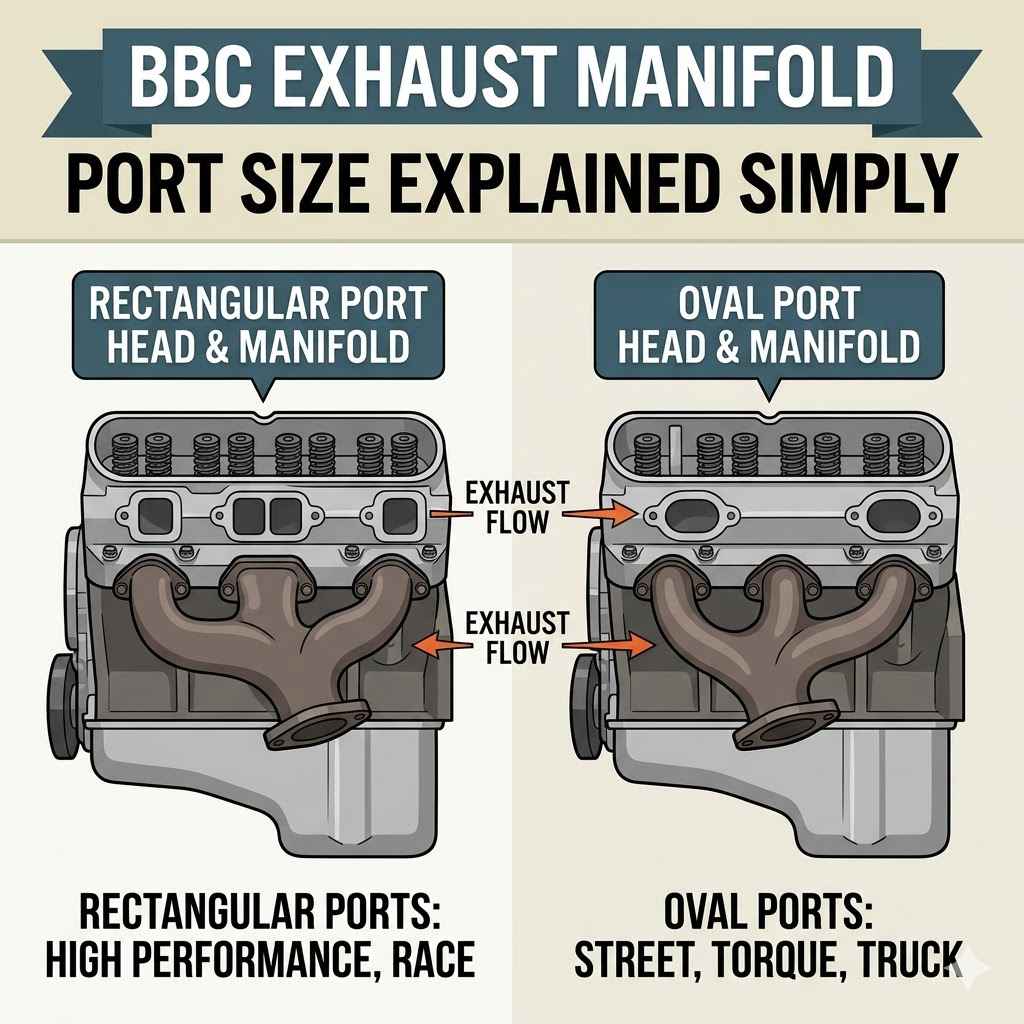
The size of these ports is often determined by the engine’s intended use. A street engine might have smaller, more efficient ports for good low-end torque and fuel economy. A race engine, designed for maximum power at high RPMs, will likely have much larger ports to allow for maximum exhaust flow when the engine is running fast.

Want to learn more about Exhaust Manifolds? This post could provide more insights. 1970 Plymouth Duster Exhaust Manifold Guide

Why Port Size Matters for BBC Engines

Big Block Chevrolet engines are known for their large displacement and power potential. Because they move a lot of air and fuel, they also produce a lot of exhaust gas. Properly sizing the exhaust manifold ports is critical to handling this volume effectively.

For BBC engines, especially those built for performance, the exhaust manifold is a crucial component that works closely with the cylinder heads.

The cylinder head’s exhaust port size needs to be matched with the exhaust manifold’s port shape and size. If there’s a mismatch, it creates a restriction where the two components meet. This is often called a “step” or “transition.” Think of it like a narrow doorway after a wide hallway; traffic slows down at the doorway.

This reduces the efficiency of exhaust gas expulsion.

When discussing the BBC Exhaust Manifold Port Size Explained, it’s important to remember that this isn’t just about making the hole bigger. It’s about creating a smooth transition that allows gases to flow quickly and without interruption. For a BBC, which can produce significant horsepower, optimizing this flow can mean a noticeable difference in performance, whether it’s for drag racing, street performance, or even heavy towing.

The stock ports on many BBC heads and manifolds are often designed for general use and may not be optimal for high-performance applications. Enthusiasts often port-match their manifolds to their cylinder heads or select aftermarket manifolds with port sizes that better complement their engine’s build. This process aims to maximize the potential of the engine by ensuring it can exhale as freely as it inhales.
Understanding BBC Exhaust Manifold Port Size

How Port Size Affects Engine Performance

The size of the exhaust manifold ports has a direct and significant impact on how an engine performs. It’s not just a small detail; it’s a key factor in achieving the power and efficiency goals for any BBC build. We will look at how different port sizes can change an engine’s behavior, from its power output to its torque delivery.

Find out more about Exhaust Manifolds by exploring this related topic. What Vehicles Use 984221 & 984222 Exhaust Manifolds

Power and Torque Curves

The relationship between exhaust port size and an engine’s power and torque curves is fundamental. Smaller ports tend to increase exhaust gas velocity, especially at lower engine speeds. This higher velocity helps to create a stronger scavenging effect, pulling exhaust gases out more efficiently.

This leads to better torque, particularly in the low to mid-range RPMs, which is desirable for street driving and vehicles that need good pulling power.

As the engine speed increases, the volume of exhaust gases also rises significantly. If the ports are too small, they can become a bottleneck, limiting the amount of exhaust that can escape. This restriction prevents the engine from reaching its full potential at higher RPMs, limiting horsepower.

The engine might feel like it’s “running out of breath” as the RPMs climb.

Conversely, larger exhaust ports allow for a greater volume of exhaust gases to pass through more easily, especially at high RPMs. This can lead to a significant increase in peak horsepower. However, if the ports are too large for the engine’s operating range, the exhaust gas velocity might be too low at lower RPMs.

This can result in a noticeable drop in torque in the lower and mid-range, making the engine feel less responsive off the line.

The goal is to match the port size to the engine’s intended use. For a street-driven BBC that needs good throttle response and usable torque for everyday driving, slightly smaller or well-matched ports are often preferred. For a drag racing BBC that spends most of its time at wide-open throttle and high RPMs, larger ports that prioritize maximum airflow at high speeds are usually the better choice.

A common compromise for a versatile BBC might involve a port size that offers a good balance, providing adequate low-end torque while still allowing for healthy horsepower gains at higher RPMs. This often involves careful matching of the cylinder head port to the manifold port and potentially using aftermarket headers designed for optimal flow across a broader RPM range.

Example of Port Size Impact

Consider two identical BBC engines built for street performance. Engine A has exhaust manifold ports that are 1.75 inches in diameter. Engine B has exhaust manifold ports that are 2.00 inches in diameter.

When tested on a dynamometer:

  1. Engine A shows strong torque from 2500 RPM up to 5000 RPM, making it feel responsive when accelerating from a stop or cruising at lower speeds. Its peak horsepower might be around 500 HP at 5800 RPM.
  2. Engine B might have slightly less torque from 2500 to 4000 RPM, feeling a bit flatter in that range. However, from 5000 RPM upwards, it pulls much harder, achieving a peak horsepower of 530 HP at 6200 RPM.

This example illustrates how port size can shift the engine’s power band, demonstrating the trade-offs between low-end torque and high-end horsepower.

Find out more about Exhaust Manifolds by exploring this related topic. What’s Included in an Exhaust Manifold Replacement

Fuel Efficiency and Emissions

While performance is often the main driver for enthusiasts discussing BBC Exhaust Manifold Port Size Explained, fuel efficiency and emissions are also indirectly affected. An engine that can breathe more efficiently tends to operate with less wasted energy. This can translate to better fuel economy.

When exhaust gases are expelled quickly and completely, the cylinder is cleaner for the next intake stroke. This allows the fresh air and fuel mixture to burn more completely. Incomplete combustion, often caused by inefficient exhaust scavenging, can lead to unburned fuel entering the exhaust, which not only wastes fuel but also contributes to higher emissions of hydrocarbons.

Modern engines often use sophisticated exhaust port designs and variable valve timing to optimize both performance and emissions across a wide range of operating conditions. For older BBC designs, achieving good fuel efficiency might involve selecting a manifold and port size that promotes good low-end torque and efficient combustion at cruising speeds, rather than solely focusing on maximum peak power.

Optimizing exhaust flow can also help the catalytic converter work more effectively if one is present. A steady and efficient flow of exhaust gases allows the catalyst to do its job of converting harmful pollutants into less harmful substances. A restrictive exhaust system can cause exhaust gases to build up heat and pressure, which can reduce the efficiency of the catalytic converter.

Statistically, studies have shown that improvements in exhaust system efficiency can lead to measurable gains in fuel economy. For example, research by the Society of Automotive Engineers (SAE) has indicated that optimizing exhaust flow can contribute to a 1-3% improvement in fuel efficiency. While this might seem small, over thousands of miles, it adds up.

Engine Temperature Management

Exhaust gases carry a significant amount of heat away from the engine’s combustion chambers. The efficiency with which these hot gases are removed impacts the overall operating temperature of the engine. Properly sized exhaust ports and manifolds can help manage this heat.

If the exhaust ports are too small, the hot gases can linger in the cylinder, transferring more heat to the cylinder walls, piston, and valves. This can lead to higher engine temperatures. Prolonged exposure to excessive heat can lead to premature wear on engine components and, in extreme cases, engine damage like detonation or piston scoring.

On the other hand, a well-designed exhaust system that efficiently removes hot gases helps keep these critical components cooler. This is especially important for high-performance BBC engines that generate a lot of heat due to their power output. A cooler-running engine generally operates more reliably and can maintain its performance levels for longer periods.

The exhaust manifold itself plays a role in this. Materials and design can influence how much heat is retained or radiated. However, the initial exit from the cylinder head, dictated by the port size, is the first step in this heat management process.

A smooth, unobstructed flow allows heat to dissipate more effectively through the exhaust system.

Consider a scenario where an engine is consistently running hotter than expected. While many factors can contribute, a restrictive exhaust port is a common culprit. The engine is working harder to push out the hot gases, and this resistance generates additional heat, creating a feedback loop that can escalate engine temperatures.

Ensuring the ports are adequate for the engine’s demands is a vital aspect of thermal management.

Curious about Exhaust Manifolds? We've got more info in this linked article. When Edelbrock Made Marine Exhaust Manifolds

Selecting the Right Exhaust Manifold Port Size

Choosing the correct exhaust manifold port size for your BBC is a decision that depends heavily on the specific goals for your engine. This isn’t a one-size-fits-all situation. We’ll explore the factors you need to consider to make the best choice for your particular application.

Matching to Cylinder Head Ports

The most crucial factor when selecting an exhaust manifold is its port size and shape must be compatible with the exhaust ports on your cylinder heads. This is often referred to as “port matching.” If your cylinder head exhaust ports are, for example, 2.00 inches in diameter, you ideally want an exhaust manifold with ports that are at least that size, or slightly larger, to create a smooth transition.

If the manifold port is significantly smaller than the cylinder head port, it will create a restriction. This is like putting a funnel into a wider opening – the flow is limited by the narrowest point. This mismatch forces the exhaust gases to slow down and compress as they enter the manifold, hindering flow and reducing power.

Imagine trying to pour a gallon of water through a tiny spout; it takes a long time.

Conversely, if the manifold port is much larger than the cylinder head port, it can create turbulence and disrupt the natural flow of exhaust gases. While it might seem like bigger is always better, this is not the case. An overly large port can lead to a loss of exhaust gas velocity at lower RPMs, reducing scavenging effectiveness.

This can result in less low-end torque.

The ideal scenario is to have the manifold port slightly larger than the head port, with smooth, radiused edges to promote a seamless transition. Some performance manifolds are designed with ports that are already close to matching common performance head port sizes. For custom builds, enthusiasts might even use gasket templates to precisely match the manifold ports to the head ports.

A common practice in performance engine building is to use a port matching template or a gasket from the cylinder head manufacturer as a guide. This template is placed against the manifold’s port opening, and the manifold is then carefully ground or ported to match the template’s shape and size. This ensures minimal restriction at the critical junction between the head and the manifold.

Want to learn more about Exhaust Manifolds? This post could provide more insights. Choosing the Best Spray Paint for Exhaust Manifolds

Considering Engine Application and Usage

The intended use of your BBC engine is a primary driver in selecting the right port size. A street car that sees daily driving will have different needs than a dedicated drag racing machine.

  • Street Performance: For a street-driven BBC, you generally want a good balance of low-end torque and mid-range power for responsive acceleration. Exhaust manifold ports that are around 1.75 inches to 1.875 inches in diameter are often a good starting point. This size promotes good exhaust gas velocity at typical street RPMs, leading to better throttle response and drivability.
  • Drag Racing: If your BBC is primarily for drag racing, where the engine will spend most of its time at wide-open throttle and high RPMs, larger ports are beneficial. Ports in the 2.00-inch to 2.25-inch range or even larger can help maximize horsepower by allowing a greater volume of exhaust gases to escape quickly at high engine speeds.
  • Towing and Heavy Hauling: For applications requiring significant pulling power, such as towing or in heavy trucks, torque is paramount. This usually means favoring port sizes that maintain good exhaust gas velocity at lower RPMs, similar to street performance applications, to ensure strong low-end grunt.
  • Pro Street/Show Cars: For engines that are built for show but might see occasional spirited driving, the choice can be more aesthetic or based on a desired power band. Often, a size that provides a good compromise between street manners and potential high-RPM performance is chosen.

It’s also important to consider the camshaft profile. A camshaft with a long duration and high lift will move more air and fuel, requiring larger ports to handle the increased exhaust volume. Conversely, a milder camshaft might not benefit as much from extremely large ports and could even suffer from a loss of low-end torque.

Real-Life Scenario: Street Rod BBC Build

A builder is working on a 1969 Camaro with a 454 cubic inch BBC engine. The goal is to have a powerful street car with good acceleration and a broad power band for weekend cruising and occasional spirited driving. The cylinder heads have exhaust ports measuring 1.875 inches in diameter.

Instead of choosing the largest available exhaust manifold ports, the builder opts for a set of high-quality aftermarket headers with 1.875-inch primary tubes and 3-inch collectors. These are chosen specifically because the primary tube diameter closely matches the cylinder head exhaust port size, ensuring a smooth transition. This decision prioritizes drivability and responsiveness in the most commonly used RPM range for a street car.

The result is an engine that pulls strongly from around 3000 RPM and continues to provide good power well past 6000 RPM. The engine feels lively and responsive, with no noticeable flat spots in the power band, making it enjoyable to drive in various situations.

Aftermarket Options and Materials

The market offers a wide variety of exhaust manifolds and headers for BBC engines, each with different port sizes, materials, and designs. Understanding these options can help you make an informed choice.

Cast iron exhaust manifolds are the most common type found on stock engines. They are durable and relatively inexpensive but often have restrictive port designs and sizes that are optimized for emissions and noise reduction rather than performance. Many aftermarket cast iron manifolds offer improved porting and slightly larger openings compared to stock.

Steel headers are popular for performance applications. They are typically made from mild steel or stainless steel. Stainless steel headers are more expensive but offer superior corrosion resistance and durability.

Headers come in various primary tube diameters and lengths, which affect exhaust scavenging and flow characteristics. The collector size at the end of the headers also plays a role in the overall exhaust flow.

When looking at aftermarket headers, pay close attention to the primary tube diameter and the collector size. The primary tube diameter is directly related to the exhaust port size. For BBC engines, common primary tube sizes range from 1.75 inches for milder street applications to 2.125 inches or larger for high-performance racing engines.

The collector size is the diameter of the pipe where all the primary tubes merge, and it should generally be sized to match or be slightly larger than the primary tubes to avoid creating a restriction.

Some high-end headers feature stepped primary tubes, starting smaller and increasing in diameter further down the tube. This design aims to optimize exhaust gas velocity at lower RPMs while still providing good flow at higher RPMs. The materials used also affect heat retention; thicker steel or ceramic coatings can help keep exhaust gases hotter, which aids in scavenging.

Statistics on Aftermarket Header Performance

Independent dyno testing has frequently shown that replacing restrictive stock exhaust manifolds with well-designed aftermarket headers can yield significant power gains. For BBC engines, these gains can range from 15 to 40 horsepower and 20 to 50 lb-ft of torque, depending on the engine’s overall configuration and the quality of the headers.

A study conducted by a prominent automotive magazine tested several different header configurations on a mild 454 BBC. They found that headers with 1.75-inch primary tubes and 3-inch collectors added approximately 25 horsepower and 30 lb-ft of torque compared to the stock cast iron manifolds. When they tested headers with 2.00-inch primary tubes, the peak horsepower increased by another 10 horsepower, but the low-end torque was slightly reduced below 3500 RPM.

Exhaust ComponentTypical Primary Tube DiameterPrimary UseProsCons
Stock Cast Iron Manifold~1.5 – 1.75 inchesOriginal Equipment, Low EmissionsDurable, Quiet, AffordableRestrictive, Limited Performance
Mild Steel Headers1.75 – 2.00 inchesStreet Performance, Mild BuildsImproved Flow, Moderate CostProne to Rust (unless coated)
Stainless Steel Headers1.75 – 2.25+ inchesHigh Performance, Racing, Show CarsExcellent Flow, Corrosion Resistant, DurableExpensive

Customizing and Porting Exhaust Manifolds

For those seeking maximum performance, modifying existing exhaust manifolds or headers, a process known as porting, can unlock hidden potential. This is where fine-tuning becomes an art form. We will discuss what porting involves and why it’s a popular choice for serious engine builders.

The Process of Porting

Porting an exhaust manifold or header involves carefully grinding away excess material from the inside of the port. The goal is to smooth out rough surfaces, remove any casting imperfections, and enlarge the port to match the cylinder head’s exhaust port, or to achieve a desired size and shape for optimal flow. This process requires patience, the right tools, and a good understanding of airflow dynamics.

The process typically starts with gasket matching. A gasket that fits the cylinder head’s exhaust port is used as a template. The manifold port is then carefully ground to match the shape and size of the gasket.

This eliminates the step created by a mismatch between the head and the manifold. After gasket matching, the internal surfaces of the port are smoothed to reduce turbulence. This is often done using various grinding bits, burrs, and abrasive stones on a die grinder.

For performance builds, porting might go beyond simple gasket matching. Enthusiasts might use flow benches to measure the airflow through the ports and identify areas where material can be removed to improve flow without creating excessive turbulence or losing too much exhaust velocity. The shape of the port can also be altered, widening or lengthening it slightly to better suit the engine’s intended RPM range.

The final step often involves polishing the port to a smooth finish. A highly polished surface creates less friction for the exhaust gases to travel over, further enhancing flow efficiency. However, it’s important not to over-port, which can weaken the manifold or header and create ports that are too large, leading to the issues discussed earlier regarding loss of velocity and torque.

The use of specialized tools is essential. Die grinders with various attachments, carbide burrs for rough material removal, and carbide or ceramic grinding stones for shaping are common. Safety equipment, such as eye protection, hearing protection, and a dust mask, is also critical due to the dust and debris generated during the grinding process.

Benefits of Port Matching

Port matching your exhaust manifold or headers to your cylinder heads offers several key benefits that can lead to noticeable improvements in engine performance. It’s a way to optimize the connection between two critical engine components.

  • Improved Airflow Efficiency: By creating a smooth, consistent passage for exhaust gases, port matching significantly reduces restrictions. This allows gases to exit the combustion chamber more quickly and with less effort from the engine.
  • Increased Horsepower and Torque: With improved exhaust flow, the engine can breathe more freely. This translates directly into more power and torque, especially in the mid-range and upper RPMs where exhaust flow becomes a major limiting factor.
  • Reduced Engine Stress: When exhaust gases are expelled efficiently, the engine doesn’t have to work as hard. This can lead to lower engine temperatures and reduced stress on components like pistons and valves, potentially extending engine life.
  • Smoother Power Delivery: A well-matched exhaust system contributes to a more consistent and predictable power curve. This makes the engine feel more responsive and easier to drive, especially for performance street applications.

When port matching, it’s also a good opportunity to inspect the manifold or header for any cracks or damage. Any imperfections found can be repaired at this stage. For headers, checking the welds and ensuring all tubes are securely attached to the flanges is also a good practice.

The cost of porting can vary. If you have the tools and skills, it’s a cost-effective way to gain performance. If you hire a professional shop, the cost will depend on the complexity of the work and the shop’s rates, but it’s often less expensive than purchasing a high-end set of custom-matched headers.

Case Study: Ported BBC Manifolds on a Muscle Car

A classic muscle car owner with a 502 cubic inch BBC engine was experiencing a lack of power above 5500 RPM. The car had a mild performance camshaft and aftermarket cylinder heads with 2.00-inch exhaust ports. The existing exhaust manifolds were stock-style cast iron units with considerably smaller, rough ports.

The owner decided to have his cast iron manifolds professionally ported and matched to the cylinder heads. The process involved carefully grinding the manifold ports to match the 2.00-inch opening of the heads, smoothing the internal passages, and slightly radiusing the entry and exit points. The final result showed the manifold ports were enlarged to approximately 1.95 inches, with a much smoother internal finish compared to their original state.

After installation, the engine was re-dynoed. The results showed a gain of 35 horsepower and 40 lb-ft of torque, with the most significant improvements occurring above 5000 RPM. The engine also felt more responsive and pulled harder through its entire power band, demonstrating the substantial impact of proper port matching on a performance BBC engine.

DIY Porting Considerations

For those with mechanical aptitude and the right tools, DIY porting of exhaust manifolds or headers can be a rewarding project. However, it requires care and attention to detail to achieve good results and avoid costly mistakes.

First, gather the necessary tools. A good quality die grinder is essential. You’ll also need a variety of grinding bits: carbide burrs for removing material quickly, carbide or ceramic grinding stones for shaping, and flap discs or abrasive wheels for smoothing.

Safety gear, including heavy-duty gloves, eye protection, and a dust mask or respirator, is non-negotiable.

Start by test-fitting the manifold against the cylinder head with a gasket in place. Mark the outline of the head’s exhaust port onto the manifold. Begin by carefully removing material from the manifold port to match the marked outline.

It’s better to remove too little material and have to go back than to remove too much.

Work slowly and check your progress frequently. Use a light touch and let the tool do the work. Avoid overheating the metal, which can alter its properties.

Periodically clean out the port to get a clear view of your work. Aim for a smooth transition from the cylinder head port into the manifold port. Avoid creating sharp edges or abrupt changes in direction.

Once you’ve achieved the desired shape and size, use finer grit abrasive stones or flap discs to smooth the internal surfaces. A smooth finish is crucial for optimal airflow. Finally, clean the manifold thoroughly to remove all grinding dust and debris before installation.

Be aware that cast iron can be brittle, so apply consistent pressure and avoid gouging. For headers, be mindful of the thin wall thickness, especially in bends, as it’s easier to grind through them by accident.

Customizing and Porting Exhaust Manifolds

Frequently Asked Questions

Question: What is the difference between exhaust manifold port size and header primary tube size

Answer: The exhaust manifold port is the opening in the cylinder head. The header primary tube size refers to the diameter of the tubes that connect to the exhaust manifold ports. The primary tube should ideally match or be slightly larger than the cylinder head port size to ensure a smooth transition and efficient flow.

Question: Do I need to port match my exhaust manifold if I’m using stock BBC heads

Answer: Even with stock heads, port matching can offer benefits. Stock manifolds often have rough ports that are smaller than the head ports. Port matching will smooth the transition and improve airflow, leading to better performance, though the gains might be less dramatic than with aftermarket performance heads.

Question: How do I know if my exhaust manifold ports are too small

Answer: Signs of restrictive exhaust ports include a lack of power at higher RPMs, an engine that feels like it’s “choking,” and potentially higher engine temperatures. A performance dyno run might also show a power curve that drops off sharply after a certain RPM.

Question: Can oversized exhaust manifold ports hurt performance

Answer: Yes, oversized ports can hurt performance, especially at lower RPMs. They can reduce exhaust gas velocity, hindering the scavenging effect. This can lead to a loss of low-end torque and make the engine feel less responsive.

Question: Is stainless steel better than mild steel for headers

Answer: Stainless steel is generally considered better for headers because it is more resistant to corrosion and heat. This means stainless steel headers tend to last longer and maintain their performance characteristics over time compared to mild steel headers, which are more prone to rusting and cracking if not properly coated or maintained.

Conclusion

Understanding BBC Exhaust Manifold Port Size Explained is key to unlocking your engine’s potential. Matching port sizes between your cylinder heads and exhaust manifold ensures efficient exhaust gas removal. This leads to more power, better torque, and improved engine operation.

Always consider your engine’s intended use when selecting or modifying port sizes to achieve optimal results for your build.

Similar Posts