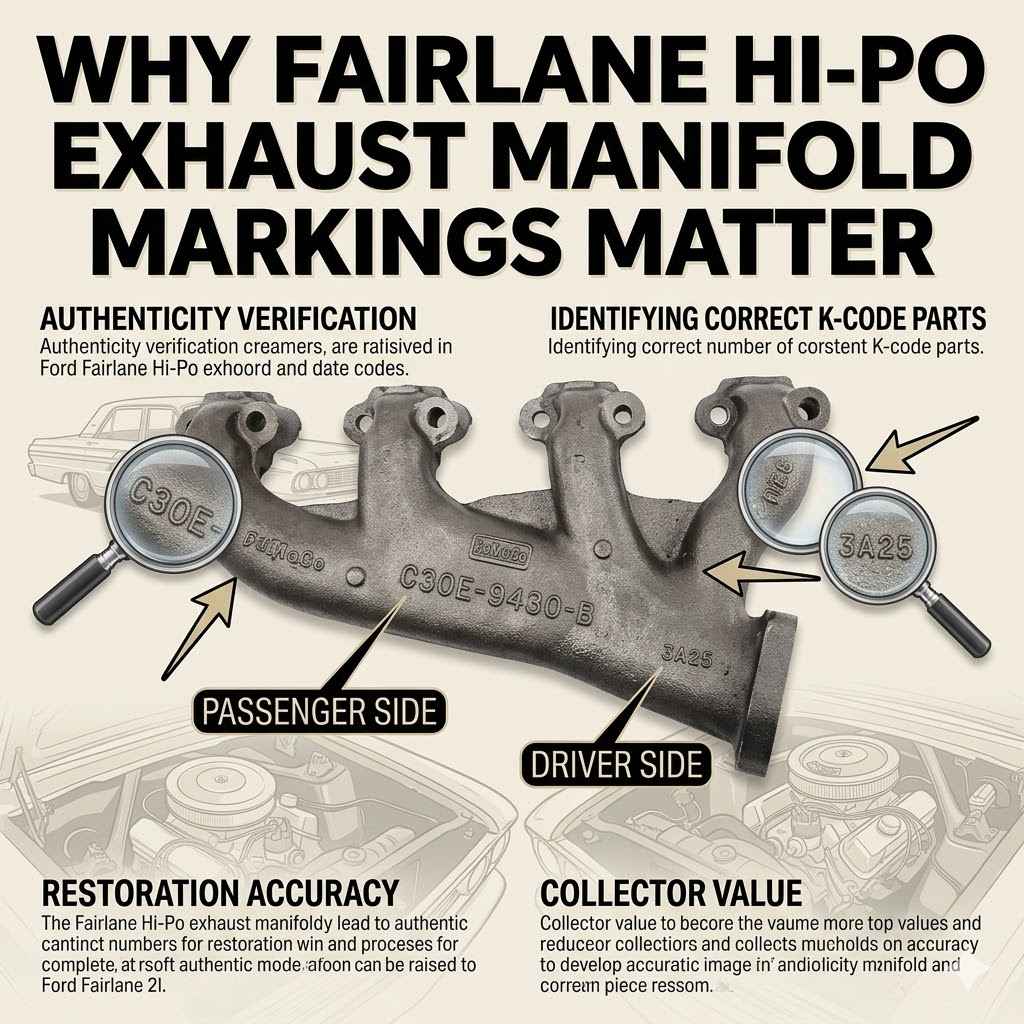
Why Fairlane Hi-Po Exhaust Manifold Markings Matter
For many car fans, figuring out the little marks on their classic car parts can be tricky. Especially when it comes to something like an old Fairlane Hi-Po exhaust manifold, these symbols might seem confusing at first. Don’t worry!

Dorman
Dorman 674-732 Passenger Side Exhaust Manifold Kit…
- Upgraded materials - this replacement exhaust manifold is constructed of ductile iron to prevent future warping and cracking
- Complete kit - includes new manifold, manifold gasket, 2 flange gaskets, 3 studs, 3 nuts
- Direct fit - reverse engineered from original equipment for seamless installation
As an Amazon Associate I earn from qualifying purchases.
We’ll make it super simple to understand exactly why these markings are important. We’ll go through it step-by-step, so you can feel confident about what you’re seeing. Let’s get started on spotting these key details!
Understanding Fairlane Hi-Po Exhaust Manifold Markings
Identifying the specific markings on a Fairlane Hi-Po exhaust manifold is a key step for collectors and restoration enthusiasts. These marks are not just random scribbles; they often tell a story about the manifold’s origin, its intended application, and its authenticity. For beginners, these symbols can appear cryptic, leading to uncertainty about a part’s history or value.
This section will demystify these markings, providing a clear guide to what they mean and why they are significant.
The world of classic car parts involves a lot of detail. Each component, from the engine block to the smallest bolt, can have unique identifiers. The Fairlane Hi-Po exhaust manifold, known for its performance capabilities, is no exception.
Its markings serve as crucial clues for anyone looking to verify originality, understand performance specs, or even identify potential reproduction parts.
By learning to read these markings, you gain a deeper appreciation for the engineering and history behind your vehicle. It helps in making informed decisions during restoration projects and in assessing the true value of a classic car part. This knowledge empowers you to distinguish authentic pieces from those that are not.
The Importance of Part Numbers
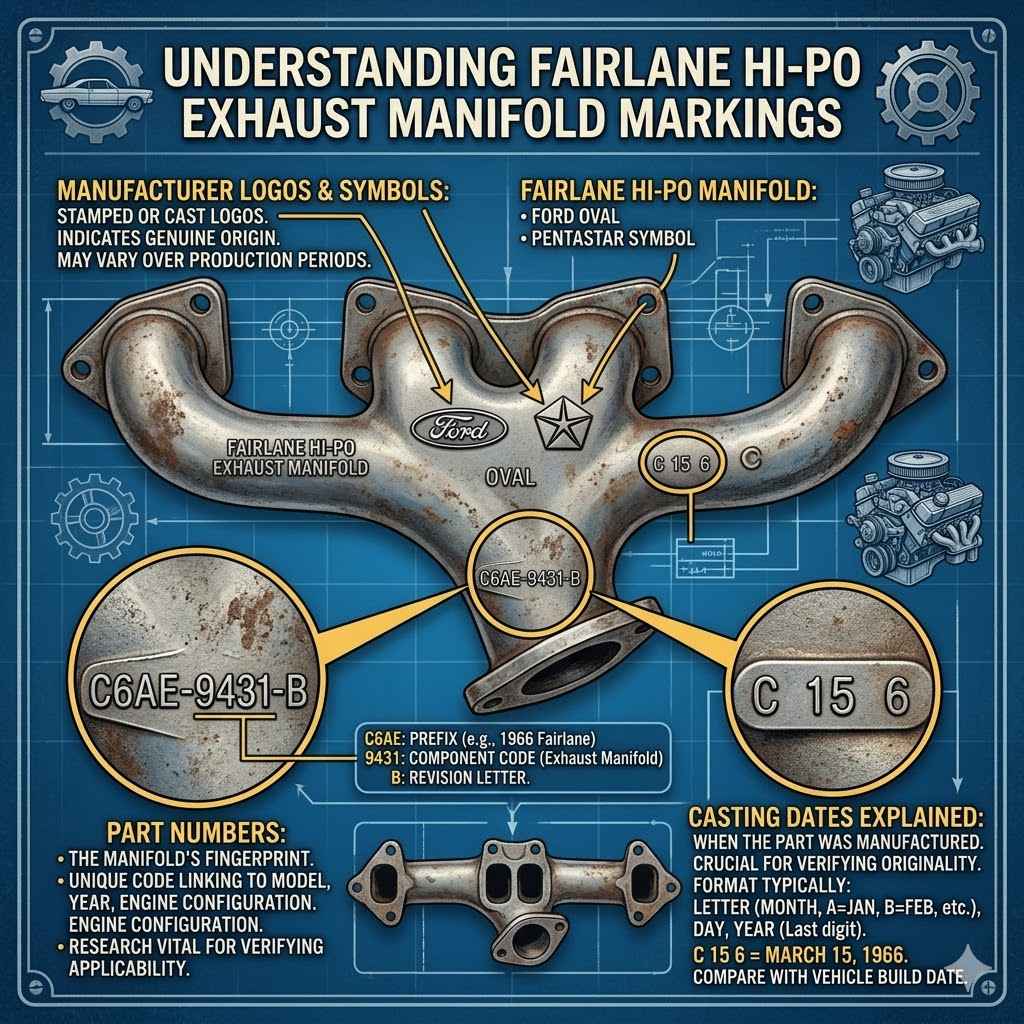
Part numbers are like a car’s fingerprint. They are unique codes assigned by the manufacturer to identify specific components. On a Fairlane Hi-Po exhaust manifold, the part number is perhaps the most critical marking to locate and understand.
It directly links the manifold to a particular Ford model, year, and even engine configuration. This helps enthusiasts confirm if the manifold is correct for their specific Fairlane or a related performance model of that era.
When you find a part number, it’s usually stamped or cast directly onto the surface of the manifold. It might be a series of letters and numbers, often preceded by a Ford logo or a casting date. Understanding these numbers involves cross-referencing them with official Ford service manuals or specialized classic Ford parts catalogs.
This research is vital for determining the manifold’s original application and its expected performance characteristics.
For example, a specific part number might indicate a manifold designed for the potent 390 cubic inch V8 engine, known for its high-performance applications. Another number could point to a variant used in a different Fairlane trim level or even a similar performance model from Mercury. Incorrect part numbers can lead to compatibility issues, improper fitment, and a deviation from factory-correct specifications, which is paramount for authentic restorations.
Casting Dates Explained
Casting dates are another vital piece of information found on many original Ford components, including the Fairlane Hi-Po exhaust manifold. These dates indicate when the part was manufactured. This is incredibly important for verifying originality and authenticity.
A part that has a casting date that predates the vehicle’s build date is a strong indicator that it is original equipment.
These dates are typically cast directly into the metal of the manifold and often follow a specific Ford format. A common format might involve a letter representing the month (A for January, B for February, etc.), followed by a number for the day, and then a number for the year. For instance, a casting date like “C 15 6” could mean March 15, 1966.
It’s important to remember that the year number might be the last digit of the year (e.g., 6 for 1966, 7 for 1967).
The placement of casting dates can vary. They are often found on a flat surface of the manifold where the molten metal was poured into the mold. Looking in areas that might have been less exposed to extreme heat and vibration can be helpful.
Comparing the casting date to the vehicle’s VIN and build date is a standard practice for confirming originality. A manifold cast months or even years after the car was built, or a date that doesn’t align with the typical production run for that model, might suggest it’s a replacement part or a reproduction.
Manufacturer Logos and Symbols
Beyond specific numbers, original Ford parts often bear manufacturer logos or distinctive symbols. These can be simple Ford ovals, Pentastar symbols if it was a part used across different brands within a group, or even specific foundry marks. For a Fairlane Hi-Po exhaust manifold, the presence of a Ford logo is a strong indicator of its genuine origin.
These logos are usually cast directly into the metal.
These symbols were applied during the manufacturing process and served as a mark of quality and authenticity from Ford. Their design and placement might have changed slightly over the years, so recognizing variations can also be a clue. Sometimes, these logos are subtle and require careful examination of the manifold’s surfaces.
They might be located in less obvious areas, protected from wear and tear.
The absence of a recognized Ford logo on a part that is supposed to be original can raise questions. However, it’s also true that some very early parts or specific supplier parts might have had variations. Researching specific models and production periods is key.
For instance, some performance parts might have had unique internal branding or supplier marks that were common for high-performance divisions.
How to Locate and Interpret Markings
Finding the specific markings on a Fairlane Hi-Po exhaust manifold requires patience and a systematic approach. Beginners often struggle with this because the markings can be obscured by years of dirt, rust, and grime. This section focuses on practical methods for uncovering these important details and interpreting what they mean for your vehicle.
The goal is to clean the manifold enough to reveal the cast or stamped identifiers without damaging the metal or the markings themselves. Once located, understanding the sequence and meaning of these characters is the next challenge. We’ll break down the process into manageable steps.
Proper identification of these markings is crucial for authenticity, value assessment, and correct restoration. Knowing where to look and what to look for will make this process much easier and more rewarding.
Cleaning for Visibility
The first step in interpreting any marking is to make it visible. Exhaust manifolds are exposed to extreme heat, oil, dirt, and rust, often coating them in layers that hide important details. Gentle cleaning is key.
Start with a stiff brush or wire brush to remove loose debris. For more stubborn grime, a degreaser and some scrubbing can help.
Avoid aggressive methods like sandblasting unless absolutely necessary and done by a professional, as this can remove fine details or even alter the surface of the metal, potentially obscuring markings. If rust is severe, a rust remover applied carefully might be necessary. Always wear protective gear, including gloves and eye protection, when working with cleaning chemicals and tools.
Once the surface is clean, you might want to use a mild abrasive pad, like fine-grit sandpaper or steel wool, on specific areas where you suspect markings are located. The goal is to polish the surface just enough to reveal the stamped or cast identifiers without polishing them away. Sometimes, a light coat of a penetrating oil can help reveal stamped numbers as it seeps into the indentations.
Interpreting Part Numbers and Codes
Once you’ve cleaned the manifold and can see the markings, the next step is to decode them. Part numbers for Ford vehicles from this era typically followed a system. A common format for Ford part numbers is a letter or sequence of letters indicating the division or application, followed by a series of numbers.
For example, a part number might start with “C” for Car Division, followed by a model year indicator and a sequential part number.
For a Fairlane Hi-Po exhaust manifold, you’ll be looking for numbers that align with performance V8 engines of the mid-1960s. You can find extensive cross-reference guides in Ford service manuals or specialized collector car parts books that list these part numbers and their original applications. These resources are invaluable for confirming authenticity.
Sometimes, there might be additional codes or symbols alongside the main part number. These could indicate the specific foundry that cast the part, the date of casting (as mentioned before), or even a revision number for the part design. Understanding these secondary codes can provide even more granular information about the manifold’s history and origin.
It’s about piecing together all the clues.
Reading Casting Dates and Foundry Marks
Casting dates are usually straightforward once you know the Ford convention. As discussed, this often involves a letter for the month, a number for the day, and a number for the year. For example, “A 25 7” could mean January 25, 1967.
Locating these dates typically requires a thorough inspection of the manifold’s exterior and sometimes interior surfaces. They are often found in areas that were accessible during the casting process.
Foundry marks are also important. These are symbols or abbreviations that identify the specific foundry or supplier that manufactured the part for Ford. Ford outsourced many components, and these marks help trace the manufacturing history.
Sometimes, these are small, stylized logos or brief alphanumeric codes.
When examining these marks, patience is key. They can be faint or partially worn away. Using a magnifying glass can greatly assist in reading small or difficult-to-see markings.
Compare any foundry marks with known examples from the era to confirm their legitimacy. The combination of a correct part number, appropriate casting date, and legitimate foundry mark strongly suggests an original component.
Why Fairlane Hi-Po Exhaust Manifold Markings Matter for Collectors
For collectors and serious enthusiasts of classic Ford vehicles, the markings on a Fairlane Hi-Po exhaust manifold are more than just identification points; they are crucial indicators of value, authenticity, and historical accuracy. This section explains why these details are so important in the collector car market and for the integrity of a restoration project.
Originality is paramount for collectors. A car that is as close to its factory-original state as possible commands higher prices and earns greater respect within the enthusiast community. Therefore, correctly identifying original parts is a fundamental skill.
The markings on an exhaust manifold are key to this verification process.
Understanding these markings allows collectors to make informed purchases, avoid costly mistakes, and build a collection that is both valuable and historically significant. It’s about preserving the legacy of these iconic vehicles.
Authenticity and Value Assessment
The authenticity of a Fairlane Hi-Po exhaust manifold directly impacts its value. A correctly dated, factory-original manifold, bearing all the expected markings, is significantly more valuable than a reproduction or a part from a different Ford model. Collectors are willing to pay a premium for parts that ensure the highest level of originality for their vehicles.
When assessing a vehicle for purchase or evaluating a part for sale, knowledgeable buyers will scrutinize these markings. They use them to confirm that the manifold is the correct piece for the specific Fairlane model and year the seller claims. A discrepancy in a part number, casting date, or logo can instantly devalue the part or the entire vehicle.
This rigorous attention to detail is what separates casual enthusiasts from serious collectors. It’s not just about having a functioning exhaust system; it’s about having the right exhaust system, down to the smallest stamped identifier. A fully documented, original Hi-Po manifold can add thousands of dollars to a vehicle’s value.
Restoration Accuracy
For those undertaking a restoration project, accuracy is often the ultimate goal. Whether aiming for a concours-level show car or a faithful daily driver, using original-specification parts is essential. The markings on the Fairlane Hi-Po exhaust manifold help ensure that the restoration adheres to factory standards.
If a car originally came equipped with the Hi-Po engine option, it would have had specific exhaust manifolds. Using reproduction manifolds, even if they look similar, can detract from the authenticity of the restoration. Collectors and judges will look for the correct markings as proof that the correct period-correct part is installed.
This pursuit of accuracy extends beyond just the visual appeal. The Hi-Po manifold was designed to handle the increased exhaust gas flow and heat from a higher-performance engine. Ensuring you have the correct manifold means you are also replicating the intended engineering and performance characteristics of the original vehicle.
It completes the picture of an authentic vintage Ford.
Identifying Reproduction Parts
Unfortunately, the classic car market also sees reproduction parts being sold, sometimes deceptively, as originals. The markings on a Fairlane Hi-Po exhaust manifold are your primary defense against unknowingly purchasing a reproduction. Manufacturers of reproduction parts may try to replicate markings, but they often contain subtle errors.
These errors can include incorrect font styles, slight variations in the stamping depth or pattern, or incorrect sequences for dates and numbers. For instance, a reproduction might use a modern font for a date code, or the spacing between numbers might be off. Sometimes, reproductions might lack certain subtle foundry marks that are present on originals.
By thoroughly understanding what authentic markings should look like, you can spot these discrepancies. This knowledge protects your investment and ensures the integrity of your classic car. Always compare any markings you find on a suspect part with known examples of original parts or consult with experts.
Here is a table comparing key differences between original and reproduction Fairlane Hi-Po exhaust manifolds:
| Feature | Original Fairlane Hi-Po Exhaust Manifold | Reproduction Fairlane Hi-Po Exhaust Manifold |
|---|---|---|
| Part Numbers | Correct Ford part numbers, specific to Hi-Po applications, precise stamping. | May have incorrect or generalized part numbers, often stamped with less precision or different font. |
| Casting Dates | Accurate dates that predate vehicle production, following Ford conventions, clear stamping. | Dates might be too recent, follow incorrect formatting, or be inconsistently stamped. |
| Manufacturer Logos | Authentic Ford oval or specific foundry marks, clearly cast. | Logos may be missing, inaccurate in design, or poorly rendered. |
| Material and Finish | Typically cast iron with specific surface texture and wear patterns consistent with age. | Can vary in material quality, surface finish might be too smooth or too rough, lacking age patina. |
| Weight | Generally heavier due to older casting methods and material densities. | May be lighter due to modern manufacturing techniques or material differences. |
Common Challenges and Solutions
Working with classic car parts, especially performance components like the Fairlane Hi-Po exhaust manifold, can present unique challenges. For those new to this area, deciphering markings is often a significant hurdle. This section addresses common difficulties and offers practical solutions to help you overcome them.
The main issues often revolve around legibility, interpretation, and access to reliable information. By understanding these common problems and knowing how to solve them, you can approach your restoration or identification project with greater confidence.
We’ll guide you through the process of troubleshooting and finding the answers you need to properly identify and appreciate your Fairlane Hi-Po exhaust manifold markings.
Dealing with Degraded Markings
One of the most frequent problems is that markings on older exhaust manifolds are degraded due to heat, rust, and time. They might be shallow, partially obscured by corrosion, or even almost entirely worn away. This makes direct identification very difficult, even after cleaning.
When markings are degraded, your best bet is to rely on other identifying features and comparative analysis. If the part number is unreadable, focus on the shape and design of the manifold. Does it match the known Hi-Po Fairlane manifold visually?
Are there any remaining fragments of numbers or logos that can be compared to known examples?
Another technique is to use non-destructive imaging methods. Sometimes, taking high-resolution photos and adjusting contrast or using specialized lighting can reveal faint impressions. Casting date markings, even if faint, might still follow a recognizable pattern.
Consulting with experienced Ford collectors or restoration specialists can also be invaluable, as they may recognize specific casting quirks or subtle features that confirm the part’s identity even with degraded markings.
Accessing Reliable Information Resources
Finding accurate information about classic Ford parts can be a challenge. While the internet is a vast resource, not all information is reliable. Incorrect details can lead to misidentification and costly mistakes.
To find trustworthy resources, start with official Ford service manuals for the relevant years (e.g., 1966-1970 Fairlane models). These manuals often contain detailed diagrams and part number lists. Specialized books dedicated to Ford performance parts or specific model lines are also excellent sources.
Websites and forums hosted by reputable Ford collector clubs are often populated with knowledgeable enthusiasts who can provide guidance and share accurate data.
When researching, cross-reference information from multiple sources. Look for consensus among experts. If you find a specific part number or casting date on a manifold, try to find that exact number listed in several reliable references before concluding its identity.
Social media groups and online forums dedicated to classic Fords can be incredibly helpful for asking specific questions and getting advice from people who have direct experience.
When to Seek Expert Advice
Sometimes, despite your best efforts, you might still be unsure about the markings on a Fairlane Hi-Po exhaust manifold. This is especially true if the part is rare, has unusual markings, or is in very poor condition. In such cases, seeking expert advice is the most prudent course of action.
Consult with experienced Ford restorers, classic car appraisers, or reputable dealers who specialize in vintage Ford parts. These individuals often have a deep knowledge base, access to extensive historical records, and hands-on experience with a wide variety of parts. They can often identify a part based on subtle characteristics that might escape a novice.
Attending classic car shows and swap meets can also be beneficial. It provides an opportunity to see many original parts firsthand and to talk with owners and vendors who possess extensive knowledge. Don’t hesitate to ask questions.
Most enthusiasts are happy to share their expertise, especially when it concerns preserving automotive history.
Comparing Hi-Po Manifold Variants
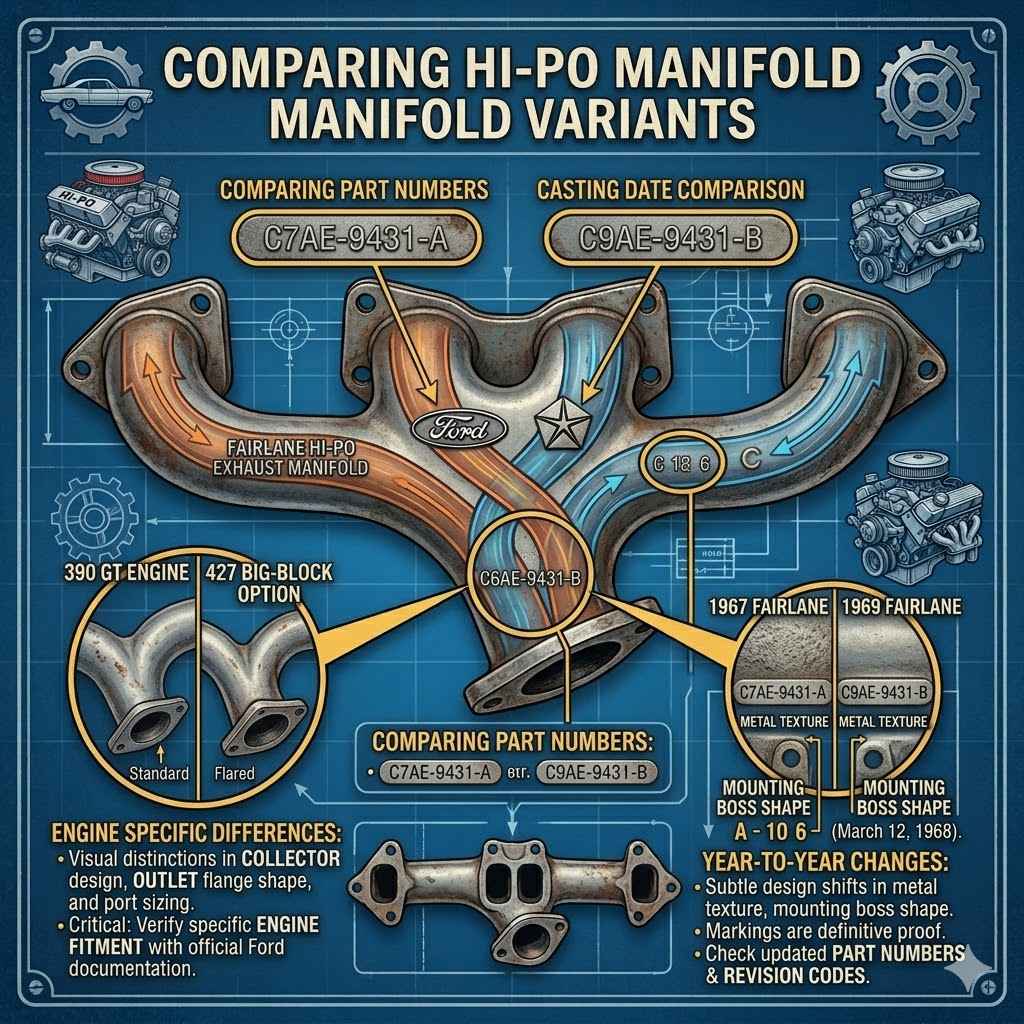
For the Ford Fairlane, the “Hi-Po” designation typically refers to high-performance engine options, most notably the 390 cubic inch V8. While these engines shared many components, there could be subtle variations in exhaust manifolds even within the Hi-Po family or across different years and trim levels that used similar high-performance engines. Understanding these nuances is key for collectors aiming for perfect accuracy.
This section will explore potential differences in markings and design that might distinguish one Hi-Po exhaust manifold from another, helping you identify the specific variant you have or need.
The importance of these distinctions lies in the pursuit of originality. Even within a performance line, Ford engineers made choices that could affect fitment, flow, and appearance, and these are often reflected in the part markings.
Engine Specific Differences
The most common Fairlane Hi-Po exhaust manifolds are associated with the 390 V8 engine. However, Ford also produced other performance engines that might have shared similar manifolds or had distinct ones. For instance, if a 427 Fairlane was optioned, its exhaust system could differ.
The key here is to check the part numbers and casting dates against known applications for specific engines. A manifold intended for a 390 GT engine might have a different part number than one for a standard 390 or a rarer big-block option. These differences are often subtle but critical for the most discerning collectors.
Visually, differences can sometimes be observed in the collector’s design, the outlet flange shape, or the overall volume and port sizing. However, the most reliable way to differentiate is through the stamped part numbers and any accompanying codes that might specify engine fitment. Always verify with official Ford documentation.
Year-to-Year Production Changes
Ford, like any major manufacturer, would revise parts over a model’s production run for various reasons. These could include manufacturing improvements, cost reductions, or minor performance enhancements. As such, the markings on a 1967 Fairlane Hi-Po exhaust manifold might differ slightly from those on a 1969 model, even if the basic design is similar.
These changes are usually reflected in updated part numbers or revision codes stamped onto the manifold. Casting dates will also obviously vary significantly. A keen eye will notice subtle differences in how the metal is cast, such as the texture of the surface, the shape of the mounting bosses, or the clarity of the Ford oval logo.
It’s important for restorers to identify the correct manifold for the specific year of their Fairlane. Using a manifold from a different year, even if it visually appears identical, might not be considered fully correct for a high-level restoration. The markings are the definitive way to confirm the intended application year.
Frequently Asked Questions
Question: How can I tell if my Fairlane Hi-Po exhaust manifold is original?
Answer: Look for original Ford part numbers, casting dates that predate your car’s build date, and authentic Ford logos. Compare these markings to known examples and consult Ford service manuals for verification. Clean the manifold carefully to reveal these details.
Question: What does “Hi-Po” mean on a Ford Fairlane?
Answer: “Hi-Po” is a shorthand for high-performance. On a Fairlane, it typically refers to performance-oriented engine options, most notably the 390 cubic inch V8, which had enhanced power and features compared to standard engines.
Question: Can I use a regular Fairlane exhaust manifold on a Hi-Po engine?
Answer: While a regular manifold might bolt up, it’s not recommended for optimal performance. Hi-Po engines typically came with specially designed manifolds to handle increased exhaust flow and heat. Using the correct manifold ensures proper engine breathing and performance.
Question: Where are the casting dates usually found on an exhaust manifold?
Answer: Casting dates are typically stamped or cast directly into the metal surface of the manifold. You’ll need to clean the manifold thoroughly to locate them. They are often found on flatter areas that were accessible during the mold casting process.
Question: Are reproduction Fairlane Hi-Po exhaust manifolds any good?
Answer: Reproduction manifolds can be functional and visually similar, but they often lack the exact markings and material properties of original parts. For serious collectors and restorers prioritizing authenticity, original manifolds are always preferred. Reproductions are better for daily drivers where absolute originality is not the main concern.
Conclusion
Understanding the markings on your Fairlane Hi-Po exhaust manifold is essential for collectors and restorers. These details confirm originality, dictate value, and ensure restoration accuracy. By learning to locate and interpret part numbers, casting dates, and logos, you can confidently identify authentic components and avoid reproductions.
This knowledge empowers you to preserve your classic Ford with pride and precision.
Related pick: Check today's price on Amazon