4 Best Gasket Materials for Exhaust Heat (2026): We Compared
For continuous exhaust heat, multi-layer graphite or graphite-steel composite gaskets are the safest all-around choice; for short peak spikes above about 1,200°F, use MLS or wire-reinforced designs, and for warped or low-load flanges, soft graphite beats rigid metal. Pick the wrong material and the joint can leak, blow out, or seize fasteners fast. This guide compares exhaust gasket materials by temperature, flange flatness, and bolt load so you can pick the one that fits your joint.
Quick comparison
| Product | Badge | Best for | Price | ||
|---|---|---|---|---|---|
 |
2PCS Exhaust Gasket Graphite and Steel,Exhausts FlangeYGDMD | Our pick | 1.91" · graphite/steel · flange | $5.99
Price as of 15 Oct 2026
|
View |
 |
Thickened High Temperature Ceramic Fiber Gasket PaperHasanbar | Also great | 7"x10" · ceramic fiber · sheet | $9.99
Price as of 15 Oct 2026
|
View |
 |
PLKHCU 2Pcs 3" Copper Exhaust Flange Collector Gasket +PLKHCU | Also great | 3" · copper · collector kit | $18.99
Price as of 15 Oct 2026
|
View |
 |
Hoiricn 2PCS Car Exhaust Gasket Set, 3" 3-Bolt High-SealingHoiricn | Also great | 3" · composite · 3-bolt | $7.99
Price as of 15 Oct 2026
|
View |
 |
JOIUYOLJ Exhaust Flange Gasket 2.5-inch 2Pcs 3-Bolt forJOIUYOLJ | Pair with it | 2.5" · stainless/graphite · 3-bolt | $7.09
Price as of 15 Oct 2026
|
View |
Use the table to match the gasket to the joint, not the headline temperature rating. A flat flange with strong clamp force can take a stiffer gasket, while a warped or thin flange usually needs a more compliant material.
How we chose
The main filters are continuous temperature, peak spikes, flange type, and bolt load. Those four decide whether a gasket survives without oxidation, creep, crush-set, or blowout.
We also weighed thermal cycling and reuse risk. Exhaust joints heat and cool fast, so a gasket that seals once but loses seating stress quickly is the wrong pick.
Finally, we separated vehicle exhaust use from industrial process ratings. A material that is excellent in a refinery line may still be a poor fit for a warped header flange.
| Application | Typical heat exposure | Flange type | Pressure/bolt-load needs | Best material | Avoid-if notes |
|---|---|---|---|---|---|
| Header flange | Hot continuous exhaust with sharp heat spikes | Thin raised-face or slightly uneven flange | Low to moderate bolt load; cycling matters | Flexible graphite | Avoid rigid metal if the flange is warped or the fasteners are lightly loaded |
| Turbo outlet | Very hot exhaust gas; short peak spikes can be severe | Compact flange, often high clamp stress | Moderate to high bolt load; thermal cycling is severe | Spiral wound gasket or reinforced graphite | Avoid soft sheet material if the joint sees high boost, movement, or frequent retorque need |
| Catalytic converter flange | Hot exhaust with moderate continuous load | Raised-face or 3-bolt flange | Moderate load; leak control matters more than extreme pressure | Graphite-steel composite or flexible graphite | Avoid ceramic fiber unless the joint is unusually hot and the clamp load is controlled |
| Motorcycle pipe joint | Hot cycles, vibration, and frequent thermal movement | Small flange or slip-joint style connection | Low to moderate load; reuse risk can be high | Flexible graphite, sometimes reinforced with stainless tang or foil | Avoid rigid metal if the joint relies on conforming to a small or imperfect surface |
| Heat shield joints | Radiant heat, not usually full exhaust-gas temperature | Light-duty sheet or bracket interface | Low load; vibration and gap control matter | Compressed non-asbestos fiber or mica-based sheet | Avoid overbuilding with hard metal unless the joint is precision made and heavily clamped |
Best exhaust gasket material for high heat
Flexible graphite is the best all-around answer for most high-heat exhaust flanges because it handles continuous service at 450–500°C in oxidizing air, seals with moderate bolt load, and tolerates thermal cycling better than brittle sheet materials. For most DIY exhaust joints, that balance matters more than chasing the highest temperature number.
Heat alone does not decide the winner. Exhaust joints also fail from oxidation in air, repeated expansion and contraction, and low clamp load that lets the gasket lose seating stress or blow out.
Why flexible graphite wins on heat, load, and cycling
Flexible graphite is the go-to high temperature gasket material for refineries and power plants, and that same behavior translates well to many exhaust joints. It is common in exhaust and refinery service, which tells you it is comfortable in hot gas service where oxidation and cycling both matter.
The practical advantage is compliance. A compressible graphite gasket can fill small flange defects, slight waviness, and surface scratches without needing extreme bolt load.
When a reinforced graphite gasket is the safer pick
A reinforced graphite gasket is the safer pick when the flange sees vibration, poor surface finish, or repeated service removal. Stainless tang or foil reinforcement helps the gasket stay together during handling and installation, but it still seals like a compressible material instead of a rigid ring.
Say your 3-bolt cat-back flange leaks after a few heat cycles. If the flange faces are slightly uneven, a reinforced graphite style is usually a better first move than a harder metal design that needs a cleaner, flatter seat.
Quick comparison of material families
Here is the short version: flexible graphite suits most exhaust flanges, spiral wound gaskets suit hotter or more demanding joints, ceramic fiber is for pure heat resistance, and rigid metal belongs on precision faces with enough clamp load. CNAF is useful in general service, but it is not the first pick for the hottest exhaust joints.
Flexible graphite
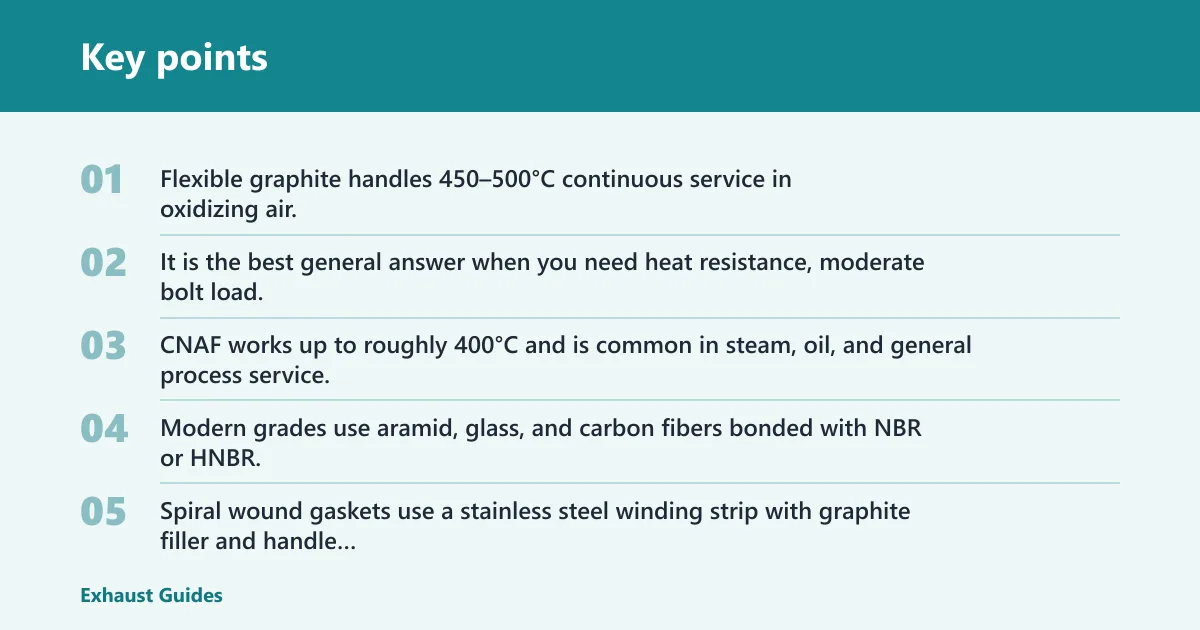
Flexible graphite handles 450–500°C continuous service in oxidizing air. It is the best general answer when you need heat resistance, moderate bolt load, and better sealing on a flange that is not perfect.
Compressed non-asbestos fiber
CNAF works up to roughly 400°C and is common in steam, oil, and general process service. Modern grades use aramid, glass, and carbon fibers bonded with NBR or HNBR, but exhaust owners should treat it as a lower-heat option than graphite.
Spiral wound gasket
Spiral wound gaskets use a stainless steel winding strip with graphite filler and handle 500°C+ steam and hydrocarbon service. They tolerate thermal cycling well and are a strong choice when the flange can support higher seating stress.
Kammprofile gasket
A Kammprofile gasket uses a grooved metal core with graphite or PTFE facings. It is preferred for heat exchangers and critical process flanges because it holds seating stress through thermal cycling better than many soft designs.
Mica-based sheet
Mica-based sheet seals from -150°C to over 1000°C and does not oxidize in air at elevated temperature as quickly as many organic fillers. Products sold as Thermiculite or vermiculite-bonded sheets often live in the same conversation when oxygen is present at extreme heat.
Ceramic fiber gasket
Ceramic fiber gaskets use alumina-silicate ceramic fibers and can handle continuous service up to 1200°C. They are best when pure heat resistance is the main requirement, such as furnace doors, kiln seals, and very hot ductwork.
Solid metal ring-joint gasket
Solid metal ring-joint gaskets are available in soft iron, low-carbon steel, stainless 304/316, and Inconel variants. They tolerate 1000°C+ and belong on API-rated wellhead flanges and ultra-high-pressure hydrocarbon service with precision-machined groove faces.
Metal-jacketed gasket
Metal-jacketed gaskets place a soft filler inside a stainless steel or copper jacket, with filler choices including graphite, ceramic, or non-asbestos fiber. They fit heat exchanger flanges, autoclave covers, and pressure vessel manways where controlled compression matters.
Which gasket material is best for an exhaust manifold?
For most exhaust manifolds, flexible graphite is the best balance of heat resistance, sealing, and tolerance for imperfect flange faces. If the manifold flange is very flat and the clamp load is high and even, a spiral wound or other reinforced design can work well, but rigid metal is less forgiving on warped parts.
Header flanges are often thin and prone to distortion. That makes compressibility valuable because the gasket has to compensate for face irregularity, not just survive temperature.
Header flanges and uneven mating faces
Header flanges often live in the worst mix of conditions: high heat, vibration, uneven bolt load, and some distortion from previous overheating. Flexible graphite handles that mix better than a hard ring that depends on perfect seating.
Metal can be better only when the flange surfaces are true, the bolt pattern is sound, and the joint has enough clamp force to seat the gasket without local gaps.
Graphite versus metal on manifold joints
Graphite is better when the priority is leak control on a slightly imperfect flange. Metal is better when the flange is machined well and you need higher resistance to blowout or higher seating stress.
A common first-timer mistake is choosing the hottest-looking gasket for a manifold that is actually leaking because the flange is warped by a few thousandths. In that case, the harder gasket can leak sooner because it cannot conform.
Turbo outlet, cat flange, or pipe joint: what should you buy?
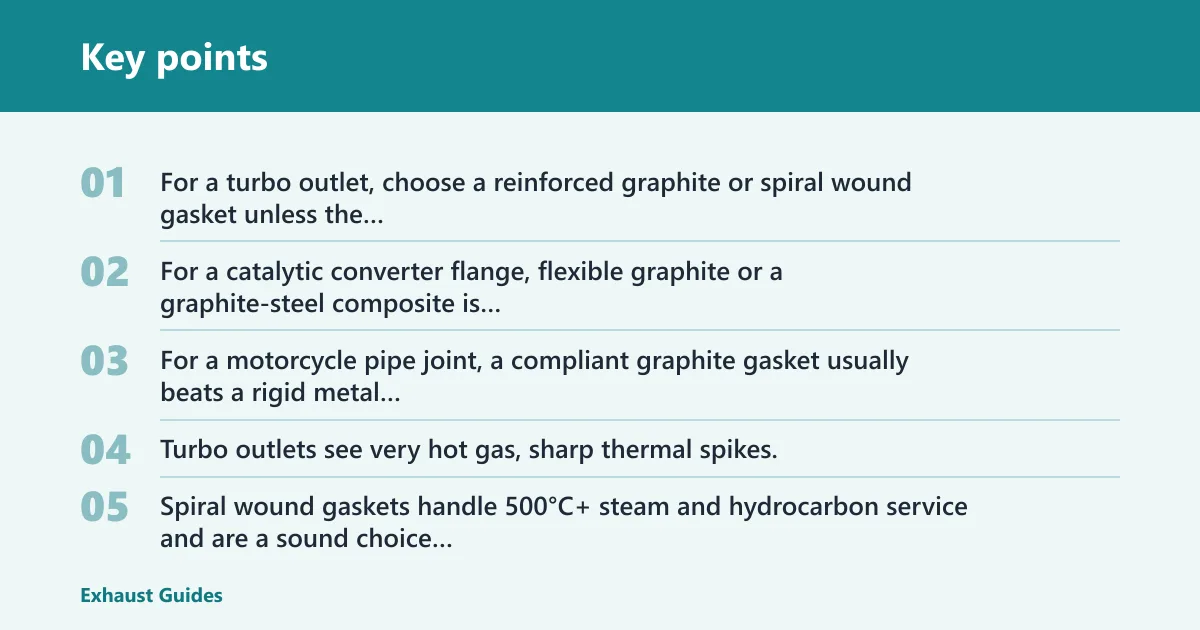
For a turbo outlet, choose a reinforced graphite or spiral wound gasket unless the flange is precision machined and heavily loaded. For a catalytic converter flange, flexible graphite or a graphite-steel composite is often the best compromise. For a motorcycle pipe joint, a compliant graphite gasket usually beats a rigid metal part because vibration and reuse risk are high.
Turbo outlet seals
Turbo outlets see very hot gas, sharp thermal spikes, and strong movement from heat and boost changes. Spiral wound gaskets handle 500°C+ steam and hydrocarbon service and are a sound choice when the joint can accept the seating stress they need.
If the turbo flange is less than perfect, a reinforced graphite gasket is often safer than a harder design that may not conform under limited bolt load.
Catalytic converter flanges
Catalytic converter flanges usually need leak control more than extreme pressure capacity. Flexible graphite is often the best practical answer because it handles heat, oxidation, and normal exhaust cycling without requiring the kind of precision groove used by ring-joint systems.
Metal becomes less attractive when the clamp pattern is modest or the flange faces are not perfectly flat.
Motorcycle pipe joints
Motorcycle exhaust joints often combine vibration, compact flanges, and frequent thermal cycling. A graphite-steel composite or flexible graphite gasket is usually the safer call because it can seal with moderate bolt load and tolerate repeated heat swings.
Metal gaskets can work, but only if the joint geometry supports them. Thin pipes and small flanges usually favor conformity over rigidity.
When is metal better than graphite?
Metal is better than graphite when the flange faces are precision machined, the clamp load is controlled, and the joint needs high resistance to blowout or creep under severe service. Graphite is better when the joint is imperfect, lightly loaded, or likely to be removed and reused.
Spiral wound versus Kammprofile
Spiral wound gaskets are strong general-purpose high-temperature seals because the metal winding and graphite filler combine resilience with thermal cycling tolerance. Kammprofile gaskets hold seating stress even better on critical flanges because the grooved core supports the sealing face.
For exhaust work, spiral wound is usually the more familiar fit when you need heat tolerance and some forgiveness. Kammprofile is more specialized and starts to make sense when the flange and clamp system are unusually consistent.
Solid ring-joint gaskets for precision grooves
Solid metal ring-joint gaskets are the right answer only for proper ring grooves and heavy-duty pressure service. They tolerate 1000°C+ and live in API-rated and ultra-high-pressure service, but they are not a casual substitute for a typical exhaust flange.
Use one when the hardware is built for it. Otherwise, the joint may be harder to seal, not easier.
Exhaust gasket material decision table
Use this table to sort by actual joint conditions. The best material is the one that matches heat, flange geometry, and seating stress at the same time.
| Material | Temperature behavior | Flange fit | Load behavior | Best exhaust use | Main caution |
|---|---|---|---|---|---|
| Flexible graphite | 450–500°C continuous in oxidizing air | Good on imperfect or slightly warped flanges | Low to moderate bolt load | Header flanges, cat flanges, motorcycle joints | Can creep or crush-set if the joint is over-cycled or under-clamped |
| CNAF | Up to roughly 400°C | Moderate fit on general flanges | Moderate load in lower-heat service | Heat shields or cooler exhaust-adjacent joints | Not the best choice for the hottest manifold or turbo joints |
| Spiral wound | 500°C+ steam and hydrocarbon service | Best on flatter, stronger flanges | Higher seating stress tolerated well | Turbo outlets and demanding collector flanges | Needs enough clamp load and a decent face finish |
| Kammprofile | Strong through thermal cycling | Excellent on critical flat flanges | Maintains seating stress well | High-value flanges with controlled hardware | Not the usual DIY choice for ordinary exhaust repairs |
| Mica-based sheet | -150°C to over 1000°C | Useful where oxygen and extreme heat combine | Needs proper compression but stays stable at heat | Very hot exhaust-adjacent or heat shield work | Can be more material than a normal exhaust joint needs |
| Ceramic fiber gasket | Continuous service up to 1200°C | Useful where pure heat resistance matters most | Usually lower pressure, higher heat focus | Very hot ducting and special exhaust heat barriers | Can be too soft or bulky for ordinary flange sealing |
| Solid metal ring-joint | 1000°C+ capability | Requires precision-machined groove faces | High seating stress and controlled hardware | Special groove flanges, not typical exhausts | Wrong geometry means poor sealing and difficult installation |
| Metal-jacketed | Depends on filler; good in heat exchanger service | Best on controlled industrial flanges | Works where seating stress is engineered | Heat exchangers, vessel covers, special hot joints | Usually overkill for vehicle exhaust flanges |
Which one should you buy?
If cost matters most and the flange is reasonably flat, buy flexible graphite first. It gives you the broadest fit across exhaust manifolds, cat flanges, and motorcycle joints without forcing the flange to be perfect.
If the flange is warped, lightly loaded, or likely to be reopened, stay with graphite rather than a rigid metal part. A more forgiving gasket usually beats a harder one that depends on perfect hardware.
If the joint is a turbo outlet or another severe heat location with good flange quality, move up to a spiral wound or reinforced design. That is the point where metal reinforcement starts paying off.
If the joint is a precision groove flange or true industrial hardware, then a solid ring-joint or Kammprofile-style solution can make sense. For normal exhaust repair, those are special cases, not the default.
Do high temperature exhaust gaskets need sealant? Sometimes, but not always. Use sealant only when the gasket maker or flange condition calls for it, and avoid smearing sealant on a gasket that depends on controlled compression or on a surface that must slide and settle during torque-up.
Frequently asked questions
What is the best exhaust gasket material for high heat?
Flexible graphite is the best all-around exhaust gasket material for high heat because it combines strong temperature tolerance, oxidation resistance in air, and better sealing on imperfect flanges. For hotter, higher-load joints, spiral wound or reinforced designs can be a better fit, but graphite is the safest general choice.
What is the best exhaust gasket material?
For most exhaust repairs, flexible graphite is the best single answer because it handles common exhaust temperatures, moderate bolt load, and small flange defects better than rigid metal. If the joint is precision made and heavily loaded, a metal-backed or spiral wound option may be more appropriate.
Is graphite or metal better for exhaust gaskets?
Graphite is better for most exhaust gaskets because it seals with less bolt load and adapts to flange irregularity. Metal is better only when the flange is flat, the load is controlled, and the joint needs more resistance to blowout or creep than a compressible gasket can provide.
Do high temperature exhaust gaskets need sealant?
Not always. Some exhaust gaskets are designed to seal dry, while others may benefit from a thin sealant only if the manufacturer allows it or the flange finish is poor. Sealant is not a cure for warped flanges, and it can interfere with proper crush or seating.
What temperature can exhaust gasket materials handle?
It depends on the material and whether you mean continuous service or a short spike.