Straight Pipe vs Cat-Back: What Changes on Road Use?
If you drive on public roads, choose a cat back. A straight pipe is typically much louder than a cat back and is often not legal for public-road use. Pick wrong and you can end up with drone, failed inspections, fines, or a car that gets old fast. This guide compares what each setup removes, how they differ in sound and legality, and which one fits daily driving, weekend use, or maximum noise.
| Decision factor | straight pipe | cat back | Winner |
|---|---|---|---|
| Emissions hardware retained | May remove the catalytic converter depending on layout | Usually keeps the catalytic converter in place | cat back |
| Sound control | Minimal sound control; loudest option | Still louder than stock, but keeps more sound control parts | cat back |
| Drone risk | High, especially on highways and steady-speed cruising | Lower when a resonator and muffler remain | cat back |
| Install complexity | Can vary by platform, often more involved when emissions parts are removed | Usually a bolt-on from the catalytic converter back | cat back |
| Inspection and legality risk | High in many places | Lower, but still depends on local noise and emissions rules | cat back |
| Best fit | Track-only or off-road builds | Daily drivers and mild weekend cars | tie |
Straight pipe vs cat back: the core trade-off
The key difference is simple: a cat back changes the exhaust after the catalytic converter and usually keeps emissions hardware in place, while a straight pipe removes more sound control and may delete the catalytic converter depending on the vehicle. For typical street use, cat back is the better balance of sound, comfort, and legality.
That difference matters because the exhaust system moves hot gases away from the engine, but it also shapes cabin sound, legal exposure, and how tiring the car feels at speed. A straight pipe is the loudest option, and stock exhaust is the quiet baseline. EPA guidance and state inspection rules also make emissions equipment removal a legal issue on many public roads.
Why sound, legality, and comfort move in different directions
The catalytic converter handles emissions, the muffler cuts overall volume, and the resonator helps tune frequencies so the exhaust does not drone or rasp as badly. Remove more of those parts and the system gets loud quickly, but comfort usually drops with it. SAE acoustic research and hearing-safety guidance both show that repeated high sound exposure is a real concern.
On many cars, the jump from stock to cat back is clear without being extreme. The jump from cat back to straight pipe is where idle, cruise, and wide-open throttle can all become hard to ignore.
Straight pipe vs cat back matrix

| Use case | Retained catalytic converter | Loudness | Drone risk | Install complexity | Typical legality risk | Best-fit driver profile |
|---|---|---|---|---|---|---|
| Daily driver | Usually yes | Moderate | Lower if the resonator stays | Moderate | Lower, but still local-rule dependent | Driver who wants more sound without making commuting tiring |
| Weekend car | Usually yes | Moderate to loud | Medium | Moderate | Moderate | Driver who wants a louder car for short trips and meets |
| Turbo car | Often yes with cat back; may be removed in a straight pipe layout | High | Medium to high | Moderate to high | Moderate to high | Driver focused on spool, sound, and supporting mods |
| Track-only build | No, or not required | Very high | High but less important | Higher | Highest, since street use is not the target | Driver who values maximum noise and accepts the trade-offs |
Cat-back vs Straight Pipe by Use Case
| Use case | Retained catalytic converter | Loudness | Drone risk | Install complexity | Typical legality risk | Best-fit driver profile |
|---|---|---|---|---|---|---|
| daily driver | cat back: yes / straight pipe: maybe not | cat back: moderate / straight pipe: very high | cat back: lower / straight pipe: high | cat back: moderate / straight pipe: moderate to high | cat back: lower / straight pipe: high | cat back |
| weekend car | cat back: yes / straight pipe: maybe not | cat back: moderate to loud / straight pipe: very high | cat back: medium / straight pipe: high | cat back: moderate / straight pipe: moderate to high | cat back: moderate / straight pipe: high | cat back |
| turbo car | cat back: often yes / straight pipe: maybe not | cat back: high / straight pipe: very high | cat back: medium / straight pipe: high | cat back: moderate / straight pipe: higher | cat back: moderate / straight pipe: high | straight pipe |
| track-only build | cat back: yes or no / straight pipe: usually no | cat back: high / straight pipe: very high | cat back: less important / straight pipe: less important | cat back: moderate / straight pipe: higher | cat back: high / straight pipe: highest | straight pipe |
What a cat back actually replaces
A cat back exhaust bolts on from the catalytic converter back. It usually replaces the midpipe and muffler, and sometimes the resonator, while keeping the catalytic converter in place. That is why it is usually the milder option and the safer starting point for street use.
Because it keeps more of the original emissions hardware, a cat back is often easier to live with. It usually gives a deeper or louder tone without turning every trip into a noise event.
Muffler and resonator changes
The muffler is the main sound-damping part, so changing it strongly affects idle, cruise, and wide-open throttle volume. The resonator tunes frequencies and helps reduce drone and rasp, which is why cat back systems that keep a resonator tend to sound cleaner.
A muffler delete removes the muffler and leaves the rest of the system in place. That can make a car louder without going full straight pipe, but it still raises cabin noise and can add drone.
What a straight pipe removes
A straight pipe is a continuous exhaust tube with minimal restriction. On some cars it starts at the header or turbo and runs back from there, and it can remove the muffler and resonator while also creating risk around catalytic converter removal.
This is why straight pipe is the louder choice by a wide margin. In many layouts, it is not one part but a broader change to the exhaust path.
How the layout changes by platform
On a turbocharged engine, straight pipe may be described as turbo-back, since the path starts after the turbo. On a naturally aspirated engine, it may be header-back. The exact layout depends on the platform, but the goal is the same: less restriction and less sound control.
That does not mean more restriction is always bad. Backpressure is often used as a shorthand in exhaust talk, but the useful question is balance, not chasing a number for its own sake.
How do they sound at idle, cruise, and WOT?
At idle, a cat back usually keeps the car noticeably louder than stock without becoming extreme. A straight pipe is far more aggressive, and at wide-open throttle it can push past 120 dB; the guide’s straight-pipe WOT range is 105–120+ dB. Sustained exposure above 85 dB can damage hearing over time, according to OSHA and NIOSH hearing guidance.
Idle and cold start
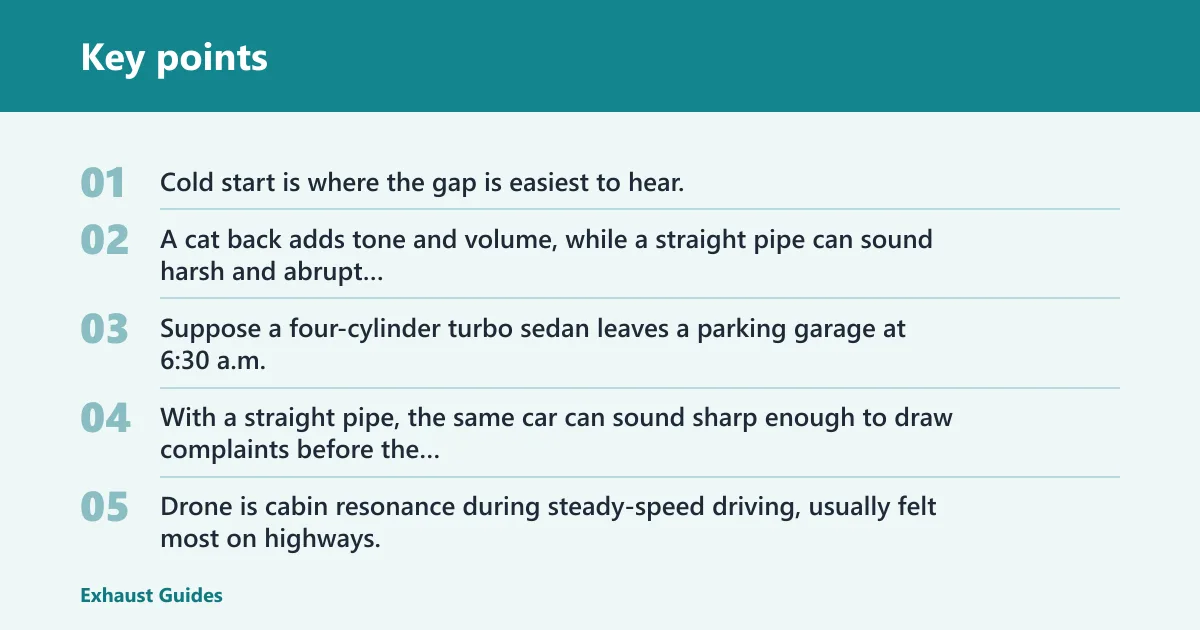
Cold start is where the gap is easiest to hear. A cat back adds tone and volume, while a straight pipe can sound harsh and abrupt because it lacks more of the parts that smooth the note.
Suppose a four-cylinder turbo sedan leaves a parking garage at 6:30 a.m. With a cat back, the exit is louder. With a straight pipe, the same car can sound sharp enough to draw complaints before the first stoplight.
Steady-speed cruise and drone
Drone is cabin resonance during steady-speed driving, usually felt most on highways. This is the main reason a straight pipe can be annoying after the novelty wears off, while a cat back with a resonator often stays more tolerable.
A common first-timer mistake is assuming loud at idle means acceptable on the freeway. Picture a 70 mph commute in top gear; if the cabin fills with a low, booming note, the problem is not the outside volume. It is drone.
Wide-open throttle comparison
Under wide-open throttle, both setups get louder, but the straight pipe stays the noisiest option. That makes it attractive for people who want maximum sound at pull events or on track, but it also raises the chance of fatigue and attention on the street.
Does a straight pipe add horsepower?
Usually, no horsepower gain to speak of comes from a straight pipe alone. SAE-style engine testing and dyno results commonly show that exhaust gains depend on the engine, the full system, and calibration; deleting parts without matching the setup does not guarantee meaningful power.
Backpressure and flow trade-offs
Backpressure is often treated like a goal, but that is too simple. The better question is whether the exhaust is sized and routed for the engine’s needs. Too much restriction can hurt flow; too little attention to the rest of the setup can hurt drivability and tone.
Turbocharged engine guidance
Turbocharged engines are more responsive to exhaust restriction changes, so a straight pipe can show slightly better spool behavior in some builds. Even then, gains tend to be modest unless the car also has supporting mods and calibration changes.
That makes a cat back a common compromise for turbo cars that still see street use. It can open the sound without forcing every drive to sound like a full race build.
Naturally aspirated engine expectations
Naturally aspirated engines usually see minimal power gain from exhaust noise mods. The change is more likely to be in sound than in seat-of-the-pants performance, which is why many owners are happier with a cat back than with a full straight pipe.
Which setup fits your car?
Daily drivers should usually stay with a cat back because it keeps the catalytic converter, controls sound better, and reduces the odds of drone becoming a daily complaint. Weekend cars can go either way, but a cat back still gives the easier road trip experience.
Daily driver
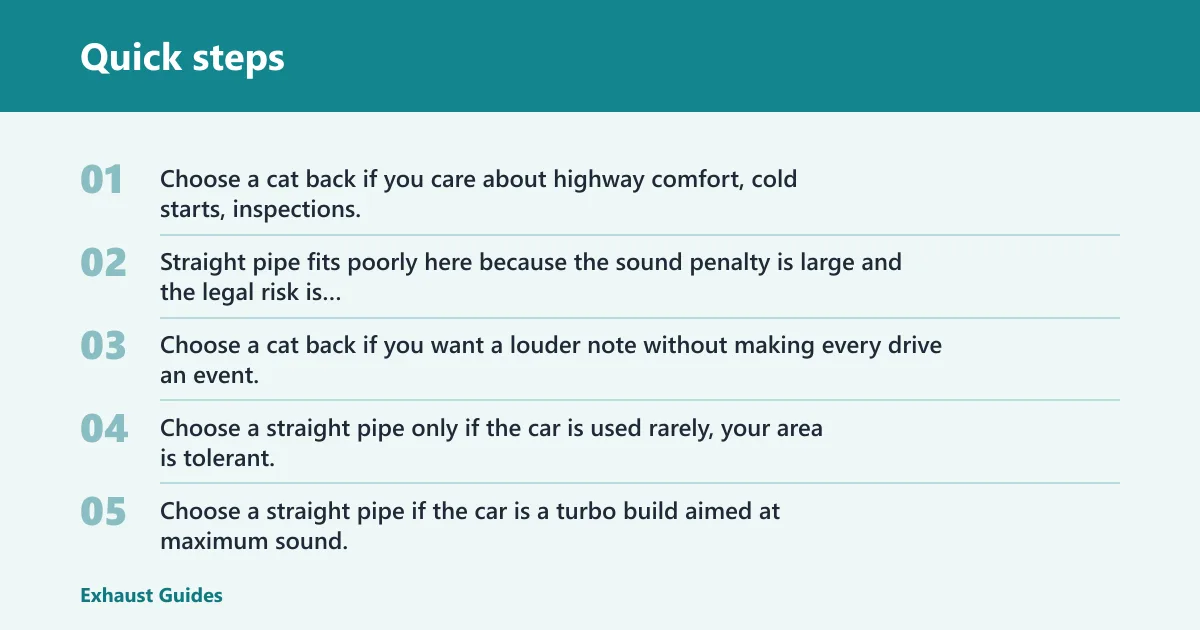
Choose a cat back if you care about highway comfort, cold starts, inspections, or a car that does not wear on you after a week of commuting. Straight pipe fits poorly here because the sound penalty is large and the legal risk is often too high.
Weekend car
Choose a cat back if you want a louder note without making every drive an event. Choose a straight pipe only if the car is used rarely, your area is tolerant, and you are willing to accept more drone and inspection trouble.
Turbo car
Choose a straight pipe if the car is a turbo build aimed at maximum sound, supporting mods, and little street mileage. Choose a cat back if you still want some performance-minded sound with better civility and lower risk.
Track-only build
Choose a straight pipe if the car stays off public roads and the goal is maximum noise with minimal restriction. For this use, comfort and legality matter less than sound and flow.
Choose cat back if you want a simpler bolt-on, want to keep the catalytic converter, or need the car to pass inspections more easily. Choose straight pipe if the car is not a commuter, the noise goal is the priority, and you accept the legal and comfort trade-offs.
Choose straight pipe if… / Choose cat back if…
Choose straight pipe if… the car is track-only, you want the loudest setup, you can accept drone, and local emissions and noise rules do not apply to your use. It is also the stronger fit for owners who are already building around other exhaust and turbo changes.
Choose cat back if… the car sees daily use, you want more sound without deleting more hardware than necessary, or you need better odds of passing inspections. It is the safer recommendation for most street cars.


Frequently asked questions
Catback exhaust vs straight pipe
A catback exhaust keeps the catalytic converter and replaces parts from that point rearward, while a straight pipe can remove the muffler, resonator, and sometimes the catalytic converter depending on the platform. If you want a street-friendly sound change, cat back is the better fit. If you want maximum noise, straight pipe is louder and riskier.
Cat back exhaust vs downpipe
A cat back works after the catalytic converter, while a downpipe is closer to the turbo on turbocharged cars and can include or replace catalytic hardware. A downpipe usually has a larger effect on flow and legality than a cat back, so it brings more risk and more tuning considerations.
Catted vs catless downpipe
A catted downpipe keeps a catalytic converter in the pipe, while a catless downpipe removes it. The catted version is usually easier to live with and less likely to trigger legal or inspection problems, while the catless version is louder and carries the highest emissions risk.
Will a straight pipe cause drone on the highway?
Very often, yes. Drone is one of the main complaints with straight pipes because the steady engine speed on the highway can line up with cabin resonance. A resonator and muffler help control that, which is why cat back systems are usually easier to live with.
Can I daily drive a straight-pipe exhaust?
You can, but it is usually a bad match for commuting. The cabin can be tiring at cruise, cold starts are harsh, and inspections or noise rules can become a recurring problem. A cat back is the safer daily-driver choice for most owners.
Is a cat-back legal if I keep the catalytic converter?
Often more likely, but not guaranteed. Keeping the catalytic converter helps with emissions compliance, yet local noise rules and inspection standards still matter. A cat back lowers the legal risk compared with a straight pipe, but it does not make every setup street legal everywhere.