
How to Find a Leaking Tailpipe Joint
A leaking tailpipe joint usually leaves soot, a chuffing sound, or a puff of exhaust at the slip fit or clamp; if the noise is only at the rear joint, that joint is the leak. Ignoring it can waste fuel, trigger an exhaust smell, and turn a small gap into a rusted section that needs replacement. This guide shows how to confirm the leak, rule out the muffler, seam, or condensation, and choose clamp, sealant, or replacement.
Signs your tailpipe joint is leaking

- Thick visible smoke makes leaks easy to spot
- Adjustable pressure suits different leak-testing jobs
- Includes adapters and OEM approved smoke fluid
A rear exhaust leak usually shows up at the joint itself, not at the engine. The most useful clues are fresh dry soot near the clamp or slip fit, a hiss or crisp tick from the rear of the car, and exhaust odor near the bumper or cabin intake. Water alone is usually not enough to call it a leak.
Soot, hiss, and rear-end odor
Fresh dry soot near a flange is a key visual clue for an exhaust leak. On a tailpipe slip joint, the soot may collect on the pipe end, around the clamp band, or on nearby heat shields. A high-pitched hiss can point to a mid-pipe pinhole or slip joint, while a louder chuff suggests a wider gap.
A rear exhaust leak often smells strongest when the car is idling or backing into a wall or garage door. That backpressure can push more odor toward the rear of the vehicle, which helps separate a tailpipe joint leak from a front-of-engine leak that mainly sounds louder under the hood.
Cold-start tick and RPM-linked noise
A leaking joint may produce a crisp tick that is loudest when cold. As metal expands with heat, the sound can fade. A sharp tick that follows engine speed can indicate a pre-turbo exhaust leak, but a similar rhythm at the rear can still come from a loose or misaligned tailpipe slip joint.
If the noise rises with throttle and seems to come from behind the cabin, start with the rear section. A loud tractor-like rumble can mean a severed pipe, while low-frequency sputtering can point to a catalytic converter flange or flex pipe problem farther forward.
Condensation versus exhaust leakage
Tailpipe condensation can be normal on cold starts. A cold engine may drip water from the tailpipe, especially in cool weather or after short trips, because exhaust vapor can condense inside the system. That water is usually clear and does not leave black residue.
Water becomes more suspicious when it appears with soot, hissing, or a smell at the joint. A leaking exhaust joint can cause water coming out of the tailpipe, but water by itself does not prove the joint is bad. Location matters: drips at the rear outlet are common on cold starts; drips at the slip joint with soot are not.
How do you confirm the leak is at the rear joint?
Confirm the leak at the rear joint by checking the car cold, looking for soot at the slip fit or clamp, then using a soapy water or smoke test at that exact connection. A rear leak often becomes obvious only after you isolate the tailpipe joint from the muffler seam and from any front exhaust problem.
Cold inspection before startup
Park safely and let it cool. Work on a cold engine and cold exhaust. A cold visual inspection should come before part removal, and it keeps you away from burns near the muffler, pipe, and clamps.
Trace the rear seam. Follow the pipe from the muffler outlet to the tailpipe tip. Look for fresh dry soot, black carbon tracking, cracked seam sealer, rust flakes, and any gap where the slip joint should overlap evenly.
Check the clamp shape. Inspect the exhaust clamp for looseness, distortion, and corrosion. A clamp that has ovalized or bent unevenly can stop squeezing the joint evenly, which makes a repeat leak more likely even if the bolt is tight.
Picture a tailpipe that shows black soot only on the lower side of the slip fit, while the muffler shell stays clean. That pattern points to the joint, not the muffler body. If soot appears on the muffler seam instead, the repair target shifts away from the tailpipe connection.
Soapy water check at the slip joint
Mix the soap solution. Use dish soap and water in a spray bottle or sponge. The goal is a wet film that can form bubbles over the suspect seam without flooding the exhaust system.
Start the engine cold. Use the soapy water test on a cold engine immediately after startup. Watch the slip joint, clamp edge, and nearby welds for bubbles that grow or pop in the same spot.
Mark the exact leak point. If bubbles appear only near one part of the joint, note whether they start at the clamp band, the overlap edge, or a pinhole in the pipe wall. That detail helps decide whether tightening, sealant, or replacement makes sense.
Use the soapy water test on visible joints, not on a hot exhaust. The point is to catch escaping gas at the leak path, not to wash the entire system. If bubbles show up from under the clamp edge, the joint may be misaligned or the pipe ends may be too uneven to seal well.
Smoke test for small leaks
A smoke test can identify micro-leaks without disassembling the system. It is the best choice when the joint looks suspicious but soap bubbles are too small to see. Smoke should be pushed through the exhaust path in a controlled way so pressure does not damage sensors, flex sections, or seals.
Block the outlet carefully. Seal the tailpipe outlet only enough to let smoke build gently in the system. Do not use extreme pressure; a low, controlled flow is often enough to reveal a tiny seep at a slip joint.
Watch the rear connection. Look for smoke at the clamp, at the overlap, and around any nearby weld seam. Smoke often escapes where soot starts, which can save time if the leak is hidden by rust scale.
Confirm the leak path. If smoke exits from the joint and nowhere else, the rear leak is confirmed. If smoke appears upstream, the rear joint may be innocent and the noise you heard may have traveled back from another section.
Tailpipe joint diagnosis table
| Symptom | Likely cause | Quick test | Repair verdict |
|---|---|---|---|
| Black soot around the clamp, rear odor | Slip joint leak or clamp not sealing evenly | Cold start with soapy water at the joint | Often repairable if the pipe ends are sound |
| Water drip with no soot, no noise | Normal condensation on a cold engine | Wipe it clean and check again after startup | No repair needed unless soot or odor appears |
| Clamp looks twisted or pinched oval | Clamp distortion or poor alignment | Loosen and inspect contact pattern on the pipe | Clamp replacement may help if the pipe is intact |
| Rusty, thin pipe end with loose fit | Rust-thinned pipe end | Probe gently for flaking metal and movement | Sealant is a false fix; replace the section |
| Smoke or bubbles at a broad gap | Large separation or damaged joint | Measure overlap and inspect for missing metal | Replacement is the sound repair |
| Noise stays at the rear but no soot at clamp | Muffler seam leak or adjacent rear section leak | Check the muffler shell and rear welds separately | Repair the actual leak location, not the tailpipe only |
What causes a tailpipe joint to leak?
Tailpipe slip joints leak when the parts do not meet evenly, the clamp loses clamping force, or corrosion thins the pipe end until it cannot seal. Rear exhaust work can also leave the joint slightly misaligned, so the leak starts after a muffler or tailpipe replacement.
Loose or distorted exhaust clamps
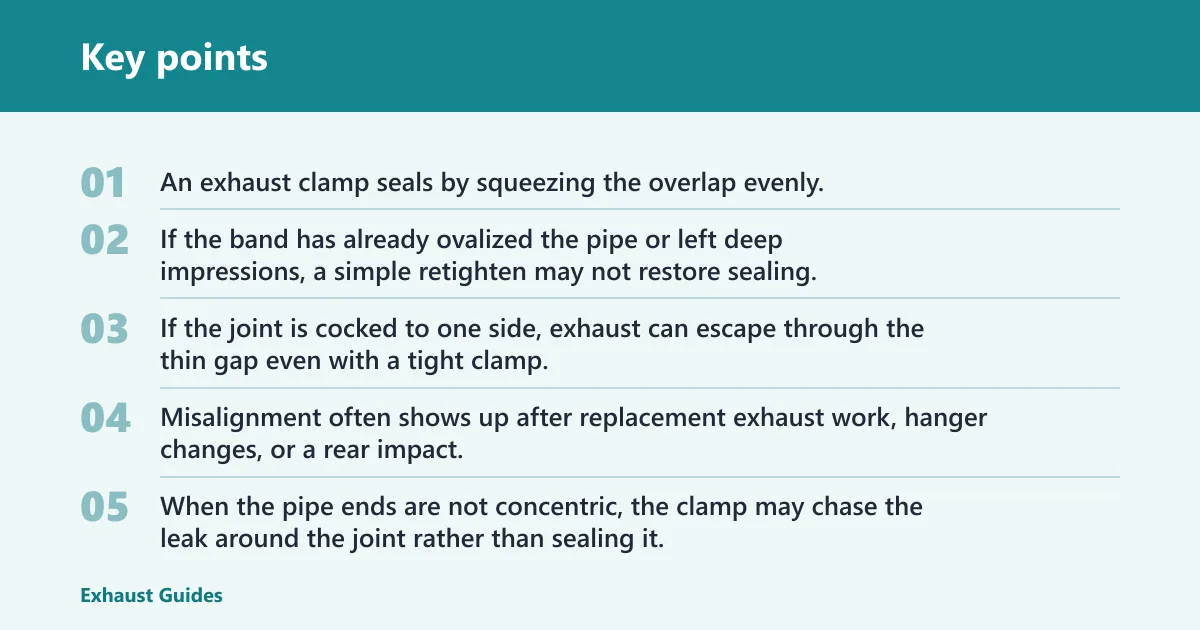
An exhaust clamp seals by squeezing the overlap evenly. If the bolt is loose, the band is bent, or rust has eaten into the clamp, it can pinch one side and leave a path on the other. That uneven pressure can create a hiss, soot trail, or repeat leak after a short drive.
Inspect the clamp for corrosion at the bolt, flattened spots in the band, and any sign that the clamp has been tightened past its useful range. If the band has already ovalized the pipe or left deep impressions, a simple retighten may not restore sealing.
Ovalized slip joints and misalignment
A tailpipe slip joint is a common leak point at the connection between exhaust sections, especially when one section was forced together at an angle. The overlap should be centered and round. If the joint is cocked to one side, exhaust can escape through the thin gap even with a tight clamp.
Misalignment often shows up after replacement exhaust work, hanger changes, or a rear impact. When the pipe ends are not concentric, the clamp may chase the leak around the joint rather than sealing it.
Rust-thinned pipe ends and separated seams
Rust-thinned pipe ends are a hard stop for sealant-based repairs. If the metal at the slip end is flaking, soft, or visibly reduced in thickness, the joint cannot hold compression for long. The same is true when a seam is split wide enough that the pipe flexes under light hand pressure.
Suppose the tailpipe sounds like a tick at idle, but the clamp is already tight and the pipe edge flakes when touched with a pick. That joint is past the point where a paste repair can do much. The better fix is replacement of the damaged pipe end or the affected section.
How do you seal a leaking pipe joint?
Seal a leaking pipe joint only when the gap is small, the pipe ends still have solid metal, and the clamp can squeeze the overlap evenly. High-temperature exhaust sealant can help minor slip-joint leaks, but it is not a structural fix for larger separations, rust holes, or broken hangers.
When clamp tightening is enough
If the joint leaks because the clamp is simply loose, retightening may solve it. Recenter the pipe first so the overlap is even, then tighten the clamp in small increments. If the leak stops and the clamp still sits square, the repair is holding its shape.
Center the joint first. Push the pipes into straight alignment before tightening. A crooked joint can seal poorly even when the clamp is very tight.
Tighten in small stages. Bring the clamp down gradually and recheck the joint between passes. This helps avoid distorting the band and creating a new leak path on the opposite side.
Recheck for soot. Run the engine cold, then inspect for bubbles or fresh soot after a short idle. If the leak remains, the joint likely needs sealant or replacement rather than more force.
When high-temperature sealant can work
High-temperature exhaust sealant fits minor gaps at a slip joint or a small pinhole at the rear section. It should withstand exhaust heat, but it cannot restore metal that has already rusted away. Use it only when the joint still overlaps properly and the clamp can press the surfaces together.
The best sealant for a leaking pipe joint is the one rated for exhaust heat and used within its limits. If the gap is large, the parts move, or the pipe ends are thin, sealant becomes a temporary patch at best. It may stop a hiss for a while and then fail when the system heats and cools again.
When replacement is the only sound repair
Replacement is often the right answer when the joint is badly ovalized, the pipe ends are rust-thinned, the clamp cannot sit square, or the leak returns after cleaning and resealing. Broken hangers also matter, because a hanging exhaust moves enough to reopen a joint that looked sealed on the lift.
How to repair a leaking pipe joint permanently depends on the metal left to work with. If the pipe wall is sound and the fit is only slightly off, clamp correction and sealant may last. If the section is rusted through or separated, permanent repair means replacing the damaged part.
Can water from the tailpipe mean a leak?
Yes, but only in context. Water from the tailpipe can be normal condensation on a cold start, especially when the engine has not fully warmed up. Water becomes a leak clue when it appears with soot, odor, or a rear joint noise that was not there before.
Normal condensation on cold starts
Condensation usually shows as clear droplets or light vapor from the tailpipe tip. It is most common after short trips, humid weather, or long idle periods. On its own, it does not point to a bad joint.
The key question is where the moisture appears. If the water is only at the outlet, the exhaust may be doing normal exhaust things. If the water is along the slip joint, mixed with black residue, or paired with a hiss, the rear connection deserves a closer look.
Water plus soot or noise at the joint
Water, soot, and a rear-end hiss together point away from harmless condensation. Carbon soot trail at the clamp, a crisp tick that is loudest when cold, and a wet mark at the overlap usually mean exhaust is escaping at that joint and carrying moisture with it.
A common first-timer mistake is to see a drip at the tailpipe and assume the whole system is leaking. The location matters. A drip at the tip with no soot is often normal; a drip from the joint with black staining is a repair issue.
Rear leak clues that point to a fault
Rear leak clues include soot on the tailpipe joint, odor near the bumper, a hissing or ticking sound from behind the cabin, and repeat wetness at the overlap after a cold start. If those clues line up, the joint is more likely to be the source than the muffler body or the front of the engine.
When should you stop driving?
Stop driving if exhaust odor enters the cabin, if anyone feels headache, dizziness, or nausea, or if the leak is large enough to change how the car runs. The CDC warns even a small vehicle exhaust leak can cause carbon monoxide to accumulate, so cabin fumes should be treated as a safety problem, not a nuisance.
Cabin fumes and carbon monoxide risk
Carbon monoxide risk matters most when exhaust can drift under the body and into the cabin. A rear leak can still be dangerous, especially if the rear of the car is sealed tightly by a liftgate, hatch, or trunk cavity that traps fumes. If the smell reaches passengers, do not keep driving to “see if it clears.”
Heat, loose parts, and under-vehicle hazards
Loose exhaust parts can shift, touch the body, or separate further with vibration. Heat near a damaged joint can also make inspection unsafe. If a pipe is hanging, rubbing, or close to falling, repair it before road use.
A large pre-turbo leak can reduce energy reaching the turbine, but a rear leak still deserves prompt repair because it can grow, dirty nearby parts, and create a cabin exposure risk. A leak at the tailpipe joint is often repairable early; after heavy corrosion, it becomes a replacement job.
Frequently asked questions
How do I find a leaking tailpipe joint?
Start with a cold inspection of the rear exhaust connection, then look for fresh dry soot, a misaligned clamp, or rust at the slip fit. Use soapy water immediately after startup or a smoke test for smaller leaks. If the noise and soot are only at the rear joint, that joint is the source.
How can I tell if my tailpipe has a pinhole leak?
A pinhole leak often makes a sharp hiss and may leave a tiny soot spot or bubble only when the system is pressurized. Smoke testing is usually better than sight alone for this problem. If the hole is in rust-thinned metal, sealant may hold briefly but replacement is the lasting repair.
What are the signs of a leaking exhaust pipe joint?
Common signs are a cold-start tick, a rear hiss, black soot around the clamp, and exhaust smell near the bumper. Water at the tailpipe can be normal, so it should be judged with the sound and soot together. A rear joint leak usually gets louder before the metal warms and expands.
How do I seal a leaking pipe joint on an exhaust?
Only seal a small, stable gap with a high-temperature exhaust sealant after you align the joint and confirm the metal is still sound. Tighten or replace the clamp first if the leak comes from poor compression. Do not rely on sealant for big gaps, broken hangers, or rust holes.
How to fix a leaking pipe joint without replacing the whole exhaust
If the pipe ends are solid, you may be able to recenter the joint, replace a distorted clamp, and apply exhaust sealant to a small leak. That approach works only when the overlap is intact and the leak is minor. If the pipe is ovalized or thin, replacement of that section is the better fix.
Can a leaking exhaust joint cause water coming out of the tailpipe?
Yes, but water by itself does not prove a leak. Tailpipe condensation is common on cold starts, especially after short trips. If water appears with black soot, a hiss, or odor at the joint, the rear connection is more likely leaking exhaust than showing normal moisture.