Are Turbo Mufflers Legal for Daily Driving?
A turbo muffler is legal for daily driving if the full exhaust stays within your state or city noise limit and keeps every required emissions part in place. Ignore that rule, and you can get tickets, fail inspection, or have to redo the exhaust. This guide explains when turbo mufflers are street-legal, where the risk starts, and how to check fit before you buy or install one.
Turbo muffler basics
A turbo muffler is a muffler with baffled chambers and perforated tubes. It is not related to a turbocharger. The design usually sits in the middle for sound, quieter than a straight-through muffler, less muted than many stock replacements, and aimed at street-driven use rather than maximum flow at any cost.
The internal path matters. Exhaust gas is redirected through chambers, which cuts noise and changes tone without relying on fiberglass packing. That creates a moderate sound level and a flow-versus-noise tradeoff that many daily drivers can live with.
How the chambers work
Turbo mufflers use a series of internal turns and openings to break up exhaust pulses. The perforated tubes let gases move through while the chambers cancel some of the sharp sound. More restriction usually means less volume, while less restriction usually means more sound and more flow.
Because the muffler body does the work, a turbo muffler does not depend on packing material the way a glasspack does. That usually helps it hold a more stable sound over time.
Are turbo mufflers legal for daily driving?
Turbo mufflers are often acceptable for daily driving if the exhaust still meets local noise and inspection rules. A turbo muffler by itself is not the legal question; the real question is whether the car stays within the noise limit, keeps required emissions parts, and passes any inspection tied to the vehicle code.
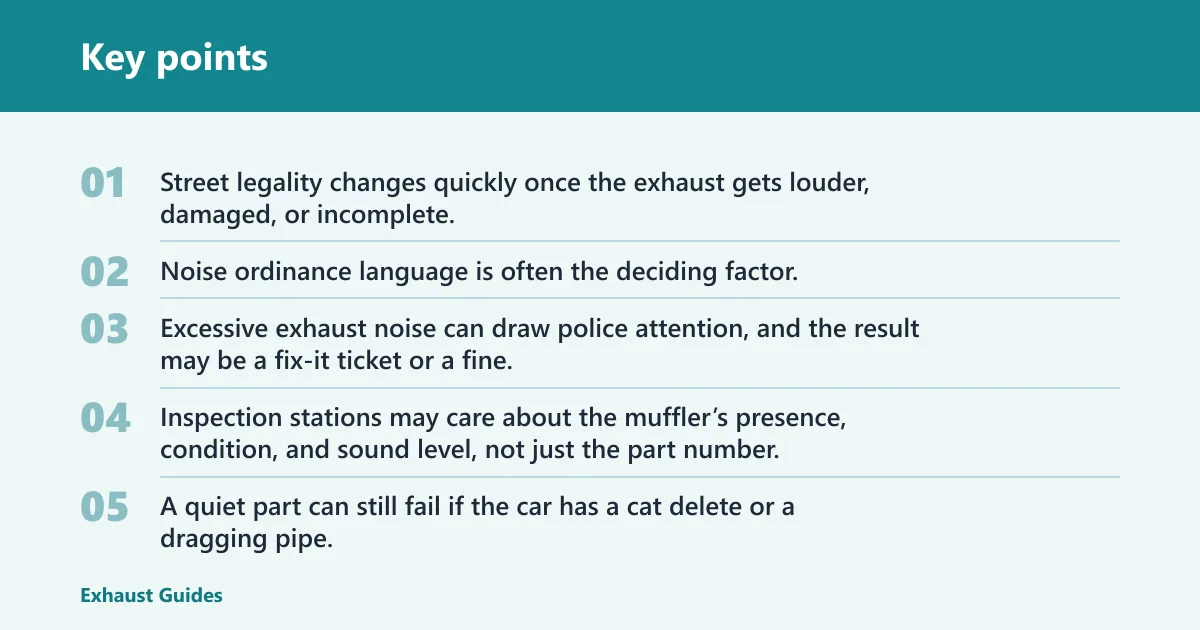
Street legality changes quickly once the exhaust gets louder, damaged, or incomplete. A turbo muffler that sounds moderate on one car can still be illegal on another if the rest of the system is modified, missing, or too loud for the area.
Why local noise rules matter
Noise ordinance language is often the deciding factor. Excessive exhaust noise can draw police attention, and the result may be a fix-it ticket or a fine. Arizona is one example of a state where vehicle noise enforcement can be strict, but the exact limit and enforcement method still depend on the local rule set and the vehicle type involved.
When inspection rules change the answer
Inspection stations may care about the muffler’s presence, condition, and sound level, not just the part number. If the car must pass a visual or sound-based inspection, a turbo muffler is only acceptable if the complete exhaust is intact and within the standard used in that area.
What street-legal usually depends
For daily driving, “street-legal” usually depends on three things: the noise limit, whether emissions equipment is still installed, and whether the exhaust is secure. A quiet part can still fail if the car has a cat delete or a dragging pipe.
Turbo muffler vs. other muffler types
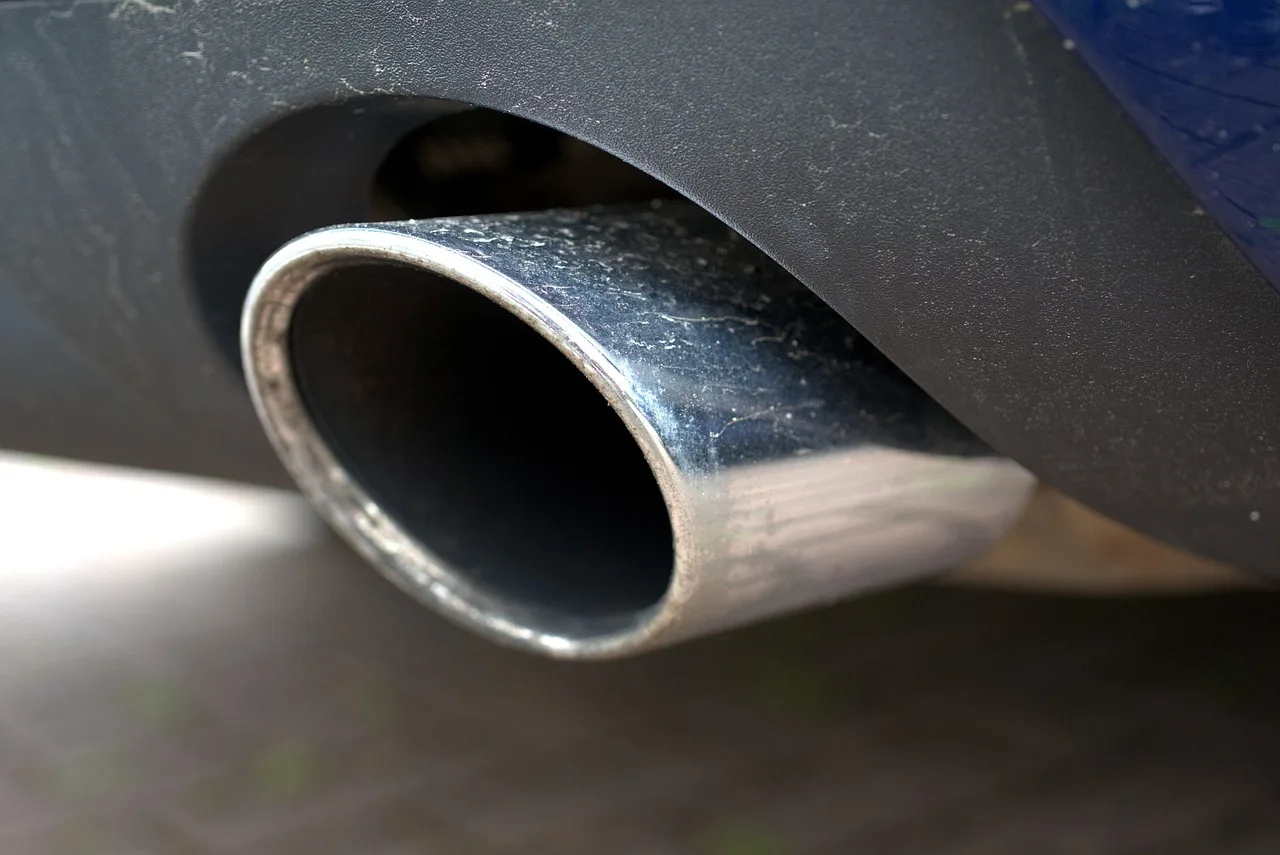
Turbo mufflers sit between comfort and output. Chambered mufflers use a series of internal baffles and chambers and are often recommended for daily drivers wanting a deeper tone without excessive volume. Straight-through mufflers use a perforated core with packing material and are usually the loudest option. Glasspacks use fiberglass packing inside a metal shell and tend to sound raspy.
| Type | Sound and flow | Daily-driving note |
|---|---|---|
| Turbo muffler | Moderate sound at approximately 92dB; baffled chambers and perforated tubes | Often the best all-around sound for street-driven vehicles |
| Chambered muffler | Deeper, mellow tone; more restrictive than straight-through designs | Good for drivers who want lower volume and less drone |
| Straight-through muffler | Loudest option at approximately 105dB; best flow, minimal restriction | May not be street-legal in all areas |
| Glasspack muffler | Raspy sound; fiberglass packing can burn out over 6-18 months of regular use | Budget performance option, but sound can get louder as packing degrades |
Chambered vs. turbo muffler
Chambered mufflers are usually the better pick if the goal is a deeper tone with less chance of harsh volume. Turbo mufflers still fit many commuter cars well, but chambered designs usually lean a little further toward calm daily use. Both are more street-friendly than a straight-through setup in many neighborhoods.
Straight-through vs. turbo muffler
Straight-through mufflers favor flow and usually give up more noise control. That can work for track-oriented builds, but the louder result is more likely to cause daily-driving problems. If the car must stay compliant on the street, a turbo muffler is usually the safer choice.
Glasspack vs. turbo muffler
Glasspacks are cheaper and louder, but the fiberglass packing can wear out over time. As that packing degrades, the exhaust often gets louder and raspier. A turbo muffler is usually more predictable for a commuter that needs to stay near the same sound level.
When a turbo muffler is a good daily-driver choice
A turbo muffler is a strong fit for stock replacement, mild street builds, and commuter cars that need lower volume without shutting off flow completely. It is also a reasonable option when the goal is to pass noise ordinances while keeping the exhaust less restrictive than a very quiet factory-style setup.
Turbo mufflers are often the best all-around sound for street-driven vehicles. They are best for street performance builds that need to pass noise ordinances, especially when the rest of the exhaust remains legal and in good condition.
Stock replacement use
If the original muffler is rusted, cracked, or too loud, a turbo muffler can be a practical replacement. The key is fitment and compliance, not just sound. Match inlet and outlet sizes, body length, and hanger position before buying.
Adding a resonator for lower drone
Pairing a turbo muffler with a resonator can reduce cabin drone without forcing the system into an overly quiet setup. That matters on highway commuters, where drone often becomes the real complaint long before outside noise does.
Milder street builds
For a mild performance build, a turbo muffler usually gives a better balance than a straight-through unit. It lets you keep some tone without pushing the car toward the louder edge that can trigger a stop or an inspection problem.
When legality gets risky
Legality gets riskier when a turbo muffler is part of a louder or incomplete exhaust system. The part itself may be fine, but a cat delete or an open section can put the car over the local limit. That is where a street-friendly muffler can still become a problem.
Suppose a commuter sedan gets a turbo muffler, but the catalytic converter is removed and the midpipe is shortened. Even if the muffler is moderate on its own, the full system may now be too loud or may fail emissions-compliance rules for street use.
Turbo muffler with a cat delete
A cat delete can increase legal risk. Noise rises, emissions compliance becomes a separate issue, and some areas treat the whole setup as illegal regardless of the muffler choice. A turbo muffler does not cancel out missing required emissions equipment.
Very loud exhaust combinations
If the turbo muffler is paired with headers or a short exhaust exit, the total sound can climb well past a legal limit. Loudness is judged at the vehicle level, not by the muffler name alone.
Daily commuters that fail inspection
A daily driver that passes sound on the street can still fail inspection if the system is incomplete, loose, or too modified for the local standard. Some areas check for secure mounting, required emissions parts, and obvious damage before they even consider the noise issue.
Turbo muffler compliance checklist
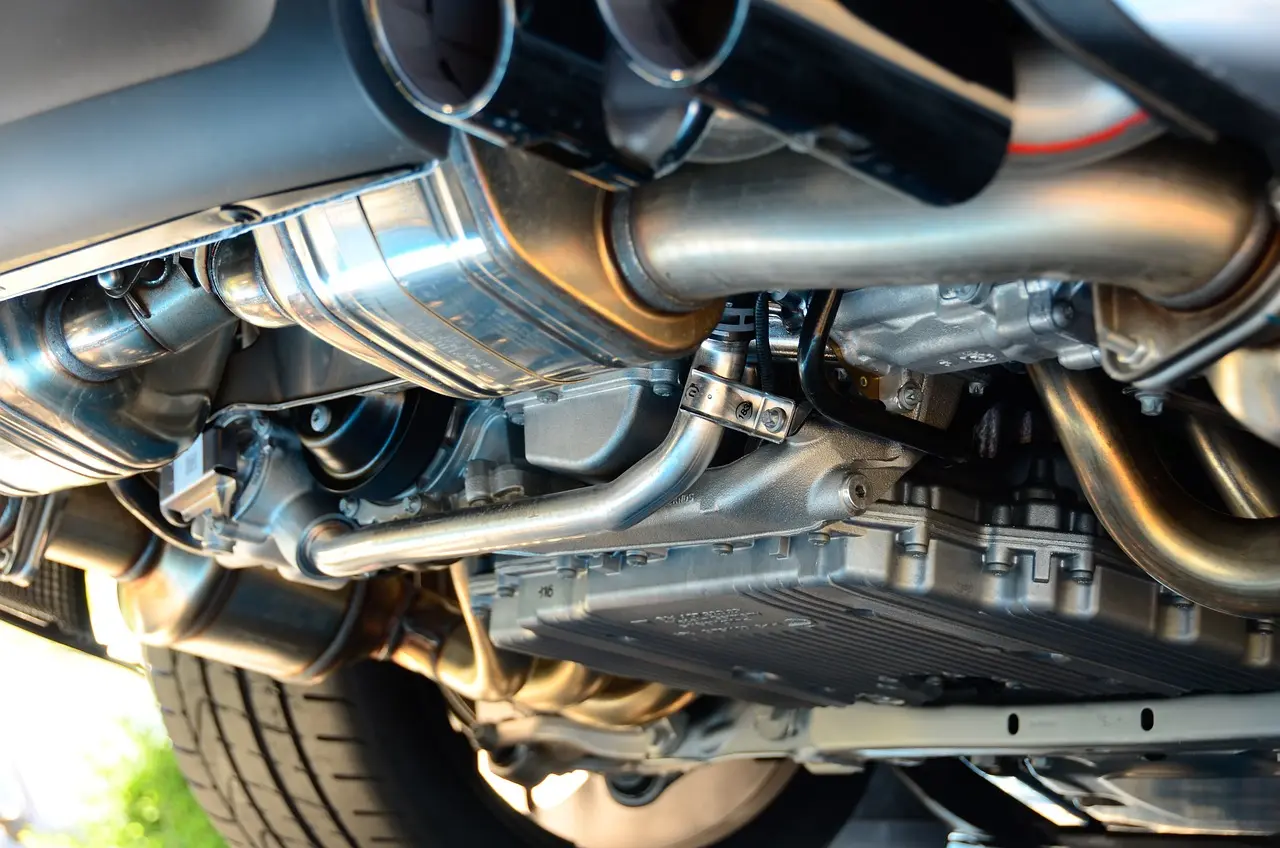
Use this checklist before you buy or install a turbo muffler. It separates legal risk from performance preference and helps you avoid a setup that looks fine on paper but fails on the road.
Check local noise rules. Look up the city ordinance and state vehicle code language for exhaust noise. If the area uses a decibel limit, check how that limit is applied and remember that the full exhaust, not the muffler alone, is what gets judged.
Confirm inspection requirements. Make sure your area does not require a stock-style muffler, intact catalyst, or a visual inspection for missing parts. If the car needs periodic inspection, a legal street setup today may still fail later if the rules are tighter than expected.
Verify emissions parts. Do not treat a turbo muffler as a substitute for a catalytic converter where that part is required. Required emissions equipment must stay in place, or the car can be illegal even if the sound level seems reasonable.
Inspect the mounting points. Check hangers, brackets, and clamps before install. Weak support can let the muffler drag, shift, or detach, which creates both a safety issue and a likely legal problem.
Measure the fitment. Match inlet and outlet size, body length, and clearance to nearby suspension and underbody parts. Poor fit can cause rattles, contact, or a low-hanging exhaust that fails inspection or gets damaged on the road.
Plan for drone control. If the car spends a lot of time on the highway, consider a resonator or a quieter muffler choice. A setup that sounds fine at idle can still be tiring at cruise if the cabin drone is high.
Can you drive with a bad or missing muffler?
You should not treat a bad or missing muffler as a normal daily-driving condition. A broken, detached, or dragging exhaust can be unsafe, can expose the cabin to exhaust fumes, and can bring legal attention because the car may become excessively loud or obviously defective.
Broken hangers, brackets, and clamps
Muffler hangers, brackets, and clamps are common failure points. If they crack or loosen, the muffler can sag low enough to scrape the road or detach entirely. Once that happens, the issue stops being only noise and becomes a road-safety problem.
Detached exhaust and carbon monoxide risk
Missing sections or leaks can let exhaust fumes enter the cabin. Carbon monoxide is odorless and invisible, so you cannot rely on smell alone. Driving without a muffler is not safe, and exhaust damage can turn into a health hazard very quickly.
A common first-timer mistake is thinking a loud exhaust just means a performance gain. If the muffler hangs loose and the car suddenly sounds much louder than before, the problem may be a failed hanger or detached section, not a legal tuning choice.
Why a loud failure can become a legal issue
A sudden jump in volume can draw police attention and lead to a fix-it ticket or a fine. That is especially true if the exhaust is visibly hanging down, missing a section, or obviously not attached the way it should be.
What to verify before you buy or install
Before installation, check the rule set, the condition of the rest of the exhaust, and the exact fit. That is the fastest way to avoid buying a muffler that sounds right but fails the legal or mechanical check.
Read the local code. Verify the noise limit, any muffler requirement, and whether your area bans modified exhausts above a certain level. Some jurisdictions care about sound alone; others care about missing equipment or visible modifications too.
Check inspection and emissions rules. Confirm whether your daily commuter needs a catalytic converter or a specific muffler condition to pass. If the car is due for inspection soon, buy for compliance first and sound second.
Inspect the whole system. Look for cracked pipes, loose clamps, bad hangers, and rusted brackets before adding a new muffler. A new part will not fix an unsafe or illegal exhaust that is already failing elsewhere.
Confirm clearance and support. Make sure the muffler body will clear suspension movement, heat shields, and the ground. A secure exhaust is less likely to fail, rattle, or attract attention on the street.
Frequently asked questions
Is a turbo considered a muffler?
No. A turbocharger is an engine-boosting part, while a turbo muffler is an exhaust-noise control part. The names sound similar, but they do different jobs. A turbo muffler uses baffled chambers and perforated tubes to reduce sound.
Are muffler deletes legal?
Muffler deletes can be illegal for street use, depending on local rules. A muffler delete can violate local noise rules even if the car still runs fine. The answer depends on your area’s code, inspection rules, and whether the exhaust stays within the legal sound limit.
Can I drive with a bad muffler?
You can physically move the car, but it is a bad idea. A damaged muffler can be loud, unsafe, and more likely to fail inspection. If the exhaust is hanging, leaking, or dragging, the problem is both legal and mechanical.
Is it illegal to have no muffler?
In many places, yes. A no-muffler setup often breaks local noise rules and can create safety concerns from exhaust leaks or missing parts. Even where enforcement is lighter, a loud or incomplete exhaust can still bring a ticket or inspection failure.
What makes a muffler legal for street use?
Street use usually depends on the full setup meeting local noise limits, keeping required emissions parts, and staying securely mounted. A legal muffler on one car may not be legal on another if the rest of the exhaust is louder or altered in a restricted way.
Can you drive with a broken muffler?
It is not a good idea. A broken muffler can detach, drag, or leak exhaust into the cabin, and carbon monoxide is an invisible hazard. A loud breakage can also attract police attention and lead to a fix-it ticket or fine.
Are muffler deletes legal uk?
Not automatically. In the UK, exhaust noise and roadworthiness rules still apply, and a delete that makes the car too loud or unsafe can fail inspection or draw enforcement. The answer depends on the vehicle’s noise level and overall compliance, not the part name alone.
Chambered vs turbo muffler: chambered mufflers usually give
Chambered mufflers usually give a deeper, mellower tone and are often a good choice for daily drivers wanting less volume. Turbo mufflers are also street-friendly and often around moderate sound, but they are usually a bit more neutral in tone and use baffled chambers with perforated tubes.
Is it illegal to remove your muffler?
Often yes, if the removal makes the vehicle too loud or violates equipment rules. Removing the muffler can also make the car less safe if the exhaust is left unsupported or incomplete. Check the local noise law and inspection standard before changing the system.
Are muffler deletes illegal?
They can be. Many places focus on noise, so a delete that pushes the car beyond the local limit is a problem even if the engine runs normally. Legal status depends on where you drive, how loud the car is, and whether the system remains complete.