Street Legal Exhaust Guide
By Daniel Cho, technical editor. This guide uses the same verification sequence inspection programs and roadside enforcement usually follow: emissions equipment first, state-required exhaust equipment next, then local noise rules and test methods. The focus is on checking labels, part numbers, approval records, inspection manuals, and code language before you buy or install.
A street-legal exhaust generally has to clear federal emissions rules, your state’s vehicle-equipment law, and the noise rules where you drive, park, or get stopped. Labels such as “49-state legal,” “for off-road use,” and “race only” often give you a first clue about legality before you buy. Miss this and you can face a failed inspection, a fix-it order, fines, denied warranty coverage, or an emissions-tampering violation. This street legal exhaust guide shows you how to classify your setup, verify labels and part numbers, and check the right layer of law before you buy, install, or drive.
What makes an exhaust street legal?



A street legal exhaust must comply with federal emissions law, your state’s equipment rules, and any local noise code that applies where the vehicle is used. Quiet alone is not enough, and passing one inspection lane does not help if another rule still bans that setup.
The three law layers to check in order
Start with federal emissions compliance. This is where catalytic converters, emissions-device tampering, and aftermarket approval claims matter most. A quiet car can still be illegal if the catalytic converter was removed, replaced with a nonapproved part, or defeated through tuning and hardware changes. The controlling federal rule is the Clean Air Act’s anti-tampering provision, 42 U.S.C. § 7522(a)(3), enforced by EPA.
Next comes state equipment law. Many states regulate whether a street vehicle must have a working muffler, whether bypasses or cutouts are banned, and whether the exhaust can be modified to increase noise beyond what state law allows. Examples include California Vehicle Code § 27150 and New York Vehicle and Traffic Law § 375(31).
Then check local noise rules. Cities and counties often enforce their own noise ordinances, and those rules can be stricter than state law. The code may set a decibel cap, require an RPM-based sound test, measure at a set distance, or use a broader standard such as “excessive” or “unusual” noise. Real-world examples include Denver Revised Municipal Code noise limits and New York City Noise Code provisions.
Why vehicle type and modification type change the answer
Street legal exhaust status depends on what you drive and what changed. A car, diesel pickup, and motorcycle can face different equipment rules, inspection procedures, and enforcement patterns. A muffler swap usually raises noise questions first. A high-flow cat or header change usually raises emissions questions first.
The actual setup matters more than the marketing label. In practice, it helps to sort a system into original exhaust, cat-back, muffler removal, straight pipe, and cutout/bypass. That tracks how regulators enforce the rules: EPA and CARB focus first on emissions devices and tampering, while state codes and municipal ordinances focus heavily on mufflers, bypass devices, and noise output.
Street legal versus “good enough until stopped”
Some exhausts avoid attention for months, then fail inspection or draw a citation after a roadside stop. That does not make them street legal. A system can sound restrained and still violate emissions law. Another can keep the catalytic converter intact yet still break state muffler law or a local noise ordinance.
Which parts change legality first?
The parts that change legality first are usually the muffler, any bypass or cutout, and the catalytic converter. Muffler changes usually affect noise and equipment rules first, while catalytic-converter changes bring emissions risk first. Cat-back and axle-back systems fall between those points and still need proof, not assumptions.
Mufflers and resonators are noise-control parts
A muffler is the main noise-control component in many street exhaust systems. Many street vehicles are required to have one, even if the law does not demand the factory-original design. Common styles include OEM, aftermarket, straight-through, chambered, and turbo style mufflers.
Straight-through mufflers often flow more freely and may raise sound output. Chambered and turbo designs control sound in different ways. None of those designs is automatically legal or illegal on its own. The real question is whether the installed part keeps the vehicle within the laws that apply to that vehicle class and location.
Catalytic converters are where federal risk starts
The catalytic converter is an emissions-control device. Removing it, gutting it, replacing it with an uncertified part, or altering related hardware can create legal problems even if the vehicle stays fairly quiet. This is the failure case many buyers miss: a quiet exhaust can still be illegal because the emissions equipment is wrong.
High-flow cats need closer review than many listings suggest. A seller’s “performance” claim does not show that the part is approved for public-road use on your exact year, engine, and application. EPA’s aftermarket catalytic converter policy and CARB’s aftermarket parts program both require application-specific compliance, not generic “street legal” language.
Why cat-back, axle-back, and straight pipe labels are not enough
A cat-back system changes the exhaust after the catalytic converter. An axle-back changes the rear section only. Those labels describe location, not legality. A cat-back can still violate noise law, fail an equipment check, or include undocumented welding and deleted resonators that change the result.
A straight pipe setup removes major sound-control components and often emissions hardware too. That usually raises both noise and emissions risk at once. If a listing says “track legal” or “drag legal,” treat that as a racing-use claim, not a street-use approval.
How to classify your exhaust setup before you check laws
Classify the exact hardware first, then match it to the law layer it is most likely to trigger. That usually saves time because a muffler delete points you to state equipment law and local noise rules, while a high-flow cat points you to EPA, CARB, and inspection-program approval requirements.
Start with the exact change, not the product category
Classify the setup in plain terms before reading any law: stock replacement, aftermarket muffler, axle-back, cat-back, high-flow cat, muffler delete, straight pipe, or mixed used system. Then note whether the catalytic converter is still present, whether the muffler is still present, and whether any bypass, cutout, or valve can route exhaust around those parts.
This matters because the first legal question is usually obvious once the setup is named correctly. Stock replacement usually points to fitment and equipment presence. Muffler delete points to noise and state equipment law. High-flow cat points to emissions approval. Straight pipe points to both.
Watch for mixed systems and secondhand changes
Used exhausts often no longer match the original listing. A prior owner may have cut out a resonator, welded in a different rear section, or mixed an approved front pipe with an unapproved muffler section. Missing tags, altered welds, and seller statements without part numbers are warning signs.
Say your used cat-back arrives with polished cans, but the mid-pipe shows a fresh weld where a resonator used to be. The product category is still “cat-back,” but the real setup is now a modified cat-back with an undocumented noise change. That changes what you need to verify first.
Cars, trucks, and motorcycles are checked differently
Cars and light trucks often go through inspection lanes that combine visual equipment checks, readiness-monitor checks, and noise enforcement by police or local code officers. Motorcycles may draw more roadside attention for sound and equipment, especially where riders change only the mufflers.
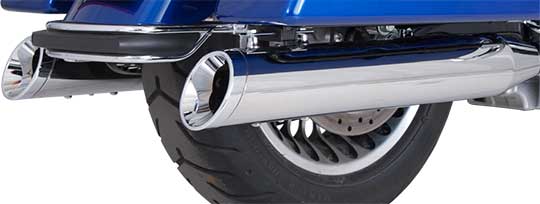
For motorcycles, buyers also need to separate slip-ons from full systems. A slip-on usually changes the rear muffler section, while a full system reaches farther upstream and is more likely to affect emissions hardware, catalyst location, heat shields, and labeling. EPA motorcycle emissions rules, California anti-tampering rules, and state muffler statutes make that distinction important even before sound is measured.
A practical example is California versus Texas. In California, an emissions-related exhaust change can raise CARB and inspection questions quickly. In Texas, the immediate issue for many roadside stops is often whether the vehicle still has a muffler and whether the exhaust has become “excessive or unusual” under Transportation Code § 547.604, even before anyone discusses a formal sound reading.
Can you legally drive without a muffler or with a muffler delete?
Usually, that is where trouble starts. Many states require a functioning muffler on street vehicles, and a muffler delete can raise noise enough to draw local enforcement. Even where the wording is broad, a deleted muffler can lead to citations, inspection failure, or a fix-it order based on equipment law.
What a muffler delete changes
A muffler delete removes the muffler and replaces it with straight pipe or a simpler section of tubing. That commonly raises exhaust volume and changes tone. On many vehicles it also removes an item that state equipment rules expect to be present and working.
That is why muffler deletes create two separate risks. First, they often violate a state requirement for a muffler or for a noise-control device that prevents excessive sound. Second, they make local noise enforcement easier because the vehicle is more likely to draw attention. California Vehicle Code § 27150, Texas Transportation Code § 547.604, and similar statutes in many states all work this way.
When a quieter setup can still be noncompliant
Some vehicles stay relatively subdued after a muffler change because of turbocharging, long piping, or a retained resonator. That does not settle the legal question. If the state requires a muffler and it is gone, a quiet result may still be noncompliant on equipment grounds.
Suppose a turbocharged 2.0-liter sedan keeps both catalytic converters and the rear resonator, but the owner deletes the center muffler. Idle may sound mild. A visual inspection can still flag the missing muffler if the jurisdiction requires one, even before any meter comes out.
How loud can an exhaust be before it becomes illegal?
There is no single national exhaust number. An exhaust becomes illegal when it exceeds the sound standard that applies in that place and under that test method, or when it violates a broader “excessive noise” rule. The measurement procedure matters as much as the decibel figure printed in a code table.
Decibel limits are only half the rule
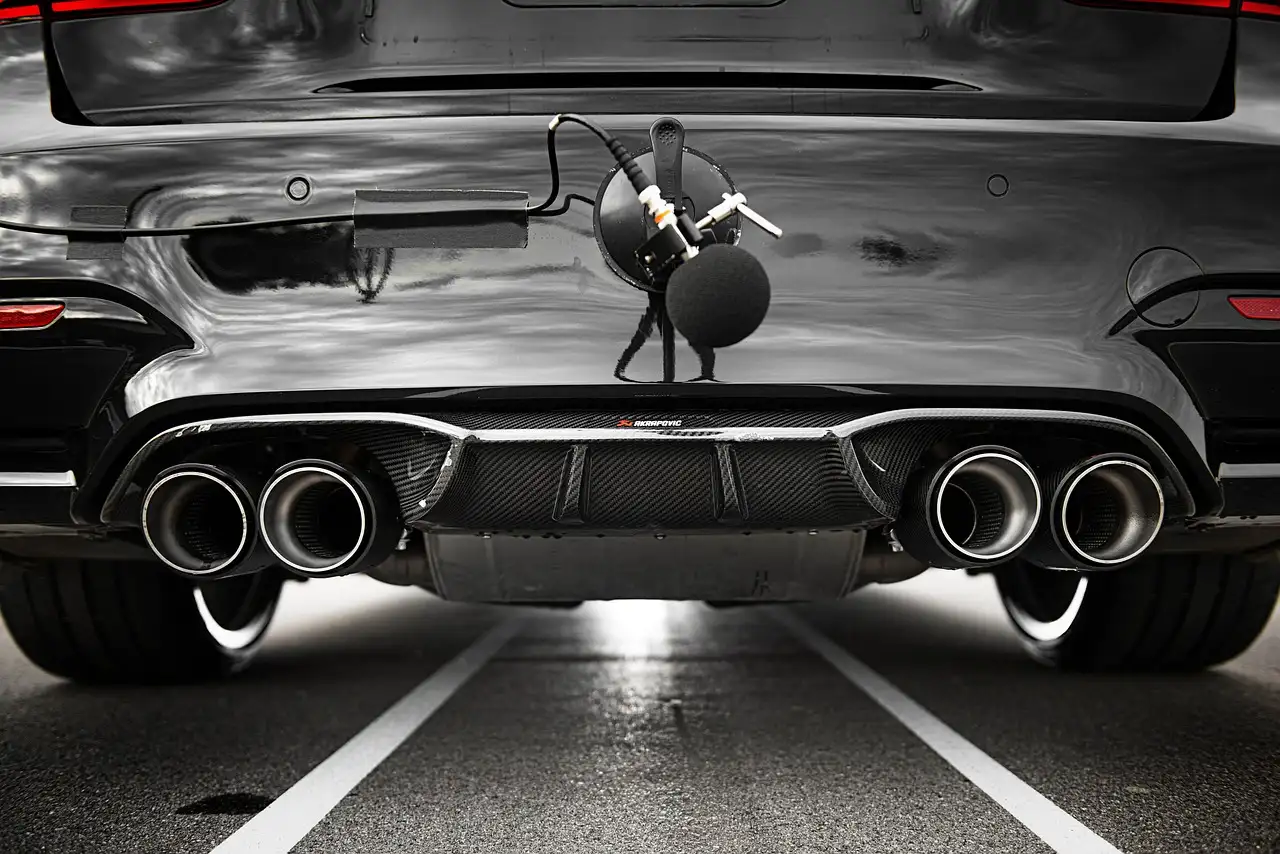
A decibel threshold only matters with the required measurement procedure. That point gets missed all the time. A listed limit means little unless the code also defines engine speed, vehicle condition, microphone distance, test surface, and whether the reading is taken at idle, under load, or at a set RPM. California’s vehicle-noise enforcement framework and many municipal codes spell this out in detail.
That is why generic claims like “under the legal dB limit” are weak without the test method. A part can seem quiet in a driveway rev clip and still fail a formal test performed at a specified RPM and distance.
State rules and local noise ordinances can conflict
A state may allow enforcement through a broad excessive-noise standard, while a city uses a stricter ordinance with a numeric cap. The reverse can happen too: state law may specify one method while a local code officer uses an equipment or nuisance standard for enforcement.
Local rules may use decibel limits, RPM tests, or distance-based measurement. That is why the same setup can appear acceptable at the state level yet still draw a municipal citation. A street legal exhaust has to clear both layers where both apply.
Vehicle class can change the available test path
Not every jurisdiction offers the same test for every vehicle. California’s Bureau of Automotive Repair Referee vehicle-noise process is limited by vehicle eligibility and test method, which is why a passenger car and a heavier truck may not follow the same path. Before relying on a quoted decibel number, confirm the applicable state or local procedure for that vehicle class.
Will inspection or emissions testing fail your exhaust?
Yes, a modified exhaust can fail inspection in several ways: missing required equipment, visual signs of tampering, readiness-monitor problems, or a direct noise or safety issue. Passing one part of inspection does not clear the rest. Loud-but-emissions-compliant and quiet-but-emissions-noncompliant are different failure cases.
Visual checks, readiness checks, and tampering rules
Inspection programs vary, but the common checkpoints are easy to map. Some lanes perform a visual check for equipment presence. Some check readiness monitors and fault codes. Some rely more on anti-tampering standards, smoke opacity, or function-based emissions criteria. Some include sound or refer obvious noise violations to separate enforcement.
A muffler delete may fail because the muffler is absent. A straight pipe may fail because both the muffler and catalytic converter are missing. A high-flow cat setup may fail because the converter lacks the approval required for that vehicle application, even if no check-engine light is present. States with formal anti-tampering rules, such as California, and inspection guidance, such as New York DMV materials, make this especially clear.
Does a loud muffler fail inspection?
A loud muffler can fail inspection if the program checks for excessive noise, requires an effective muffler, or treats the installed part as an equipment violation. Even where inspection does not meter sound, a clearly loud setup can still lead to a roadside citation or a repair order under state or local law.
Performance branding does not change that. An aftermarket muffler can be legal, or it can fail on sound, missing proof, or a state rule that bars modified mufflers from increasing noise beyond an allowed standard.
Will a muffler delete fail emissions testing?
A muffler delete does not automatically fail every emissions test by itself, because the muffler is mainly a noise-control part, not the catalytic converter. But it can still fail inspection where the program includes equipment checks, tampering review, or state rules requiring a muffler. If catalytic-converter changes are also present, emissions failure risk rises fast.
This is where shoppers get tripped up. A lane may pass tailpipe or readiness criteria yet still reject the car for missing required equipment. Passing emissions alone does not make the full exhaust street legal.
What does “50-state legal” actually mean?

“50-state legal” should mean the exhaust meets emissions requirements nationwide for the covered application and does not conflict with state equipment rules, but the label helps only if the claim is backed by proof for your exact vehicle and part. It is not the same as universal legality in every city, inspection lane, or mixed-part installation.
What the marketing phrase covers and what it does not
As a practical matter, a true nationwide claim is a high bar. It does not mean every version of a product line qualifies, and it does not mean a used, modified, or incomplete version still qualifies after welding, missing inserts, or mixed components. EPA and CARB both regulate by part, application, and configuration, not by vague product-family language.
It also does not mean the system is automatically lawful under every local ordinance. A city can still enforce a stricter noise rule if the vehicle exceeds that local standard when tested under the local method.
EPA Executive Order and CARB Executive Order checks
For emissions-related aftermarket claims, proof matters more than ad copy. At the federal level, EPA prohibits tampering and regulates aftermarket catalytic converters; in California, CARB’s Executive Order process governs many emissions-related aftermarket parts. If a part is sold as race use, track use, or off-road use, that usually answers the street-use question unless the seller can provide valid road-use documentation for your exact application.
California and other CARB-style jurisdictions add another layer. Buyers in those states should verify that the CARB EO is current, active, and matched to the exact vehicle, engine family, and part number. For a concrete example, a converter approved for one Honda engine family or one truck calibration does not automatically carry over to another trim, model year, or emissions group.
How to match an EO to the exact application
- Get the full part number from the box, tag, stamping, or invoice.
- Confirm the vehicle year, make, model, engine, and emissions family details if listed.
- Check whether the approval covers only certain trims, transmissions, or engine calibrations.
- Confirm the approval is current, not expired or superseded.
- Make sure the installed system matches the approved configuration, including catalytic-converter position and included components.
If the seller can only say “it’s 50-state legal” but cannot produce the approval number, application chart, or original labeling, treat the claim as unverified.
Decision checklist: verify your setup before you buy or install
Use the modification type to decide what proof to demand first. That keeps the process efficient: muffler and cutout changes usually start with state equipment law and local code, while converter changes start with EPA, CARB, and inspection-program documentation.
Use this table to identify the first proof to demand
| Modification type | Likely law layer affected | What proof to verify first |
|---|---|---|
| Muffler delete | State equipment law and local noise ordinance | Whether your state requires a functioning muffler; whether local code uses a decibel, RPM, distance, or excessive-noise standard |
| Cat-back | Local noise ordinance first, then state equipment law | Exact part number, included components, sound-control parts retained, and any inspection rule on modified mufflers |
| Axle-back | Local noise ordinance and state equipment law | Whether the axle-back retains a compliant muffler design and whether the listing is for street use rather than track use |
| Straight pipe | Federal emissions, state equipment law, and local noise ordinance | Presence of catalytic converters and mufflers; any off-road or race-only marking; inspection rules on missing equipment |
| High-flow cat | Federal emissions and CARB-state emissions law | EPA EO or CARB EO status, exact vehicle application, and whether the approval is current and active |
| Aftermarket muffler | State equipment law and local noise ordinance | Street-use labeling, exact muffler design, and whether state law bars noise increase or requires an effective muffler |
| Motorcycle exhaust | State equipment law, local noise ordinance, and emissions law depending on system type | Whether it is a slip-on or full system, current approval documents if emissions-related, and local sound enforcement method |
How to use the checklist in practice
Read across the row for your exact setup, then verify the first proof before spending money. Do not start with brand reputation or forum comments. Start with the law layer the modification is most likely to trigger.
If the seller cannot provide labels, EO numbers, or documents, the safe assumption is that the claim is unproven. That matters most for high-flow cats, race-marketed systems, secondhand full systems, and any part missing its original tags or stamps.
How to verify used, secondhand, and track-marketed exhaust parts
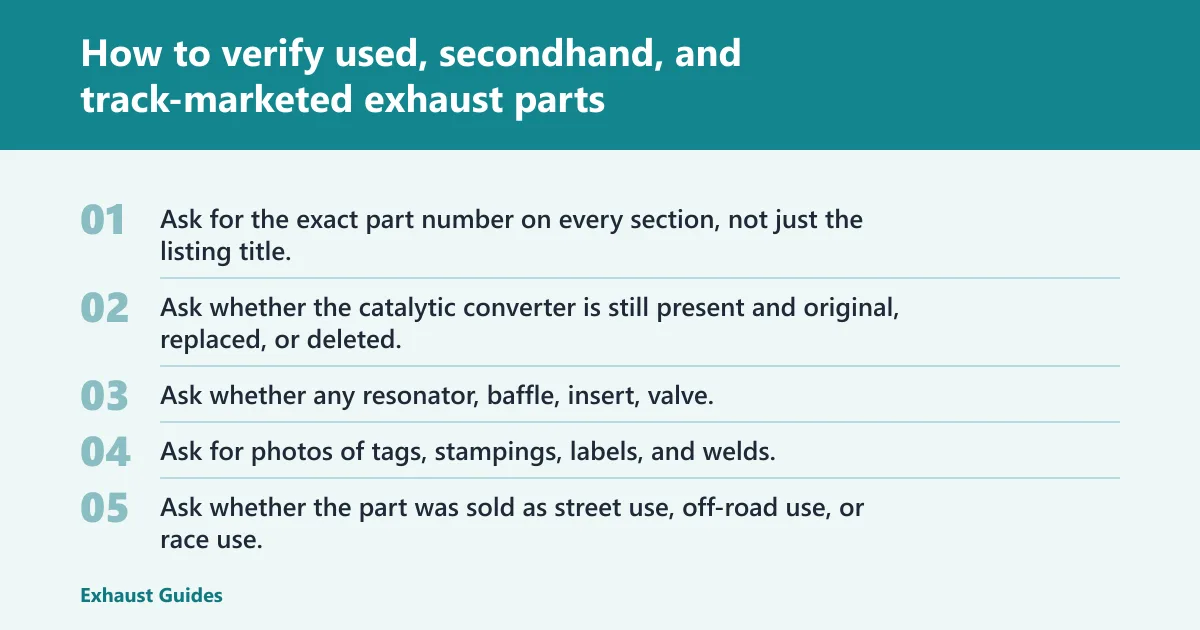
Used exhaust parts are where buyers most often lose the paper trail. Verification usually comes down to four things: exact part number, intact labels or stampings, evidence that no emissions or noise-control parts were removed, and a code check for the state and city where the vehicle will actually be driven.
Missing tags, welded changes, and mixed-brand systems
Used exhausts fail verification for simple reasons: no label, no part number, no invoice, missing insert, altered pipe diameter, or a weld where a section was removed. Any of those can break the chain between the claimed legal product and the part now sitting on the floor.
A common first-timer mistake is buying a “street legal” muffler secondhand because the canister still has a logo. The logo proves branding, not legal status. The proof that matters is the exact part number, the original product description, and any approval or application document tied to that number.
Track-only, race-only, and drag-legal do not prove street use
Track-legal means the part is accepted for track activity, not public-road use. Drag-legal means it meets a racing venue’s rules, not emissions or municipal street-noise rules. Off-road use language points the same way: it warns that road-use approval is missing or limited.
That is the practical point here. “Race only” language may be fine for a closed-course build, but it is bad evidence for a street bike or daily-driven truck. EPA tampering guidance and CARB aftermarket-parts rules both treat racing-use claims very differently from approved street-use applications.
A pre-purchase proof workflow for marketplace deals
- Ask for the exact part number on every section, not just the listing title.
- Ask whether the catalytic converter is still present and original, replaced, or deleted.
- Ask whether any resonator, baffle, insert, valve, or muffler section was removed or welded over.
- Ask for photos of tags, stampings, labels, and welds.
- Ask whether the part was sold as street use, off-road use, or race use.
- Match any EPA EO or CARB EO to the exact vehicle application if emissions-related.
- Check your state inspection rules and your city or county noise code before install.
If any answer is missing, the risk goes up. If several answers are missing, the part should be treated as unverified no matter how common the model is online.
For motorcycle buyers, separate slip-ons from full systems before anything else. Slip-ons change hands often in private-party listings because they are easy to swap and often keep the rest of the system in place. That convenience does not answer the legality question. It only means the part changes hands often and documentation gets lost.
Frequently asked questions
Are muffler deletes illegal in my state?
They often are, but the exact reason varies. Some states require a functioning muffler as equipment. Others focus on excessive noise, modified exhaust restrictions, or inspection standards. Check state equipment law first, then local noise rules, because a muffler delete commonly triggers both even before emissions issues are considered.
Can you drive without a muffler legally?
Sometimes the answer is no on equipment law alone, even if the vehicle is not extremely loud. Many street vehicles are expected to have an effective muffler. If the muffler is missing, a city noise code or an inspection program can create a second violation path on top of the state rule.
Does a loud muffler fail inspection?
It can. Inspection failure may come from an excessive-noise rule, a requirement for an effective muffler, or a broader equipment standard. Even where inspection does not meter sound, a loud setup can still draw roadside enforcement under state law or a municipal noise ordinance.
Will a muffler delete fail emissions testing?
Not always by emissions measurement alone, because the muffler is mainly for noise control. But a muffler delete can still fail inspection where the program checks required equipment or flags modified exhausts. If catalytic-converter changes happened too, both emissions and equipment failure become more likely.
What is the difference between a street legal exhaust and a 50-state legal exhaust?
A street legal exhaust is legal for road use only if it meets the rules that apply where the vehicle is driven, including local noise law. A 50-state legal exhaust is a broader compliance claim that still needs proof for the exact part and vehicle, not just a label.
Do I need to check local noise ordinances too?
Yes. Local noise ordinances can be stricter than state rules and may use different test methods, including decibel caps, RPM-based tests, distance measurements, or broad excessive-noise language. A setup that looks acceptable under state law can still be ticketed or restricted under city or county code.
Are exhaust cutouts street legal?
Often no, or only when they remain closed and the rest of the system still meets the law. Many state codes prohibit bypasses or require the exhaust to route through a functioning muffler at all times. A cutout also creates an obvious enforcement target for local noise rules. See bypass or cutout rules before buying.
Does keeping the catalytic converter make a loud cat-back legal?
No. Keeping the converter helps on emissions, but it does not clear state muffler rules or local sound limits. A cat-back can still be ticketed, fail inspection, or violate a city ordinance if the muffler design, resonator removal, or measured sound level breaks the rule that applies there.
What should I bring to inspection if my exhaust is aftermarket?
Bring the invoice, exact part number, any emissions approval paperwork, and any label or stamping information visible on the system. If the part involves a catalytic converter or another emissions-related component, have the application documentation ready. That makes it easier to answer visual-check questions in the lane.
Sources
- U.S. Environmental Protection Agency, Clean Air Act anti-tampering prohibition, 42 U.S.C. § 7522(a)(3).
- U.S. Environmental Protection Agency, aftermarket catalytic converter policy and tampering guidance.
- California Air Resources Board, Aftermarket Parts Program and Executive Order database guidance.
- California Vehicle Code § 27150 and related vehicle-noise provisions.
- California Bureau of Automotive Repair Referee, vehicle noise and inspection guidance.
- Texas Transportation Code § 547.604, Muffler Required.
- New York Vehicle and Traffic Law § 375(31), mufflers and exhaust systems.
- New York State DMV inspection program materials covering emissions, OBD, and anti-tampering checks.
- Denver Revised Municipal Code noise-control provisions.
- New York City Noise Code municipal noise-control provisions.