Are Exhaust Cutouts Legal
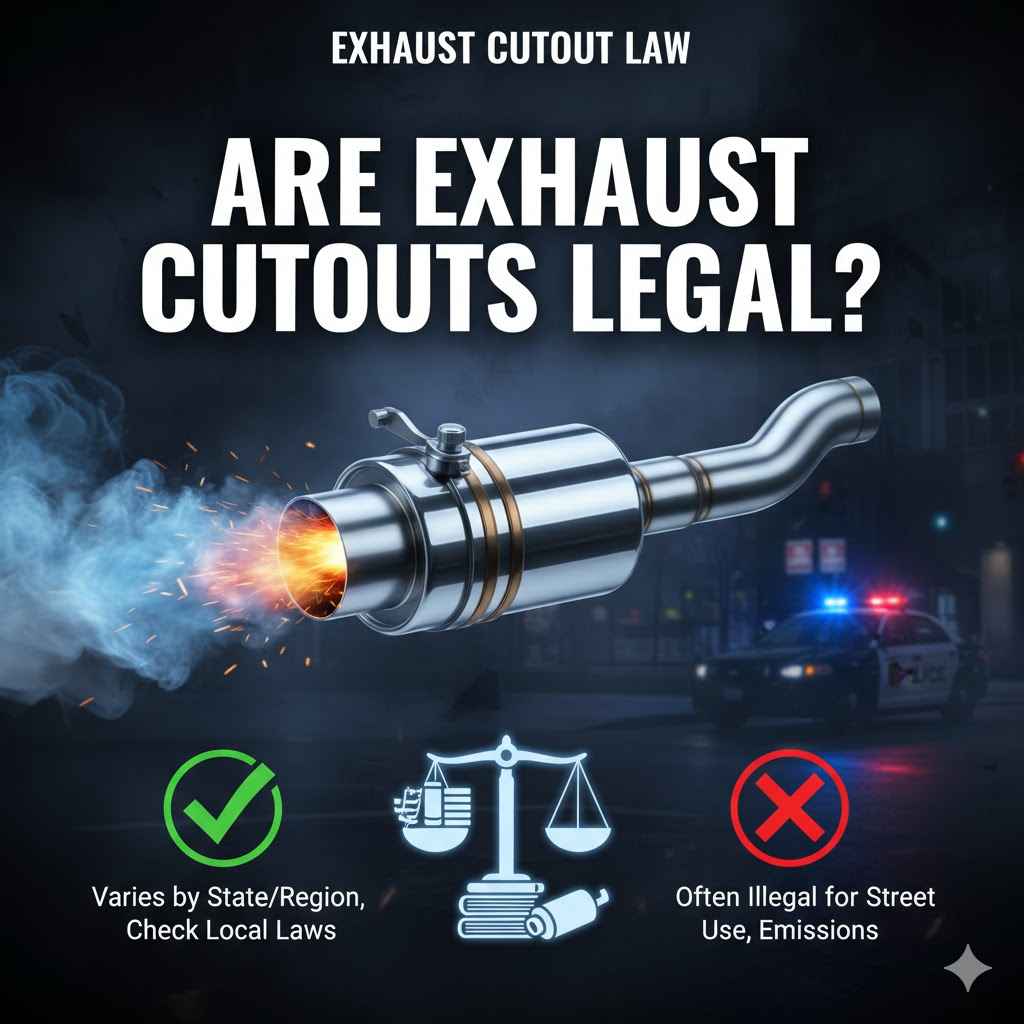
Many car fans wonder, Are Exhaust Cutouts Legal? It’s a common question, especially for those new to modifying their cars. The rules can seem tricky, and figuring them out might feel overwhelming. This guide makes it simple.
We will break down everything you need to know, step by step, so you can make informed choices about your vehicle.
Understanding Exhaust Cutouts And Their Legality
Exhaust cutouts are devices installed in a vehicle’s exhaust system. They allow the driver to bypass a portion of the exhaust, usually a muffler, to create a louder, more aggressive sound. This bypass is typically controlled by a valve, which can be opened or closed.
When the valve is open, exhaust gases flow directly out, bypassing mufflers and catalytic converters. When closed, the exhaust system functions normally.
The appeal of exhaust cutouts lies in their ability to offer two distinct sound profiles from a single system. Drivers can enjoy a quiet ride for daily driving by keeping the valve closed. For performance driving or simply to enjoy a sportier exhaust note, they can open the valve.
This duality makes them an attractive modification for many car enthusiasts seeking flexibility in their vehicle’s sound output.
However, the legality of these devices is not straightforward. It varies significantly based on local, state, and even federal regulations. The primary concern for lawmakers and law enforcement is noise pollution and emissions.
Many jurisdictions have strict laws against excessive vehicle noise and tampering with emissions control systems. Understanding these varying laws is key to knowing if exhaust cutouts are permissible in your area.
This section will explore the fundamental aspects of what exhaust cutouts are and why their legality becomes a point of frequent discussion. We will look at how they function and the basic reasons why they might be subject to legal scrutiny. By the end of this part, you’ll have a clear picture of the device itself and the general context of its legal standing.
How Exhaust Cutouts Work
Exhaust cutouts operate on a simple mechanical principle. At its core, an exhaust cutout is a valve that is inserted into the exhaust pipe. This valve can be either electric or manual.
Electric cutouts are operated by a switch inside the vehicle, often mounted on the dashboard or a convenient location. When the switch is activated, a small motor opens or closes the valve.
Manual cutouts typically involve a lever or a cable system that the driver operates. While less common now due to convenience, they serve the same purpose of opening or closing the exhaust bypass. The valve itself is often a butterfly valve, similar to those found in throttle bodies, designed to restrict or allow flow.
When the valve is in the closed position, the exhaust gases are forced to travel through the intended path of the exhaust system, including mufflers and resonators, which are designed to reduce noise.
When the valve is opened, the exhaust gases find a much shorter, less restrictive path. They bypass the mufflers and any other sound-dampening components. This direct route allows the raw sound of the engine’s combustion process to escape with significantly less attenuation.
The engine’s exhaust note becomes louder, deeper, and often produces more pops and crackles, especially during acceleration or deceleration. This is the primary reason many enthusiasts install them.
The installation process usually involves cutting into the exhaust pipe and welding the cutout assembly in place. Professional installation is often recommended to ensure a secure fit and proper sealing to prevent exhaust leaks when the valve is closed.
The Purpose Behind Exhaust Cutouts
The main reason people install exhaust cutouts is to achieve a desired sound. For many, the stock exhaust system on their car is too quiet and lacks the aggressive tone that complements a performance vehicle. Exhaust cutouts offer a cost-effective way to get a much louder and sportier exhaust sound without replacing the entire exhaust system.
Beyond just sound, some believe that opening the exhaust bypass can offer a slight increase in engine performance. By reducing backpressure in the exhaust system, especially at higher RPMs, the engine may be able to expel exhaust gases more efficiently. This can lead to minor horsepower gains.
However, this effect is often debated and typically very small on most street cars unless significant other modifications are present.
Another reason is the flexibility they provide. A driver might want a loud exhaust for weekend cruises or track days but prefer a quieter, more neighbor-friendly sound for daily commuting. Exhaust cutouts allow for this switch on demand.
This versatility is a significant draw for owners who want the best of both worlds without having to swap exhaust components frequently.
Some enthusiasts also find that the visual aspect of exhaust cutouts adds to their vehicle’s aesthetic. However, the primary drivers are almost always sound and the ability to control it.
Are Exhaust Cutouts Legal In The United States
In the United States, the legality of exhaust cutouts is not governed by a single federal law that universally prohibits or permits them. Instead, it is a patchwork of regulations that vary significantly from state to state and even at the local city or county level. This means a modification that is perfectly legal in one state might be illegal in another, and sometimes even illegal on one side of a county line compared to the other.
The primary legal challenges with exhaust cutouts revolve around two main areas: noise ordinances and emissions regulations. Many states and cities have laws that set maximum decibel limits for vehicle exhaust. Opening an exhaust cutout can easily exceed these limits, leading to citations.
Furthermore, if an exhaust cutout bypasses the catalytic converter, it can lead to violations of federal and state emissions standards, which are often stricter.
It is crucial for vehicle owners to research the specific laws in their jurisdiction. This involves checking state vehicle codes, local municipal ordinances, and any specific regulations enforced by the Department of Motor Vehicles or equivalent agencies. Ignoring these laws can result in fines, vehicle impoundment, and mandatory removal of the offending modification.
This section will explore the general legal landscape of exhaust cutouts within the United States. We will look at the common reasons why they are restricted and what types of laws typically apply. Understanding this broad context is the first step in determining their legality for your specific situation.
Federal Regulations And Their Impact
While there isn’t a specific federal law that says “exhaust cutouts are illegal,” federal regulations do set the groundwork for their restricted use. The most significant federal legislation impacting exhaust modifications is the Clean Air Act. This act, enforced by the Environmental Protection Agency (EPA), sets standards for vehicle emissions.
Modifying an exhaust system to bypass or remove emissions control devices, such as catalytic converters, is a direct violation of the Clean Air Act.
Many aftermarket exhaust components, including exhaust cutouts, are sold “for off-road use only.” This designation is a legal disclaimer by the manufacturer to avoid liability for illegal installation or use on public roads. When a cutout is installed in a way that bypasses the catalytic converter, it directly compromises the vehicle’s ability to meet federal emissions standards. This is a serious offense that can lead to substantial fines.
Another federal agency that plays a role is the Department of Transportation (DOT). While DOT primarily focuses on safety, they do set standards for vehicle equipment. However, their regulations are less directly focused on the sound or emissions aspects of exhaust systems compared to the EPA.
The Noise Control Act of 1972 also exists, aiming to set noise emission standards for products distributed in commerce. However, enforcement at the vehicle level is often handled by states and local authorities.
It’s important to note that even if a federal law doesn’t explicitly ban them, the EPA’s authority over emissions can effectively make many cutout installations illegal if they disable emissions control equipment.
Catalytic Converters And Emissions
A catalytic converter is a vital part of a vehicle’s exhaust system designed to reduce harmful pollutants. It uses chemical reactions to convert toxic gases like carbon monoxide, nitrogen oxides, and unburned hydrocarbons into less harmful substances like water vapor, carbon dioxide, and nitrogen. These pollutants are primarily responsible for smog and respiratory problems.
When an exhaust cutout is installed in a way that bypasses the catalytic converter, the vehicle begins to emit significantly higher levels of these harmful gases. This is a direct violation of the Clean Air Act and is taken very seriously by regulatory bodies. The EPA sets strict limits on the types and amounts of emissions a vehicle can produce, and disabling the catalytic converter guarantees that these limits will be exceeded.
The rationale behind banning the removal or bypass of catalytic converters is environmental protection and public health. In densely populated areas, the cumulative effect of millions of vehicles emitting uncontrolled pollutants can have severe consequences. This is why tampering with catalytic converters, often facilitated by exhaust cutouts, is a major legal concern at the federal level.
Many states also have their own emissions testing programs. If your state requires emissions testing, a vehicle with a bypassed catalytic converter will inevitably fail. This failure would then trigger further investigation and potential penalties.
State And Local Laws Regarding Noise
Beyond federal emissions standards, state and local laws are the most common source of restrictions on exhaust cutouts due to noise. Almost every state has some form of vehicle noise regulation. These laws typically set maximum decibel limits that vehicle exhaust systems cannot exceed.
These limits are often measured at a specific distance from the vehicle and at certain engine RPMs.
For example, some states might have a limit of 95 decibels for cars. An open exhaust cutout, especially on a V8 or larger engine, can easily produce sounds well over 100 or even 110 decibels. Law enforcement officers are often equipped with sound meters to enforce these regulations.
A violation can result in a ticket, a fine, and an order to correct the exhaust system.
Local ordinances can be even stricter. Cities and towns often enact their own noise bylaws to address concerns about excessive vehicle noise disturbing residents. These local rules can sometimes be more restrictive than state laws and may be enforced more rigorously in residential areas.
Some cities have specific “loud exhaust” ordinances that target modified vehicles.
The challenge for drivers is that these noise laws are not always clearly posted or easily accessible. It often requires diligent research into state vehicle codes and local municipal codes to understand the specific requirements. Ignorance of the law is generally not a valid defense.
Enforcement And Penalties
Enforcement of exhaust noise laws can vary greatly. In some areas, it might be a minor issue that rarely gets addressed, while in others, it can be a frequent source of citations. Law enforcement officers often have discretion in issuing tickets for exhaust violations.
Factors like the time of day, location (e.g., near residential areas, schools, hospitals), and the perceived severity of the noise can influence their decision.
The penalties for violating exhaust noise laws can range from a simple warning to a significant fine. In more severe or repeated cases, a court may order the vehicle to be brought into compliance, which could mean removing the illegal exhaust modification. Some jurisdictions may even impound vehicles for repeated or egregious violations.
Fines can range from fifty dollars to several hundred dollars per offense.
The specific penalty often depends on the jurisdiction and whether it’s a first offense or a repeat offense. Some states might have escalating penalties for subsequent violations. It’s also possible that a citation for an illegal exhaust could lead to a requirement for a formal inspection by a mechanic or state agency to ensure compliance before the vehicle can be legally operated again.
One common scenario is being pulled over for speeding or another traffic violation, and the officer notices the loud exhaust. Even if the initial stop was for something else, the illegal exhaust can lead to an additional citation. This makes ensuring your exhaust system complies with all applicable laws a good idea to avoid unexpected legal trouble.
Common Scenarios And Legal Pitfalls
When considering exhaust cutouts, several common scenarios highlight the potential legal pitfalls. Many enthusiasts install them with the intention of only using them in specific, controlled environments like race tracks or private property. However, the temptation to use them on public roads, even for a short period, can lead to trouble.
Another pitfall is the assumption that if a modification is widely available for purchase, it must be legal. As mentioned, many exhaust components are sold “for off-road use only,” meaning the responsibility for legal installation and use falls entirely on the consumer. This can create a false sense of security.
Furthermore, the interpretation of laws can differ. What one law enforcement officer deems acceptable, another might not. This ambiguity can make it difficult for drivers to know for sure if their setup is compliant, even if they’ve done their research.
The safest approach is to err on the side of caution and ensure strict compliance.
This part will walk through some typical situations where exhaust cutouts might be installed and the legal consequences that can arise. We will also discuss common misunderstandings and provide practical advice to help you avoid legal issues related to these modifications.
“Off-Road Use Only” Disclaimer
The phrase “for off-road use only” is a legal shield used by manufacturers of aftermarket automotive parts. It signifies that the product is not intended for use on public roads where it may violate federal, state, or local laws. When you purchase an exhaust cutout with this disclaimer, you are acknowledging that you assume all responsibility for its legal installation and operation.
This disclaimer is particularly relevant for exhaust components that can bypass emissions equipment or significantly increase noise levels. Manufacturers cannot guarantee that their products will be legal in all jurisdictions or for all applications. By stating “off-road use only,” they are attempting to limit their liability if a customer is cited or fined for using the product illegally.
It is crucial for consumers to understand that this disclaimer does not make the product legal to use on public roads. If you choose to install and use an “off-road use only” exhaust cutout on your daily driver, you are doing so at your own risk. Law enforcement officers and regulatory agencies will not recognize this disclaimer as a justification for illegal use.
They will enforce the existing laws regarding emissions and noise pollution.
Many online retailers and forums will emphasize this disclaimer. It’s a standard practice in the performance parts industry. It highlights the importance of checking your local laws before making any modifications, regardless of how the part is marketed.
Bypassing Emissions Control Systems
Bypassing emissions control systems, such as the catalytic converter, is one of the most significant legal violations associated with exhaust cutouts. These systems are mandated by federal law to protect the environment and public health. When an exhaust cutout is positioned to allow exhaust gases to flow directly from the engine manifold or exhaust manifold past the catalytic converter and out of the vehicle, it effectively disables the converter’s function.
A catalytic converter works by using precious metals like platinum, palladium, and rhodium to catalyze chemical reactions. These reactions transform harmful pollutants like hydrocarbons (unburned fuel), carbon monoxide (a poisonous gas), and oxides of nitrogen (which contribute to smog) into less harmful substances such as carbon dioxide, water, and nitrogen gas. Without the catalytic converter, these pollutants are released directly into the atmosphere.
The consequences of bypassing the catalytic converter can be severe. Fines from the EPA can be substantial, potentially reaching tens of thousands of dollars for individuals. In addition, many states require emissions inspections, and a vehicle without a functional catalytic converter will fail these tests.
This failure can lead to an inability to register the vehicle or renew its license plates until the issue is rectified.
The legality is quite clear on this point: tampering with or removing federally mandated emissions control devices is illegal. Even if your state doesn’t have emissions testing, federal law still applies to vehicles operating on public roads.
Using Cutouts On Private Property Or Tracks
Using exhaust cutouts exclusively on private property or at designated race tracks is generally considered legal. These locations are not public roads, and therefore, the same noise and emissions regulations that apply to public thoroughfares do not usually govern them. This is often why products are advertised as “for off-road use only.”
If you own a large piece of private land and have no neighbors who could be disturbed by the noise, or if you regularly attend track days at a closed course facility, then an exhaust cutout can be a fun and legal modification. The key is ensuring that the noise generated does not escape and become a nuisance to others or violate any local ordinances related to noise pollution from private property.
However, there can still be nuances. For example, if your private property is within city limits, local noise ordinances might still apply, especially if the noise carries beyond your property boundaries. At race tracks, while generally permissible, some tracks may have their own decibel limits for vehicles participating in events.
It’s always wise to check the specific rules of the venue or property owner.
The critical distinction is the absence of public access and the context of operation. When the vehicle is not being operated on a public highway, the legal framework surrounding emissions and noise generally shifts. This allows for more freedom in exhaust system configuration.
Alternatives To Exhaust Cutouts
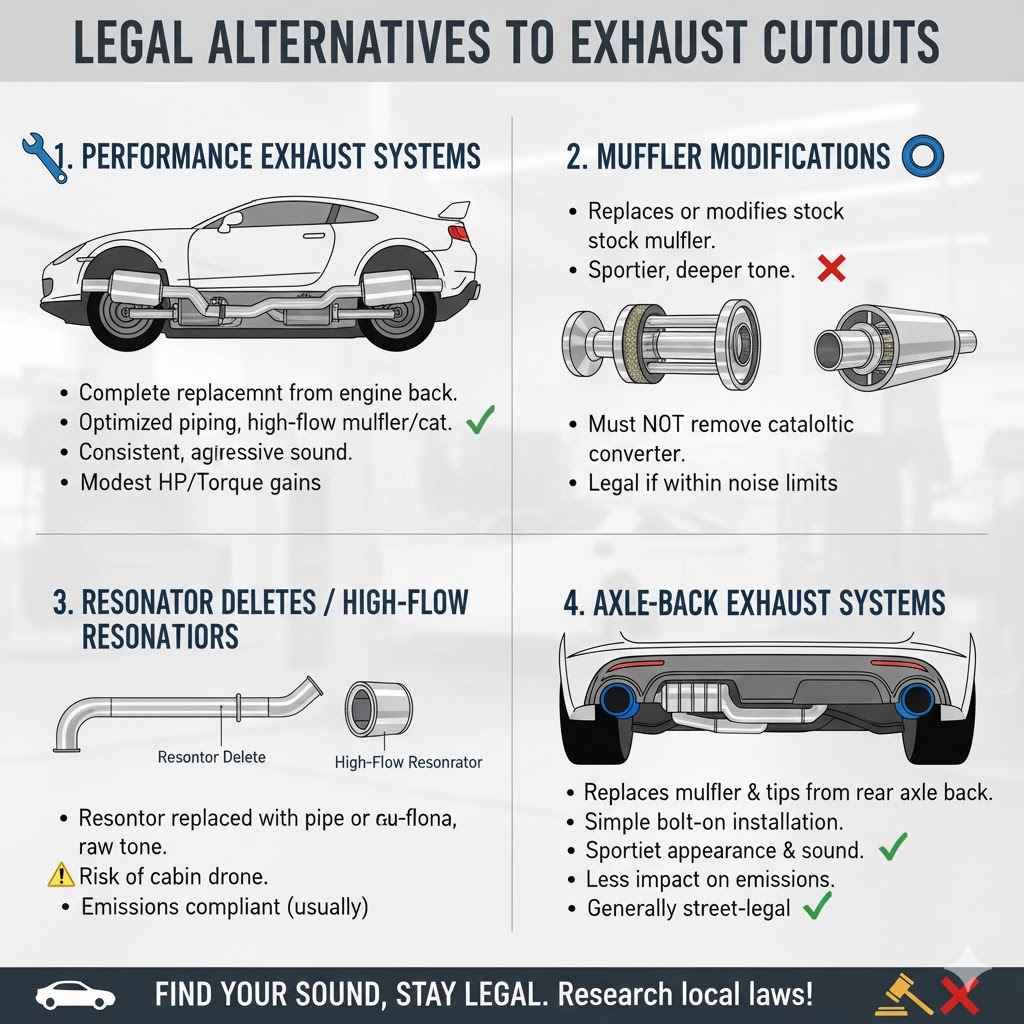
Given the potential legal complexities and fines associated with exhaust cutouts, many car owners look for alternative ways to achieve a more aggressive exhaust note or sound without risking legal trouble. Fortunately, there are several options available that offer a balance between performance, sound, and legality. These alternatives often focus on improving exhaust flow and tone through better-designed components rather than simply bypassing them.
These alternatives generally aim to enhance the natural sound of the engine and improve exhaust efficiency while remaining compliant with noise and emissions regulations. They represent a more permanent and often more refined solution compared to the on-demand nature of cutouts. Exploring these options can provide a satisfactory outcome without the legal headaches.
This section will introduce and explain some of the most popular and legal alternatives to exhaust cutouts. We will discuss how they work, their benefits, and why they are a safer choice for most vehicle owners. You’ll discover ways to modify your exhaust system to achieve a sportier sound and potentially some performance benefits while staying on the right side of the law.
Performance Exhaust Systems
Performance exhaust systems are designed as complete
A performance exhaust system usually consists of a less restrictive muffler, optimized piping diameters, and sometimes a high-flow catalytic converter or resonator. Mufflers in performance systems are designed to produce a deeper, sportier tone. They achieve this by using different internal baffling or packing materials that allow more sound to pass through than stock mufflers, but still dampen it to acceptable levels.
The benefit of a full performance exhaust system is that it provides a consistent, aggressive sound profile. It can also offer modest horsepower and torque gains due to improved exhaust scavenging. Unlike cutouts, there’s no on-the-fly switching; the sound is always present, though it varies with engine RPM.
This makes it a more predictable and generally legal modification. Reputable brands invest heavily in ensuring their products are street-legal in most places.
When choosing a performance exhaust, it is still wise to check for any state-specific laws or local ordinances that might apply to aftermarket systems. Some systems might be louder than others, and what is acceptable in one area could be borderline in another.
Muffler Modifications
Modifying or replacing the muffler is another common and often legal approach to altering exhaust sound. The muffler is the primary component responsible for reducing the noise produced by the engine’s combustion process. Stock mufflers are designed for quiet operation, often using chambers and baffles to absorb sound waves.
Aftermarket mufflers come in various designs. Some offer a sportier tone by using straight-through perforated cores or different chamber designs that allow more exhaust sound to resonate. These are often referred to as “performance mufflers” or “sport mufflers.” They aim to provide a deeper, more aggressive sound without being excessively loud or illegal.
It is also possible to have a stock muffler modified. A muffler shop might be able to re-chamber a stock muffler or add a small, internal bypass that is less aggressive than a full external cutout. However, these modifications can be less predictable in terms of sound and legality.
The safest route is often to
When considering muffler modifications, always ensure that the work does not involve removing or tampering with the catalytic converter. A properly installed aftermarket muffler, designed to meet noise standards, is a widely accepted modification for enhancing exhaust sound.
Resonator Deletes Or High-Flow Resonators
Resonators are secondary sound-deadening components in an exhaust system, typically located between the muffler and the exhaust tip. Their primary function is to cancel out specific sound frequencies, particularly droning noises that can be irritating at certain RPMs. Removing a resonator or replacing it with a high-flow version can alter the exhaust note.
A resonator delete typically involves replacing the resonator with a straight piece of pipe. This can make the exhaust sound louder and more raw, sometimes introducing more pops and crackles. However, it can also increase the level of drone, which is an unpleasant, persistent humming noise that can be noticeable inside the cabin, especially during highway cruising.
High-flow resonators are designed to offer a bit more sound than a stock resonator without removing it entirely. They are engineered to have less restriction, allowing for a slightly louder and richer exhaust tone. This can be a good middle ground for those who want a sportier sound but are concerned about the drone from a full resonator delete or the excessive loudness of a cutout.
The legality of resonator deletes or high-flow resonators usually hinges on whether they increase the vehicle’s overall noise level beyond legal limits. Since they do not typically bypass catalytic converters, they are less likely to face federal emissions scrutiny. However, local noise ordinances would still apply.
Many consider these modifications a safer bet than cutouts when seeking a louder exhaust.
Axle-Back Exhaust Systems
An axle-back exhaust system is a component that replaces the exhaust from the rear axle back to the exhaust tip. This typically includes the muffler and the exhaust tip. It is one of the simpler exhaust modifications to install and generally has less impact on overall emissions compared to a full cat-back system or headers.
Axle-back systems are popular because they can significantly change the sound of the vehicle. By using a less restrictive muffler, they can produce a sportier, more aggressive tone. The installation is usually straightforward, often requiring just a few bolts and clamps to remove the old section and attach the new one.
The legality of axle-back systems depends on the sound level they produce. Manufacturers typically design these systems to be louder than stock but within legal limits for most areas. They are a good option for someone who wants a noticeable improvement in exhaust sound and a sportier appearance without the extreme loudness or legal ambiguity of exhaust cutouts.
It provides a consistent, engineered sound rather than a variable one.
When purchasing an axle-back system, look for reputable brands that state their products are street-legal or meet specific noise standards. Always cross-reference this with your local regulations if you are concerned about compliance.
Frequently Asked Questions
Question: Are exhaust cutouts legal to install on my car
Answer: The legality of installing exhaust cutouts varies greatly. They are often illegal on public roads if they bypass emissions equipment like catalytic converters or if the noise level exceeds local ordinances. Always check your specific state and local laws.
Question: Can I get a ticket for having an exhaust cutout
Answer: Yes, you can receive a ticket for having an exhaust cutout, especially if it makes your vehicle too loud for local noise ordinances or if it bypasses emissions controls. Fines and requirements to remove the modification are possible.
Question: Are exhaust cutouts legal for racing
Answer: Exhaust cutouts are often legal for use on race tracks or private property where emissions and noise regulations for public roads do not apply. This is sometimes referred to as “off-road use only.”
Question: What are the risks of using exhaust cutouts
Answer: The main risks include significant fines, vehicle impoundment, failure of emissions tests, and the requirement to remove the modification. There is also the potential for voiding vehicle warranties.
Question: What is a legal alternative to an exhaust cutout
Answer: Legal alternatives include installing a performance exhaust system, a sport muffler, or a high-flow resonator. These modifications can enhance sound and performance while usually remaining compliant with noise and emissions laws.
Final Thoughts
The question of Are Exhaust Cutouts Legal? hinges on local laws concerning noise and emissions. While appealing for sound control, they frequently violate these regulations on public roads. Opting for performance exhaust systems, sport mufflers, or high-flow resonators offers a safer, legal path to a sportier exhaust note and enhanced vehicle acoustics.