Best Titanium Motorcycle Exhausts
Titanium exhausts are worth the price when you want the biggest weight drop, are fitting a full system to a sportbike or track bike, and can pay for tuning; for most street riders, a titanium canister or stainless system gives better value. Pick the wrong fitment or skip tune checks, and you can end up with poor fueling, noise problems, and a part that costs more than it returns. This guide compares titanium exhaust options by fitment, sound, weight, legality, durability, and ECU or fuel-map needs.
Best overall pick: a model-specific titanium slip-on or full system that keeps the factory mounting points, matches the exact year range, and includes the right O2 sensor ports and hardware for your bike.
Quick picks

| Use case | Best titanium choice | Key fitment note | Fitment risk | Value note |
|---|---|---|---|---|
| Street commuting | Titanium slip-on | Retains the stock header and usually installs faster | Lower if the model-year match is exact | Best when you want sound and weight savings without a full system bill |
| Canyon riding | Titanium full system | More likely to change scavenging and throttle response | Medium to high if header diameter or sensor ports are wrong | Good if you want sharper response and can verify tuning needs |
| Track days | Titanium race exhaust | Often sold for specific model years, such as the Yamaha FZ-09 / FJ-09 / MT-09 / Tracer 900 2014-2020 system or BMW S1000R / S1000RR / M1000R / M1000RR 2019+ header | High if the bike must stay street legal | Best when weight and heat management matter more than cost |
| Touring | Stainless system or quiet titanium slip-on | Look for a removable baffle and strong bracket support | Lower if you keep emissions hardware intact | Usually better than a loud race setup for long days |
| Appearance-first builds | Titanium canister or full titanium system | Heat tint develops faster on visible tubing than on a tucked-away canister | Medium if fitment is cosmetic rather than exact | Best when finish matters and you accept the premium |
Best overall for street riders
A titanium slip-on gives most street riders the cleanest starting point because it keeps the stock header, cuts weight, and usually avoids the tuning work of a full system. Use it when you want a cleaner sound and a modest performance change without opening the entire exhaust path.
Best for track use
A titanium race exhaust fits best on a track bike or a serious sport build. The Yamaha titanium race exhaust listed for FZ-09 / FJ-09 / MT-09 / Tracer 900 2014-2020 and the BMW titanium race header for S1000R / S1000RR / M1000R / M1000RR 2019+ show the pattern: these parts are model-specific, premium-priced, and aimed at performance-first fitment.
Best for value
For value, a slip-on usually beats a full titanium system. A smaller change at the muffler gives you easier installation and some weight reduction, while a full system adds headers, more cost, and a greater chance that you will need an ECU tune.
Best for touring comfort
For touring, quiet matters as much as material. A titanium canister with a removable dB killer is a smarter pick than a race pipe, because you can keep volume down on long highway runs and reduce the chance of annoying neighbors at cold start or in hotel lots.
Best for appearance-first builds
If the build is about visual finish, titanium is a strong choice because the metal changes color with heat in a way many riders want. Check whether the system includes the stainless or titanium sections you actually want to see, since some kits mix materials and can look different than the product photos suggest.
What titanium motorcycle exhaust systems
Titanium exhaust systems use titanium in the pipework, header, canister, or both, depending on the kit. That material choice usually targets lower weight, good corrosion resistance, and high heat tolerance, but the real benefit depends on whether the exhaust is a slip-on, header, or full system and whether it is built for your exact make, model, and year.
Common formats are simple. A slip-on keeps the stock header. A full system includes headers, mid-pipe, and muffler. A header-only kit changes the primary pipes and is usually chosen for race use or a very specific tuning goal.
Top titanium exhaust picks
Yamaha titanium race exhaust, 2014-2020
This is a track-oriented option for the Yamaha FZ-09 / FJ-09 / MT-09 / Tracer 900 family for 2014-2020. Ignis lists it at $1,599.00 USD. That price points to where titanium belongs best: riders who want model-specific fitment, reduced weight, and a race-bias setup rather than a low-cost street upgrade.
BMW titanium race header, 2019+
This header is listed for BMW S1000R / S1000RR / M1000R / M1000RR 2019+ models, and Ignis prices it at $1,299.00 USD. A header changes the primary pipes that affect scavenging and the torque curve, so this is the kind of part to choose only when the bike, year, and tuning plan already line up.
Universal-style slip-on example with exact dimensions
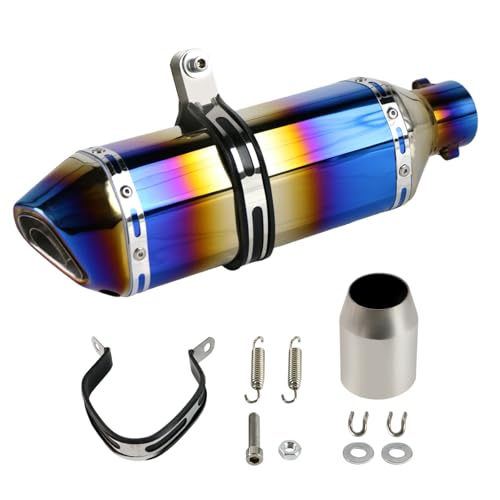
All Road Tire lists a Tesmirror motorcycle exhaust muffler with a 1.5-2 inch inlet, a 51 mm slip-on type connection diameter, an overall length of 365 mm, and fitment for pipe diameters from 38 to 51 mm. It also includes a removable DB killer. That combination suits riders who want a quieter, more flexible muffler fit than a full race system.
Harley Touring slip-on example
West End Motorsports lists a TAB Performance 4.5 inch BAM Sticks slip-on for 2017-up Harley Davidson Touring models. That is a good reminder that many exhaust choices are bike-family specific, and a titanium discussion still starts with exact year coverage, not generic pipe diameter alone.
Honda Rebel slip-on example
The same source lists a Vance & Hines Upsweep slip-on muffler for 2017-up Honda Rebel 300/500. Even when a listing is not titanium-specific, it helps frame the fitment standard riders should expect: model-year exactness, mounting point compatibility, and a clear match to the stock header layout.
How to choose between slip-on, header, and full system
Choose the part that matches your real goal. A slip-on is for easier installation, moderate sound change, and smaller performance gains. A header is for riders who want scavenging changes and are prepared to think about diameter, sensor locations, and tuning. A full system is for the biggest potential gain, the highest cost, and the most setup work.
- Confirm the exact make, model, and year range.
- Check whether the kit is slip-on, header, or full system.
- Verify header diameter and pipe layout against your bike.
- Look for O2 sensor ports if the bike is fuel injected.
- Check whether the catalyst stays in place or is removed.
- Review mounting hardware, brackets, springs, hooks, and clamps.
- Decide whether you need a dB killer for sound control and legality.
If your bike is a 2019 S1000RR and you buy a header built for a different year range, the sensor bung may be misaligned and the bracket may be stressed. The pipe may bolt partway into place but still stress the bracket or leave the sensor bung misaligned, which creates vibration and tuning problems. Fitment errors often start as small offsets.
Suppose your bike uses a stock O2 sensor and the new titanium system omits the sensor port. You now need a different solution before the bike runs correctly, and that can turn a “simple” exhaust swap into a more expensive job.
Is titanium better than stainless steel for a motorcycle exhaust?
Titanium is better when weight savings and heat handling matter more than price. Stainless steel is often better when you want lower cost, easier replacement, and a tougher budget-to-durability balance for regular street use. If you are not chasing track weight or premium finish, stainless often makes more sense.
Weight savings
Titanium usually saves more weight than stainless because the material is lighter, especially on a full system where the header and mid-pipe are included. The actual reduction depends on the bike and the parts removed, so the biggest gains tend to show up on larger systems rather than a small slip-on only.
Sound character
Titanium often sounds sharper and a little more metallic than stainless, but the muffler design, packing, catalyst, and dB killer matter more than the base metal alone. A titanium can with a baffle can be quieter than a stainless can without one.
Heat and corrosion resistance
Titanium handles exhaust heat well and resists corrosion better than many alternatives. That helps on bikes exposed to rain, salt, or frequent heat cycling. It does not prevent heat tint, which is a cosmetic change rather than a failure by itself.
Price and long-term value
Titanium costs more. The value works only if you care enough about weight, heat, and material finish to pay for them. For a commuter, the extra money often buys more than the bike actually needs. For a track bike, the premium is easier to justify.
What should you check before buying?
Start with fitment, then move to hardware and legal details. The most common buying mistake is skipping the bike-specific details that determine whether the system bolts up cleanly, clears bodywork, and works with the engine management setup already on the motorcycle.
Exact make, model, and year fitment
Do not buy by engine size alone. Year-specific fitment matters.
Header diameter and pipe layout
Header diameter changes gas speed and can alter the torque curve. If the pipe is too large for the engine and use case, low-end response can suffer. If the pipe layout does not match the bike, the system may fit badly even if the flange pattern looks close.
O2 sensor ports and catalyst retention
Fuel-injected bikes usually need the right O2 sensor bung location. Shoes Every Wear lists a 2″LAF exhaust pipe with a built-in 18mm O2 sensor port, which is the kind of detail that determines whether the bike can keep stock sensor hardware or move to a tuned setup. Also check whether the catalyst is retained if street legality matters.
Mounting hardware and bracket alignment
Check springs, hooks, clamps, and brackets before purchase. The mount should hold the pipe square without forcing the system into place. Misalignment can create vibration, cracked brackets, or exhaust leaks that show up after a few heat cycles.
DB killer or baffle options
A removable DB killer changes volume and tone, and it can be the difference between a usable street exhaust and a setup that annoys everyone around it. All Road Tire’s Tesmirror muffler includes a removable DB killer, which is the kind of feature to prioritize if you ride in neighborhoods, apartments, or noise-sensitive areas.
Titanium exhaust fitment matrix
| Use case | Weight savings | Sound control | Tune requirement | Legality risk | Install difficulty | Value for money | Short recommendation |
|---|---|---|---|---|---|---|---|
| Street commuting | Medium | Good with a baffle, weaker without one | Usually low for a slip-on | Medium if catalyst is removed or noise limits are exceeded | Low to medium | Good only if you want the material premium | Choose a titanium slip-on with a removable dB killer and exact year fitment. |
| Canyon riding | Medium to high | Moderate | Possible on a header or full system | Medium | Medium | Strong if you want response and weight reduction | Pick a model-specific system that preserves clean mounting and sensor placement. |
| Track days | High | Low to moderate | Often yes | High for street use | Medium to high | Strong for performance-first builds | Use a titanium race exhaust only if the bike is track-focused and you can tune it. |
| Touring | Low to medium | High with a baffle | Usually low for a slip-on | Low to medium if the catalyst stays in place | Low | Fair if comfort matters more than material | Choose quiet hardware and bracket stability over maximum weight loss. |
| Appearance-first builds | Medium | Depends on muffler design | Varies | Medium | Medium | Fair if finish matters most | Choose titanium for color change and finish, but confirm the pipe is not just a cosmetic shell. |
Do titanium exhausts need a tune?
Sometimes. A titanium slip-on on a fuel-injected bike can run acceptably with the stock map if the catalyst and sensor setup stay close to factory. A full system or header change is more likely to shift fueling enough that an ECU flash or piggyback controller becomes the right move.
Slip-on vs full system
A slip-on usually keeps more of the factory exhaust path, so the engine sees a smaller change. A full system replaces headers and mid-pipe, which can change exhaust velocity, scavenging, and mixture enough to justify tuning.
Fuel-injected bikes
Fuel-injected motorcycles are the ones most likely to need attention after an exhaust change, because the engine computer expects a certain flow and sensor pattern. If the new pipe changes those assumptions, the bike may run lean, surge, or show poor throttle response.
ECU flash or piggyback tuning
An ECU flash changes the factory map. A piggyback controller adjusts signals without replacing the stock calibration. Either can help if the exhaust removes the catalyst, adds a larger header, or changes the O2 sensor setup. The right choice depends on the bike and the parts installed.
Signs the bike needs a tune
Watch for popping, hesitation, surging at steady throttle, or a flat spot that was not there before. Those are practical clues that the exhaust change did more than just alter the sound.
How to judge sound, legality, and maintenance
Sound control starts with the muffler design, then the dB killer, then the catalyst. Legality depends on the market, local noise limits, and whether emissions equipment stays in place. Maintenance is mostly about cleaning, checking fasteners, and watching for heat tint, leaks, or bracket stress after installation.
Sound with and without a DB killer
A removable DB killer or baffle typically lowers volume and softens the tone. Without it, the exhaust can become sharper and louder, which may be fine for off-road or track use but less suitable for street riding or shared parking.
Street legality checks
Verify whether the exhaust keeps the catalyst, whether it carries the right emissions compliance status for your region, and whether local noise limits allow the final setup. Race headers and race exhausts are the most likely to create compliance problems, even when the fitment is excellent.
Heat tint and discoloration
Heat tint on titanium is common. It is not automatically damage. What matters is whether the color change stays even or appears alongside blue spots, soot at joints, or warped mounting points that suggest a leak or excessive heat concentration.
Cleaning and inspection after install
Use a mild cleaner that will not scratch the finish, and inspect clamps, springs, and brackets after a few heat cycles. Recheck alignment where the pipe meets the head, mid-pipe, and muffler. A small shift can become a vibration issue later.
A common first-timer mistake is buying a titanium muffler for its look, then ignoring the bracket angle. If the canister hangs one degree off, the vibration load moves into the mount and the joint can loosen after a few rides. Clean fitment matters more than shiny metal.
Frequently asked questions
What does a titanium motorcycle exhaust sound like compared with stainless steel?
Titanium often sounds a little sharper and more metallic, but the muffler design, catalyst, and baffle matter more than the base metal. A titanium pipe with a dB killer can be quieter than a stainless pipe without one, so sound is not determined by material alone.
Are titanium exhausts worth the money for street riding?
Usually only if you care about the material itself, want a lighter setup, or are building a premium street bike with exact fitment. For routine commuting, the cost can outpace the benefit. A good stainless slip-on often gives better value for day-to-day road use.
How much weight does titanium save on a motorcycle exhaust?
It depends on what you replace. A full titanium system usually saves more than a slip-on because it removes the headers and mid-pipe too. The exact amount varies by bike, so treat any large number you see as model-specific unless the seller states the comparison clearly.
Do titanium motorcycle exhausts need a tune?
A slip-on often does not, but a full system or header change often does, especially on fuel-injected bikes. The need rises when the catalyst is removed, the header diameter changes, or the O2 sensor setup no longer matches the factory calibration.
Can I install a titanium slip-on myself?
Often yes, if the kit matches the exact model and year and includes the right brackets, clamps, springs, and mounting hardware. You still need to check alignment and clearances carefully. If the O2 sensor, catalyst, or mid-pipe changes, the job becomes less straightforward.