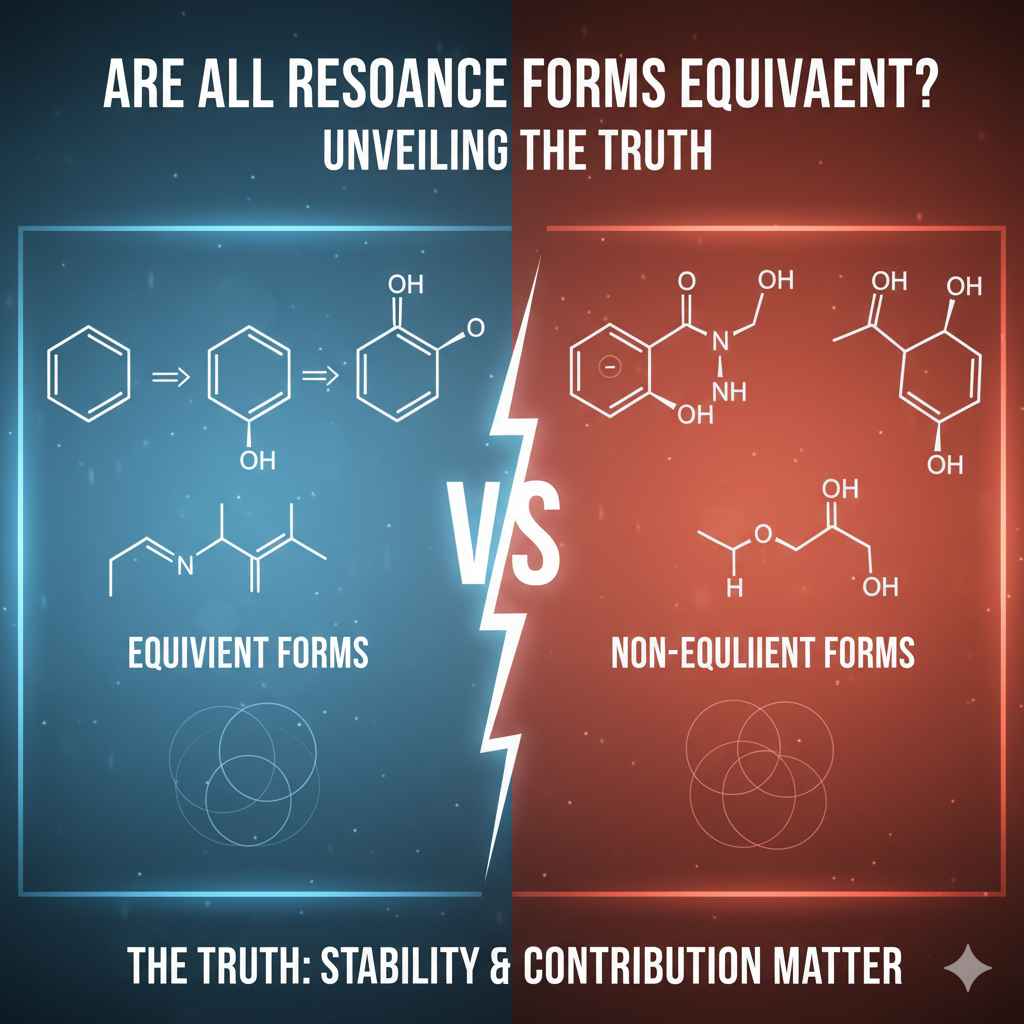
Are All Resonance Form Equivalent: Unveiling the Truth
Have you ever wondered if all resonance forms are created equal? When diving into the fascinating world of chemistry, you might find yourself puzzled by this concept.
It’s easy to get lost in the maze of molecular structures and electron configurations. But understanding resonance forms is crucial for anyone eager to grasp how molecules truly behave. What if we told you that mastering this concept could unlock a deeper understanding of chemistry’s secrets?
This article will guide you through the intricacies of resonance forms, revealing whether they all hold the same weight and why it matters to your comprehension of chemical reactions. Let’s unravel this mystery together, ensuring you never look at molecular structures the same way again.
Resonance Forms In Chemistry
Resonance forms show different ways electrons can be arranged. They help explain molecules that can’t be described by one structure. Electrons move between atoms, making several resonance forms possible. Not all resonance forms are equivalent. Some are more stable than others. Stability depends on electron distribution.
Resonance forms share the same molecular formula. They must have the same number of atoms and electrons. The overall charge and atom positions remain unchanged. Resonance forms differ only in electron placement. The goal is to find the most stable form. This form often has the lowest energy.
Concept Of Resonance
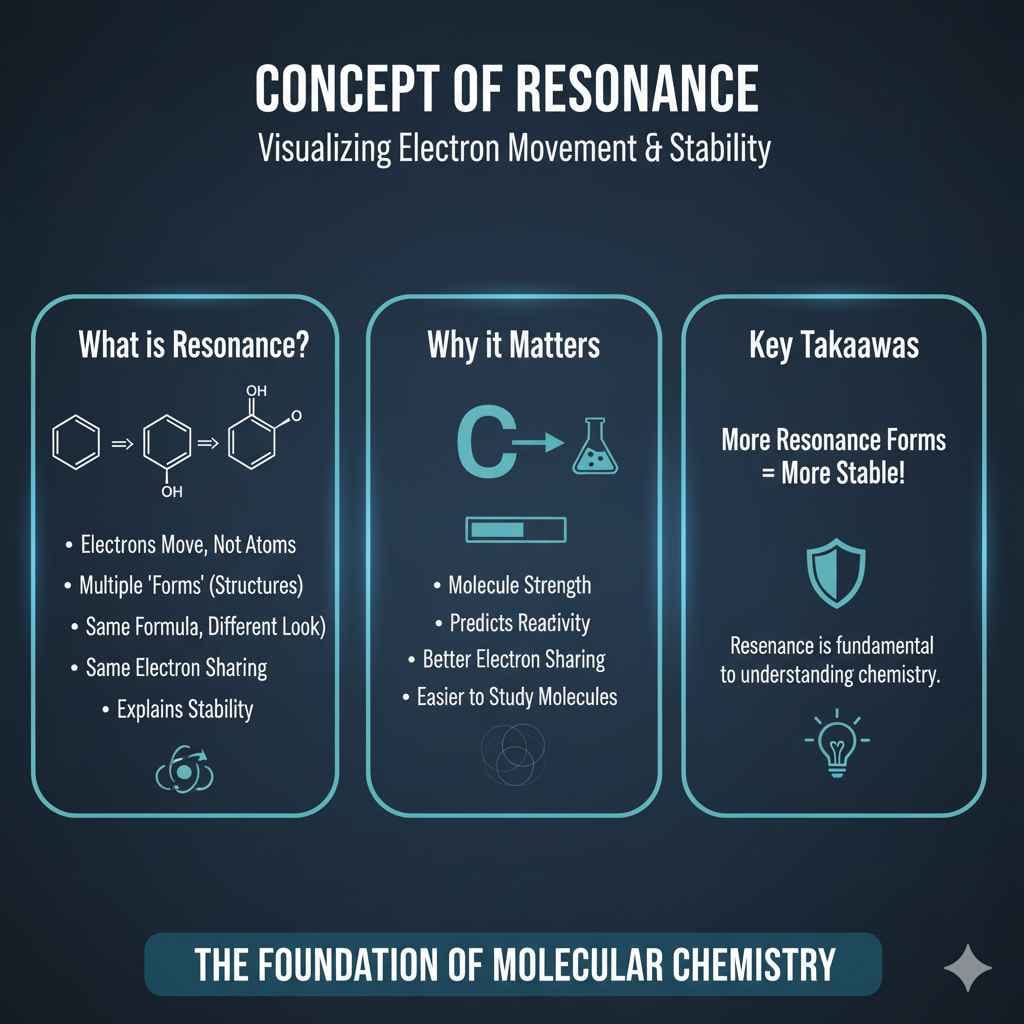
Resonance shows how electrons move in molecules. It helps us see different forms. Each form is called a resonance structure. Molecules can have many resonance structures. They look different but have the same formula. Resonance does not mean molecules change shape. It is just a way to show electron movement. Resonance helps explain why some molecules are stable. It shows the best way electrons share space.
Resonance is very important in chemistry. It helps us understand molecule strength. Some molecules have better resonance structures. These molecules are more stable. Resonance also helps predict how molecules react. It can show us the best way molecules fit together. Without resonance, some molecules would be weak. Chemistry would be hard to understand without resonance. It makes studying molecules easier.
Equivalence Of Resonance Forms
Resonance forms show different structures. Not all are equal. Each form must follow certain rules. Atoms should have the same number. Charges must be balanced. Bond lengths should be similar. Energy levels should not vary much. These rules help decide equivalence. All forms must share similar energy. If one form is too different, it may not be equivalent.
Resonance affects stability. Equivalent forms mean more stable molecules. More forms lead to stronger bonds. Molecules with more resonance forms are usually stable. Non-equivalent forms can make molecules weak. Stability is key for molecule function. Less stable molecules break easily. Stability affects how a molecule behaves. Understanding resonance helps in chemistry. Knowing stability helps in research.
Examples Of Non-equivalent Resonance Forms
Organic molecules can have different resonance forms. These forms are not always the same. For example, consider the benzene molecule. Some resonance forms are more stable. Others are less stable. Stability depends on the distribution of electrons. Electrons affect how a molecule reacts.
Resonance affects how chemicals react. Molecules with stable forms react slower. Less stable forms react faster. This impacts reaction ratesand outcomes. Different forms can lead to different products. Understanding these forms helps in predicting reactions.
Factors Affecting Resonance Equivalence
Electronic distribution is key in resonance forms. It shows how electrons are spread. Electrons like balance. Balanced forms are usually more stable. If electrons are uneven, the form might be less stable. Charges affect resonance too. Negative charges prefer electronegative atoms. This makes forms more stable.
Atomic arrangement is crucial for resonance. Atoms must be in the right place. If atoms are too far, resonance might be weak. Bond lengths matter too. Short bonds can make resonance stronger. Atoms should be aligned correctly. This helps in sharing electrons. A good arrangement leads to better resonance.
Tools To Analyze Resonance Forms
Determining if all resonance forms are equivalent involves analyzing electron distribution. Tools like molecular modeling software help visualize these differences. Understanding resonance forms aids in predicting molecular stability and reactivity.
Computational Chemistry Techniques
Computational chemistry helps scientists understand molecules. These techniques use computers to study how molecules act. Scientists can see the different shapes a molecule can have. Each shape is a resonance form. Software tools do these calculations. They include Gaussian and Spartan. These tools are very helpful.
They show if resonance forms are equivalent or not. This helps in chemistry studies. It makes it easier to know how molecules behave. Many scientists use these techniques. They trust the results. With these tools, chemistry becomes clearer.
Experimental Methods
Scientists also use experiments to study resonance. They look at real molecules. Experiments can show how molecules behave. Tools like NMR spectroscopy help in this. NMR shows how atoms are arranged. This tells if resonance forms are the same. Experiments confirm what computers find. Both methods work together.
Using experiments, scientists can double-check their findings. This is very important. Accuracy matters in science. Experiments give real-world data. It helps ensure the results are correct. This makes chemistry more reliable.
Role Of Resonance In Chemical Properties
Resonance forms can change how a molecule reacts. Different forms can make a molecule more or less reactive. Reactivity depends on the stability of these forms. More stable forms react less. Less stable forms react more. Resonance affects the distribution of electrons. This can make bonds stronger or weaker. Stronger bonds are less likely to break. Weaker bonds may break easily. Resonance gives clues about how a molecule will behave in reactions.
Resonance forms can change the color of a molecule. Color depends on how light interacts with electrons. Different forms absorb different light. This changes what we see. Resonance can also affect smell. Aroma comes from molecules interacting with our nose. Different forms can smell different. Resonance helps explain why some things look and smell unique. This is due to the electron arrangement in molecules.
Misconceptions About Resonance Equivalence
Many believe all resonance formsare the same. This is not true. Resonance forms can have different energy levels. Some forms are more stable. Others are less stable. Not all resonance forms contribute equally. The more stable forms are more important. They have a bigger role. Misunderstandings exist about resonance equivalence.
Resonance does not mean forms are real. It means they help understand molecules. Resonance forms are imaginary. They show possible structures. Resonance helps explain molecule behavior. It helps in understanding chemical bonds. Not every form has the same impact. The impact depends on stability. Understanding these differences is important. It clears confusion about resonance.
Future Of Resonance Studies
Scientists are finding new ways to study resonance forms. New tools help them see molecules better. These tools are more accurate. Researchers use them to learn more about molecular structures. This helps in making better medicines.
Understanding resonance can help in many areas. It can improve chemical reactions. This is useful for making new materials. Better materials mean stronger buildings and safer cars. Resonance studies also help in creating new medical treatments. These studies can make healthcare better for everyone.

Frequently Asked Questions
What Are Resonance Structures?
Resonance structures are different representations of a molecule, showcasing possible electron arrangements. They help explain molecular stability and reactivity. Resonance doesn’t imply physical separation but a hybrid of possible states. Understanding resonance aids in predicting chemical behavior and bonding properties.
Are Resonance Forms Equivalent?
Not all resonance forms are equivalent; they differ in stability. The most stable form contributes more to the molecule’s actual structure. Equivalent resonance forms have similar energy levels. Recognizing equivalent forms helps predict molecule behavior and reactivity.
How Do Resonance Forms Affect Molecules?
Resonance forms impact molecular stability and reactivity. They influence bond lengths, angles, and charge distribution. Molecules with resonance are typically more stable. Resonance helps chemists predict how molecules interact and react with other substances.
Why Are Resonance Forms Important In Chemistry?
Resonance forms are crucial in understanding molecular structure and reactivity. They help predict reaction outcomes and stability. Chemists use resonance to explain unexpected experimental results. Understanding resonance is essential for accurate chemical analysis and synthesis.
Conclusion
Understanding resonance forms can be tricky. Not all are equal. Some forms contribute more to the molecule’s stability. Others have less impact. Recognizing these differences is important in chemistry. It helps predict molecular behavior. Resonance offers insight into electron distribution.
This understanding aids in solving complex problems. Practice and study enhance skills in this area. Remember, each form has its own role. Knowing their impact is key. Keep exploring resonance to deepen your chemistry knowledge.