Will a Bad Catalytic Converter Damage the Engine?
Yes, if the catalyst is melted, broken, or plugged enough to raise exhaust backpressure, it can overheat the engine and damage valves, pistons, or the head gasket; a converter with only low efficiency usually will not. Ignoring a real restriction can turn a driveability issue into an expensive engine repair. This guide shows the difference between efficiency loss and dangerous blockage, plus the checks that tell you what to do next.
Exhaust flow restriction and its impact on engine health
A bad catalytic converter can damage the engine when it stops flowing enough exhaust gas. That can raise backpressure, hurt cylinder scavenging, and push heat back toward the exhaust ports. A converter that only fails the emissions test, though, often causes a check engine light without immediate engine damage.
Efficiency loss versus restriction
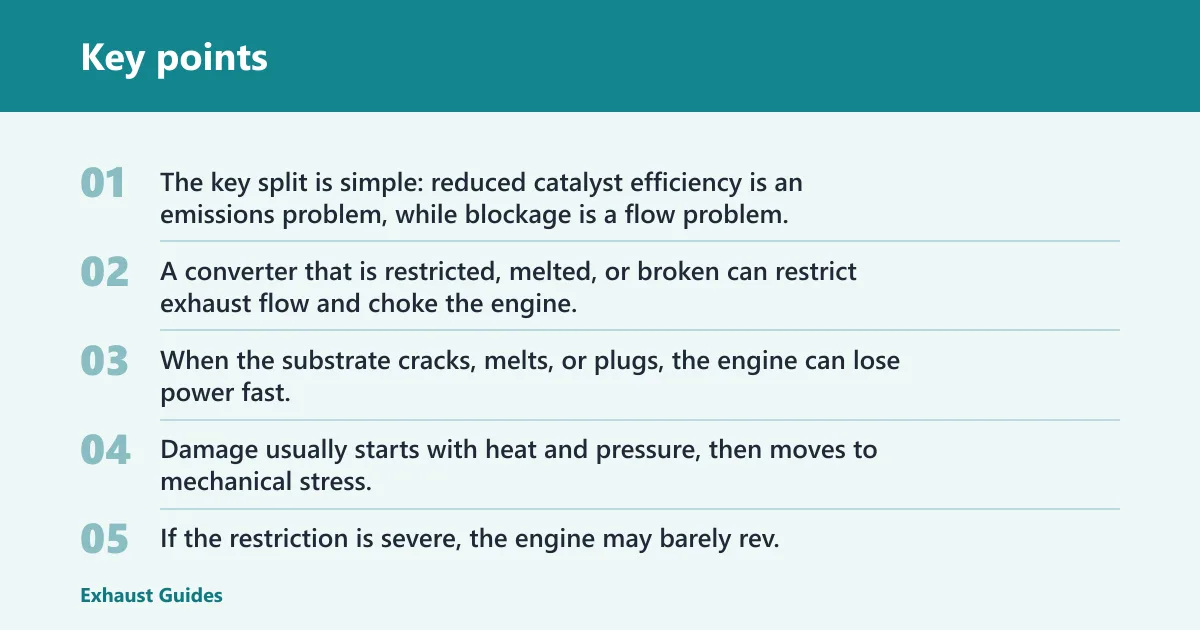
The key split is simple: reduced catalyst efficiency is an emissions problem, while blockage is a flow problem. A converter with poor oxygen-storage performance may set P0420 or P0430 and still pass enough exhaust to avoid major driveability symptoms. A converter that is restricted, melted, or broken can restrict exhaust flow and choke the engine.
The converter is an exhaust aftertreatment device with a ceramic or metallic honeycomb substrate coated with platinum, palladium, and rhodium. It normally works in an operating range of about 400°C to 900°C. When the substrate cracks, melts, or plugs, the engine can lose power fast.
The main engine-damage path
Damage usually starts with heat and pressure, then moves to mechanical stress. Rising exhaust backpressure can cause sluggish acceleration, rough idle, shaking, stalling, and excess heat under the floor. If the restriction is severe, the engine may barely rev.
That extra heat can stress exhaust valves and nearby gaskets. If the root cause is a misfire or rich running, the same fault can keep feeding unburned fuel into the converter and make the problem worse.
Catalytic converter failure modes decision table
| Failure mode | Likely symptoms | Engine-damage risk | First diagnostic step |
|---|---|---|---|
| Efficiency loss | P0420 or P0430, check engine light, possible rotten egg smell, little or no power loss | Low at first; damage is more likely from the cause behind the code than from the converter itself | Check for misfires, fuel-trim faults, and exhaust leaks before replacing the converter |
| Partial restriction | Sluggish acceleration, poor fuel economy, heat under the floor, rough idle or stalling under load | Moderate; backpressure can raise temperatures and stress valves and gaskets | Compare upstream and downstream oxygen sensor data, then confirm with a backpressure test |
| Severe blockage | Engine feels choked, barely revs, may stall, hot exhaust smell, possible rattling from a loose substrate | High; continued driving can overheat the engine and create serious damage | Stop driving and confirm restriction with an exhaust backpressure test |
| Melt or contamination | Same as restriction if melted; poisoned converters may show only emissions failure with little power loss | High if melted, low to moderate if poisoned but still free-flowing | Look for misfires, coolant or oil entry, and signs of silicone or sealant contamination |
What symptoms point to restriction?
Restriction usually shows up as power loss first. The car may feel flat on hills, hesitate when you press the throttle, or stall when idling after a long drive. A blocked converter can also make the engine barely rev because exhaust cannot leave the cylinders fast enough.
Power loss, stalling, and hot exhaust symptoms
Exhaust backpressure rises when flow is restricted, which reduces cylinder scavenging. Less scavenging means the cylinder does not empty cleanly, so fresh intake charge has less room to enter. The result can be sluggish acceleration and poor fuel economy.
Excess heat under the floor is another warning sign. A badly restricted converter can get hot enough to cook nearby components and make the floor area feel much hotter than normal after a drive.
Rattle, sulfur smell, and check engine light behavior
A rattling noise from under the car often points to a broken substrate inside the converter. That loose material can shift and block passages intermittently, so symptoms may change with road bumps or engine speed.
A rotten egg smell points to sulfur-related converter trouble or rich running. It can appear with converter inefficiency, but it does not prove a clog by itself. A check engine light may come on with either efficiency loss or restriction, so the light alone does not separate the two.
Say your sedan sets P0420 after a winter fill-up, but it still accelerates normally and only smells slightly sulfurous at idle. That pattern fits an efficiency fault better than a blocked converter, so the first move is to check fuel control and scan data before assuming the exhaust is plugged.
How P0420 and oxygen sensors fit together
P0420 is an OBD-II catalyst-efficiency code, and P0430 is the same idea on the other bank. These codes usually mean the converter is not storing oxygen the way the engine computer expects. They often point to reduced converter efficiency rather than clogging alone.
Upstream sensor behavior
The upstream oxygen sensor responds quickly to mixture changes. That fast switching makes it useful for fuel control and for comparing exhaust changes before and after the converter. A slow, lazy, or biased upstream sensor can create the wrong picture, so do not blame the converter before checking sensor data.
Downstream sensor behavior
The downstream oxygen sensor should be steadier on a healthy system. If the converter is working, the downstream signal usually looks less active because the catalyst smooths out oxygen swings. If it mirrors the upstream sensor too closely, the converter may have weak oxygen-storage capacity.
Why P0420 does not prove a clog
A P0420 code alone does not confirm a blocked converter. The code can appear with exhaust leaks, fuel-trim problems, old oxygen sensors, or a converter that still flows well but no longer cleans exhaust effectively. Replacing the converter before checking those items risks wasting money and missing the real fault.
-
Scan for related codes.
Check for misfire codes, fuel-trim faults, and oxygen-sensor codes first. A P0420 with a misfire often means the converter is reacting to another problem. -
Inspect for exhaust leaks.
Look at the manifold, flex joint, and flange areas before and after the converter. Small leaks can skew oxygen sensor readings and make a healthy converter look weak. -
Compare sensor behavior.
Watch upstream and downstream oxygen sensor activity with a scan tool. A steady downstream signal with normal power points away from a clog; a flat or slow sensor pattern can support a restriction diagnosis.
Can a blocked catalytic converter cause misfires?
Yes. A blocked catalytic converter can cause misfires indirectly by raising exhaust backpressure so high that cylinder scavenging drops and the engine struggles to clear spent gases. It can also follow misfires, because misfiring cylinders send raw fuel into the converter and can overheat or melt it.
Backpressure effects on cylinder scavenging
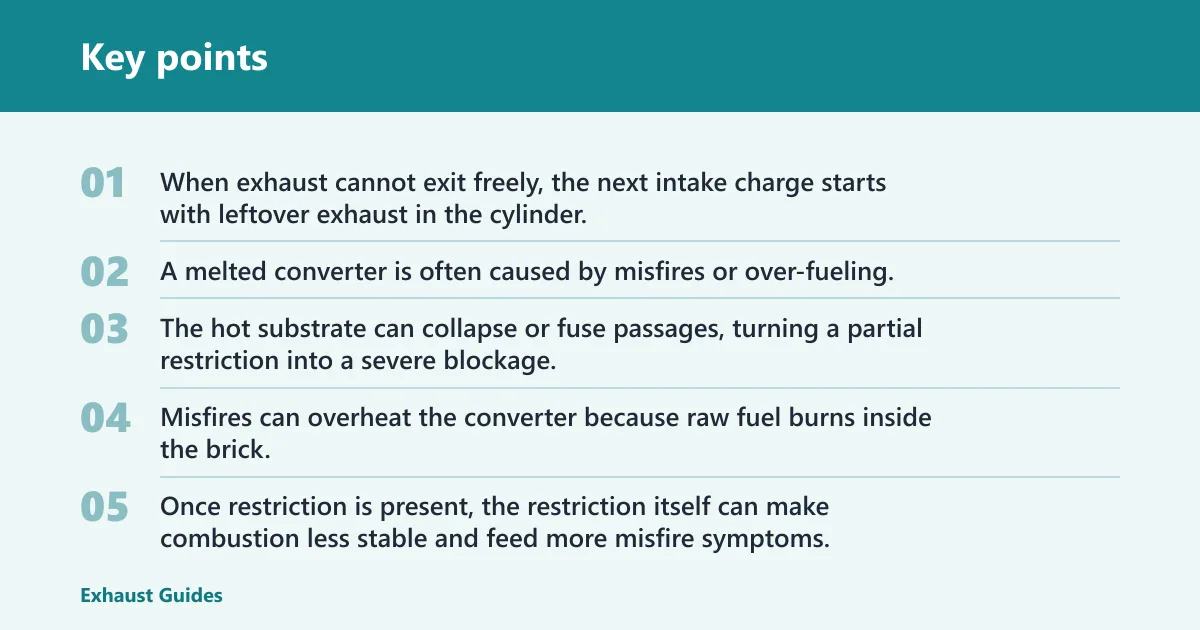
When exhaust cannot exit freely, the next intake charge starts with leftover exhaust in the cylinder. That reduces oxygen available for combustion and can make combustion unstable, especially at idle and under load. The engine may shake, stumble, or stall.
A melted converter is often caused by misfires or over-fueling. The hot substrate can collapse or fuse passages, turning a partial restriction into a severe blockage. That is the point where engine damage risk rises fast.
How misfires can both cause and follow converter trouble
Misfires can overheat the converter because raw fuel burns inside the brick. That extra heat can melt the substrate and create the blockage. Once restriction is present, the restriction itself can make combustion less stable and feed more misfire symptoms.
That loop is why misfire diagnosis belongs before converter replacement. If the spark, fuel, or air problem remains, the new converter can fail the same way.
Suppose a minivan idles smoothly in park but starts shaking and losing power at highway speed, then sets a catalyst code. That pattern can point to rising exhaust backpressure under load, so the next check should be for a blocked converter, not only a sensor issue.
What should you check first?
Start with the likely causes that can mimic converter failure: misfires, fuel trim, and exhaust leaks. Then use temperature comparison and backpressure testing to separate an efficiency problem from a true restriction. That order keeps you from replacing a converter that is only reporting another fault.
Misfires, fuel trim, and exhaust leaks
-
Check for misfires.
Look for rough running, stumble, or stored misfire codes. Fix ignition, injector, or air-leak issues first, because they can damage the converter and also trigger catalyst codes. -
Review fuel trims.
Large positive or negative trims can show a mixture problem that affects catalyst readings. A converter may look bad when the real issue is rich running or unmetered air. -
Inspect for leaks.
Exhaust leaks before the converter can pull in outside air and confuse sensor readings. Repair leaks before calling the converter bad.
Infrared thermometer check
An infrared thermometer is a supporting tool, not proof by itself. It can compare inlet and outlet temperatures on the converter after the engine has run long enough to heat the exhaust. A healthy converter often shows a temperature rise across the unit, but the exact pattern alone cannot confirm a clog.
Exhaust backpressure test
An exhaust backpressure test is commonly used to help confirm a restriction. It helps separate clogging from sensor-related faults because it measures how hard the engine must push exhaust out. If pressure is high, the converter or another exhaust passage is restricting flow.
The temperature check and the backpressure test work best together. If the scan data suggests low efficiency but the backpressure reading is normal, the issue is more likely emissions performance than a blocked exhaust.
How long can you drive with a bad catalytic converter?
How long you can drive depends on the failure mode. A converter with only low efficiency may allow normal driving for a while, although the repair should still be planned. A restricted or melted converter can become an engine-damage problem quickly and should not be ignored.
When limited driving is usually low risk
If the only symptom is P0420 or P0430 with normal power, no stalling, and no overheating, limited driving is usually lower risk. That said, the underlying cause still needs diagnosis because a poisoned or inefficient converter may be the result of a misfire, rich running, or a sensor problem.
When to stop driving now
Stop driving if the engine barely revs, stalls in traffic, or shows heavy power loss with excessive heat under the floor. Those signs suggest major restriction and a real risk of engine damage. A flashing check engine light can also indicate a severe misfire, and that can damage the converter and the engine at the same time.
Frequently asked questions
Does a bad catalytic converter affect the engine?
Yes, but not always in the same way. A converter with only poor efficiency may mostly affect emissions and the check engine light. A converter that is restricted, melted, or broken can raise backpressure, reduce scavenging, and make the engine run hot, rough, or weak.
Does a bad catalytic converter affect engine performance?
Yes, if flow is restricted. Drivers often notice sluggish acceleration, poor fuel economy, rough idle, shaking, or stalling. A converter that has only lost efficiency may not change performance much, which is why P0420 or P0430 does not automatically mean the exhaust is blocked.
Will a bad catalytic converter cause engine damage?
It can, but only in the failure modes that restrict exhaust flow or overheat the exhaust system. The usual path is backpressure, heat, and prolonged misfire or rich running. A converter that only fails the efficiency test is far less likely to damage the engine by itself.
Can a bad catalytic converter ruin your engine?
Yes, if it is severely plugged or melted and you keep driving. That kind of restriction can overheat valves, stress the head gasket, and leave the engine unable to breathe under load. A poisoned converter that still flows normally is much less likely to ruin the engine.
How long can a car last with a bad catalytic converter?
There is no fixed time. A car with only a catalyst-efficiency code may run for weeks or longer if the underlying problem is mild, while a heavily blocked converter can fail the same day. The deciding factor is whether exhaust flow is still normal.
Can a blocked catalytic converter cause engine misfires?
Yes. High backpressure can leave exhaust in the cylinder, weaken combustion, and make the engine misfire, especially under load. Misfires can also be the cause of the blockage, so both directions must be checked before replacing parts.
Does a bad catalytic converter make the check engine light flash?
Usually not. A flashing check engine light is more commonly tied to a severe misfire that can overheat the converter. A bad converter more often sets a steady P0420 or P0430, unless the engine also has a separate fault that is serious enough to flash the light.