
Will a Bad Oxygen Sensor Hurt Gas Mileage?
A bad oxygen sensor can cut gas mileage by roughly 10% to 15% when fuel trim goes wrong, and a dead heater or biased sensor can sometimes do more. Ignoring it can waste fuel, turn on a check-engine light, and hide a richer problem elsewhere. This guide shows how to tell whether the sensor is causing the MPG drop or reacting to another fault.
Why upstream sensor affects mileage most
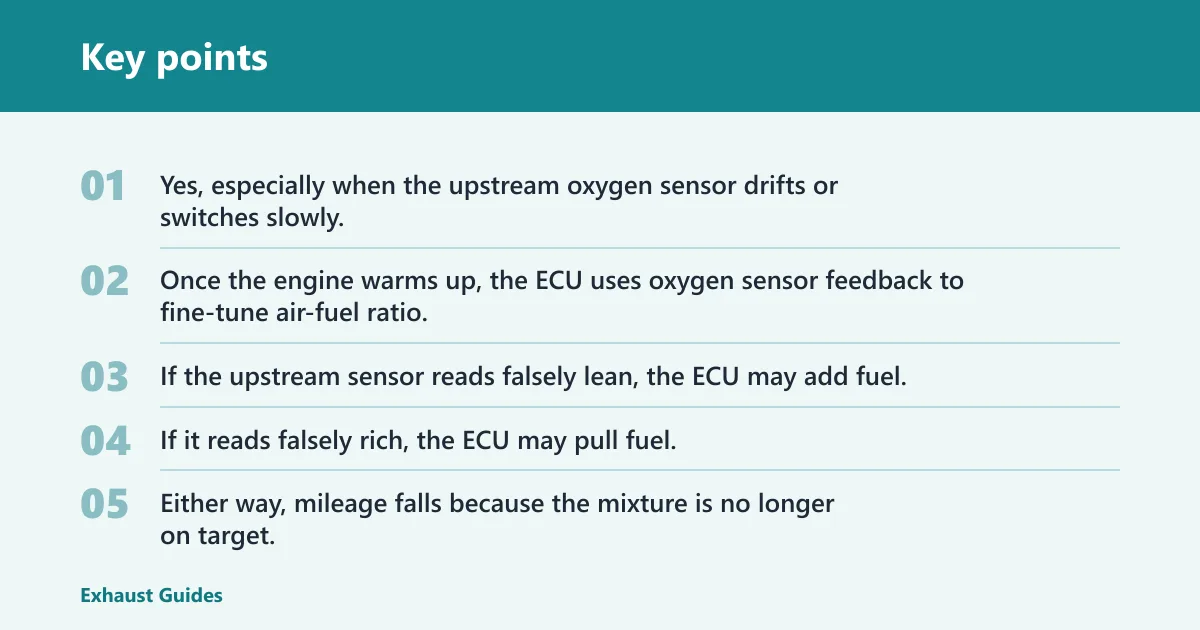


Yes, especially when the upstream oxygen sensor drifts or switches slowly. That sensor sits before the catalytic converter and is commonly the ECU’s main feedback input in closed-loop fueling. A faulty downstream sensor usually has far less direct effect on MPG because it mainly monitors catalyst performance, not fuel trim.
Once the engine warms up, the ECU uses oxygen sensor feedback to fine-tune air-fuel ratio. If the upstream sensor reads falsely lean, the ECU may add fuel. If it reads falsely rich, the ECU may pull fuel. Either way, mileage falls because the mixture is no longer on target.
Why the upstream sensor matters most
The upstream sensor is the primary sensor for fuel trim feedback. A biased or slow sensor can keep the engine slightly rich or slightly lean for long stretches, and that is where fuel economy loss shows up. On many vehicles, a small bias is enough to move short-term fuel trim and then teach long-term fuel trim the wrong correction.
Why the downstream sensor usually does not
The downstream oxygen sensor sits after the catalytic converter and mainly checks catalyst efficiency, not fueling. A downstream-only fault can set a code and confuse diagnosis, but it usually does not create a major MPG drop by itself. If mileage is poor and only the rear sensor is flagged, look harder at the front sensor and the rest of the fuel system.
How oxygen sensors affect fuel mixture
Oxygen sensors help the ECU keep the air-fuel ratio near target after warm-up. In closed-loop operation, the ECU watches the sensor signal, then adjusts injector pulse width to correct rich or lean operation. That is why a bad sensor can hurt gas mileage even when the engine still feels mostly normal.
Short-term fuel trim shows the immediate correction window. Long-term fuel trim shows the learned correction over time. Those two numbers are the fastest way to tell whether the ECU is reacting to a bad sensor signal or to a real mixture problem elsewhere.
Rich and lean corrections through fuel trim
If the ECU thinks the mixture is lean, fuel trim usually goes positive as it adds fuel. If it thinks the mixture is rich, fuel trim goes negative as it removes fuel. The key is pattern recognition: a sensor bias often pushes trims one direction without a matching mechanical cause, while vacuum leaks, MAF errors, or fuel pressure faults tend to create more steady and explainable trim patterns.
What MPG symptoms point to a failing oxygen sensor?
Fuel economy loss is one clue, but it is not the only one. A failing sensor often causes rich-running clues, lean-running clues, or a drop in MPG with very little else obvious. Scan data matters more than guesswork, because the same mileage complaint can come from the sensor, the MAF, a vacuum leak, or fuel delivery trouble.
Rich-running clues
A rich condition can lower MPG, foul plugs, and leave a fuel smell at the tailpipe. On scan data, you may see negative fuel trims, a lazy upstream signal that stays high, or an engine that spends too much time in closed-loop correction after warm-up. Exhaust odor and black soot are stronger hints than a sensor code alone.
Lean-running clues
A lean condition can also hurt mileage because the ECU may add fuel to compensate, especially at idle or cruise. Positive fuel trims, hesitation on tip-in, rough idle, or surging at steady speed point away from a simple sensor-only fault and toward unmetered air, low fuel pressure, or a sensor that reads low when it should not.
When MPG drops without obvious drivability problems
That is common. A small upstream sensor bias may not create a rough idle or misfire, but it can still shift fuel trim enough to waste fuel over time. Picture a 2.4-liter engine that loses 3 to 5 mpg, runs smoothly, and stores no code yet; that is exactly when scan-tool data becomes more useful than seat-of-the-pants diagnosis.
Oxygen sensor MPG decision table
The table below separates likely causes by trim pattern, code family, and what to test next. It is meant to keep you from replacing an oxygen sensor when the real problem is elsewhere.
| Likely cause | Typical MPG impact | Likely fuel-trim direction | Common codes | Next best test |
|---|---|---|---|---|
| Upstream O2 sensor bias or slow response | Moderate; often 5% to 15% | Either positive or negative, often unstable or slow to change | P0130-P0167 family, plus fuel-trim or catalyst efficiency codes | Watch live O2 switching and compare short-term fuel trim at idle and 2,500 rpm |
| Downstream-only sensor fault | Usually small or none | Usually little effect on trims | P0136-P0167 family | Check upstream sensor behavior before replacing the rear sensor |
| Vacuum leak | Moderate to large, especially at idle | Positive at idle, often better at higher rpm | P0171, P0174, lean codes, sometimes misfire codes | Smoke test intake, inspect PCV hoses, brake booster line, and intake boots |
| MAF error | Moderate | Often positive or erratic across idle and cruise | P0100-P0104, fuel-trim codes, sometimes misfire codes | Compare grams per second to engine size and check for contamination or intake leaks |
| Fuel pressure regulator or injector fault | Moderate to large | Low pressure usually positive; leaking injector often negative | P0172, P0175, misfire codes, fuel-trim codes | Measure fuel pressure, watch leak-down, and check for wet plugs or fuel odor |
| Stuck thermostat or open-loop operation | Moderate in short trips | Trims may stay inactive or delayed until warm-up | Coolant temp codes, thermostat codes, sometimes none | Confirm coolant reaches normal operating temperature and closed loop turns on |
| Injector leakage | Moderate to large | Often negative at idle; may worsen after shutdown | P0172, misfire codes, fuel-trim codes, fuel odor | Check fuel pressure decay, plug appearance, and injector balance if available |
Can fuel economy drop without an O2 sensor code?
Yes. MPG can fall before a code appears because the ECU may still be correcting within its allowed range. A sensor can drift slowly, the engine may stay just inside a threshold, or another fault can create a mixture problem that does not trigger a direct oxygen-sensor code. Not every MPG problem sets a warning light.
Look for the P0130-P0167 family, but do not stop there. Fuel-trim codes, misfire codes, MAF codes, and coolant-temperature codes can all explain bad mileage better than an oxygen sensor code alone. An OBD-II scanner is the right starting point, but live data is what separates cause from symptom.
How can you tell if the O2 sensor is not the real cause?
Use the trim pattern and engine conditions. A bad sensor can mimic a rich or lean problem, but vacuum leaks, MAF errors, fuel pressure faults, injector leakage, and a stuck thermostat each leave different clues. The goal is to match the code, the trim direction, and the operating condition before replacing parts.
-
Check closed-loop status.
Warm the engine fully and confirm the ECU enters closed loop. If it stays open loop too long, the sensor may be fine and the problem may be coolant-temperature related, especially on short-trip vehicles. -
Read short-term and long-term trims.
Look at idle, steady cruise, and 2,500 rpm. Positive trims at idle that improve with rpm often point to a vacuum leak; trims that stay off across the range can point to MAF or fuel delivery trouble. -
Compare upstream sensor activity.
A healthy upstream sensor should switch rapidly once warm. If it is slow, biased, or stuck high or low while trims chase it, the sensor is a stronger suspect. -
Rule out air leaks first.
Smoke-test the intake, inspect the PCV system, and check brake-booster hoses and intake boots. Vacuum leaks can force positive trims and look like a lean O2 issue. -
Check fuel delivery next.
Measure fuel pressure against spec and watch for pressure drop after shutdown. A weak pump, bad regulator, or leaking injector can cause rich or lean correction that resembles sensor failure.
A common first-timer mistake is replacing the front oxygen sensor because the fuel economy dropped on a highway commute, then discovering the MAF was underreporting airflow. A 2.0-liter engine with a dirty MAF can show positive trims and poor MPG even though the front O2 sensor is simply reporting the wrong mixture the ECU created.
Suppose a 3.5-liter engine shows 18 mpg instead of 24 mpg, with short-term fuel trim near zero at cruise but long-term fuel trim strongly negative. That pattern points more toward a rich-running issue such as injector leakage or excessive fuel pressure than a sensor that is merely “bad.”
When should you replace the oxygen sensor?
Replace the sensor when the data points to the sensor, not just because mileage dropped. A confirmed slow or biased upstream sensor, a heater failure in the P0130-P0167 range, or a sensor that tracks poorly while the rest of the engine checks out is a solid reason to replace it. If another fault is creating the mixture problem, fix that first.
Do not rush to replace the rear sensor for MPG complaints. The downstream sensor is usually not the direct cause of poor fuel economy. If the code and trims point to the front sensor, repair that one. If the trims point elsewhere, the oxygen sensor may be reacting correctly to a different fault.
Frequently asked questions
Will a bad oxygen sensor affect gas mileage?
Yes. A bad upstream oxygen sensor can change fuel trim enough to lower MPG, especially once the engine is in closed loop. A downstream sensor usually has much less direct effect on mileage. If the trim data does not support a sensor fault, look for another richer-running problem first.
Can a bad oxygen sensor affect gas mileage?
Yes, and the upstream sensor is the one that matters most. If it reads biased or slow, the ECU may add or subtract fuel incorrectly. That can hurt MPG even if the engine still runs smoothly and no check engine light is on yet.
How much does a bad O2 sensor affect gas mileage?
A common rule of thumb is about 10% to 15% when fuel trim is wrong, though a dead heater or badly biased sensor can do more. The actual loss depends on whether the fault is upstream, whether the ECU stays in closed loop, and whether another problem is also present.
Does an O2 sensor affect gas mileage?
Yes, but mainly the upstream sensor does. It feeds the ECU the information used for real-time fueling corrections. The downstream sensor mainly monitors the catalytic converter, so it is less likely to be the direct reason mileage falls.
How can I tell if the O2 sensor or something else is causing bad gas mileage?
Use trim direction and operating conditions. Positive trims at idle that improve with rpm often point to a vacuum leak, while steady off-target trims can point to MAF or fuel pressure issues. If the upstream O2 signal itself is slow or biased, and other systems check out, the sensor becomes the better suspect.