How to Test a Catalytic Converter Without Removing It
Test a catalytic converter without removing it by checking for a 2–3 psi exhaust backpressure rise at 2,500 rpm, comparing upstream and downstream O2 readings, and ruling out exhaust leaks first. Miss this diagnosis and you can replace a good converter, chase the wrong code, or keep driving with a real restriction that overheats the engine. This guide gives you a no-removal step-by-step path for catalyst efficiency, exhaust restriction, and sensor or leak faults.
What you’ll need


- OBD2 scanner or scan app with live data and freeze-frame access
- Infrared thermometer
- Vacuum gauge or exhaust backpressure gauge
- Basic hand tools for shield, clamp, and sensor access
- Safety glasses and heat-resistant gloves
- Wheel chocks and a level parking spot
📊 wikiHow estimates catalytic converter cleaner usually costs between $15 and $20 USD. Source: Wikihow.
Catalyst test matrix
Use this table to sort the problem before you blame the converter. A code like P0420 or P0430 points to a failed catalyst-efficiency check, not automatic clogging. A converter can also be physically restricted without setting a code, so symptoms still matter.
| Symptom | Scan-data pattern | Simple home check | Likely fault | Next action |
|---|---|---|---|---|
| P0420 with normal power | Downstream O2 switches too much; fuel trims near normal | Check for recent battery disconnect or exhaust leak | Efficiency loss, bad O2 data, or leak | Inspect leaks, then compare sensor behavior again |
| P0420 with power loss | Load rises, rpm falls, rear O2 may flatten | Hold 2,500 rpm in Park and watch for restriction signs | Restriction or melted substrate | Measure backpressure or vacuum drop |
| Rotten egg smell | May show rich trims or misfire history | Check for raw-fuel smell at tailpipe after a short idle | Converter overheat or rich running | Fix rich condition or misfire first |
| Rattling from the converter | Often no code, or a catalyst code after damage | Tap the shell lightly when cool | Broken honeycomb substrate | Plan replacement after root-cause check |
| Flashing CEL and loss of power | Misfire codes or severe fuel-trim swings may appear | Scan for misfire counts right away | Active misfire can overheat the converter | Stop driving when safe and inspect |
| Rear O2 mirrors front O2 | Upstream and downstream waveforms look nearly the same | Confirm no exhaust leak ahead of the converter | Bad converter or leak upsetting the test | Repair leaks, then repeat live-data check |
| Exhaust leak upstream of the converter | O2 data looks lean or unstable | Look for ticking, soot, or gasket noise on cold start | Leak, not converter failure | Seal the leak before retesting |
| No-code restriction | No DTCs, but rpm climbs slowly under load | Watch for weak high-rpm pull on a short road test | Physical restriction without a code | Do a backpressure or vacuum test |
How do you test a catalytic converter without removing it?
Read codes, check live data, compare temperatures, and measure backpressure before you replace anything. Start with OBD2 data, then move to temperature and pressure checks only if the symptoms fit restriction. That keeps you from mistaking an O2 sensor fault or exhaust leak for a clogged converter.
Step 1: Read codes and freeze-frame data
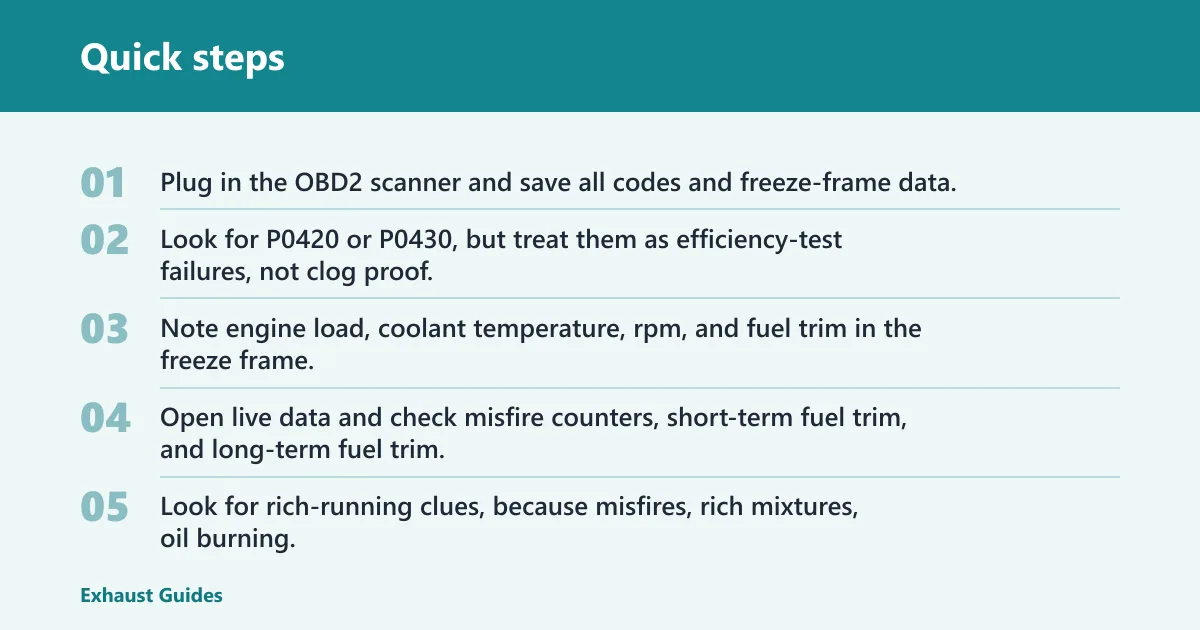
- Plug in the OBD2 scanner and save all codes and freeze-frame data.
- Look for P0420 or P0430, but treat them as efficiency-test failures, not clog proof.
- Note engine load, coolant temperature, rpm, and fuel trim in the freeze frame.
Step 2: Check for misfires and fuel-trim clues
- Open live data and check misfire counters, short-term fuel trim, and long-term fuel trim.
- Look for rich-running clues, because misfires, rich mixtures, oil burning, and coolant leaks can damage the converter.
- If misfires are active, fix them first.
Step 3: Compare upstream and downstream O2 activity
- Warm the engine fully and view upstream and downstream O2 sensor data side by side.
- Watch for the downstream sensor mirroring the upstream sensor too closely.
- If the pattern is suspicious, inspect for an exhaust leak before condemning the converter.
Step 4: Check converter inlet and outlet temperature
- With the engine warm, aim an infrared thermometer at the converter inlet and outlet.
- Check for a hotter outlet than inlet after a steady cruise or a 2,500 rpm hold.
- If the converter is cold at both ends while the engine is running well, keep looking for sensor or leak problems.
Step 5: Measure exhaust backpressure or vacuum drop
- Install a backpressure gauge at the upstream O2 sensor port or use a vacuum gauge at the intake manifold, following the vehicle service procedure.
- Run the engine at about 2,500 rpm and watch for roughly a 2–3 psi rise in exhaust backpressure.
- If pressure climbs faster than that, or vacuum drops steadily under load, suspect restriction.
Step 6: Rule out exhaust leaks and sensor faults
- Inspect joints, flange gaskets, flex pipes, and sensor bungs for soot or ticking.
- Repair leaks first, then clear codes and repeat the live-data test.
- If the rear O2 still tracks the front O2 and the pressure test supports restriction, the converter is the stronger suspect.
Can a P0420 code mean a clogged converter?
Yes, but only as a possibility, not proof. P0420 means the catalyst system failed an efficiency check, and P0430 means the same thing on the other bank. A clogged converter is one possible cause, but sensor faults, exhaust leaks, and engine damage can produce the same code.
Why P0420 is an efficiency code
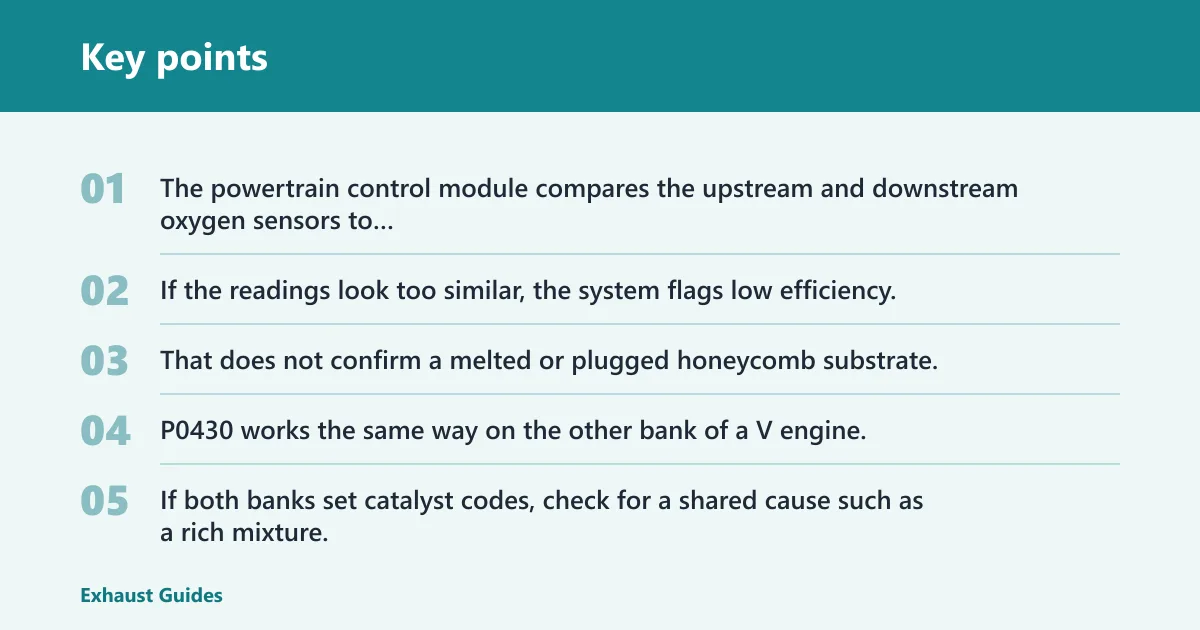
The powertrain control module compares the upstream and downstream oxygen sensors to judge how well the converter is storing oxygen and cleaning exhaust. If the readings look too similar, the system flags low efficiency. That does not confirm a melted or plugged honeycomb substrate.
When P0430 follows the same logic
P0430 works the same way on the other bank of a V engine. If both banks set catalyst codes, check for a shared cause such as a rich mixture, recent battery disconnect, or a leak affecting both sides before buying parts.
Why sensor faults and leaks can fake the result
A sluggish downstream sensor can mimic a bad converter. An upstream exhaust leak can sometimes skew oxygen readings and distort the test. Modified exhausts and some high-flow converters also change normal sensor patterns, so stock-system expectations do not always apply.
What symptoms show a restricted converter?
Loss of power under load is the best symptom clue for restriction, especially when the engine feels weak at higher rpm. A restricted converter can also cause poor fuel economy, a rotten egg smell, overheating, and a rattling shell if the substrate has broken apart.
Power loss at higher rpm
If the engine pulls fairly well at idle but falls flat on hills or during hard acceleration, suspect a flow problem. That is when a backpressure test matters most. A restriction check without supporting symptoms wastes time.
Rattling or broken substrate noise
A rattle often means the honeycomb substrate has cracked or broken loose. It is not proof of clogging by itself. A loose substrate can rattle before it plugs the outlet, or it can rattle after overheating damage.
Rotten egg smell
That smell points to sulfur compounds reaching the converter and overheating it. A converter can fail from misfire, rich running, oil entry, or coolant contamination, so the smell should trigger engine-side diagnosis, not just parts replacement.
Poor fuel economy and overheating
When the engine runs hot and mileage drops, check for misfires, rich fuel trim, and exhaust restriction. A flashing Check Engine Light plus serious symptoms means stop driving when safe and inspect the vehicle.
Suppose a 4-cylinder sedan shows P0420, but it still accelerates normally and the rear O2 only drifts during cruise. That leans toward an efficiency or sensor issue, not a hard clog. Now change one variable: add a ticking exhaust leak near the manifold, and the O2 data can look bad even though the converter is fine.
Common mistakes
These errors lead to bad parts swaps and missed engine problems. Fix the cause first, then judge the converter.
- Replacing the converter before checking misfires, rich running, oil burning, or coolant leaks
- Using cleaner for melted, cracked, or physically broken substrate
- Ignoring exhaust leaks or a bad O2 sensor
- Assuming a code proves clogging
- Driving with flashing CEL and serious power loss
- Trusting scan data alone on a modified exhaust or high-flow converter
If that didn’t work, try this next
If the scan data looks clean but the car still feels strangled, move from light diagnosis to direct pressure testing. That sequence catches physical restriction that a code may miss, and it helps separate converter failure from sensor or leak noise.
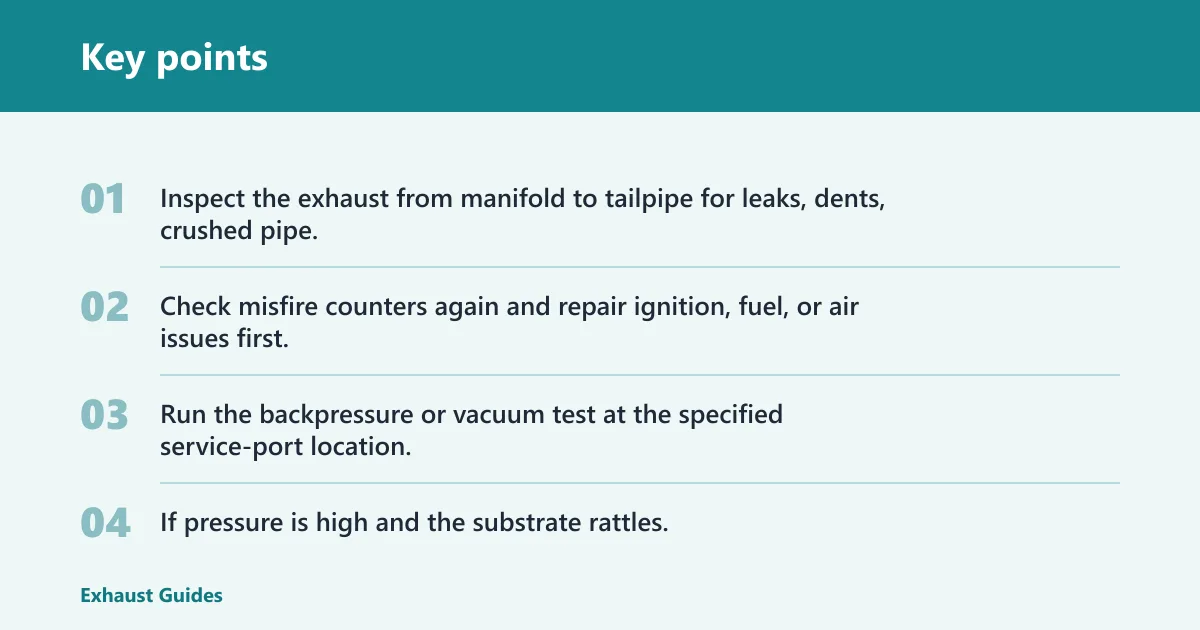
- Inspect the exhaust from manifold to tailpipe for leaks, dents, crushed pipe, or loose heat shields.
- Check misfire counters again and repair ignition, fuel, or air issues first.
- Run the backpressure or vacuum test at the specified service-port location.
- If pressure is high and the substrate rattles, plan converter replacement after the engine fault is fixed.
Try a catalytic converter cleaner only for mild deposit-related issues. wikiHow says to pour it into a gas tank that is one-quarter full, then drive about 15 minutes. It usually costs between $15 and $20 USD, but it will not repair a melted, cracked, or physically restricted converter.
Picture a truck that sets P0420 after a battery change. The scan tool shows normal fuel trims, but the rear O2 mirrors the front O2 and there is a soot mark at the upstream flange. That points to an exhaust leak path first. Change only that variable, retest, and the code may vanish without touching the converter.
Prevention is simple here: fix misfires fast, keep the engine from running rich, and repair leaks before they bake the converter again.
Frequently asked questions
How do I confirm a catalytic converter problem before replacing it?
Use three checks together: live O2 data, a temperature comparison, and a backpressure or vacuum test. If the rear sensor mirrors the front sensor, the outlet is not hotter than the inlet, and pressure rises abnormally under load, the converter deserves suspicion after leaks and misfires are ruled out.
Can a catalytic converter cleaner help if the converter is clogged?
It can help only if the issue is mild deposit buildup, not physical damage. Pour it into a quarter-full tank, drive about 15 minutes, and retest. If the substrate is melted, cracked, or loose, the cleaner will not change the result. (Wikihow)
How do I tell the difference between a bad O2 sensor and a bad catalytic converter?
A bad sensor often gives erratic or implausible readings without matching driveability symptoms. A bad converter usually shows a rear O2 signal that follows the front O2 too closely, plus possible power loss or smell. Swapping sensor banks or checking for exhaust leaks helps separate the two.
What tools can I use to test exhaust backpressure at home?
A dedicated backpressure gauge is the cleanest option, and a vacuum gauge can help when used according to service data. Connect at the upstream O2 sensor port or manifold test point, then compare readings at idle and around 2,500 rpm. Follow the vehicle procedure for the exact port and limits.
When should I stop driving with a suspected clogged catalytic converter?
Stop driving when the Check Engine Light flashes, power falls off hard, or the exhaust smells hot and rotten. Those signs can mean the converter is overheating or blocking flow. Shut the engine down once it is safe and inspect the vehicle before more damage happens.
What does a rattling catalytic converter mean?
A rattle usually means the honeycomb substrate has broken or come loose inside the shell. That is mechanical damage, not just a bad efficiency reading. Rattle does not prove a clog by itself, but it often means the converter is damaged enough to fail soon.