
Are Muffler Deletes Legal on Motorcycles: State Law Basics
A motorcycle muffler delete is legal only where your state allows it and the bike still meets federal emissions rules, state muffler and equipment rules, and local noise limits. Ignore those rules and you can get tickets, fail inspections, and be told to swap the exhaust back to a compliant part. This guide breaks down the three layers, then shows you how to check a part before you buy it.
Motorcycle exhaust legality checklist
Use this checklist before you order a part or unbolt anything. It separates the three legal layers that matter most: federal emissions, state equipment rules, and local noise limits. Keep the paperwork that matches your bike, your state, and the exact exhaust part number.
| Check | Federal emissions | State equipment | Local noise | Documentation to keep |
|---|---|---|---|---|
| Muffler present? | Yes if removing it also alters emissions controls on your model. | Yes if your state requires an OEM-style muffler or approved equivalent. | Yes if the city or county uses a muffler or sound rule. | Part listing, install sheet, and any compliance marking. |
| Catalyst retained and functional? | Yes when the original emission controls stay connected and working. | Some states still inspect visible equipment. | Usually separate from noise checks. | EO label, emissions label, and shop invoice. |
| Sound limit met? | Federal noise rules mainly cover manufacturers and sale or import compliance. | State law may set a muffler or equipment standard. | Yes if your area sets a dB limit or uses idle or drive-by testing. | dB limit, inspection sticker, and any local permit or exemption. |
| Off-road or dual-sport use? | Federal tampering rules still matter if emissions parts are changed. | Trail rules may require equipment that street rules do not. | Noise rules can still apply near roads or mixed-use areas. | Spark arrestor proof and trail-use paperwork. |
Yes/no path: If the answer is no on any row, treat the part as a risk until you confirm the exact state and local rule. If the answer is yes across all three layers, keep the proof with the bike and the sales receipt.
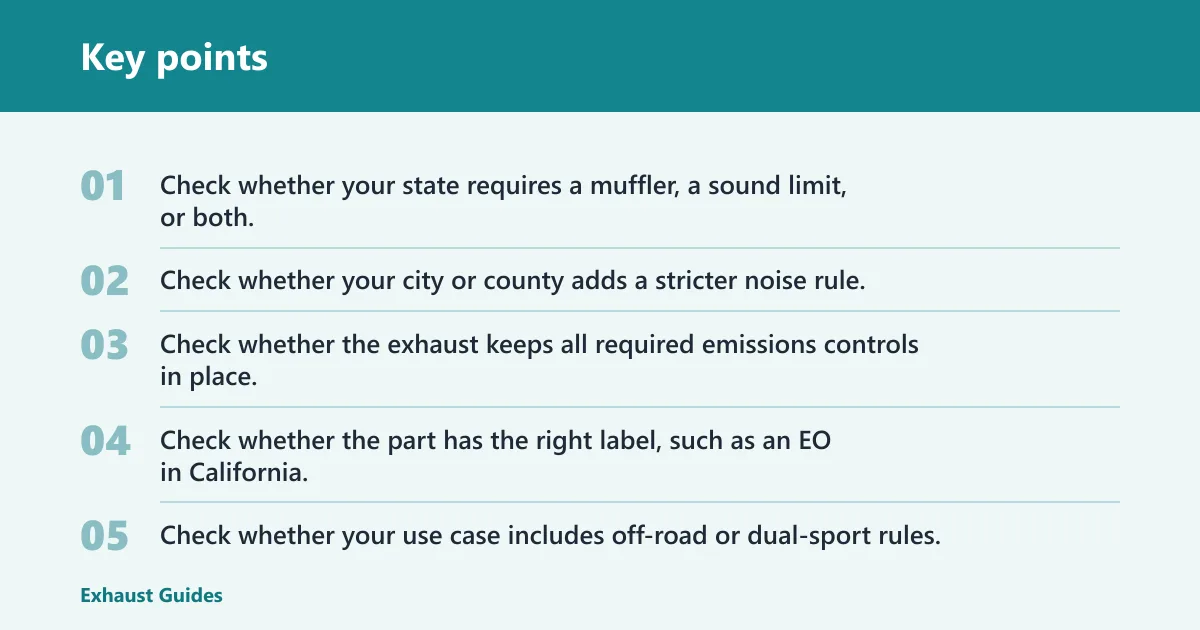
- Check whether your state requires a muffler, a sound limit, or both.
- Check whether your city or county adds a stricter noise rule.
- Check whether the exhaust keeps all required emissions controls in place.
- Check whether the part has the right label, such as an EO in California.
- Check whether your use case includes off-road or dual-sport rules, including a spark arrestor.
What counts as a muffler delete?
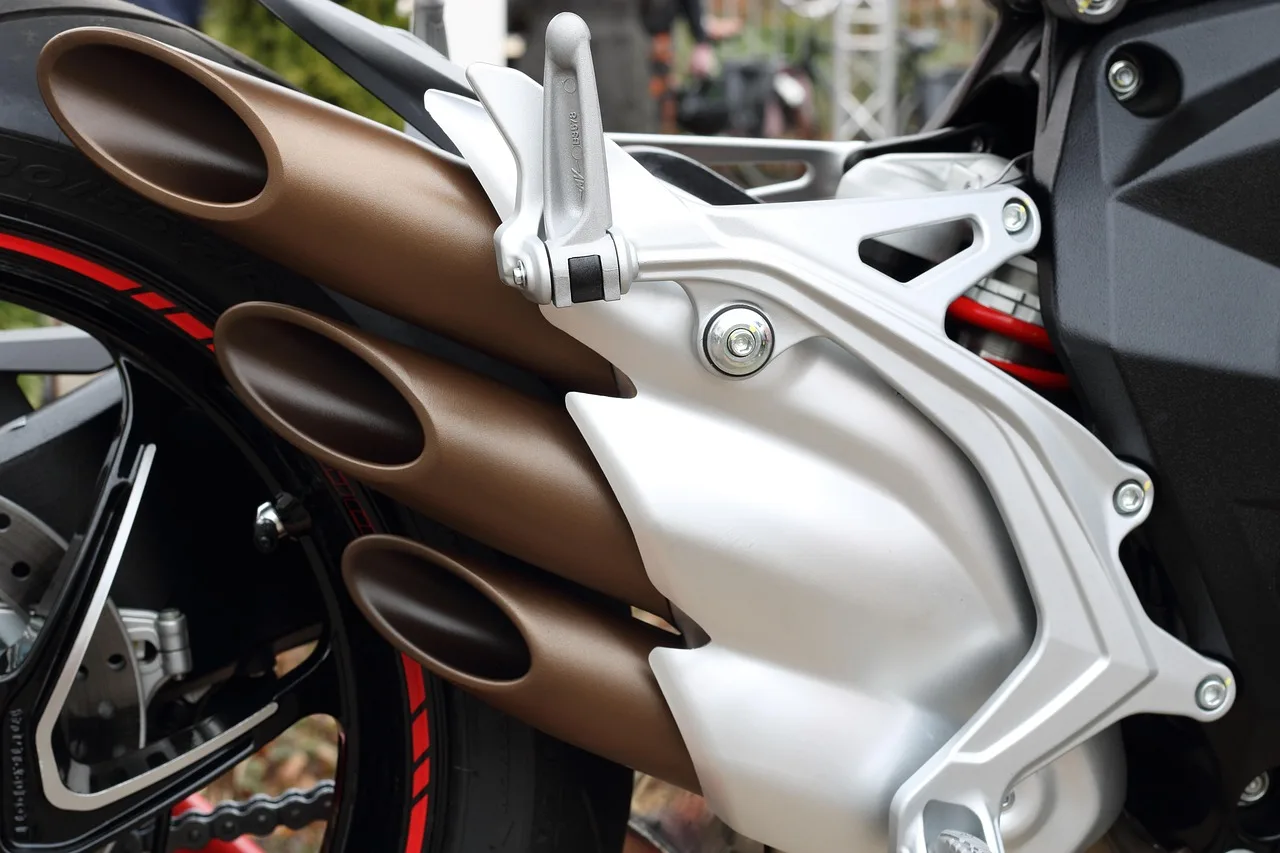
A muffler delete removes the muffler but leaves the rest of the exhaust system in place. A straight pipe replaces the muffler with plain tube, and it is usually the louder option. That difference matters because the louder setup is more likely to trigger noise-law problems and roadside attention.
Muffler delete vs. straight pipe
The two terms are not the same. A muffler delete removes only the muffler, while a straight pipe can remove the muffler and often the resonator too. On many bikes, that can be loud, and a straight pipe is often more likely to exceed a local sound limit.
Stock exhaust is typically quiet. A muffler delete usually sits in the loud range, and the sound can rise sharply under throttle. Sustained exposure above 85 dB can damage hearing over time, so the rider and nearby traffic both feel the change.
Slip-on mufflers vs. full systems
Aftermarket motorcycle exhausts usually fall into two broad categories: slip-on mufflers and full systems. A slip-on replaces the muffler section. A full system changes more of the exhaust path, so it may be more likely to affect emissions equipment and labeling requirements.
That is why the same bike can have a legal-looking part on paper and still end up out of compliance in the wrong state. The part category matters as much as the sound level.
Are muffler deletes legal in your state?
Maybe, but only if your state’s equipment law allows the setup and your local noise rule does not ban it. State muffler laws vary widely. Some focus on equipment, some on sound level, and some let local ordinances go stricter than the state rule.
State noise limits and equipment rules
State laws often do one of two things: require a muffler or set a maximum sound level. A bike can satisfy one and still fail the other. That is why a legal part in one state can be a citation risk in the next state over.
Inspection rules add another layer. Some places check the exhaust at registration or safety inspection time, while roadside enforcement can still happen later if the bike is loud enough to violate the local rule.
Local ordinances can be stricter
Local noise ordinances can be tighter than state law. A bike may clear a general state equipment rule and still violate a city dB limit, especially where the limit is enforced at idle or by a drive-by test.
Say your bike passes a state inspection with the original muffler removed but the plate and lights are fine. If the city uses a low sound limit downtown, the bike can still draw a ticket on the road. The inspection result does not erase the local rule.
Do emissions rules still apply?
Yes. Federal EPA tampering rules apply to emissions equipment, not just sound. Removing or altering catalytic converters or sensors can be illegal even if the exhaust is not unusually loud. Noise legality and emissions legality are separate questions, and you need both answers.
Catalytic converters and sensors
If the motorcycle was originally equipped with catalysts, the catalysts can be retained for replacement-part treatment. CARB also considers some aftermarket exhausts replacement parts when the original emission controls are reconnected and functioning. That distinction matters because a quiet pipe can still be a tampering problem if it changes the emission system.
For street bikes, check whether the part keeps all required sensors and catalytic hardware in place. If it does not, the risk is not limited to a noise ticket.
Why noise and emissions are separate
A bike can be loud and still keep its emissions equipment. It can also be quiet and still violate emissions rules if it deletes or disables a catalyst or sensor. That is why a “legal loud” setup is usually a compliance question, not a sound-only question.
California and CARB rules
California is often stricter than many states on aftermarket exhausts. CARB can treat a motorcycle exhaust as a replacement part, a modified part with an Executive Order, or a racing-vehicle-only part. An EO is California approval, not a universal federal approval.
Executive Order labels
For California riders, the EO label is one of the first things to check. It shows that a modified part has the California approval tied to that part number and use case. The MIC document is described as helping clarify California exhaust use and sale rules, and it specifically addresses aftermarket exhaust systems for motorcycles and ATVs in California.
Do not assume that an aftermarket can of the right shape is legal just because it fits. In California, the label and category matter.
Replacement parts vs. modified parts vs. racing-only parts
California-approved aftermarket exhausts can be replacement parts, modified parts with an Executive Order, or racing-vehicle-only parts. CARB considers some aftermarket exhausts replacement parts if original emission controls are reconnected and functioning. Racing-only language does not make a street bike legal for street use.
What matters is the part’s stated use. If the seller says “race use only,” that is a warning sign for a road bike, not a loophole.
Can you get ticketed after passing inspection?
Yes. A bike can pass a paperwork check or a station inspection and still get a roadside ticket for noise. Inspection and roadside enforcement are different events. The first checks whether the bike meets a station standard; the second checks whether the bike violates a live noise rule in traffic.
Idle tests and drive-by sound checks
Some places use idle sound limits. Others use drive-by tests or officer observation under a local ordinance. That means a bike can look fine on the forms and still be cited later if the sound level exceeds the local limit in real traffic.
A common first-timer mistake is to treat an inspection sticker as a free pass for any exhaust part. It is not. The sticker helps with registration or station compliance, but it does not cancel a city noise rule or a federal emissions problem.
What a ticket can lead
Tickets are only part of the risk. Depending on the rule, a rider may also face a fix-it notice, an inspection failure at the next check, or a forced exhaust swap back to a compliant part.
What to check before you buy
Before you buy, ask for the exact part number and the exact use category. Then compare that paperwork against your state rules, your city noise rule, and your bike’s emissions equipment. The best time to avoid a compliance problem is before the box ships.
Questions to ask a shop or seller
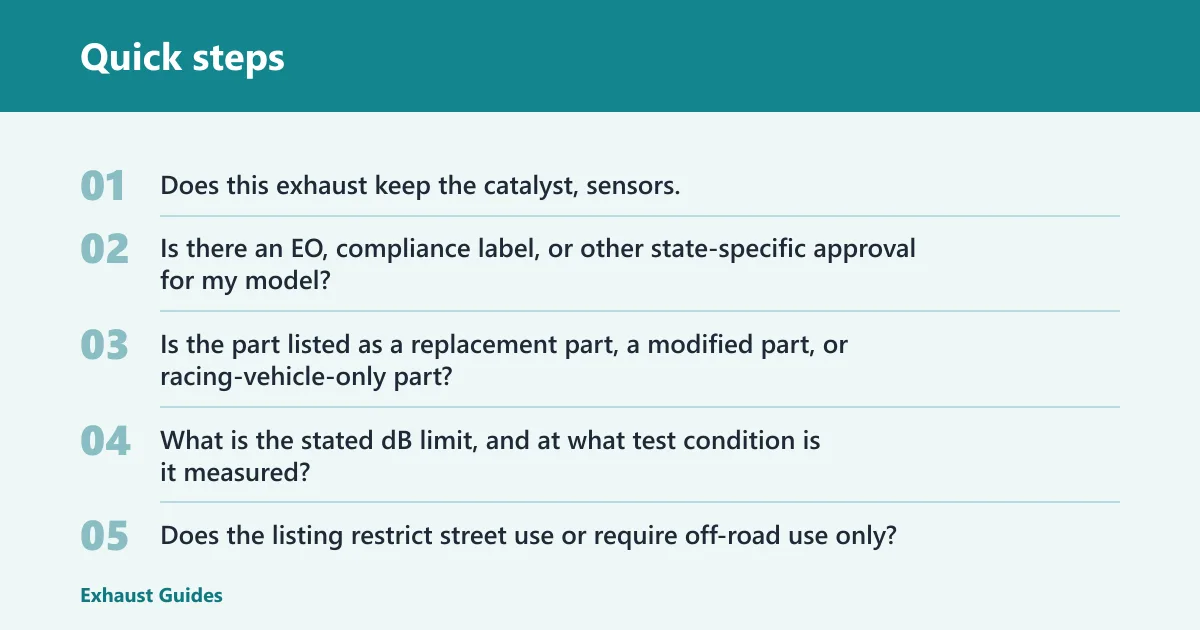
- Does this exhaust keep the catalyst, sensors, and any other original emissions equipment in place?
- Is there an EO, compliance label, or other state-specific approval for my model?
- Is the part listed as a replacement part, a modified part, or racing-vehicle-only part?
- What is the stated dB limit, and at what test condition is it measured?
- Does the listing restrict street use or require off-road use only?
- Is a spark arrestor required for my dual-sport or off-road use case?
Documentation to keep with the bike
- EO label or other compliance marking
- Inspection sticker or proof of a passed station check
- Purchase invoice with the exact part number
- dB limit or sound-test statement from the seller
- Any racing-use exception or off-road restriction
- Spark arrestor paperwork for trail use, if required
Picture a dual-sport rider who wants a quieter trail setup for a 300 cc bike. The exhaust may be fine for the trail only if the spark arrestor is present, but that does not automatically make it street legal. The rider still has to check emissions hardware, local noise rules, and any road-use restriction printed on the part.
Frequently asked questions
Are muffler deletes legal on motorcycles in my state?
They can be legal in one state and illegal in another. The answer depends on your state’s muffler rule, any local noise ordinance, and whether the bike still meets emissions requirements. Do not rely on the seller’s “fits all states” language without checking your own law.
Do motorcycle exhaust laws depend on state or local noise rules?
Yes. State laws set the baseline, but local ordinances can be stricter. A motorcycle may satisfy a state equipment rule and still violate a city dB limit or a roadside noise rule. That is why you need both the state and the local layer before you buy.
Is a muffler delete the same as a straight pipe on a motorcycle?
No. A muffler delete removes the muffler but leaves the rest of the exhaust system in place. A straight pipe replaces the muffler with plain tube, and it is usually the louder option. That extra noise makes a straight pipe more likely to trigger enforcement.
Can I get ticketed for a loud motorcycle exhaust even if it passed inspection?
Yes. Inspection results do not end roadside enforcement. A bike can pass a station check and still be cited later if the local noise rule is enforced at idle or by drive-by testing. Keep the inspection proof, but do not treat it as a free pass.
Does removing the muffler affect emissions compliance on motorcycles?
It can. The muffler itself is not always the emissions device, but a delete can still coincide with catalyst or sensor changes that trigger EPA tampering concerns. If the bike originally had catalysts, keep them where the law allows, and confirm that all original emission controls still function.
Are there states that require an OEM-style muffler or spark arrestor?
Yes, some states and trail systems require equipment that matches the original style or the off-road use rule. Spark arrestor rules are separate from street muffler rules and matter most on off-road or dual-sport bikes. Check both the road law and the trail rule before buying parts.
What’s the difference between a legal aftermarket exhaust and an illegal delete?
A legal aftermarket exhaust keeps the required emissions controls, meets the state or local sound rule, and carries the right approval or label where required. An illegal delete removes the muffler without meeting those rules. In California, that can also mean the wrong CARB category or no valid EO.
How do I check if my motorcycle exhaust is legal before buying parts?
Check the part category, the emissions hardware it keeps, the sound limit, and any state-specific approval such as an EO in California. Then compare that information with your state and city rules. If the seller cannot show the exact part number and use restriction, treat it as a risk.
Does California treat motorcycle aftermarket exhausts differently from other states?
Yes. California uses CARB rules that can classify an exhaust as a replacement part, a modified part with an Executive Order, or a racing-vehicle-only part. That system is stricter than many states, and the EO label matters because it shows California approval for the exact part and use case.


