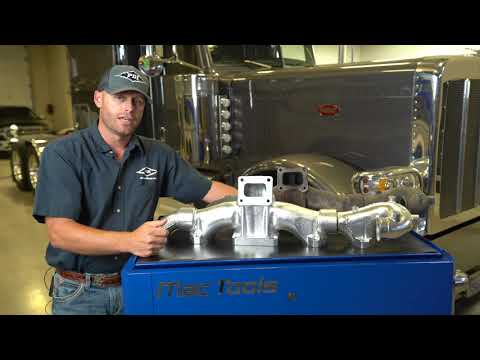
Muffler Delete Average Cost
A muffler delete removes the factory muffler from the exhaust system and replaces that section with straight tubing, usually by cutting, welding, or clamping in a new pipe. At a shop, it usually falls in the rough $50 to $250 range for basic labor and pipe work, though the total can rise quickly when rust, custom bends, or welding are involved. The immediate change is a louder exhaust note, with a deeper tone and sharper throttle bark. In areas with strict noise rules, that louder pipe can create legal trouble fast.
Most shops treat it as a simple exhaust fabrication job, not a full system replacement. That means the quote depends on the pipe length, how the factory exhaust is routed, and whether the car needs a clean reuse of hangers, tips, or a rear section.
What is a muffler delete?
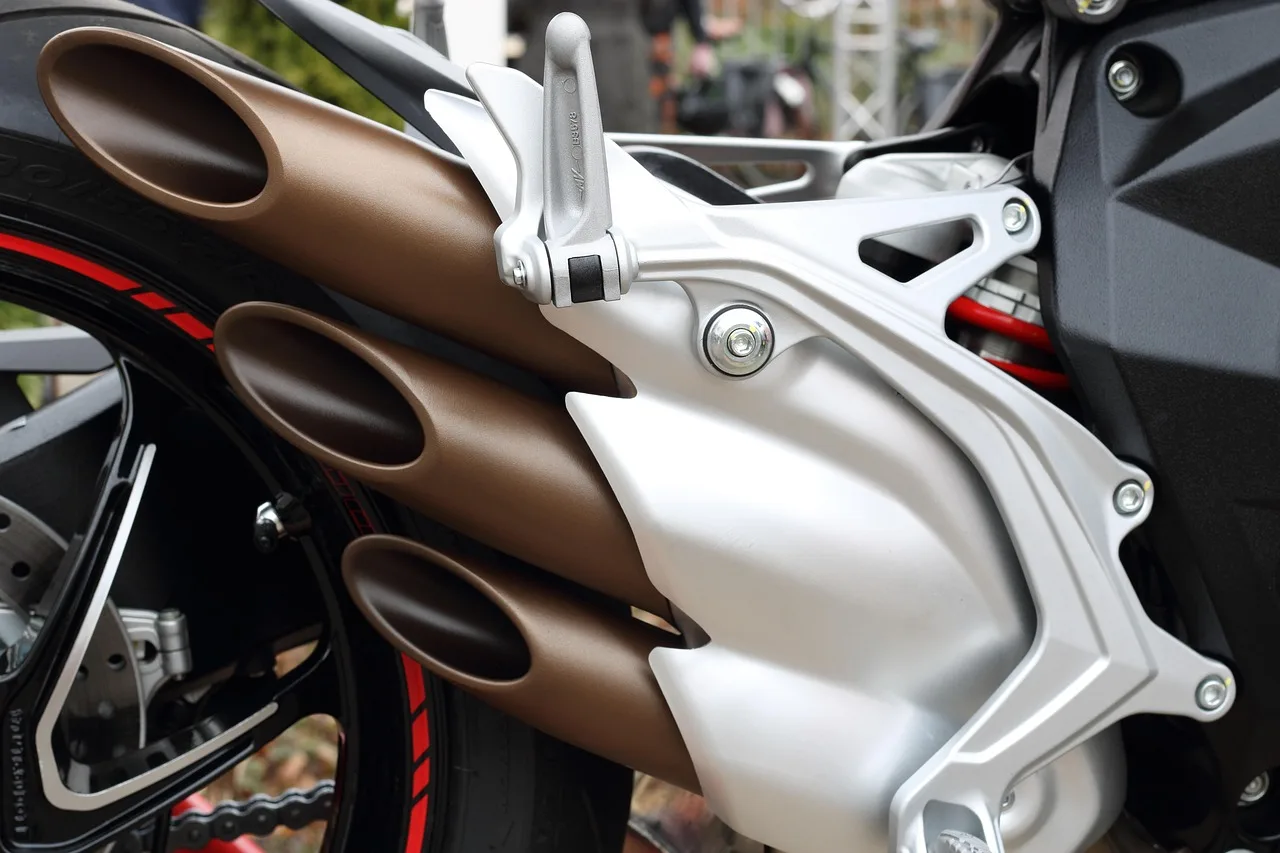


How much is a muffler delete?
At a shop, a muffler delete usually falls in the rough $50 to $250 range for basic labor and pipe work, though the total can rise quickly when rust, custom bends, or welding are involved. Parts-only material costs are lower, yet labor and hidden rework often decide the final bill more than tubing price.
Quotes differ because one shop may offer a quick cut-and-clamp job while another builds a cleaner welded section with better fitment. A lower number can be real, but it can also leave you paying again for leaks, rattles, or inspection fixes.
Labor-only vs parts-only
Parts-only pricing is usually just the replacement tube, clamps, and small hardware. Labor-only is the shop time to remove the muffler, fit the pipe, and secure the rear section. On a simple layout, parts may be inexpensive while labor sets the total.
Typical low, typical, and high ranges
One pricing pattern puts compact-car jobs at $100–$250, sedans at $150–$350, small SUVs at $200–$400, pickup trucks at $250–$600, and performance vehicles at $300–$800+. Those ranges usually reflect installed pricing, not just tubing.
Why shop quotes differ
Hourly rates vary by region, and exhaust shops charge differently for welding quality, fabrication time, and vehicle access. A shop in a high-cost metro may quote more for the same work because labor rate and shop overhead are higher. Rusted fasteners add time and risk.
Muffler cost matrix
This matrix separates the likely price pieces so you can compare a delete against the real bill, not just the first quote. The hidden risk column matters because rust, dual exhaust layout, clamp choices, and inspection rework can erase the savings from a cheap install.
| Vehicle scenario | Labor | Tube or material | Fabrication complexity | Hidden risk cost | Likely add-on | Estimated total low | Estimated total typical | Estimated total high |
|---|---|---|---|---|---|---|---|---|
| Compact sedan | $40–$90 | $20–$60 | Low | $0–$50 | Rust, clamps vs welds | $60 | $140 | $250 |
| SUV | $60–$120 | $30–$90 | Medium | $25–$100 | Rust, hanger reuse, rework after inspection | $115 | $225 | $400 |
| Pickup | $80–$150 | $40–$120 | Medium to high | $50–$150 | Rust, dual exhaust, clamps vs welds | $170 | $320 | $600 |
| Performance car | $100–$220 | $60–$200 | High | $75–$250 | Stainless upgrade, dual pipes, rework after inspection | $235 | $450 | $800+ |
What changes the price?
Price moves with four things: shop rate, rust, material choice, and how much fabrication the vehicle needs. A straight, accessible rear section costs less than a corroded exhaust with broken hangers or a dual layout that needs matching pipe lengths on both sides.
Region and shop rate
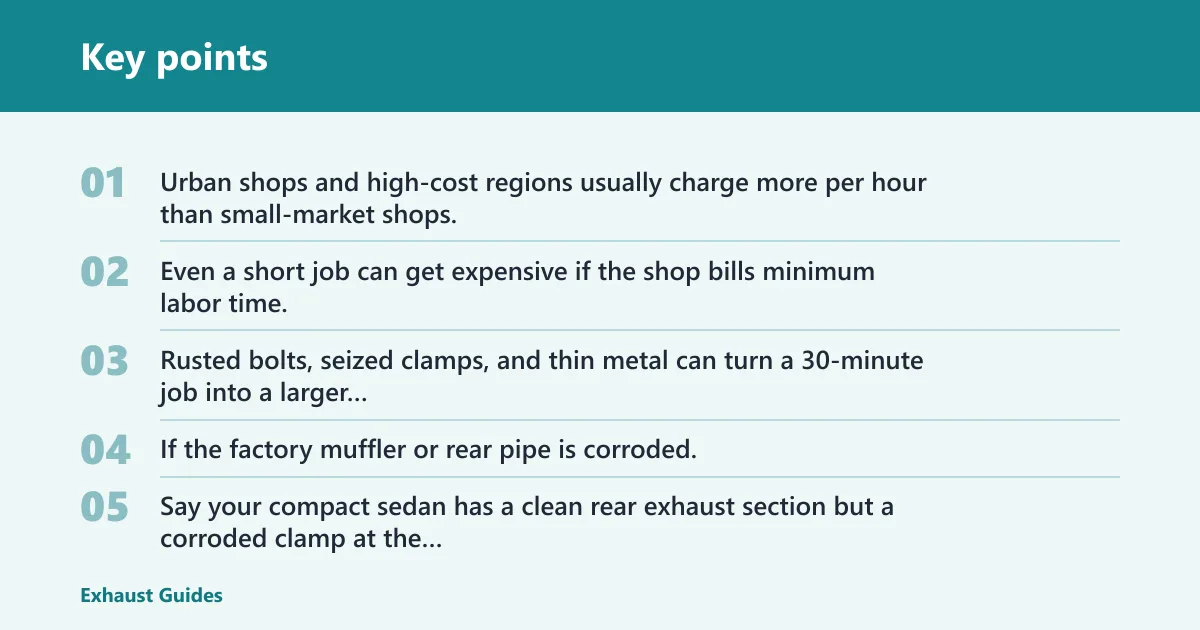
Exhaust shop labor rates are not uniform. Urban shops and high-cost regions usually charge more per hour than small-market shops, and that difference shows up quickly on custom exhaust work. Even a short job can get expensive if the shop bills minimum labor time.
Rust and fitment issues
Rusted bolts, seized clamps, and thin metal can turn a 30-minute job into a larger fabrication repair. If the factory muffler or rear pipe is corroded, the shop may need to cut farther forward, repair nearby tubing, or replace a hanger that no longer holds correctly.
Say your compact sedan has a clean rear exhaust section but a corroded clamp at the muffler flange. The quote may look low at first, then rise once the tech finds that the clamp cannot be reused and the pipe needs extra repair for a leak-free fit.
Tube material choice
Aluminized steel is the lowest-cost material option and is common in basic exhaust repairs. Stainless steel 409 costs more and resists corrosion better than mild steel, while stainless steel 304 is a higher-cost option with excellent corrosion resistance. Better corrosion resistance usually means a higher upfront bill.
Welds, clamps, and hangers
A clamp-on delete can be cheaper up front, but a welded pipe often fits better and leaks less when the work is done well. Hanger reuse can lower cost, yet worn rubber mounts or bent hangers may need replacement to stop vibration and movement. A bad fit can mean paying twice.
Is a muffler delete worth it?
It can be worth it for a weekend car or a budget build where sound matters more than refinement, but it is often a poor value for a daily driver. Trucks and performance cars tolerate the change better if the owner accepts more noise, possible drone, and the chance of later rework.
A muffler delete is cheapest when your goal is sound on a low-buck plan. It becomes a false economy when the car needs inspection fixes, the cabin drones on the highway, or the resale hit wipes out the savings versus a better exhaust part.
Daily driver use
For daily driving, the extra noise can get old fast. Highway drone, cold-start volume, and more cabin resonance are the common complaints. If the car spends hours in traffic, a resonator delete or axle-back kit may make more sense than a full muffler removal.
Weekend car use
Weekend cars tolerate a louder exhaust better because they spend less time on long highway trips and more time under light-duty use. If the car is already modified and the buyer wants a sharper note, the value case improves, but local noise rules still matter.
Truck use
On a truck, the sound change can fit the vehicle better, but dual-exhaust complexity, longer tubing runs, and rusted underbody parts can push the price up. Trucks also have a bigger chance of hanger and tailpipe alignment issues, which raises labor time.
Will it affect legality or performance?
Yes. A muffler delete can trigger noise-law noncompliance, fines, or inspection problems in stricter areas, and it can also change how the engine feels at low speed. Some cars sound better; some get more drone, reduced backpressure, or an ECU response the calibration was not built to ignore.
Noise rules and inspections
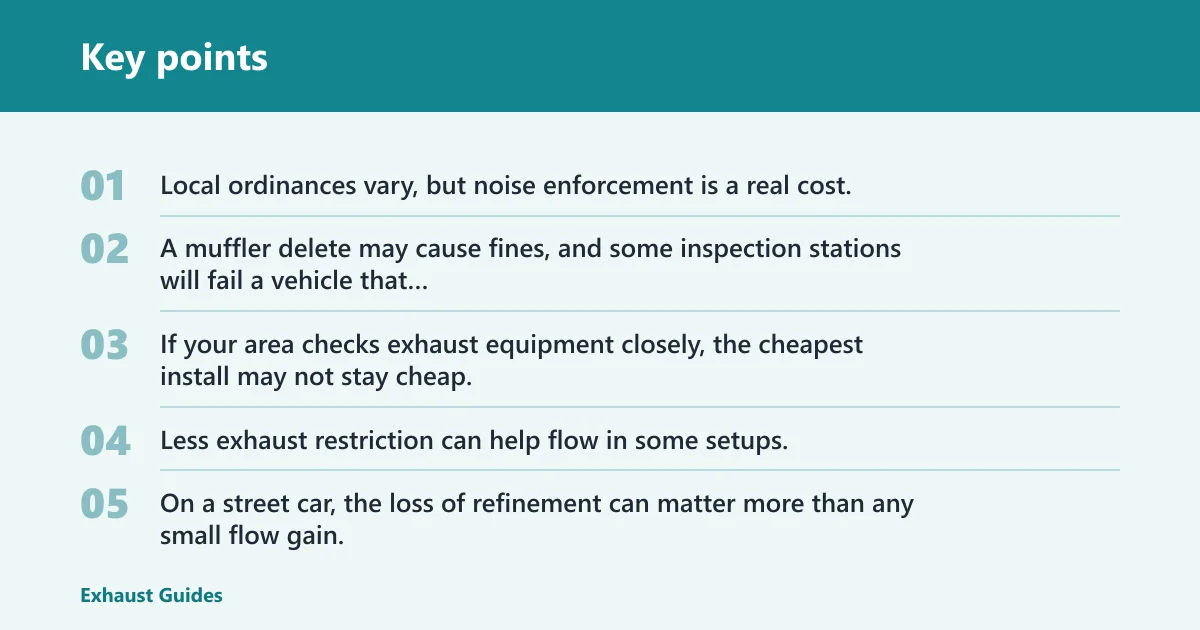
Local ordinances vary, but noise enforcement is a real cost. A muffler delete may cause fines, and some inspection stations will fail a vehicle that is too loud or has obvious exhaust modification issues. If your area checks exhaust equipment closely, the cheapest install may not stay cheap.
Backpressure and drivability
Less exhaust restriction can help flow in some setups, but a decrease in backpressure can also change low-end torque feel and drivability. On a street car, the loss of refinement can matter more than any small flow gain.
A common first-timer mistake is assuming a cheaper muffler delete quote always means the final bill will stay low. On a small sedan, a delete can add drone without adding much useful acceleration, while the same change on a more aggressive setup may feel more acceptable because the rest of the exhaust is already set up for better flow.
ECU response
Modern vehicles use an Engine Control Unit, and that matters because current calibration can be sensitive to exhaust changes. A muffler delete usually does not trigger the same issues as removing emissions equipment, but some vehicles still react with different fuel trims, sound, or throttle feel.
How much does a muffler cost?
If you mean the part alone, a muffler’s price depends on vehicle size, brand, and construction. Replacement mufflers are usually cheaper than a full exhaust job, and the cheapest option is often a basic steel unit rather than a performance model or stainless upgrade.
As a rule, the muffler part is only part of the bill. Once you include labor, hangers, seals, and fitment time, the installed price can move well above the part price, especially on rust-prone vehicles or dual-exhaust layouts.
How much does a muffler replacement cost?
Muffler replacement cost is usually higher than a delete because you pay for both the part and the install. A basic replacement may still be reasonable, but if the old muffler failed from corrosion, the nearby tubing can need repair too, which raises the total quickly.
Compared with a delete, replacement is often the better buy when you want quieter driving, cleaner resale appeal, and less legal risk. It is especially attractive if the current system is already rusted and the rear section needs more than one cut.
Muffler delete vs performance muffler
A performance muffler usually costs more up front than a delete, but it gives you a middle ground: better sound, less restriction than a stock unit, and fewer issues with drone or noise enforcement. If you want a more aggressive note without going straight-pipe loud, this is often the safer choice.
A delete wins on price only when the work is simple and the owner accepts the tradeoffs. A performance muffler is often the better value when resale, inspection risk, and cabin comfort matter more than shaving the first few dollars off the bill.
How to do a muffler delete
At a high level, the job involves removing the factory muffler, fitting replacement pipe, securing the section with welds or clamps, and checking for leaks, vibration, and hanger alignment.
- Inspect the rear exhaust section for rust, leaks, and hanger condition.
- Measure the replacement pipe path and confirm clearance around the axle and suspension.
- Remove the muffler section and fit replacement tubing.
- Choose welds or clamps based on the desired durability and budget.
- Check the system for leaks and rattles after installation.
That check matters because a small exhaust leak can create noise, odor, or a loose joint that gets worse under heat cycles and road vibration.
Frequently asked questions
How much for a muffler delete?
Most shop quotes land in the low hundreds, with simpler compact-car jobs closer to the bottom and larger or more complex vehicles higher up. Labor, pipe material, and rust usually matter more than the muffler itself because the old part is being removed rather than replaced.
Is a muffler delete bad?
It is bad for some owners and fine for others. The main downsides are noise, drone, possible fines, inspection trouble, and lower buyer appeal. If the car is a daily driver or you care about resale, the delete can be a poor trade unless the sound is the main goal.
Does a muffler delete improve performance?
It can change exhaust flow, but better flow does not always mean better results on the road. Some vehicles feel freer at higher rpm, while others lose low-end torque or gain noise without a useful performance gain. Modern calibration can also react to the change.
Muffler delete vs performance muffler: a muffler delete is usually
A muffler delete is usually cheaper, louder, and more exposed to legal and comfort issues. A performance muffler usually costs more, but it gives a more controlled sound and less risk of overdoing the volume. For many street cars, that extra cost is easier to justify.