How Many Oxygen Sensors Does a Car Need? Count by Engine
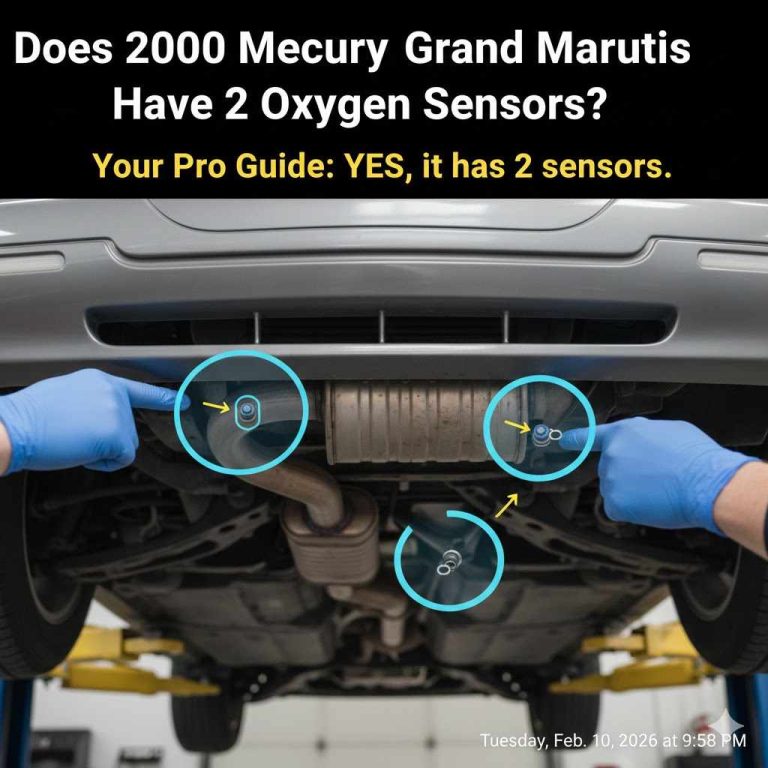
Many cars have about 2 oxygen sensors, though many have 4. Some V6, V8, turbo, or California-emissions setups use more. Miscounting can send you to the wrong part, the wrong fault code, and a wasted diagnostic path. This guide shows the quick way to estimate sensor count from engine layout and exhaust setup, then confirm the exact number.
Quick answer by engine type
The quickest count starts with engine layout. An inline engine usually has one exhaust path and 2 oxygen sensors. A V-shaped engine usually splits into two banks and has 4 oxygen sensors. Older emissions design, true dual exhaust, or unusual performance layouts can change that count.
Inline engines
An inline-4 or inline-6 often has about 2 oxygen sensors. One sits before the catalytic converter and handles fuel control. The other sits after the converter and checks converter performance. Bank 2 does not apply the same way it does on a V engine, so scan codes and parts lookup work differently.
V-shaped engines
A V6 or V8 usually has 4 oxygen sensors because the engine has two banks. Each bank can have an upstream sensor and a downstream sensor. That gives you Sensor 1 and Sensor 2 on Bank 1, plus Sensor 1 and Sensor 2 on Bank 2.
When the usual count changes
The usual 2-or-4 pattern changes when the exhaust layout changes. Older pre-1996 vehicles may have 1, and sometimes 2, oxygen sensors. A turbocharged four-cylinder still runs 2 sensors in most cases. True dual-exhaust setups and some performance designs can add or move sensors.
Why sensor count changes
Engine layout matters because it decides how many exhaust streams the car has. Model year matters because emissions rules changed over time. Exhaust design matters because two banks, two converters, or a split exhaust can mean more than the simple inline-versus-V rule suggests.
Engine layout and exhaust paths
Inline engines generally send exhaust through one path, so 2 sensors is the common pattern. V engines split cylinders into two banks, which often means one upstream sensor and one downstream sensor for each bank. That is why V6 and V8 engines so often have 4 sensors.
Model year and emissions design
Older cars before 1996 may use older emissions systems, so the sensor count can be lower. Modern cars can contain more than 200 sensors depending on autonomy level, and one industry analysis noted a modern car now utilizes over 100 sensors. Oxygen sensor count still depends on the exhaust design, not the total number of sensors on the vehicle.
True dual-exhaust exceptions
True dual exhaust can change the answer. If each bank has its own exhaust path and its own catalytic converter arrangement, the count may still be 4 on many V engines, but the layout can complicate location and code reading. That is why count and location are not the same thing.
Say your V6 has dual exhaust and one converter on each side. The car may still have 4 oxygen sensors, but Bank 1 Sensor 1 and Bank 2 Sensor 1 will not sit near the same pipe routing as they would on a single-exhaust V6. The count stays simple. The location does not.
Upstream and downstream sensors
Upstream and downstream describe position, not engine type. An upstream sensor sits before the catalytic converter and controls fuel mixture. A downstream sensor sits after the catalytic converter and checks catalytic converter performance. Many scan tools and parts listings use Sensor 1 for upstream and Sensor 2 for downstream.
What Sensor 1 does
Sensor 1 is the upstream oxygen sensor. It measures exhaust content before the converter and helps the engine control fuel mix. The target air-fuel ratio is about 14.7 parts air to 1 part fuel. If Sensor 1 reads poorly, the engine computer can adjust fueling the wrong way.
What Sensor 2 does
Sensor 2 is the downstream oxygen sensor. It sits after the catalytic converter and checks emissions performance. It does not usually control the fuel mix in the same direct way as the upstream sensor. Its job is to show whether the converter is doing its part.
Where each one sits
Think of the exhaust path in order: engine, upstream sensor, catalytic converter, downstream sensor. That order is the same idea on many cars, but the exact physical placement can vary with engine layout and exhaust routing. Do not guess from the code alone.
Bank 1, Bank 2, Sensor 1
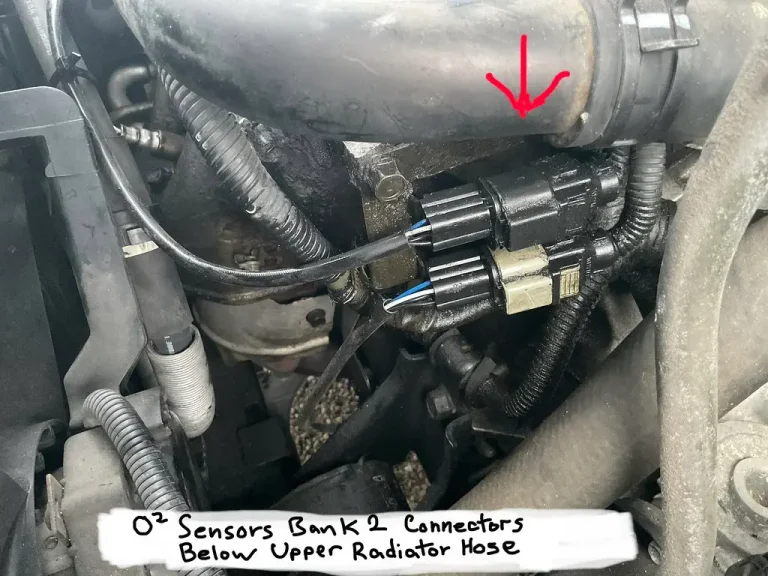
Bank labels tell you which side of the engine or exhaust you are dealing with. Bank 1 is the side that holds cylinder number one. Bank 2 is the other side. Inline engines do not have Bank 2 in the same way a V engine does, which is why the same code can mean different things on different vehicles.
What Bank 1 means
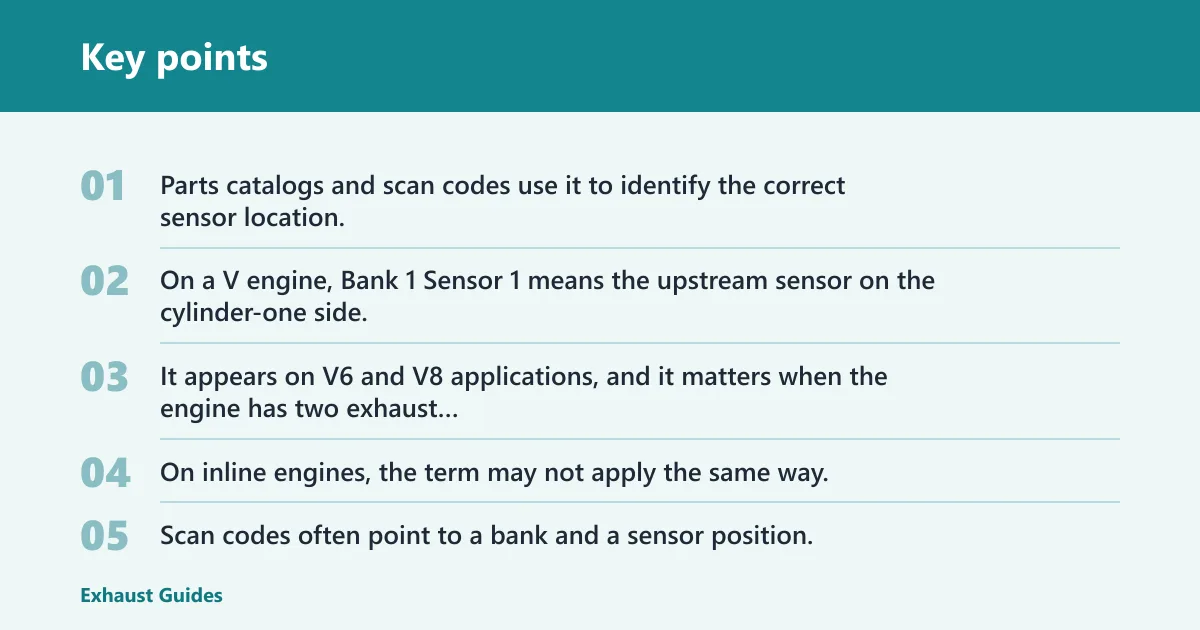
Bank 1 is the side with cylinder number one. Parts catalogs and scan codes use it to identify the correct sensor location. On a V engine, Bank 1 Sensor 1 means the upstream sensor on the cylinder-one side.
What Bank 2 means
Bank 2 is the other side of a V engine. It appears on V6 and V8 applications, and it matters when the engine has two exhaust banks. On inline engines, the term may not apply the same way, so do not assume a Bank 2 code points to a missing sensor.
How scan codes map to locations
Scan codes often point to a bank and a sensor position, but they do not always spell out the whole physical layout. A code for Bank 1 Sensor 1 means the upstream sensor on Bank 1. A code for Bank 2 Sensor 2 means the downstream sensor on Bank 2. That is location data, not a total count by itself.
Oxygen sensor decision table
This table gives a quick estimate. Use the last column to verify the exact count on the specific car, because exhaust design, emissions package, and engine options can change the answer.
| Engine layout | Exhaust layout | Model year / setup | Likely oxygen sensor count | Verify the exact count by |
|---|---|---|---|---|
| Inline-4 or inline-6 | Single exhaust path | Most modern gasoline cars | 2 | Check the emissions label and the service information for upstream and downstream sensor listings. |
| Turbocharged four-cylinder | Single exhaust path in most cases | Modern turbo setup | 2 | Confirm the exhaust diagram in the service manual and match it to the scan tool code. |
| V6 or V8 | Two banks, often one converter path per bank | Most modern gasoline cars | 4 | Use the VIN and parts catalog to confirm Bank 1 and Bank 2 sensor positions. |
| V6 or V8 | True dual exhaust | Performance or specialty layout | 4 or more in uncommon cases | Look up the exact exhaust package by VIN and verify the sensor count in the service diagram. |
| Older pre-1996 vehicle | Older emissions system | Before 1996 | 1, sometimes 2 | Check the underhood emissions label and the factory service data for that model year. |
| Inline engine | True dual-exhaust conversion or unusual setup | Modified or uncommon configuration | 2 or more, depending on hardware | Inspect the exhaust from the manifold back and count the sensors before ordering parts. |
How do you find the exact count?
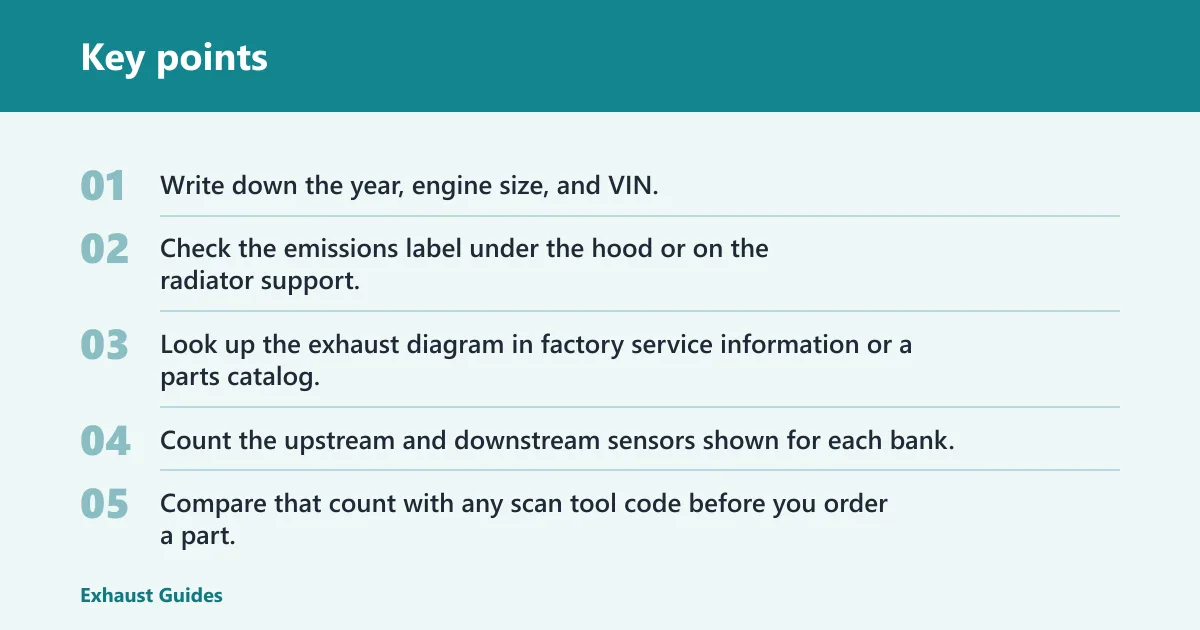
To find the exact oxygen sensor count, start with the VIN and the emissions label, then confirm the exhaust layout in the service information. If the car has a check-engine light, read the code with a scan tool and use the bank and sensor numbers as location clues, not as the full answer.
Check the VIN and emissions label
The VIN tells you the engine and emissions package. The emissions label, often in the engine bay, can identify federal or California emissions equipment. That matters because emissions packages can change the number and position of sensors on the same model.
Use the service information or parts catalog
Factory service information and parts catalogs show the exact exhaust diagram. That is the best place to confirm how many upstream and downstream sensors the car uses. Match the diagram to your engine code and emissions package, not just the model name.
Read the scan tool code correctly
A code that names Bank 1 Sensor 1 points to the upstream sensor on Bank 1. It does not tell you the total count by itself. If a code names Bank 2 Sensor 1, you know the vehicle has a banked engine layout, which helps separate inline engines from V engines.
A common mistake is assuming a check-engine code tells you exactly how many oxygen sensors your car needs. Suppose a scan tool shows Bank 1 Sensor 2 on a V6. That means the downstream sensor on Bank 1, not every oxygen sensor on the car. The fault may involve one part, while the rest are working normally.
- Write down the year, engine size, and VIN.
- Check the emissions label under the hood or on the radiator support.
- Look up the exhaust diagram in factory service information or a parts catalog.
- Count the upstream and downstream sensors shown for each bank.
- Compare that count with any scan tool code before you order a part.
Do you need to replace all sensors?
No, not every repair calls for all oxygen sensors at once. If one sensor has failed and the others test correctly, replace the failed one. Matched sets can make sense on high-mileage vehicles or when the other sensors are close to the end of their service life, but the exact vehicle and fault matter most.
When to replace only the failed sensor
Replace only the failed sensor when the code points to one location and testing backs that up. If Bank 1 Sensor 1 fails, you do not automatically need Bank 2 Sensor 1 or the downstream sensors. The goal is to fix the fault you have, not replace parts without evidence.
When matched sets make sense
Matched sets can make sense when multiple sensors are old, contaminated, or equally slow. That can save repeat labor on a hard-to-reach exhaust. Even then, the decision should follow diagnostics, not a guess that “all oxygen sensors age the same way.”
What to confirm before ordering parts
Confirm the exact engine, bank, and sensor position before buying anything. Also confirm whether the part is upstream or downstream, and whether the car uses an upstream air-fuel sensor on that location. Those differences affect fitment even when the plug looks similar.
What if your car is older?
Older pre-1996 vehicles can have fewer oxygen sensors because emissions systems were different. Some had 1 sensor, and some had 2. The exact count depends on the engine, exhaust design, and the emissions package fitted to that model year.
Pre-1996 vehicles
Before 1996, the simple 2-or-4 rule does not always apply. You may find a single sensor in the exhaust stream, or a second sensor on later or more advanced setups. The emissions label and factory service data matter more than a general rule here.
Older emissions layouts
Older layouts may not separate bank and sensor naming in the same way as later vehicles. That can make scan-code interpretation less direct. If the car is older, identify the exhaust and converter layout first, then count the sensor bosses physically if needed.
Frequently asked questions
How many oxygen sensors does a car have?
Most cars have 2 or 4 oxygen sensors. Inline engines usually have 2, while V6 and V8 engines usually have 4. The exact count changes with exhaust layout, model year, and special emissions setups, so the VIN, emissions label, and service information are the safest way to confirm it.
Does a 4-cylinder car have 2 or 4 oxygen sensors?
A 4-cylinder car usually has 2 oxygen sensors, especially with a single exhaust path. A turbocharged four-cylinder still runs 2 sensors in most cases. The exception is an unusual exhaust design or an older emissions setup, so verify the exact count before ordering parts.
How many O2 sensors does a V6 or V8 have?
A V6 or V8 usually has 4 O2 sensors because it has two banks. That usually means one upstream and one downstream sensor on each bank. True dual-exhaust systems and special performance layouts can change the count, so bank and sensor labels still need confirmation.
What is the difference between upstream and downstream O2 sensors?
The upstream sensor sits before the catalytic converter and helps control fuel mixture. The downstream sensor sits after the converter and checks catalytic converter performance. Many scan tools call them Sensor 1 and Sensor 2, but those names only make sense once you know the bank and exhaust layout.
Which O2 sensor is Bank 1 Sensor 1?
Bank 1 Sensor 1 is the upstream sensor on the side of the engine with cylinder number one. On many V engines, that location is on one bank only. On inline engines, the bank naming can work differently, so use the service diagram before you buy a part.
How can I find the exact oxygen sensor count for my car?
Use the VIN, the emissions label, and the factory service information together. Then match the scan code to the bank and sensor position. That three-step check gives you the exact oxygen sensor count and keeps you from confusing a single failed sensor with the total number on the vehicle.