Flex Pipe Repair Without Welding: Options
If the flex pipe has only a small pinhole or surface crack and the braid is intact, a clamp-on sleeve or band repair may buy some time; if the bellows is split, rust-thinned, or leaking at a weld, replacing the section is usually the better choice. Picking the wrong fix can leave you with sharp exhaust noise, fumes collecting under the car, and a repair that fails again fast. This guide shows how to diagnose the leak and choose the right no-weld repair or replacement path.
What a leaking flex pipe looks like


An exhaust flex pipe is the corrugated stainless-steel section in the front pipe or downpipe that lets the exhaust move without shaking the system apart. It cuts vibration, but the braid, bellows, and end welds can crack, split, or burn through. A leak here usually shows up as a sharp tick, a hiss, soot, or smell.
Common failure points
The outer braid can fray and open up. The bellows can tear where repeated movement concentrates stress. The end welds can crack where the flex section joins the straight pipe. Those failures behave differently from a pinhole in nearby straight tubing, so the repair choice changes with the damage.
Noise, fumes, and soot
A flex leak often gets louder under throttle and may be strongest on cold start. You may see black soot at the split or smell exhaust under the hood or cabin. A leak near the engine can pull fumes into the vehicle more easily than a rear exhaust leak, which raises safety and inspection concerns.
Why a flex-section leak is different from a nearby pipe crack
A crack in the straight pipe next to the flex section may accept a sleeve or clamp if the pipe is still round and long enough. A failed flex section usually moves, expands, and flexes under load, which can make tape, putty, and thin patch fixes much less reliable. Do not treat the two failures as the same problem.
Which repair fits the damage?
The right no-weld fix depends on the exact failure, the pipe’s shape, and how much straight length you have to work with. Small surface leaks can sometimes be sealed. Torn braid, split bellows, ovalized pipe, or rust-thinned metal usually push you toward replacement instead of another patch.
Small pinhole or surface leak
If the leak is a tiny hole in a mostly sound flex section, a high-temperature tape wrap, a clamp band, or a paste-assisted patch can buy you time. That works best when the surrounding metal is still thick and the pipe keeps its round shape. It is a short-term fix, not a cure for worn-out flex material.
Crack in a straight section near the flex
A small crack in the straight pipe just before or after the flex section is the best case for a sleeve or clamp repair. The pipe must be round enough for the seal to sit evenly, and there needs to be enough straight length on both sides of the damage. If not, the clamp will leak again.
Torn braid or split bellows
Once the braid is torn open or the bellows is split, the flex section has lost the part that absorbs movement. That damage usually cannot be sealed for long with tape, sealant, or a band clamp. Replacement is the smarter choice because the repair has to hold exhaust pressure and repeated flexing.
Ovalized, rust-thinned, or short pipe
Ovalized pipe gives a clamp or sleeve poor contact. Rust-thinned metal can crush under clamp force or split beside the repair. If there is too little straight pipe to seal on, a sleeve cannot grip correctly. In those cases, a no-weld patch often wastes money.
Flex pipe decision matrix
Use this matrix to match the damage to the repair. The key question is not only “Is there a leak?” but also “Is there enough sound, round pipe for the repair to seal?” If the answer is no, replacement is usually the better call.
| Damage type | Leak size | Pipe roundness | Available straight length | Expected durability | Inspection risk | Replace instead? |
|---|---|---|---|---|---|---|
| Surface pinhole on flex braid | Very small | Mostly round | Short to moderate | Short-term | Moderate | No, if the leak is truly small |
| Small crack in straight pipe near flex | Small | Round | At least a few inches on each side | Short- to mid-term | Moderate | Maybe, if pipe metal is sound |
| Rust-thinned straight pipe | Small to medium | Often oval or distorted | Uncertain | Poor | High | Yes |
| Split bellows or torn braid | Medium to large | Often distorted by movement | Usually not enough for a true seal | Poor | High | Yes |
| End weld leak | Small to medium | May still be round | Enough straight pipe may exist | Short- to mid-term | Moderate to high | Often yes, if the weld area is weakened |
How do you fix it without welding?
You can fix some exhaust leaks without welding, but the method has to match the damage. A clamp, sleeve, tape, or sealant can help if the pipe is stable and round. None of them can turn a torn flex section into a permanent repair.
Exhaust repair clamp: single versus double clamp
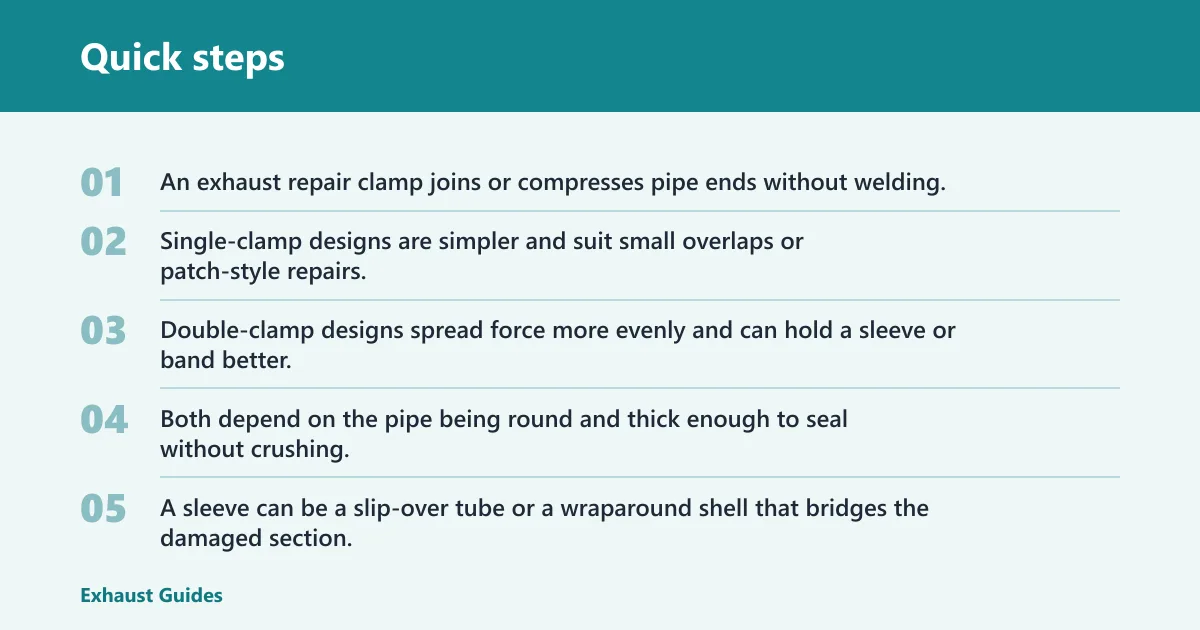
An exhaust repair clamp joins or compresses pipe ends without welding. Single-clamp designs are simpler and suit small overlaps or patch-style repairs. Double-clamp designs spread force more evenly and can hold a sleeve or band better. Both depend on the pipe being round and thick enough to seal without crushing.
Exhaust repair sleeve: slip-over or wraparound fit
A sleeve can be a slip-over tube or a wraparound shell that bridges the damaged section. It works best on a straight, round pipe with enough length for the sleeve to grip on both sides. If the area near the flex is short, tapered, or oval, the sleeve may leak at the ends.
Exhaust repair tape: where it can and cannot work
Heat-resistant exhaust tape can seal a tiny pinhole or a small surface leak for a while. It is weak on moving flex sections because heat cycling and vibration loosen the wrap. It is not a structural repair for a failed bellows or torn braid.
Exhaust sealant or putty: gap-filling support only
High-temperature sealant or putty can help fill tiny gaps under a clamp or patch, but it is not a stand-alone fix. It needs a tight mechanical repair around it and time to cure or heat-cycle as directed by the product. Used alone, it usually burns out or blows out.
Picture a 2-inch crack on the straight pipe just ahead of the flex section. If the pipe is still round and you have enough length for a sleeve, that is a repair candidate. If the braid around the bellows is split open and the pipe has gone oval, the same sleeve will likely leak again.
When is replacement the better call?
Replacement is the better call when the flex section itself has failed, when the pipe is too distorted for a seal, or when there is not enough straight length for a sleeve or clamp to bite. A damaged flex pipe that moves under load usually needs a new flex section, not another patch.
Torn flex braid or bellows
If the braid is torn or the bellows is split, the no-weld repair has to fight movement at the same time it fights exhaust pressure. That is a poor setup for tape, putty, or a thin sleeve. Replacement is the more reliable fix.
No straight pipe for a sleeve
A sleeve needs clean, straight pipe to seal on. If the leak sits too close to a bend, flange, or the end weld, there may be no usable sealing surface. In that case, a clamp or sleeve cannot do its job well enough to trust.
Pipe too thin, too oval, or too rusted
When the wall is rust-thinned, clamp force can deform the pipe instead of sealing it. When the pipe is oval, the repair cannot seat evenly. Both conditions raise leak risk and inspection risk, and both argue for replacement.
Weld-in versus clamp-in replacement flex pipe
Replacement flex pipes come in weld-in and clamp-in styles. Choose by diameter, length, and the flex section design already on the vehicle. Stainless steel exhaust pipe is the better repair material because it resists corrosion better than mild steel, but the diameter and wall thickness have to match closely for the repair to fit and seal.
What tools and materials do you need?
Before you start, let the exhaust cool fully. Use jack stands or ramps, gloves, and eye protection, and expect rusted fasteners to fight back. A good repair often depends more on fit and prep than on the patch itself.
Jack stands or ramps, gloves, and eye protection
Never work under a hot exhaust. Hot pipes can burn you, and rust flakes can fall into your eyes. Secure the vehicle on level ground, and keep your hands clear when loosening clamps or cutting pipe near the flex section.
Measuring pipe diameter and matching the replacement size
Pipe diameter needs to be matched closely, because a misfit can leak or let a clamp slip. Common sizes vary by vehicle, and a misfit can leak or let a clamp slip. Measure the outside diameter where the repair will sit, and compare it to the sleeve, clamp, or replacement flex pipe before you buy parts.
Stainless steel exhaust pipe and hardware choices
Use stainless steel exhaust pipe or stainless repair hardware where possible. It lasts better in heat and moisture than mild steel. Hardware should match the pipe diameter and sit flat; mismatched hardware can pinch the pipe unevenly or leave gaps at the seam.
Cutting, cleaning, and fastener prep
You need a saw or cutter for clean cuts, a scraper or abrasive pad for rust and carbon, and the correct socket or wrench for the clamp. Clean metal helps every no-weld repair. If scale or soot stays under the seal, the leak often returns at the same spot.
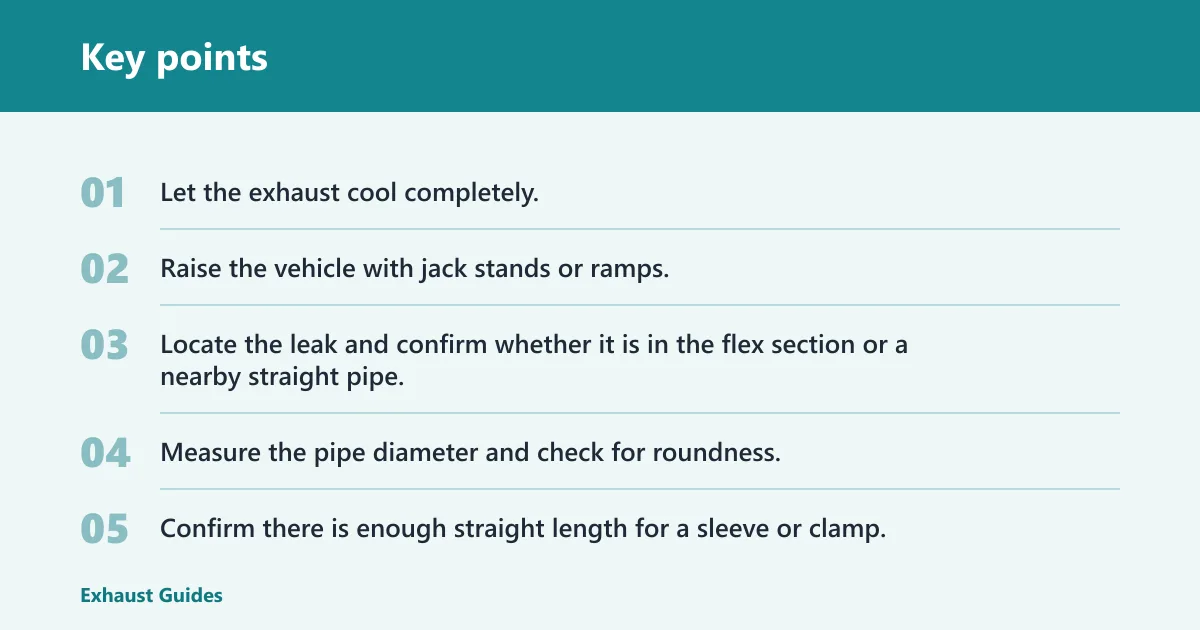
- Let the exhaust cool completely.
- Raise the vehicle with jack stands or ramps.
- Locate the leak and confirm whether it is in the flex section or a nearby straight pipe.
- Measure the pipe diameter and check for roundness.
- Confirm there is enough straight length for a sleeve or clamp.
- Clean the metal until the seal surface is free of rust and soot.
- Install the chosen repair and tighten the hardware evenly.
- Start the engine and check for leaks at idle and with a light throttle snap.
Will it pass inspection?
Maybe, but do not count on it. Visible exhaust leaks can fail inspection, and noise or fumes can matter even when the vehicle drives fine. Local emissions and safety rules vary, so a repair that seems acceptable in one area may fail in another.
Visible leaks, noise, and fumes
A repair that still seeps soot or makes a sharp exhaust note can fail a visual or sound check. A leak near the engine may also be treated more seriously because fumes can enter the cabin or engine bay. If the repair still leaks, it is not inspection-ready.
Local rules and emissions standards vary
Some jurisdictions check only visible leaks. Others care about noise, tailpipe emissions, or the location of the leak. A no-weld repair that stops the sound but leaves a visible seep can still fail. Check the local rule set before relying on a temporary fix.
Why a temporary fix may still fail a check
A clamp or tape wrap may quiet the leak for a while without restoring the pipe to a stable, sealed condition. Inspection stations often look for signs of active leakage, heat damage, or unsafe routing. A temporary repair may buy time, but it may not satisfy the standard.
Frequently asked questions
How do you repair an exhaust flex pipe without welding?
Start by identifying whether the leak is in the flex section or the nearby straight pipe. Small surface leaks can sometimes be handled with a clamp, sleeve, tape, or sealant used as support. Torn braid, split bellows, or badly rusted pipe usually need replacement instead.
Can you fix an exhaust pipe without welding at all?
Yes, for some damage. A straight pipe crack, small hole, or minor seam leak can often be handled with a clamp-on sleeve or band repair if the pipe is round and long enough. If the pipe is oval, thin, or part of a failed flex section, no-weld repair is usually short-lived.
What is the best flex pipe repair kit for a temporary fix?
The best temporary kit is the one matched to the damage. For a small straight-pipe leak, a repair sleeve with the correct diameter is usually better than tape. For a tiny surface leak, clamp-assisted tape or sealant may buy time. For a torn flex section, none of these is a real fix.
Can exhaust repair tape actually seal a leaking flex pipe?
It can seal a tiny pinhole or surface seep for a short time, but it is weak on a moving flex section. Heat cycling and vibration loosen the wrap, and larger splits will reopen. Use tape only as a short-term aid on a small leak, not as the final repair for a failed bellows.
How long does a no-weld flex pipe repair last?
Durability depends on the damage and the pipe condition. A sleeve or clamp on a round, sound straight section may last for a useful temporary-to-midterm period. Repairs on ovalized, rust-thinned, or flex-bellows damage can fail quickly, sometimes as soon as the exhaust heats and moves again.
How much does flex pipe repair cost compared with replacement?
Clamp, sleeve, tape, and sealant repairs usually cost less up front than a replacement flex pipe. Replacement costs more because of the part and the labor to fit it, but it is often the better value when the braid or bellows is torn. The cheapest fix is not always the least expensive one overall.