How to Choose the Right Muffler for Louder Exhaust Tips
Choose the muffler first for the exhaust note, then match tip size and outlet layout; the tip changes tone more than volume. A mismatched pair can bring drone, weak flow, or a louder look without the sound you wanted. For a balanced, louder-than-stock setup, start with the MagnaFlow Performance Exhaust Muffler 10416. It gives a deep signature sound, uses a straight-through perforated core, and keeps the 2.5-inch inlet and outlet easy to fit on many custom systems.
What sound do you want?
Start with the sound goal first, because mufflers change tone and drone more than raw volume. If you want deeper tone, look for a straighter, less abrupt exhaust path. If you want sharper bark, chambered designs usually create more edge. If you want less drone, put that ahead of loudness and keep the system balanced.
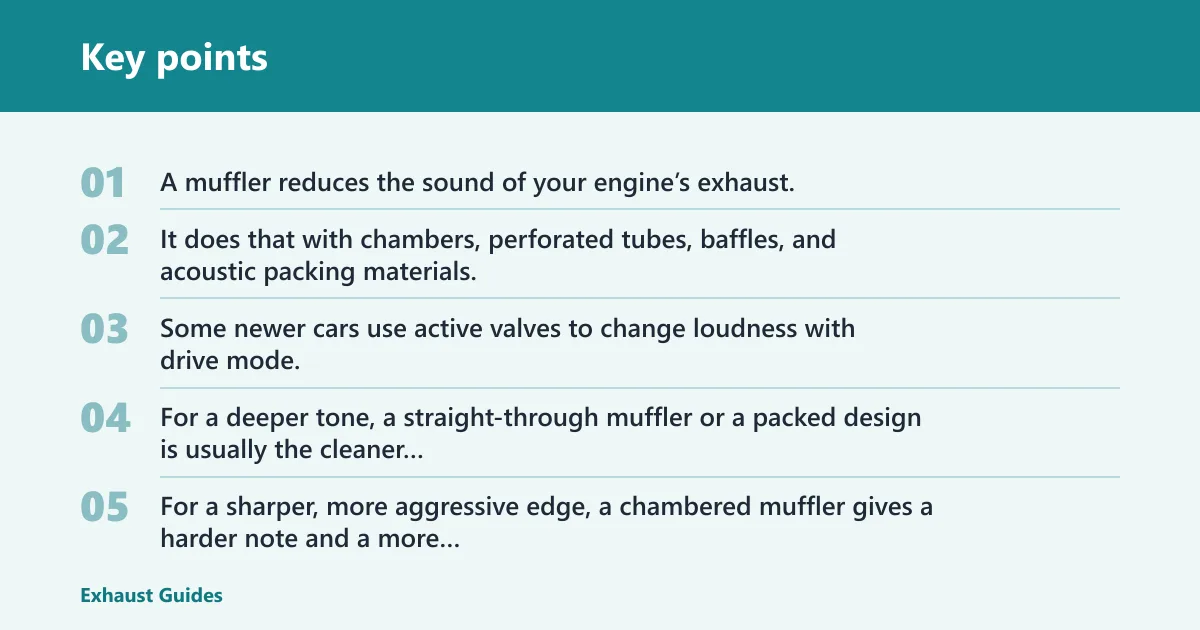
A muffler reduces the sound of your engine’s exhaust. It does that with chambers, perforated tubes, baffles, and acoustic packing materials. Some newer cars use active valves to change loudness with drive mode, so a stock vehicle may already have more than one exhaust personality.
Deeper tone versus sharper tone
For a deeper tone, a straight-through muffler or a packed design is usually the cleaner choice. For a sharper, more aggressive edge, a chambered muffler gives a harder note and a more pronounced crack on throttle. The tip can shift the character slightly, but the muffler sets the main voice.
Louder at idle versus louder under throttle
If you want more idle volume, the muffler choice matters more than the tip. A freer-flowing muffler can sound fuller at idle and on light revs. If you want the sound to wake up mostly under throttle, choose a design that opens up with flow rather than one that is simply noisy all the time.
Less drone for daily driving
If drone matters, do not chase loudness first. A resonator can help tune frequencies and reduce cabin boom, especially on steady highway speeds. That matters on daily drivers, because overly free-flowing setups can increase drone even when they sound good outside the vehicle.
How do mufflers and tips work together?
The muffler sets most of the volume change. The tip changes the end-of-pipe character, not the whole system. Bigger or differently shaped tips can alter sound a little, but they do not turn a mild exhaust into a loud one. If the sound change is dramatic, the muffler or a leak is usually the real reason.
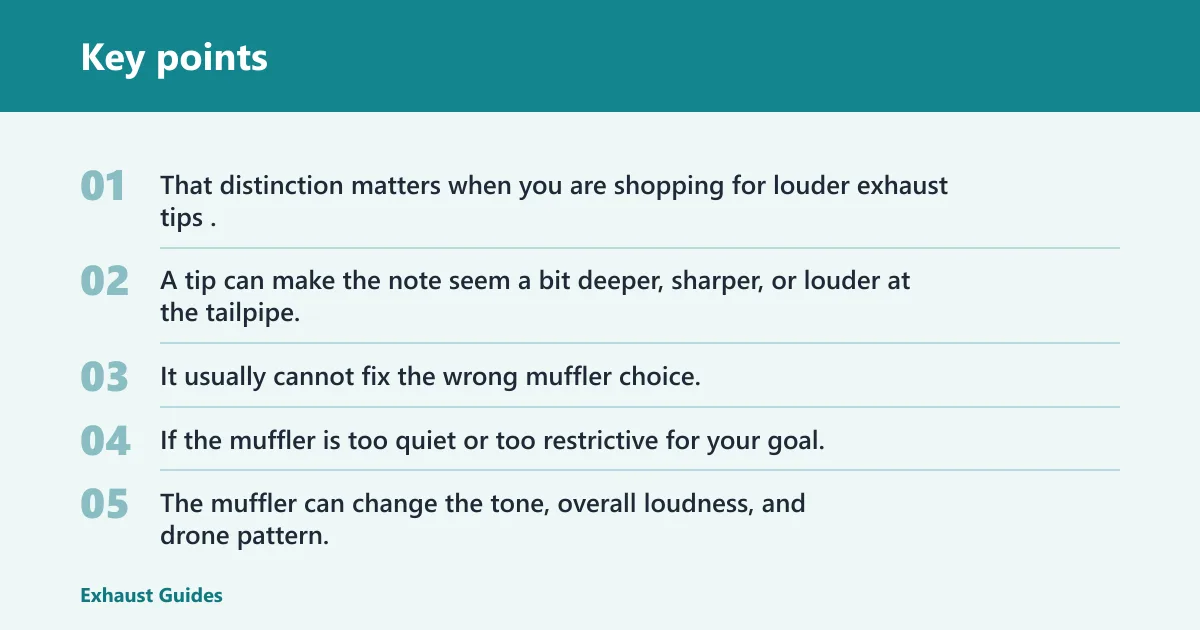
That distinction matters when you are shopping for louder exhaust tips. A tip can make the note seem a bit deeper, sharper, or louder at the tailpipe. It usually cannot fix the wrong muffler choice. If the muffler is too quiet or too restrictive for your goal, the tip will not carry the whole load.
What the muffler changes most
The muffler can change the tone, overall loudness, and drone pattern. Internal baffles, chambers, and packing decide how much sound gets absorbed or reflected. On stock engines, a muffler is not a guaranteed power adder, so choose it for the sound profile you want rather than expecting a performance gain by default.
What tip size and shape can change
Tip diameter, length, and exit shape can shift the sound character slightly. A larger outlet can make the exhaust seem a bit fuller at the tailpipe. Rolled, slash-cut, round, or square tips also change how the note exits and how the car looks, but the change is limited compared with a muffler swap.
When the tip is only a style change
If the car already has a quiet muffler and a resonator, a tip change is often mostly visual. That is common on modern sedans and many trucks with long exhaust routing. If you want a real volume increase, the muffler and outlet layout need to match the sound goal.
Which muffler type fits your sound goal?
Match the muffler style to the sound you want before you pick a tip. Straight-through mufflers usually flow well and sound cleaner. Chambered mufflers create a more aggressive note. Packed or glasspack-style mufflers can be loud and compact, but they may trade away refinement and can be more prone to drone depending on the rest of the system.
Straight-through mufflers
Choose a straight-through muffler if you want a deeper, smoother tone with less restriction than many chambered designs. A good example is the MagnaFlow 10416, which is listed as a 2.5-inch inlet/outlet, round, straight-through muffler with deep sound. The drawback is that it may still be too quiet for someone chasing a very loud idle.
Chambered mufflers
Choose a chambered muffler if you want a harder, more aggressive note. The Flowmaster Super 44 is listed as a chambered muffler with aggressive sound and a 2.5-inch center-in/center-out layout. The tradeoff is that chambered designs can be more prone to cabin drone than a milder packed setup.
Packed or glasspack-style mufflers
Choose a packed or glasspack-style muffler if compact size and a louder, freer note matter more than quiet cruising. The Cherry Bomb 87529CB is described as a glasspack-style muffler with a compact body. The drawback is that glasspack-style mufflers can be loud and less controlled on some vehicles, especially without a resonator.
Exhaust tip style and outlet layout
Tip style and outlet layout decide how the finished system fits and how it presents the sound. Single versus dual outlet changes appearance and can affect how much exhaust you hear at the rear. Center versus offset matters for fit under the car. Clamp-on and weld-on styles matter for installation quality and future changes.
Single versus dual outlet
Single-outlet setups are simpler and often easier to package under a daily driver. Dual-outlet setups can spread the exhaust note and create a broader visual look. If the vehicle came with a single outlet, a dual conversion can require more piping and more fitment checking than a tip swap alone.
Center versus offset layout
Center-in/center-out mufflers fit differently from offset layouts, and that choice matters before you buy. The Flowmaster Super 44 is a center-in/center-out design, while the Flowmaster FlowFX listing is described as a 2.5-inch offset inlet and center outlet. If the inlet and outlet do not match your piping path, the part will not line up cleanly.
Clamp-on versus weld-on fitment
Clamp-on tips and mufflers are easier to reverse, but they depend on the existing pipe size and a good seal. Weld-on parts are better for custom layouts and usually fit more cleanly when you are changing the system beyond the tip. If you are unsure, follow the vehicle and product manuals, never work under a vehicle held only by a jack, and check local laws.
Muffler tip decision matrix
| Sound goal | Best muffler type | Outlet configuration | Tip style |
|---|---|---|---|
| Deeper | Straight-through or packed | Single outlet or matched center/center | Large round or rolled-edge tip |
| Sharper | Chambered | Center/center or dual outlet if the chassis allows it | Smaller-diameter or slash-cut tip |
| Louder at idle | Chambered or packed with less internal damping | Single outlet is usually simpler | Tip only adds a small change |
| Louder under throttle | Straight-through | Matched inlet and outlet sizes | Straight-cut or slightly larger outlet |
| Less drone | Straight-through with resonator support | Keep layout close to factory routing | Any style that fits without restriction |
This matrix is the quickest way to avoid buying a loud tip for a quiet muffler, or a loud muffler with the wrong outlet layout. The tip should support the sound goal, not fight it.
Fitment checks before you buy
Fitment decides whether the sound plan works. Check inlet size, outlet size, center or offset orientation, and whether the vehicle already has a resonator. A muffler that sounds right on paper can still be the wrong choice if the piping layout does not match.
Also compare the muffler body length with the space under the vehicle. A longer body often gives more room for packing or chambers, but it can conflict with axle clearance, spare tire space, or hanger positions. On trucks, tailpipe routing and rear axle clearance matter more than many shoppers expect.
- Measure the inlet and outlet diameter at the factory pipe.
- Check whether the inlet is center or offset and whether the outlet is center or offset.
- Measure the available muffler space from hanger to hanger.
- Confirm whether the vehicle already has a resonator.
- Match the new muffler layout to the existing pipe path before ordering.
- Use the owner manual or a muffler shop layout if the routing is tight.
Say your sedan already has a resonator and you want a deeper tone without cabin boom. A straight-through muffler with the same inlet and outlet size is the cleaner move, because the resonator can still help with drone while the muffler changes the note.
Suppose your truck has a single rear exit and you are thinking about a dual-outlet tip for more sound. If the muffler stays quiet and the pipe path is unchanged, the tip may look louder than it sounds. A layout change alone will not replace the muffler’s role.
Our picks by need
Best balanced choice: MagnaFlow Performance Exhaust Muffler 10416 Also greatMagnaFlow Exhaust Products · 2.5" in/out · deep sound · round
- Deep resonating MagnaFlow sound
- Straight-through perforated core
- Universal fitment for custom placement
Drawback: Universal design may need fabrication$110.00Price as of 10 Nov 2026View on Amazon →As an Amazon Associate we earn from qualifying purchases. Prices and availability are accurate as of the date shown and are subject to change

- Deep resonating MagnaFlow sound
- Straight-through perforated core
- Universal fitment for custom placement
Based on the manufacturer’s specs and published product details, this is the best starting point for a deeper, cleaner note without jumping straight to an overly harsh setup. It is described as having a 2.5-inch inlet and outlet, a round body, and a straight-through perforated core. The drawback is that it may not satisfy someone who wants a very aggressive chambered tone.
Choose it if you want a muffler-first solution and plan to pair it with a tip that nudges the character rather than forces the volume. It fits the goal of louder exhaust tips better than a tip-only change because the muffler does the real work.
Best aggressive option: Flowmaster Super 44 Series Chambered MufflerOur pickFlowmaster · 2.5" center-in/out · aggressive sound · chambered- Deep aggressive exhaust note
- Universal muffler for custom installs
- Two-chamber Delta Flow design
Drawback: Universal fit requires some adaptation$137.95Price as of 10 Nov 2026View on Amazon →As an Amazon Associate we earn from qualifying purchases. Prices and availability are accurate as of the date shown and are subject to change

- Deep aggressive exhaust note
- Universal muffler for custom installs
- Two-chamber Delta Flow design
This is the pick for a harder, more assertive sound. The listing describes it as a 2.5-inch center-in/center-out chambered muffler with an aggressive sound and a two-chamber Delta Flow design. The drawback is that chambered designs can be more likely to drone on some cars and daily-driven trucks.
Use it when the goal is a louder exhaust note that stays intentional, not accidental. It pairs well with a simple tip change, but the muffler is what creates the character.
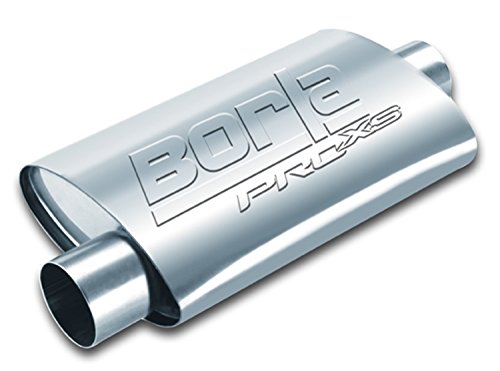
Best reversible fitment: Borla 40659 ProXS Universal MufflerUpgrade pickBorla · 2.5" center in/out · reversible · stainless- T-304 stainless steel construction
- Reversible design
- Universal muffler for weld-in installs
Drawback: Weld-in installation may need clamp hardware$124.99Price as of 10 Nov 2026View on Amazon →As an Amazon Associate we earn from qualifying purchases. Prices and availability are accurate as of the date shown and are subject to change
- T-304 stainless steel construction
- Reversible design
- Universal muffler for weld-in installs
This is the most flexible pick if you want a universal weld-in option with a stainless body and reversible design. The listing describes it as having a 2.5-inch center inlet and outlet, with a body around 14 inches long and an overall length around 19 inches. The drawback is that the straight-through design may be less aggressive than a chambered muffler for buyers chasing a louder idle.
Choose it if your priority is clean fitment and a balanced tone on a custom layout. It is a practical answer when the old muffler is the problem, not the tip.
Best compact loud option: Cherry Bomb 87529CB Glasspack MufflerBudget pickCherry Bomb · 2.5" in/out · glasspack · 18-inch body- 2.5-inch inlet and outlet
- Glasspack muffler style
- Compact 18-inch body
Drawback: Glasspack design can be very loudAs an Amazon Associate we earn from qualifying purchases. Prices and availability are accurate as of the date shown and are subject to change

- 2.5-inch inlet and outlet
- Glasspack muffler style
- Compact 18-inch body
This is the loudest-feeling compact option in this group. It has a 2.5-inch inlet and outlet and an 18-inch body, which makes it easy to package in tighter spaces. The drawback is that glasspack-style mufflers can be coarse and can amplify drone if the rest of the exhaust is not set up carefully.
Pick it only if loudness matters more than refinement. On a daily driver, the tip and resonator decisions matter even more when you go this route.
Mistakes to avoid
Do not assume a tip will fix a bad muffler choice. A larger or different exhaust tip can change tone a little, but it will not replace a restrictive or overly quiet muffler. If the sound suddenly gets much louder, check for an exhaust leak before you buy parts.
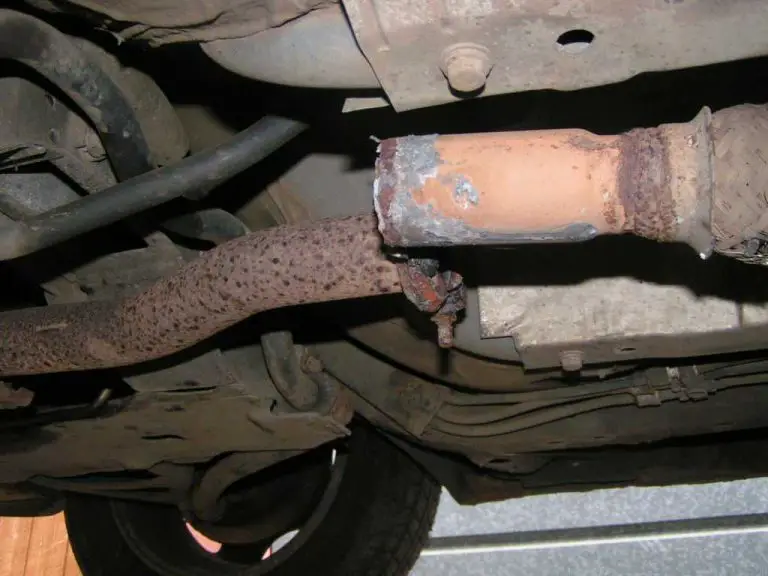
Do not ignore leaks, rusted seams, loose clamps, or worn hangers. A leak can make the exhaust louder and harsher, and it can also create cabin safety issues. Black soot streaks near seams and a metallic rattle are common warning signs.
Do not chase straight pipe loudness for a daily driver without thinking about drone and legality. Straight pipes are loud, but they can hurt drivability. Most regions require a functioning muffler and prohibit excessive exhaust noise, so check local rules before changing the system.
Do not treat cars, trucks, and motorcycles as interchangeable. Motorcycle fitment, mounting, heat management, and legality differ enough that a universal automotive muffler is not a safe assumption. For bikes, check the exact model-specific exhaust part and mounting method before ordering anything.
A common first-timer mistake is blaming the tip when the real issue is a failed clamp on a 2.5-inch pipe. Another is buying a chambered muffler for a highway commuter and then finding the drone unbearable at steady speed. In both cases, the sound goal was chosen after the hardware, and that is backward.
Frequently asked questions
How do you make a muffler louder?
The cleanest route is a muffler with less internal restriction, such as a straight-through or chambered design, plus a tip that matches the outlet size. If the muffler is already installed, check for leaks first. A leak can add noise, but it is not a proper sound modification.
Do bigger exhaust tips make it louder?
Only a little. A larger tip can change the tone and make the tailpipe sound fuller, but the muffler still controls most of the volume and drone. If you want a real change, choose the muffler first and use the tip as a final adjustment.
Will a resonated exhaust tip reduce drone?
Sometimes, but only modestly. A resonator is better placed in the system where it can target the frequency that causes drone. A resonated tip can help trim some edge at the exit, but it is not a substitute for a proper resonator or the right muffler choice.
What muffler makes a car louder?
For a louder note, look at a chambered muffler or a compact packed style. A chambered design such as the Flowmaster Super 44 leans aggressive, while a glasspack-style muffler can be loud in a smaller package. Match the choice to the vehicle, because the same muffler can sound very different on different engines.
How do you make your exhaust louder without ruining daily driving?
Start with a straight-through or balanced performance muffler, keep the inlet and outlet sizes matched, and use a tip that fits the layout. Add or keep a resonator if drone is a concern. That approach is usually safer for commuting than jumping straight to a delete or straight pipe.
How do you make a motorcycle exhaust louder?
Do not use a car muffler as a shortcut. Motorcycle exhaust needs model-specific fitment, mounting, heat clearance, and noise-law checks. The correct path is a bike-specific slip-on or exhaust system listed for that exact motorcycle, with the owner manual and local rules checked before any change.