Flex Pipe Repair vs Exhaust Manifold Repair
A leak at the braided section or bellows usually points to Flex pipe repair; cracks in the manifold, a warped flange, or a blown gasket face call for exhaust manifold repair, and a rusted-through manifold usually means replacement. Pick the wrong repair, and you waste time, leave the leak in place, or buy a part you did not need. This guide shows how to trace leak location, read the failure pattern, and choose the repair that fits the fault the first time.
| Decision factor | Flex pipe repair | exhaust manifold repair | Winner |
|---|---|---|---|
| Leak location | Best when the leak is in the braided tube or bellows section between engine movement points | Best when the leak is at the engine-side casting, flange, or gasket face | Depends on leak location |
| Failure pattern | Common with cracks, holes, leaks, collapse, or torn braid | Common with gasket leaks, flange warpage, cracks, or broken studs | Depends on failure pattern |
| Repair permanence | Temporary patch only for small leaks; welded replacement is the durable fix | Gasket or fastener repair can be durable; cracked castings often need replacement | exhaust manifold repair |
| DIY difficulty | Moderate if the section is accessible and the pipes are not seized | Often harder because of heat cycling, rusted fasteners, and cramped engine-bay access | Flex pipe repair |
| Sensor and emissions impact | Upstream leaks can affect oxygen sensor readings and fuel trims | Also a concern when the leak is upstream of sensors or the catalytic converter | Tie |
How the two repairs differ
An exhaust flex pipe is a braided, flexible exhaust tube section. It absorbs engine movement and vibration, and it is often upstream of the catalytic converter. You may find it between the exhaust manifold and catalytic converter, or between the catalytic converter and muffler.
An exhaust manifold is the engine-side exhaust component that collects exhaust gas before it moves downstream. That location changes the repair decision fast. A leak near the engine can be a gasket issue, a flange issue, a cracked manifold, or a flex pipe problem farther downstream that only sounds like it is up front.
Why location changes the repair
If the leak is in the flex section, the repair usually focuses on that section alone. If the leak is at the manifold, the job may require gasket replacement, flange cleanup, stud repair, or a new manifold if the casting is cracked or rusted through. The farther forward the leak sits, the more heat, corrosion, and fastener damage tend to complicate the fix.
A flex pipe typically lasts 5 to 10 years. After that, movement and vibration often turn into cracks, holes, or a collapse that cuts acceleration and leaves the car sluggish. The manifold does not fail the same way; it fails through warping, cracking, or sealing problems at the gasket face.
How do you tell which part is leaking?
Noise at startup, a sharp exhaust smell, vibration under load, performance loss, a Check Engine Light, and an emissions test failure can come from either component. The best clue is where the sound, soot, or heat pattern shows up. A leak that seems to come from the engine bay does not automatically mean the manifold itself is broken.
Noise patterns and where they point
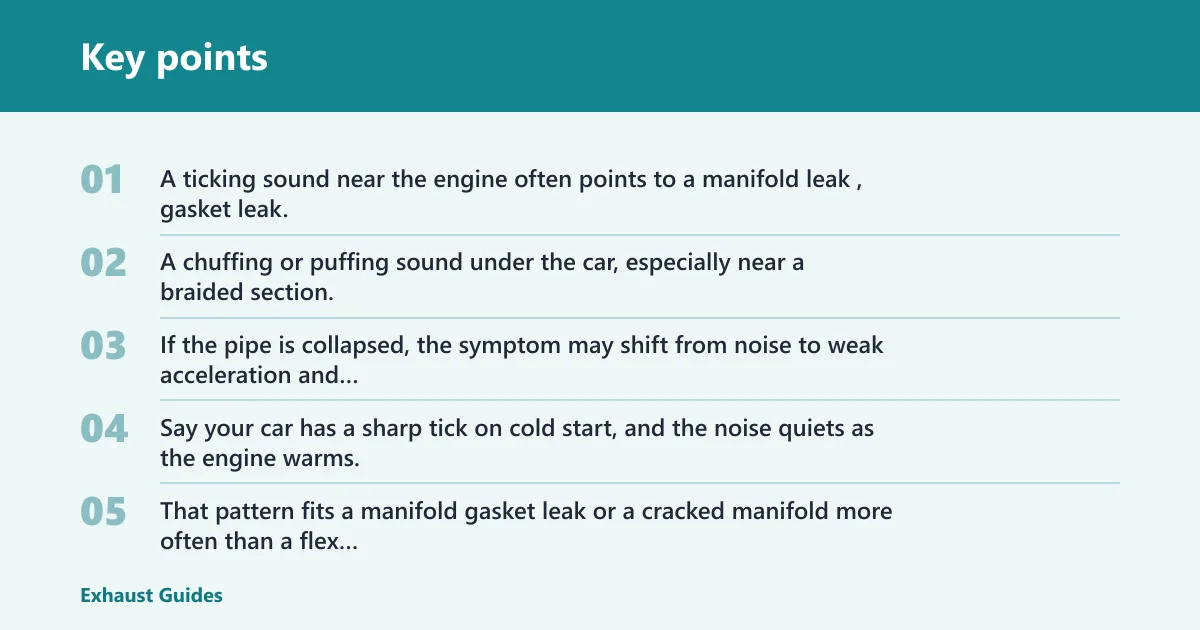
A ticking sound near the engine often points to a manifold leak, gasket leak, or cracked flange. A chuffing or puffing sound under the car, especially near a braided section, points more strongly to the flex pipe. If the pipe is collapsed, the symptom may shift from noise to weak acceleration and sluggish performance.
Say your car has a sharp tick on cold start, and the noise quiets as the engine warms. That pattern fits a manifold gasket leak or a cracked manifold more often than a flex pipe tear. If the same car also has soot at a bellows section under the car, the leak may actually be in two places.
Visible clues under the car and at the engine
Look for soot marks, rust trails, blown gasket residue, and a visible split in the braid or bellows. A gasket leak often leaves dark streaks at the flange seam. A cracked manifold may show a hairline fracture, a separated casting line, or exhaust staining around one runner.
Picture a front-wheel-drive car with a braided section just behind the engine. If that braid is frayed and blackened, and the catalytic converter is still clean at the inlet, the flex pipe is the first suspect. If the flange at the manifold has soot but the flex section looks intact, the manifold side needs attention first.
Gasket, flange, crack, or hole
A gasket leak is usually a sealing problem. A flange leak often means the surfaces no longer sit flat, or the hardware has loosened, stretched, or broken. A crack in the manifold or flex pipe is a metal failure, which means sealant alone will not hold for long.
Use the distinction before buying parts. Swapping a flex pipe will not cure a warped manifold flange. Replacing a gasket will not fix a torn braid. That sounds obvious, but many exhaust jobs go wrong because the leak noise points to one area while the fault sits in another.
Flex pipe repair options
Small leaks in a flex pipe can be sealed briefly with clamps, tape, or patch material, but that is only a stopgap. A proper welded replacement is the durable fix when the braid is thin, the tube is cracked, or the leak sits in more than one spot. If the pipe has collapsed, replacement is usually the only sensible path.
Temporary patch methods and their limits
A temporary patch can quiet a small pinhole or a short split long enough to plan the real repair. It works best when the surrounding metal is still solid and the damage is limited. It does not restore the flex pipe’s job of absorbing vibration, so the patch can fail as soon as the engine moves again.
A temporary patch is not a permanent repair. Heat, vibration, and corrosion keep working after the patch goes on. If the braid is missing in a wide area, the pipe is crushed, or the leak has spread into the adjoining tubes, patching is usually wasted effort.
When welded replacement is the right fix
Welded replacement is the better choice when the flex section is thin, split, or leaking at the ends where clamps cannot grip well. Cutting out the old section and welding in a new one gives a permanent repair if the surrounding exhaust tube is still healthy. It also restores the section that absorbs engine movement and vibration.
This is the common path when the pipe is otherwise sound but the flex element itself has failed. It is also the right call when an upstream leak is affecting oxygen sensor readings, fuel trims, or emissions testing. A repair that still leaks will not solve those problems.
When full section replacement is unavoidable
If the pipe has collapsed, if rust has eaten into the adjoining tubes, or if the leak sits too close to another damaged joint, replace the whole exhaust section. A new flex insert cannot rescue rotten pipe walls. The same is true when the exhaust section has already been patched once and the metal around the repair has thinned out.
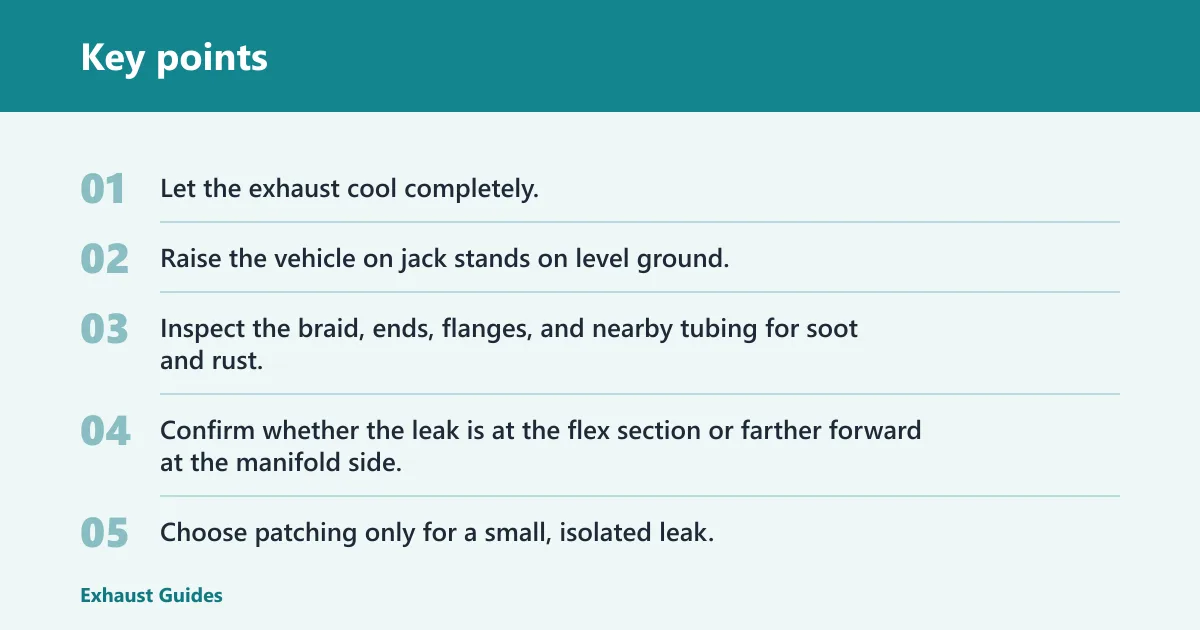
- Let the exhaust cool completely.
- Raise the vehicle on jack stands on level ground.
- Inspect the braid, ends, flanges, and nearby tubing for soot and rust.
- Confirm whether the leak is at the flex section or farther forward at the manifold side.
- Choose patching only for a small, isolated leak.
- Choose welded replacement when the damage is larger, thin, or spreading.
- Check for leaks again after the repair.
When does the manifold need repair?
Repair the manifold instead of the flex pipe when the leak comes from the engine side: the gasket face, flange, or casting. A gasket leak may be repairable without replacing the manifold. A cracked or rusted-through manifold usually is not. Fastener damage often increases both labor time and cost.
Gasket leak vs cracked manifold
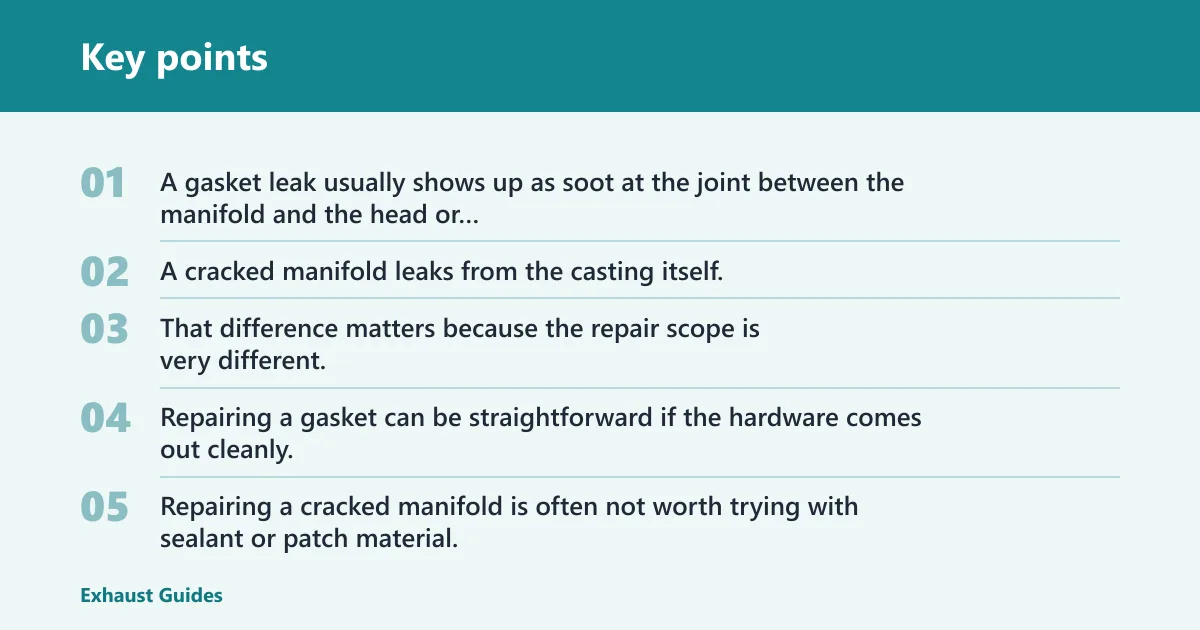
A gasket leak usually shows up as soot at the joint between the manifold and the head or at the manifold-to-pipe connection. A cracked manifold leaks from the casting itself, so the stain often appears on the body of the manifold rather than just the joint. That difference matters because the repair scope is very different.
Repairing a gasket can be straightforward if the hardware comes out cleanly. Repairing a cracked manifold is often not worth trying with sealant or patch material. A warped flange or broken casting usually means replacement, not rescue.
Repair limits for warped or broken manifolds
Manifold repairs stop being practical when the flange is warped beyond sealing, the bolt holes are damaged, or the casting has separated at a stress point. In those cases, the part may leak again even after a new gasket goes in. Once the metal has moved or cracked, the seal surface often cannot be trusted.
A common first-timer mistake is replacing the gasket when the manifold face is visibly warped. The new gasket will not fix a bad surface. The leak returns, the Check Engine Light stays on, and the job has to be opened back up.
Why fastener and flange damage changes cost
Exhaust manifold repair often costs more in labor than flex pipe repair because seized studs, broken bolts, and cramped access can add time. If the flange hardware is damaged, the job may expand from a simple swap to drilling, thread repair, or complete manifold replacement. That is why the “cheap gasket job” can stop being cheap quickly.
Flex pipe vs exhaust manifold: Which repair fits the leak?
| Leak location | Likely component | Visible clues | Safest DIY fix | Typical professional fix | When replacement is unavoidable |
|---|---|---|---|---|---|
| Under the car, in the braided section | Flex pipe | Frayed braid, soot at the bellows, buzzing or puffing under load | Temporary patch only for a small leak | Cut out and weld in a new flex section | When the braid is thin, split, or collapsed |
| At the engine-side flange | exhaust manifold repair | Soot at the joint, ticking on cold start, burnt residue around the flange | Replace gasket if the surface is flat and hardware is intact | Gasket replacement, stud repair, or flange service | When the flange is warped or broken |
| From the casting itself | exhaust manifold repair | Hairline crack, staining on the manifold body, noise that changes with heat | No lasting DIY seal fix | Manifold replacement | When the casting is cracked or rusted through |
| Near the catalytic converter inlet | Flex pipe or adjoining pipe section | Leak trace at the joint, upstream sensor noise, exhaust smell at idle | Inspect both joints before buying parts | Replace the affected section and any failed seal | When the surrounding pipe is thin or multiple leaks are present |
Use the table as a fault map, not a shopping list. The same noise can come from different spots, but the repair changes with the exact leak location. If you cannot separate the manifold side from the flex section, inspect both before ordering parts.
Can an exhaust leak affect sensors and emissions?
Yes. Upstream leaks can affect oxygen sensor readings and fuel trims, especially when the leak sits before the catalytic converter. That can cause false lean readings, odd drivability, a Check Engine Light, and emissions-test trouble. The converter can also be stressed by ongoing exhaust leaks.
Upstream leaks and oxygen sensor readings
If extra air enters before an oxygen sensor, the sensor may report a lean condition that is not really caused by the engine mixture. The engine control system can then add fuel that it does not need. That can create poor fuel trims and rough running, even if the engine itself is fine.
The upstream location is what matters. A leak after the sensor is still a repair problem, but it is generally less likely to distort readings. A leak before the sensor can change the data the engine computer relies on.
Catalytic converter stress and cabin safety
Ongoing exhaust leaks can leave the catalytic converter working harder than it should, especially if the engine management responds to false sensor data. They also raise carbon monoxide exposure risk if fumes enter the cabin. That risk is higher at idle and in slow traffic, where exhaust flow and cabin ventilation can make intrusion more likely.
A small leak is still a safety issue. Hot exhaust can burn skin and nearby components, and carbon monoxide is dangerous even when the leak sounds minor. If the smell is strong inside the car, the repair should move to the front of the line.
Choose Flex pipe repair if…
Choose Flex pipe repair if the leak is in the braided section, the tube is otherwise intact, and you need a fix that restores the vibration-absorbing section without opening the engine-side exhaust hardware. Choose exhaust manifold repair if the leak is at the head, gasket, flange, or casting, or if the manifold is cracked or warped. For a rusted-through manifold, replacement is the answer, not patching.
Use flex pipe repair for a localized leak under the car. Use exhaust manifold repair for an engine-side leak that is tied to the gasket, flange, or manifold body. If both areas show damage, repair the manifold side first when that leak is upstream and traceable, then address the flex section so the finished exhaust does not keep leaking from the next weak point.


Frequently asked questions
Is flex pipe repair temporary or permanent?
Temporary patch methods are short-term only. They can slow a small leak, but they do not restore the flex pipe’s full strength or movement control. A welded replacement is the permanent fix when the pipe still has enough sound metal for a proper weld.
When should I repair the manifold instead of the flex pipe?
Repair the manifold first when the leak is clearly at the engine-side flange, gasket face, or casting. If soot or ticking comes from the manifold area and the flex section looks intact, the manifold-side fault is the more likely cause. Do not replace the flex pipe just because the noise is near the front of the car.
Can a leaking flex pipe affect emissions or fuel trims?
Yes. Upstream leaks can change oxygen sensor readings, which can drive false lean fuel trim corrections and trigger a Check Engine Light. They can also cause emissions-test failure and may stress the catalytic converter if the leak is left in place.