Flex Pipe Repair vs Catalytic Converter Replacement
Repair the flex pipe only if the converter, front pipe, and remaining exhaust are sound. Replace the catalytic converter or front pipe when corrosion, cracks, or emissions compliance make a patch a short-lived fix. Skip that call, and you can end up with exhaust leaks, failed inspection, CEL codes, and a repair bill that grows when damage keeps spreading. This guide compares legality, total cost, and the parts that should be replaced together.
| Factor | Flex pipe repair | catalytic converter replacement | Winner |
|---|---|---|---|
| Up-front cost | Usually lower because you are repairing one failed section, not an emissions component and its related hardware. | Usually higher because the converter itself is more expensive than a flex pipe repair. | Flex pipe repair |
| Legality | Usually acceptable when you are repairing the exhaust back to its original function and not removing emissions equipment. | Replacement is legal only with the correct compliant part for the vehicle and location. | Flex pipe repair |
| Emissions readiness | Can be fine if the leak is fixed and the converter is still doing its job. | Needed when the converter is clogged, damaged, or failing emissions tests. | catalytic converter replacement |
| Risk of repeat repair | Higher if surrounding pipe, flange, or weld area is thin or rusted. | Lower when the fault is actually inside the converter and the rest of the assembly is sound. | catalytic converter replacement |
| Best-fit use case | Sound exhaust around a cracked flex section, with no widespread corrosion. | P0420-style converter failure, clogging, or a legal replacement need. | Tie |
The core trade-off
The choice is not cheap versus expensive. It is local damage versus a larger failure that will return if you only patch one spot. Flex pipe repair works when the rest of the exhaust is healthy; catalytic converter replacement is the right answer when emissions compliance or internal converter damage is the actual problem.
Cost is only part of the decision
Flex pipe work is usually the lower-cost route because you are replacing a flexible exhaust section that can be welded or clamped on some applications. A converter job often costs more because the part is doing emissions work, and the replacement has to match legal requirements for the vehicle and location.
Legality comes before performance talk
Swapping a catalytic converter for a flex pipe may seem like a tidy fix for noise or flow, but that misses the point. In most US states, replacing a catalytic converter with a flex pipe is illegal, and one guide says the swap can be fine only if it is legal in your state. Inspection rules matter more than a short-term sound change.
Durability depends on the surrounding pipe
A flex section can be replaced alone if the surrounding pipe is still in good shape. If the pipe body, flange, or sensor bung is thin or rusted, a spot repair often buys only a little time. A rusted assembly can fail again near a flange within months.
Exhaust decision matrix
| Criterion | Flex pipe repair | Front pipe replacement | Catalytic converter replacement |
|---|---|---|---|
| Legality | Usually legal when it restores the exhaust without removing emissions hardware. | Legal when the assembly matches the original emissions layout and local rules. | Legality varies by state and country; replacement must stay compliant. |
| Emissions readiness | Good if the leak is the only issue and the converter is healthy. | Good when the whole front section is replaced with the correct assembly. | Best when the converter is the failed emissions part. |
| Typical labor complexity | Moderate. Some applications allow clamping; others need cutting and welding. | Moderate to high. More hardware and more chance of rusted fasteners. | High. Sensor removal, fitment, and emissions compliance all matter. |
| Likely leak recurrence | Medium to high if nearby metal is thin or the weld area is poor. | Lower than a patch if the assembly is badly aged. | Low for the leak itself, unless the rest of the exhaust is also worn out. |
| When it is appropriate | Only the flex section is cracked or leaking, and the rest of the pipe is solid. | The flex section, pipe body, flange, or bung is part of a rusted assembly. | The converter is clogged, damaged, or failing emissions. |
| What parts usually get replaced | Flex section, clamps or weld material, sometimes gaskets. | Whole front pipe or downpipe assembly, plus gaskets and hardware. | Converter assembly, gaskets, seals, and often sensor-related hardware. |
| Inspection risk | Low if the leak is fully sealed and emissions parts remain intact. | Medium if the replacement changes the original assembly layout. | High if the part is not compliant or the swap removes emissions function. |
| Red flags that rule it out | Rusted pipe, split flange, bent mount, or damage beyond the flex section. | Severe converter failure, heavy rust throughout the assembly, or broken sensor bung. | Illegal conversion to a flex pipe, unresolved leak, or engine issue causing repeat failure. |
Legality
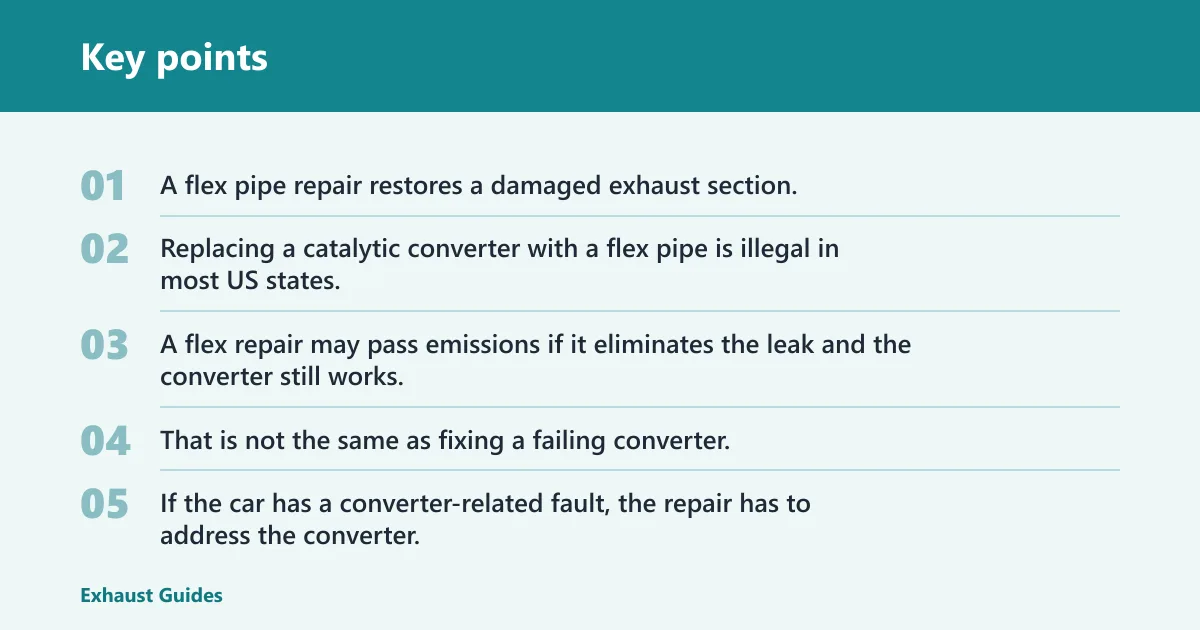
Legality is the clearest divider. A flex pipe repair restores a damaged exhaust section, while converter replacement has to preserve emissions compliance. Replacing a catalytic converter with a flex pipe is illegal in most US states, and converter removal is illegal in many places outside the US as well.
Emissions readiness
A flex repair may pass emissions if it eliminates the leak and the converter still works. That is not the same as fixing a failing converter. If the car has a converter-related fault, the repair has to address the converter, not the flexible section alone.
Labor complexity
Flex pipe work can be straightforward when the pipe is accessible and the metal around it is clean. Front pipe replacement raises the workload because the whole section comes out. Converter replacement can add sensor handling, fitment checks, and compliance concerns that do not exist in a simple leak repair.
Leak recurrence
A braided or corrugated flex pipe absorbs engine movement and vibration, so it can help reduce engine noise and prevent a repeat leak when the surrounding pipe is solid. But if the pipe is rust-thin, the next weak point appears fast. That is why a clamp-on patch over bad metal often becomes false economy.
Inspection risk
Inspection risk is not the same as drivability. A car can sound better after a repair and still fail if the repair removed required emissions hardware or left a fault code behind. Leak testing matters after the work, because an exhaust leak can cause noise, performance loss, and fault codes.
How do you tell which part failed?
Start with symptoms, then check where the evidence points. A cracked flex pipe often shows soot, ticking, or a hiss near the braided section. A converter problem usually shows up as emissions failure, loss of power from clogging, or a code pattern that stays centered on converter efficiency rather than a visible leak.

Flex pipe failure clues
A damaged flex pipe can create exhaust leaks, and the leak often appears where the braid is frayed, the inner liner is split, or the pipe is cracked near the ends. You may hear the leak most clearly on cold start or under throttle. If you can see soot around the flex section, that is a strong clue.
Converter failure clues
A catalytic converter reduces carbon monoxide, hydrocarbons, and nitrogen oxides, so its failure tends to show up as emissions trouble first. A clogged converter may also affect power. If the exhaust upstream and downstream of the flex section is sealed, but the vehicle still sets a converter-efficiency complaint, the converter deserves the closer look.
Why a P0420-style code is not a flex pipe diagnosis
A P0420-style code points to catalyst efficiency, not to a flex section by name. A bad flex pipe can still confuse oxygen sensor readings if it leaks exhaust ahead of the converter, but that is a leak problem, not proof of converter death. The code tells you to check the whole exhaust path, not to skip straight to part replacement.
When a leak test matters more than the code
Say your sedan has a loud tick from under the firewall and a P0420 code after a recent pothole hit. The code alone does not settle it. A leak test near the flex section and flange area is the smarter next step, because a small exhaust leak can drive sensor behavior and mimic a converter complaint.
Is a flex pipe repair legal?
Yes, when it repairs the exhaust without deleting emissions equipment and local rules allow that type of repair. The legal problem starts when the swap removes the converter or substitutes a noncompliant setup. Welding or clamping a flex section can be acceptable on some applications, but the repair still has to pass the inspection rules where you live.
What local law usually controls
State, provincial, and country rules usually control whether the car must retain the original emissions layout, and whether a replacement converter has to be approved for that vehicle. The safest assumption is simple: if the repair changes the emissions system, verify the rule before cutting metal.
When welding or clamping is acceptable
Clamps can be used instead of welding, and another guide recommends a hacksaw or pipe cutter to size the flex pipe. That means some jobs can be done without a welder. The catch is fit and seal quality; if the pipe is rusted or crushed, a clamp is not a cure.
Why converter removal is the wrong comparison
Do not treat a flex pipe as a legal substitute for a catalytic converter. They do different jobs. The flex pipe absorbs movement, while the converter changes exhaust chemistry. Removing the converter and calling that a repair ignores the emissions function and usually fails inspection.
Inspection and emissions-test risk
A flex repair can still fail inspection if it leaves a leak, a warning light, or a tampered emissions layout. That is why leak testing after repair matters. Noise reduction alone does not prove the car is ready for an inspection lane.
When should you replace the whole front pipe?
Replace the whole front pipe when the damage is bigger than the flex section. That is the better choice if rust has spread, the flange is damaged, a turbo outlet or manifold-adjacent section is part of the assembly, or the leak has already moved beyond a single repair point. Spot fixes do not pay off on thin metal.
Thin rust around the pipe body
If the pipe wall flakes when cleaned, or the heat-affected area around the flex has turned soft and pitted, a new flex section is not enough. The repair area may hold for a while, then split next to the weld. That is the kind of repeat failure that makes a full front-pipe replacement cheaper in the long run.
Damaged flanges or sensor bungs
Broken flanges and damaged sensor bungs change the job. They create sealing problems that a simple flex replacement does not solve. If the sensor bung is distorted, the oxygen sensors may read the exhaust stream poorly, and the code chase can start again.
Turbo outlet or manifold-adjacent assemblies
Many turbo systems place the flex section in the downpipe. Some manifold-side assemblies do the same. In those setups, the front pipe may include the flex section as part of its structure, so replacing only the flex can mean fighting a damaged, heat-cycled assembly that should have come out as one unit.
When spot repair becomes false economy
Picture a rust-belt hatchback with a split flex section, a crusty flange, and a pipe body that sheds flakes when tapped. A clamp and a short patch may stop the noise for now, but the next leak will likely appear nearby. In that case, the larger assembly is the better buy.
Choose flex pipe repair if… / Choose catalytic converter replacement if…
Choose flex pipe repair when the exhaust around it is sound, the leak is local, and the converter is still working. Choose catalytic converter replacement when the converter is clogged, damaged, or causing emissions failure, and keep the repair compliant with local law. If the front pipe is rusted through, replace the assembly instead of chasing a weak patch.
Choose flex pipe repair if…
- The braid or corrugated section is cracked, but the surrounding pipe is still solid.
- There is an exhaust leak, but no evidence that the converter is the failed part.
- You need the lowest-scope repair and the application allows welding or clamping.
- The vehicle can still pass emissions once the leak is sealed.
Choose catalytic converter replacement if…
- The converter itself is clogged, damaged, or failing emissions.
- The vehicle has a converter-related fault that does not resolve with leak repair.
- Local law requires a compliant converter replacement, not a substitute pipe.
- The exhaust diagnosis points to internal converter failure, not just a cracked flex section.


Frequently asked questions
Is it cheaper to repair a flex pipe or replace the catalytic converter?
Flex pipe repair is usually cheaper because it addresses a smaller section of exhaust, while a converter replacement involves a costlier emissions component and more compliance risk. The cheapest option is not always the right one, though. If the pipe is rusted through or the converter is truly failed, a patch can cost more later.
Can a bad flex pipe cause a check engine light or P0420 code?
Yes. A damaged flex pipe can create exhaust leaks that change oxygen sensor readings and trigger fault codes, including P0420-style complaints. That does not mean the converter is automatically bad. It means you should verify the leak first, then judge the converter after the exhaust path is sealed.
When should I replace the whole front pipe instead of just the flex pipe?
Replace the whole front pipe when the pipe wall is thin, the flange is damaged, the sensor bung is compromised, or rust has spread beyond the flex section. If the metal around the repair point is weak, a new flex section often fails near the next weak spot. That is the false-economy case.
Is replacing a catalytic converter with a flex pipe legal?
Usually no. Replacing a catalytic converter with a flex pipe is illegal in most US states, and converter removal is illegal in many other places as well. The legal issue is not the shape of the pipe. It is the loss of emissions equipment and the inspection failure that follows.
Will a flex pipe fix an exhaust leak without welding?
Sometimes. Clamps can be used instead of welding, and some applications allow a bolt-in or clamp-on repair. That only works when the pipe ends are clean, round, and solid. If rust or deformation is present, a clamp may hold poorly and the leak can return quickly.
Will replacing the catalytic converter with a flex pipe make the car louder?
It can make the exhaust louder, but that is not a valid reason to do the swap. A flex pipe can reduce noise by absorbing vibration, yet it does not replace the converter’s emissions role. If the change removes required emissions equipment, the louder result comes with legal and inspection risk.
What tools do I need to replace a catalytic converter with a flex pipe?
The basic tools include jack stands, a level surface, a cool exhaust, clamps, penetrating oil, a hacksaw or pipe cutter, and sometimes a welding machine. Negative battery cable disconnect is also commonly mentioned in repair guides. The tool list matters less than the legality check before you cut anything.