Stainless Steel vs Aluminized Flex Pipes
Choose stainless steel flex pipe for salted roads, daily driving, or long service life; choose aluminized flex pipes only for dry climates or a low-cost repair you expect to replace sooner, often in 2–5 years instead of 5–10+. Pick wrong and the flex section can rot, crack at the welds, or leak under load, turning a cheap repair into labor, noise, and possible check-engine trouble. This guide compares corrosion, heat cycling, weldability, and replacement interval so you can buy the right flex pipe for your exhaust job.
| Decision factor | Stainless steel | aluminized flex pipes | Winner |
|---|---|---|---|
| Corrosion in salt and slush | Chromium-based protection resists rust and oxidation better in chloride exposure. | Coating slows rust, but damage at bends, welds, and cut edges can start corrosion early. | Stainless steel |
| Heat cycling and oxidation | Better choice where repeated hot-cold swings and high exhaust temperature are common. | Works in high-heat exhaust use, but coating and base steel are less forgiving over time. | Stainless steel |
| Weldability and repair fit | More complex to weld, especially if the grade and filler are mismatched. | Easier to weld in some repairs, though the coating near the joint needs attention. | aluminized flex pipes |
| Up-front cost | More expensive, but usually chosen when corrosion resistance matters more than cost. | More cost-effective and lighter on the budget for a short-term repair. | aluminized flex pipes |
| Best-fit exhaust use | Daily driver, rust-belt car, coastal vehicle, or higher-heat performance build. | Dry-climate commuter or a repair where replacement timing matters less than price. | Stainless steel |
What usually fails first in a flex pipe
Flex pipes usually fail at the places exhaust stress concentrates: the bellows, the welds, and any spot where the coating is cut, scraped, or burned away. Salt, condensation, and thermal cycling attack those weak points first, so a material that looks fine on paper can still fail early where the pipe moves and flexes.
Bends, welds, and damaged spots
Aluminized steel uses an aluminum-silicon coating over mild steel, so the coating does a lot of the corrosion control. Once it is breached at a bend or weld, rust can move under the coating and spread outward. Stainless steel does not depend on a sacrificial coating in the same way; its chromium oxide layer gives it better resistance when the surface is scuffed.
A common first-timer mistake is buying the brighter-looking flex pipe without checking whether stainless steel or aluminized material better matches the vehicle’s heat and corrosion needs. Say your car needs a flex section near the firewall, where heat, vibration, and splash all hit the same spot. A cheaper aluminized part can still be the wrong buy if that joint sits in winter slush every day.
Why environment matters more than price alone
Cost matters, but the environment decides whether the lower upfront price saves money or adds another labor charge later. Road salt, short-trip condensation, and marine air all shorten the life of coated mild steel faster than they shorten stainless steel life. That is why stainless steel is generally better when corrosion resistance matters more than cost, even though it costs more up front.
Side-by-side comparison
For flex pipes, the comparison is not material only. You need to weigh coating failure, weld-zone corrosion, heat cycling, and how soon the part is likely to come out of the car again.
Corrosion resistance
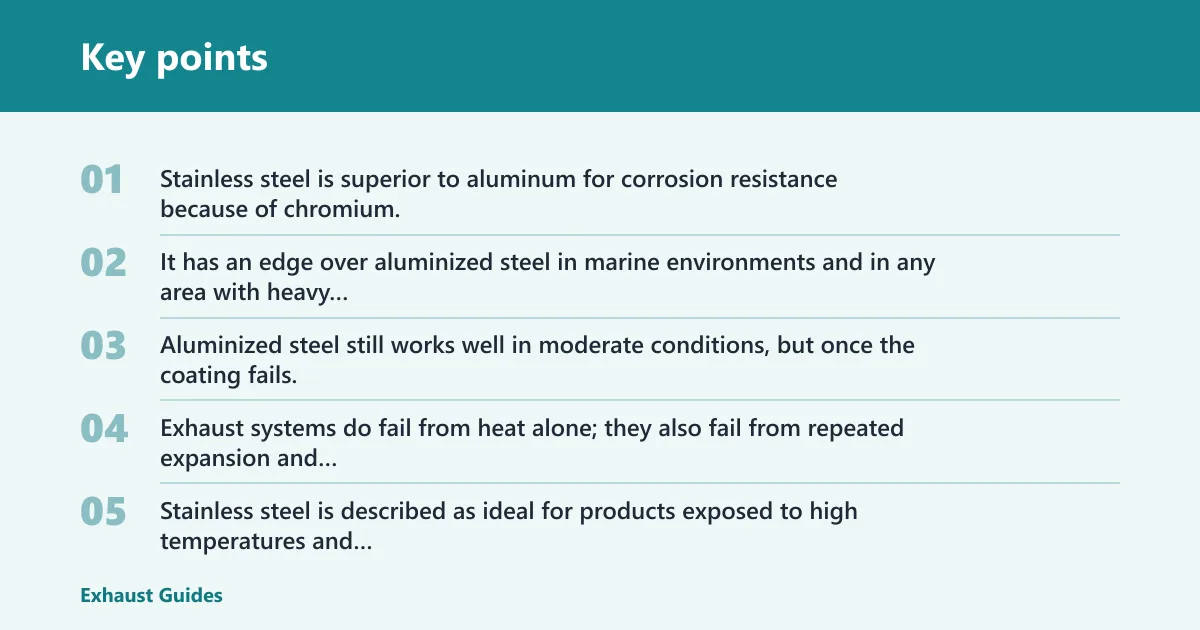
Stainless steel is superior to aluminum for corrosion resistance because of chromium, and that matters in exhaust work where moisture and salt sit inside and outside the pipe. It has an edge over aluminized steel in marine environments and in any area with heavy chloride exposure. Aluminized steel still works well in moderate conditions, but once the coating fails, the mild-steel base is exposed.
Heat and thermal cycling
Exhaust systems do fail from heat alone; they also fail from repeated expansion and contraction. Stainless steel is described as ideal for products exposed to high temperatures and corrosion, and it generally has better heat resistance than aluminum and better resistance to thermal fatigue at the flex section. Aluminized steel can be used in high-heat exhaust applications, but one source puts its temperature resistance up to 700°F, which is enough for many muffler and mid-pipe jobs, not a guarantee of long life at stressed joints.
Weldability and fabrication
Stainless steel is harder to weld than aluminized steel according to the source, so fabrication takes more care with filler choice, heat control, and fit-up. The coating on aluminized steel also changes how the joint is prepared; the coated area near a weld often needs cleanup so the joint is not contaminated. For a straightforward exhaust repair, easier joining can matter as much as material strength.
Cost and replacement timing
Aluminized steel is more cost-effective than stainless steel, and aluminum pipe is described as lighter and more affordable than stainless steel by weight. That lower initial price can help when the goal is to get the car back on the road quickly and accept an earlier replacement. Stainless steel pipe is more expensive but durable and heat resistant, so the higher buy-in can make sense when you want to avoid another exhaust job soon.
Suppose a rear flex pipe on a winter-driven sedan starts weeping at the braid after three seasons. A stainless replacement is the better spend if the rest of the exhaust is sound, because the same salt and splash exposure will likely repeat the failure on another coated part.
What is aluminized steel in a flex pipe?
Aluminized steel in exhaust work means an aluminum-silicon coating over mild steel. The coating helps slow rust and adds heat resistance at a price point below stainless steel, which is why it is common in mufflers and many exhaust repairs.
Why the coating fails first
The coating is strongest where it stays intact, and weakest where the pipe flexes, gets clamped, or takes road debris. Once the surface is cut or the coating burns away near a weld, moisture can work on the base steel underneath. That is why the first rust often appears at the ends of the flex section, not in the middle.
Why it is cheaper than stainless
Aluminized steel is presented as more cost-effective than stainless steel because it uses mild steel under a thin protective layer instead of a full corrosion-resistant alloy. The lower material cost can also matter in shipping and storage because stainless is heavier by cost and often by total replacement price. For a low-budget repair, that difference is real.
What makes stainless steel different?
Stainless steel relies on chromium-based corrosion resistance, not a coating that can flake or burn off. That is why it is usually the better choice when rust resistance, wear resistance, and heat resistance need to hold up together.
Common exhaust grades: 409, 304, and 316
Exhaust-grade stainless is not all the same. 409 stainless is commonly used in automotive exhaust because it balances cost and corrosion resistance; 304 is generally considered more corrosion resistant and is often preferred where exposure is harsher; 316 is typically chosen when chloride exposure or marine conditions are a real concern.
Why stainless is favored in salty environments
Road salt and winter slush create chloride exposure, and chloride attacks coated mild steel fast once the coating is breached. Stainless steel has an edge in marine environments for the same reason: its chromium oxide layer resists rust and oxidation better when moisture and salt stay on the surface. If the vehicle lives near the coast, stainless usually buys more time between repairs.
Which lasts longer under salt and moisture?
Stainless steel is generally reported to last longer than aluminized flex pipes in salt, winter slush, and marine air because its corrosion resistance does not depend on a thin outer coating staying perfect. Aluminized steel can still work in wet climates, but once the coating is damaged, corrosion can move quickly at the flex ends, welds, and cut edges.
Road salt and winter slush
Winter driving is hard on flex pipes because slush packs onto the pipe, then melts and refreezes around joints. That cycle keeps moisture in contact with the metal and speeds rust at damaged coating points. Stainless steel is the safer pick for rust-belt vehicles because the chromium layer keeps resisting oxidation after the first scratch.
Condensation inside the exhaust
Short trips matter more than many owners expect. When the exhaust never gets hot enough for long enough, condensation stays inside the pipe and attacks the inner surface. A coated mild-steel flex pipe can rust from the inside out, while stainless steel handles that trapped moisture better over repeated trips.
Marine and chloride exposure
Salt air is a harsh test because chloride exposure reaches the underside, the braids, and any weld heat-affected zone. Stainless steel is the better material where spray and airborne salt are regular, not occasional. Aluminized steel can still be used, but it becomes a shorter-interval part in that environment.
How do they handle exhaust heat?
Heat alone does not decide flex pipe life. What matters is how the material handles repeated heating and cooling, especially at the bellows and welds where movement is concentrated.
Heat cycling and thermal fatigue
Stainless steel handles repeated thermal cycling better in flex-pipe service because it keeps its strength and corrosion resistance under heat. Aluminized steel can tolerate high exhaust temperatures, and one source says up to 700°F, but that does not make it immune to fatigue. If the flex section sits close to the manifold or a hot turbo outlet, stainless is the safer long-life choice.
Oxidation at welds and bends
Heat exposes bare metal at the hottest spots first. On aluminized steel, the coating can discolor, crack, or burn back from welds and bends, then leave the base metal open to oxidation. Stainless steel still needs good weld practice, but it depends less on a surface coating surviving the heat zone.
Why high heat is not the same as long life
A material can tolerate temperature and still fail early from fatigue. That distinction matters in flex pipes because vibration and heat stack together. Stainless steel is the more durable answer when the exhaust sees both high heat and movement; aluminized steel is acceptable when heat is moderate and replacement can be planned sooner.
Flex pipe decision table
This table ties the choice to the conditions that actually shorten flex-pipe life. Start with the use case, then compare climate, mileage, and the repair goal.
| Vehicle use case | Climate | Annual mileage | Repair goal | Better pick |
|---|---|---|---|---|
| Daily driver | Dry, little road salt | Moderate to high | Lowest upfront spend | aluminized flex pipes |
| Rust-belt commuter | Salted roads, winter slush | Any normal commute | Longer service life | Stainless steel |
| Coastal or marine use | Salt air and chloride exposure | Any | Reduce repeat exhaust work | Stainless steel |
| Performance build | Dry to mixed, high exhaust heat | Variable | Heat and fatigue resistance | Stainless steel |
| Short-term repair | Mild, limited salt exposure | Low | Get it back on the road cheaply | aluminized flex pipes |
Choose stainless steel if… / Choose aluminized flex pipes if…
Choose stainless steel if the car sees salted roads, coastal air, or repeated short trips that leave condensation in the exhaust. It also makes sense when you want fewer repeat repairs, when the flex sits near a hot section, or when the vehicle is worth keeping longer than the cheapest fix would last.
Choose aluminized flex pipes if the car lives in a dry climate, the repair budget is tight, and you are solving a moderate-exposure exhaust problem rather than a long-life one. It is the smarter buy for a quick, affordable fix when you expect the rest of the exhaust system to move on before the flex section does.
Buy/avoid checklist: stainless steel
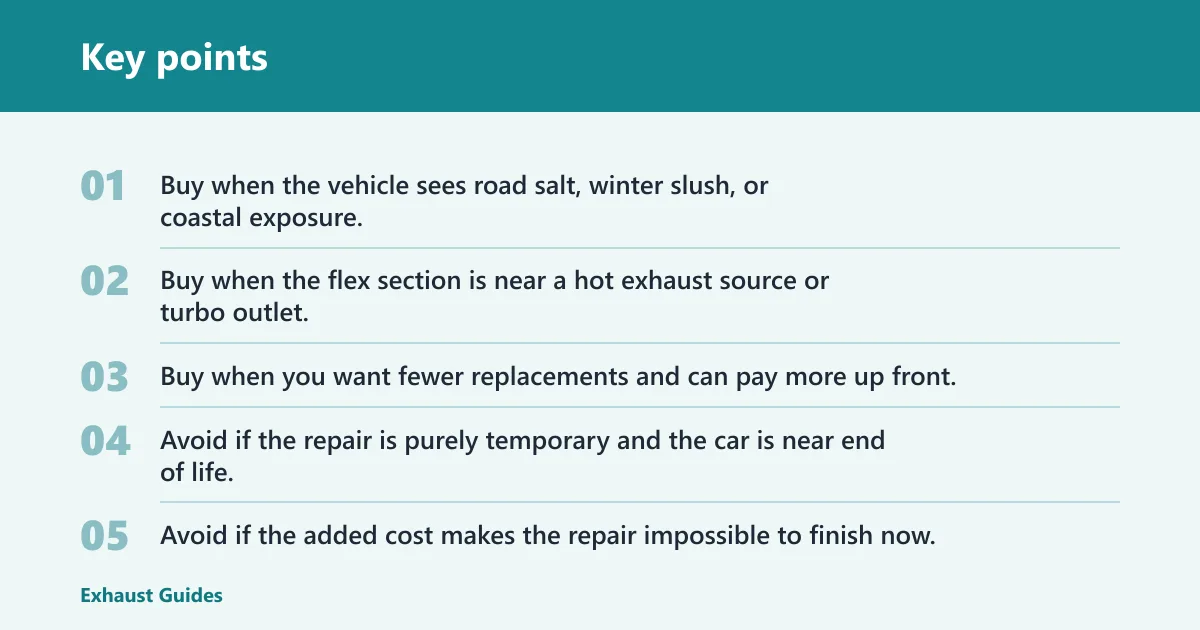
- Buy when the vehicle sees road salt, winter slush, or coastal exposure.
- Buy when the flex section is near a hot exhaust source or turbo outlet.
- Buy when you want fewer replacements and can pay more up front.
- Avoid if the repair is purely temporary and the car is near end of life.
- Avoid if the added cost makes the repair impossible to finish now.
Buy/avoid checklist: aluminized flex pipes
- Buy for dry-climate cars with limited salt exposure.
- Buy when the goal is a lower-cost repair with acceptable shorter life.
- Buy when fabrication speed matters and the joint is straightforward.
- Avoid in coastal, winter-salt, or high-condensation use.
- Avoid when the vehicle needs the longest practical replacement interval.
- Match the material to the climate first, not the price tag.
- Inspect the flex location for heat, spray, and clamp access.
- Choose stainless for salt, moisture, or long service life.
- Choose aluminized for dry use and lower-cost repairs.
- Plan the replacement interval before you order the part.

- T304 stainless steel for corrosion resistance
- Double braid design for durability
- Economical repair option versus full exhaust replacement
Frequently asked questions
Aluminum vs steel flex
For exhaust flex pipes, steel usually wins on wear, temperature, and welding strength. Aluminum is lighter and resists corrosion in some forms, but it is not the same fit for a hot, vibrating exhaust section. If you are comparing a flex pipe repair, steel-based options are the practical choice.
Aluminized steel vs stainless steel exhaust
Aluminized steel is a steel core with an aluminum-silicon coating, so it is a cost-focused exhaust material that works well in moderate conditions. Stainless steel costs more but gives better corrosion resistance, especially in salt and marine exposure. For long service life, stainless usually wins.
Stainless steel vs aluminized steel
Stainless steel is the better material when rust resistance, oxidation resistance, and long-term heat exposure matter. Aluminized steel is better when you need a lower-priced repair and the environment is less severe. In exhaust work, the choice usually comes down to climate and replacement timing.
Aluminized vs stainless exhaust
For exhaust systems, aluminized steel is often the budget option and stainless steel is the longer-life option. The key difference is that aluminized steel depends on a coating that can fail at welds, bends, and damaged spots. Stainless steel keeps resisting corrosion without that same coating dependency.
Stainless steel tubing vs pipe
In exhaust talk, “tubing” and “pipe” are often used loosely, but the fit and wall design matter more than the label. For a flex section, choose the part that matches diameter, length, and joint style exactly. A good match avoids leaks and fitment problems more than the word on the listing.
Stainless steel pipe seamless vs welded
Seamless pipe avoids a longitudinal weld, while welded pipe includes one formed seam. For many exhaust jobs, welded pipe is common and acceptable; the better choice depends on pressure, fit, and cost. In a flex-pipe repair, the main concern is the quality of the actual flex section and its end connections.
Stainless pipe vs tube
Pipe and tube are not identical terms in fabrication, but for exhaust replacement you usually care more about size, wall thickness, and end compatibility. A mismatch can create fit issues at clamps or hangers. Check the actual dimensions rather than relying on the label alone.
Stainless steel pipe vs tube
Stainless steel pipe and tube can both work in exhaust systems, but the correct choice depends on how the part is made to connect. Tube is often used when precise outside diameter matters, while pipe may be listed by nominal size. For flex repairs, the end fit and joint style matter most.
Galvanized pipe vs stainless steel
Galvanized pipe has a zinc coating, which is useful in some plumbing and structural uses, but it is not the usual choice for exhaust flex sections. Exhaust heat and corrosion conditions make stainless steel the more appropriate material. Galvanized coatings can also create fit and heat concerns in hot exhaust service.
Stainless steel vs copper pipes
Copper resists corrosion in some settings and conducts heat well, but it is not the normal material for exhaust flex pipes. Stainless steel is stronger, handles exhaust heat better, and stands up to vibration and road exposure more reliably. For exhaust repair, stainless is the practical option.