Full Exhaust System Diagram for Cars, Trucks, and Bikes
A full exhaust system runs from the engine outlet to the tailpipe. It usually includes the exhaust manifold or header, front pipe, catalytic converter, resonator, muffler, and tailpipe; motorcycles often use a shorter path with fewer sections. Get the layout wrong, and you can misread leaks, noise, emissions faults, or missing parts. This guide maps each section for cars, trucks, and bikes, with labeled flow order and quick position cues for each vehicle type. (Wikipedia)
What a full exhaust system includes
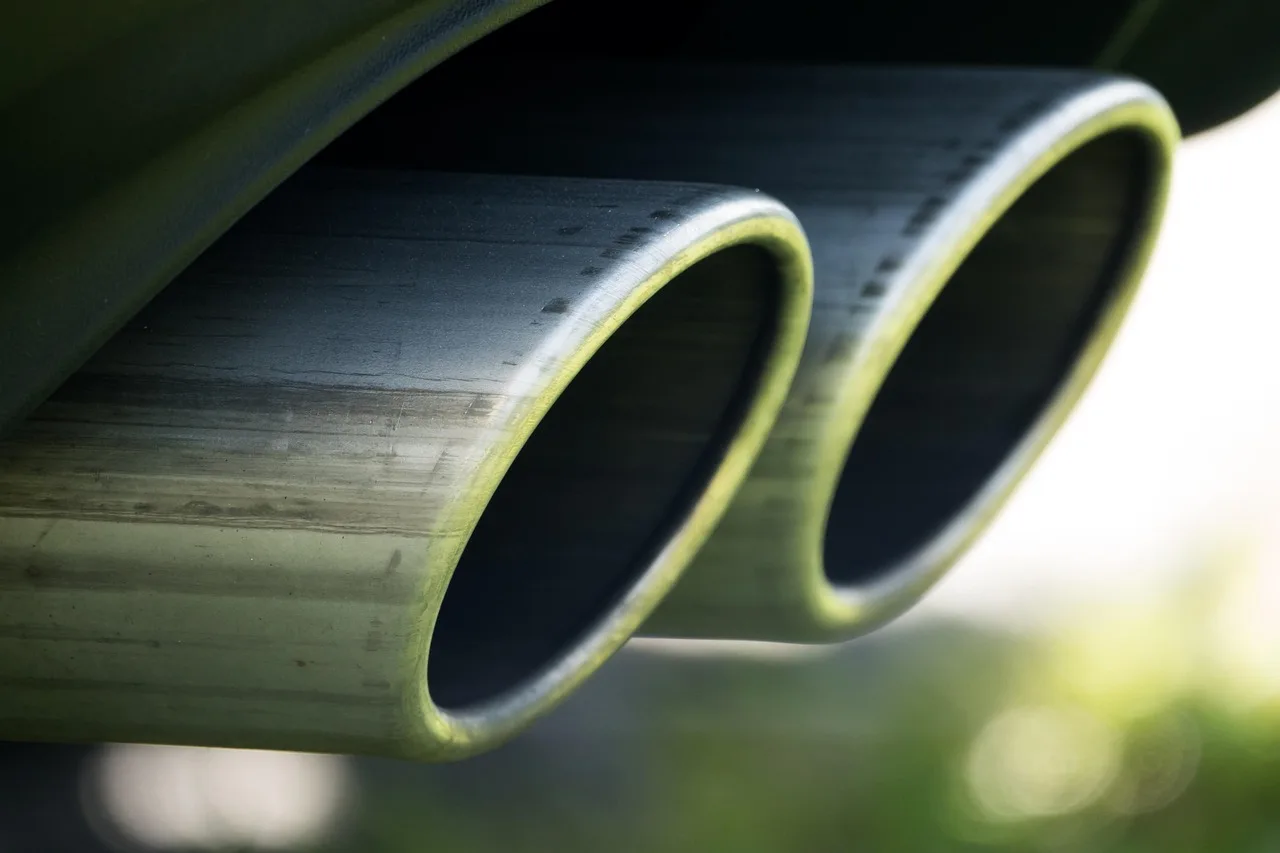
A full exhaust system is the complete gas path from the engine outlet to the final exit. Read it in this order: manifold or header, front pipe or downpipe, catalyst, flex section, mid-pipe, resonator, muffler or silencer, and tailpipe. Cars and trucks usually run that path under the floor; motorcycles compress it into a shorter side or under-engine layout.
Engine outlet to tailpipe: the full flow path
The first major part is the exhaust manifold or header. It mounts to the cylinder head or engine and gathers exhaust pulses from the cylinders into one stream. After that, gas moves into a front pipe or downpipe, then through emissions and noise-control sections, and finally out the tailpipe.
The catalytic converter is usually located after the manifold or header and before the rear piping. It contains a catalyst substrate that helps reduce pollutants in the exhaust stream. Many systems place it close to the engine in a close-coupled setup, while others place it farther back under the floor.
The flex pipe usually sits near the front of the system. It is commonly a braided stainless section that helps absorb engine movement and vibration, which can help reduce cracking and leaks at rigid joints. On turbocharged cars and trucks, the downpipe often includes this flex section and may also carry O2 sensor bungs.
The mid-pipe connects the front exhaust pieces to the rear section. It may include resonators, secondary catalysts, or both, depending on the platform. The resonator tunes exhaust note and helps reduce drone at specific frequencies. It is not the same part as the muffler.
The muffler is the final sound-deadening chamber before the tailpipe. It reduces overall exhaust noise and may use chambered or straight-through internal paths. On motorcycles, the same job is usually handled by a shorter exhaust can or silencer, sometimes with a removable dB killer insert.
The tailpipe is the final outlet section at the rear or side of the vehicle. It decides where exhaust exits and can be single or dual outlet. On cars and trucks, it is often rear-facing. On motorcycles, it is frequently short, raised, and routed to one side for clearance.
Full exhaust versus cat-back versus axle-back
A full exhaust system starts at the engine outlet and includes the front sections, catalyst position, mid-pipe, rear muffler or silencer, and tailpipe. A cat-back begins after the catalytic converter. An axle-back begins after the rear axle area and usually covers only the muffler and tail section.
That difference matters when you read a diagram. If the catalyst, flex pipe, or O2 sensors are still in place, you are not looking at a full-system change. You are looking at one section of the system.
How the layout changes by vehicle
The same core parts appear on cars, trucks, and motorcycles, but packaging changes the order and the physical space between them. Cars usually have the cleanest front-to-rear routing. Trucks often need longer pipes and more ground-clearance planning. Motorcycles package the system tightly around the engine, frame, and rear suspension.
Cars: common front-to-rear routing
On many cars, the manifold or header sits at the engine, the catalyst is close to the engine or under the floor, and the mid-pipe runs to a rear muffler. The tailpipe usually exits at the back bumper area. This layout is the easiest to read because the flow generally follows the car’s length.
Trucks: longer wheelbase and axle packaging
On trucks, the exhaust often has more distance between the engine and the rear outlet. That longer span makes the mid-pipe more obvious in a diagram. The rear axle, driveshaft, spare tire, and frame rails can force bends that do not appear on a car diagram. Catalysts may sit close to the engine or farther back, depending on model and engine type.
Motorcycles: compact routing and silencer placement
Motorcycle exhaust routing is shorter and more compact. The header leaves the cylinder head, then the system may merge into a collector, then into a short mid-section or full system that ends in a silencer. The exhaust can sit low, high, or under the seat depending on the bike. A removable dB killer is common on some aftermarket systems.
Picture a twin-cylinder bike with a side-mounted silencer and a short collector under the engine. The flow order is still the same, but the parts are stacked tighter, so the muffler-equivalent can look more like a can than a car-style box.
Exhaust system parts map
If you are a beginner, identify each part by position first, then by shape. The manifold or header is the engine-side collector. The catalyst sits next. The downpipe or front pipe leads away from the engine. After that come the flex section, mid-pipe, resonator, muffler or silencer, and tailpipe.
Manifold, header, and downpipe
The exhaust manifold is usually a cast piece. A tubular header uses separate tubes from each cylinder before merging them. Both do the same job at the start of the system: collect exhaust pulses and send them downstream. A downpipe is the section that connects the turbo outlet or manifold area to the rest of the exhaust.
On turbocharged cars and trucks, the downpipe is a common service point because it can hold an O2 sensor and a flex section in one assembly. If the diagram shows a turbo, look for the downpipe first. It is usually the first pipe after the turbine outlet.
Resonator, muffler, and motorcycle silencer
The resonator is a sound-tuning part in the mid-pipe section. It reduces drone at specific frequencies, so it changes how the system sounds without replacing the muffler’s job. The muffler is the final large sound-control chamber before the tailpipe. Motorcycle silencer is the matching term used on bikes.
Suppose a car has a raspy note under light throttle and a diagram shows a mid-pipe resonator missing. That missing section can explain the change even if the muffler is still present. The diagram helps you separate the parts by position, not by appearance alone.
O2 sensors, heat shields, gaskets, flanges, and clamps
O2 sensors measure oxygen content in the exhaust and feed that data to engine management. They are often placed before and after the catalytic converter. On a diagram, look for threaded sensor bungs in the pipe. The upstream sensor sits before the catalyst; the downstream sensor sits after it.
Heat shields protect nearby parts from exhaust heat. They are common near catalysts and underbody pipes and are often sheet-metal or composite. A loose shield can rattle at idle or over bumps. Gaskets, flanges, and clamps join sections together and are frequent leak points when fasteners loosen or sealing faces corrode.
Full exhaust system layout by vehicle type
| Section | Cars | Trucks | Motorcycles |
|---|---|---|---|
| Engine outlet | Exhaust manifold or header on the cylinder head | Manifold or turbo outlet at the engine, often crowded by frame rails | Header pipes leave the cylinder head directly |
| Front pipe/downpipe | Front pipe after the manifold; often near the engine bay | Downpipe is common on turbo trucks and may include sensor bungs | Short collector or mid-pipe section after the header |
| Catalyst location | Close-coupled or underfloor, before the mid-pipe | Close to the engine on some builds, underfloor on others | May be absent on some bikes, or built into a compact pipe section |
| Flex section | Near the front of the system, before the mid-pipe | Common near the front to absorb engine movement | Less common, but used on some compact or full systems |
| Resonator | Often in the mid-pipe area | Often in the mid-pipe, sometimes paired with longer piping | Usually minimal or absent; some systems use a small chamber |
| Muffler/silencer | Rear-mounted muffler before the tailpipe | Rear or side-mounted muffler depending on wheelbase and bed layout | Silencer or exhaust can, often shorter and lighter than car mufflers |
| Tailpipe | Rear exit, single or dual outlet | Rear or side exit, depending on chassis packaging | Short rear or side exit, often visible under the tail section |
| Common leak points | Manifold gasket, flange joints, clamp joints, flex pipe | Downpipe joints, flex section, hanger points, rear flanges | Header joints, slip joints, collector seals, silencer mounts |
| Common repair tools | Socket set, penetrating oil, oxygen-sensor socket, torque wrench | Socket set, penetrating oil, breaker bar, jack stands, torque wrench | Socket set, hex keys or spanners, penetrating oil, torque wrench |
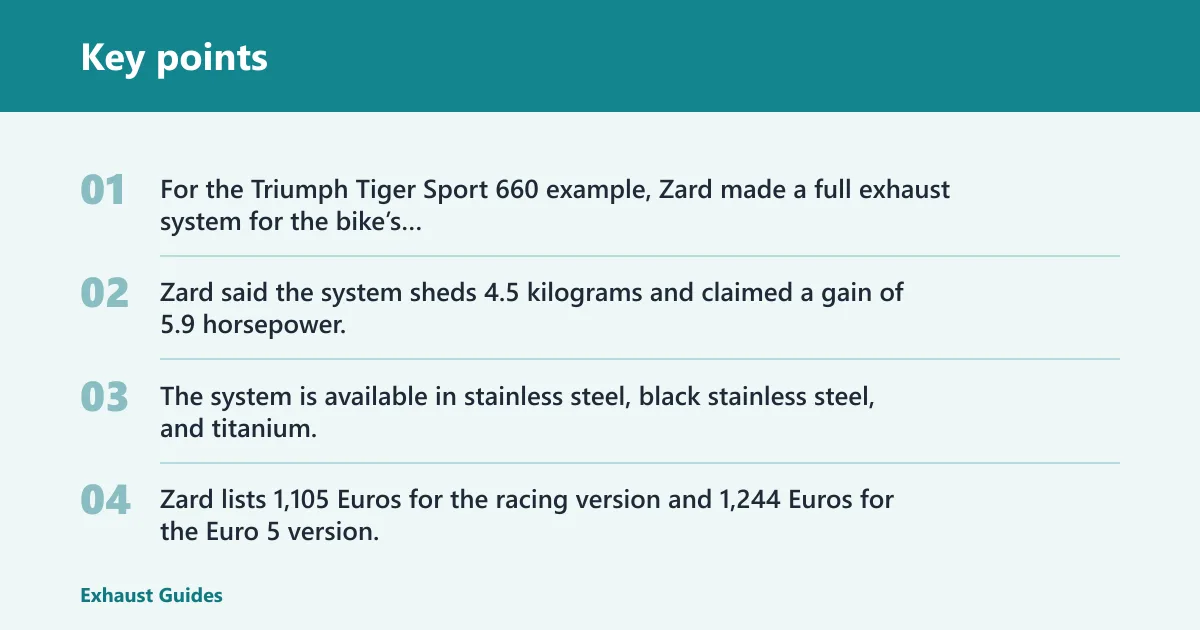
For the Triumph Tiger Sport 660 example, Zard made a full exhaust system for the bike’s 660cc inline-three-cylinder engine. Zard said the system sheds 4.5 kilograms and claimed a gain of 5.9 horsepower. The system is available in stainless steel, black stainless steel, and titanium, with a Euro 5-homologated version and a track-only racing version. It also includes a removable dB killer. Zard lists 1,105 Euros for the racing version and 1,244 Euros for the Euro 5 version.
What usually fails first?
The most common early problems are leaks at joints, cracked flex sections, loose heat shields, and broken hangers. Exhaust parts move, heat-cycle, and corrode. That makes seals and mounts wear before the main pipe does. A diagram helps you spot the exact joint or bracket that matches the noise or smell.
Leak points at joints and seals
Exhaust gaskets, flanges, and clamps are frequent leak points because they seal separate sections together. A leak at the manifold gasket often sounds sharp on cold start. A leak at a rear flange may be quieter but still trigger smell or sensor issues. If a diagram shows two fastened sections, check that joint first.
Rattles from heat shields and hangers
Heat shields can rattle when a retaining clip breaks or when the shield loosens from the pipe or body. Exhaust hangers can also fail, letting the pipe contact the chassis, axle, or heat shield. The diagram helps you see which part should float and which part should stay fixed.
Cracks, corrosion, and broken flex sections
The flex pipe is meant to absorb movement, so it often wears where the system bends or vibrates most. Corrosion also attacks lower pipes, especially where water and road spray collect. A cracked flex section or broken hanger can create a pulse leak, a drone, or a pipe that shifts under load.
A common first-timer mistake is assuming every exhaust noise comes from the muffler. If a front joint, flex pipe, or shield is loose, the sound can travel and seem farther back than it is. Reading the system from the engine outlet forward keeps the diagnosis in order.
Frequently asked questions
What are the parts of a full exhaust system on a car, truck, or bike?
A full exhaust system usually includes the exhaust manifold or header, front pipe or downpipe, catalytic converter, flex section, mid-pipe, resonator, muffler or silencer, and tailpipe. Cars and trucks often use all of these parts. Motorcycles may use fewer pieces, but the flow order is the same.
How does exhaust gas flow through a full exhaust system?
Exhaust gas leaves the engine through the manifold or header, then moves into the front pipe or downpipe. It passes the catalytic converter, flex section, and mid-pipe, then through the resonator and muffler or silencer before exiting the tailpipe. That is the reading order you should use on any diagram.
What is the difference between a full exhaust system and a cat-back or axle-back?
A full exhaust system starts at the engine outlet and runs all the way to the tailpipe. A cat-back begins after the catalytic converter, so it leaves the front emissions section in place. An axle-back begins even farther rearward, usually covering only the muffler and tailpipe area.
Where does the catalytic converter sit in the exhaust layout?
The catalytic converter usually sits after the manifold or header and before the mid-pipe. Some vehicles place it close to the engine, where it heats quickly. Others place it under the floor. A diagram should show it as the emissions-control section between the engine outlet and the rest of the pipe.
What is the difference between exhaust routing on cars, trucks, and motorcycles?
Cars usually follow a straightforward front-to-rear route with the muffler near the back. Trucks often need longer piping and more clearance around the rear axle and frame. Motorcycles pack the system tighter around the engine and frame, so the silencer may sit high, low, or to one side.
How do I identify exhaust parts from a diagram if I’m a beginner?
Start at the engine outlet and move rearward one section at a time. Find the manifold or header first, then the catalyst, flex section, mid-pipe, muffler or silencer, and tailpipe. Use shape and position together. If a part has an O2 sensor bung or heat shield, that is a strong clue.
What parts are most likely to fail in a full exhaust system?
The usual weak points are gaskets, flange joints, clamps, flex sections, hangers, and heat shields. Those parts move or seal against heat and vibration, so they wear sooner than straight pipe sections. Corrosion can also damage low-mounted sections, especially where road spray collects and drains slowly.
When should an exhaust diagram be used for repairs or upgrades?
Use a diagram before ordering parts, before tracing a leak, and before removing bolts on a rusted system. It helps you confirm whether you need a manifold gasket, a flex section, a mid-pipe, or only a clamp. It is also useful when comparing cat-back, axle-back, and full-system layouts.