How Much to Replace Exhaust Manifold Gasket
An exhaust manifold gasket replacement is often estimated at about $250 to $900, with parts often around $20 to $100 and labor about 1.5 to 4.5 hours; expect more if studs, bolts, or the manifold are damaged. Left alone, a leak can make noise, scorch valves, warp flanges, fail emissions tests, and raise repair bills. This guide breaks down parts, labor, hardware, and the warning signs that move the job from a gasket swap into a bigger repair.
Exhaust manifold cost table
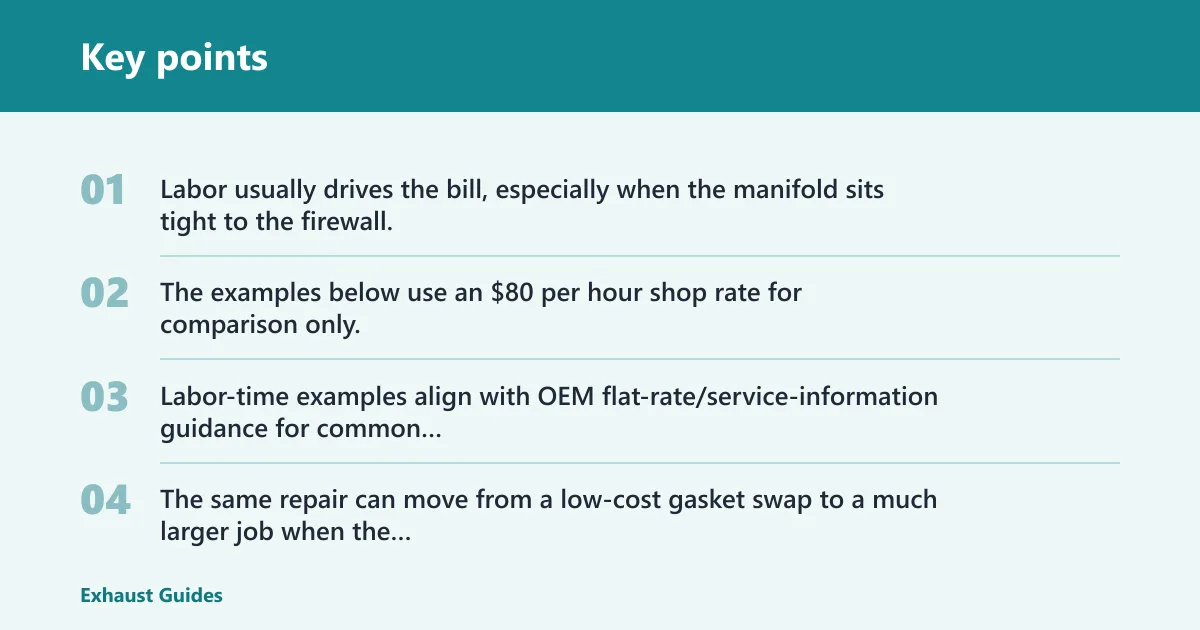


The gasket itself is rarely the main cost. Labor usually drives the bill, especially when the manifold sits tight to the firewall, a turbocharger, or a rusted fastener cluster. The examples below use an $80 per hour shop rate for comparison only; real shop rates vary widely by market, and the totals are estimates rather than quotes. Labor-time examples align with OEM flat-rate/service-information guidance for common manifold access scenarios, and torque and surface-prep steps should follow the vehicle manufacturer’s service manual for the exact engine.
| Repair scenario | Labor hours | Labor cost at $80/hr | Total estimated cost |
|---|---|---|---|
| Gasket-only with easy access | 1.3 | $104 | $150 to $250 |
| Gasket plus hardware | 2.0 | $160 | $220 to $350 |
| Gasket plus broken studs | 4.5 | $360 | $450 to $700 |
| Gasket plus warped manifold or machining | 7.0 | $560 | $650 to $1,000+ |
Those totals are estimates, not quotes. The same repair can move from a low-cost gasket swap to a much larger job when the manifold must come off in a tight bay or when fasteners need drilling and extraction.
Cost by vehicle and engine layout
A better way to estimate this repair is by vehicle layout, not just by gasket type. Inline engines and open truck bays usually land on the low end, while transverse V6 layouts, turbocharged engines, and rust-belt trucks can push the bill upward fast. The ranges below reflect common labor bands and escalation triggers; machining is included only in the higher tiers where noted.
| Vehicle/layout segment | Expected labor-hour band | Common escalation triggers | Typical bill range |
|---|---|---|---|
| Inline truck with open access | 1.3 to 2.0 | Minor corrosion, new hardware, gasket only | $150 to $350 |
| Transverse V6 with firewall-side bank | 2.5 to 4.5 | Tight packaging, more disassembly, stubborn fasteners | $300 to $700 |
| Turbo engine | 4.5 to 7.0 | Turbo removal, heat shields, extra gaskets and clamps | $500 to $1,000+ |
| Rust-belt truck or high-mileage vehicle | 4.0 to 7.0+ | Broken studs, drilling, extraction, resurfacing, possible manifold replacement | $450 to $1,200+ |
The biggest cost jump usually comes from access and fastener condition, not the gasket itself. If the manifold is warped or the flange is damaged, machining or replacement may be added to the total; those costs are not included in the lower-range estimates above.
| Cost driver | Why it raises cost |
|---|---|
| Gasket price | Usually the smallest line item. |
| Hardware kit | Adds bolts, nuts, clamps, and shop supplies. |
| Labor time | Depends on access, rust, and engine layout. |
| Broken studs or bolts | Can add drilling, extraction, and cleanup time. |
| Warped manifold or machining | May require resurfacing or replacement. |
What changes the bill most?
Labor rate and labor hours change the bill more than the gasket itself. At an $80 per hour baseline, even a modest time increase can add far more than the parts list. Rust, engine layout, and broken fasteners are the biggest cost swing factors.
Labor rate and labor hours
A shop-rate baseline of $80 per hour makes the math easy to follow, but actual rates vary widely by region and vehicle type. A gasket that costs $30 to $50 may look small, but three extra labor hours add $240 before hardware or shop supplies. That is why the labor line usually matters more than the gasket line.
Rust, heat cycling, and broken fasteners
Heat cycling cooks the gasket and fasteners over time. Rusted studs can snap during removal, which turns a normal gasket job into drilling, extraction, and cleanup. On older trucks and salt-belt cars, the fastener work often costs more than the gasket.
Manifold condition and machining needs
A warped exhaust manifold can keep a new gasket from sealing. Manufacturer service procedures typically call for checking flange flatness and cleaning the mating surfaces before reassembly; if the surface is out of spec, the shop may machine the manifold or replace it, and that is where costs jump.
How much does exhaust manifold gasket repair cost?
Typical exhaust manifold repair cost can range from about $150 to $1,000, depending on access, rust, and whether the manifold itself needs work. Gasket price is usually modest; labor, hardware, and damaged parts decide whether the final bill stays near the low end or climbs toward the top.
Typical gasket price versus labor cost
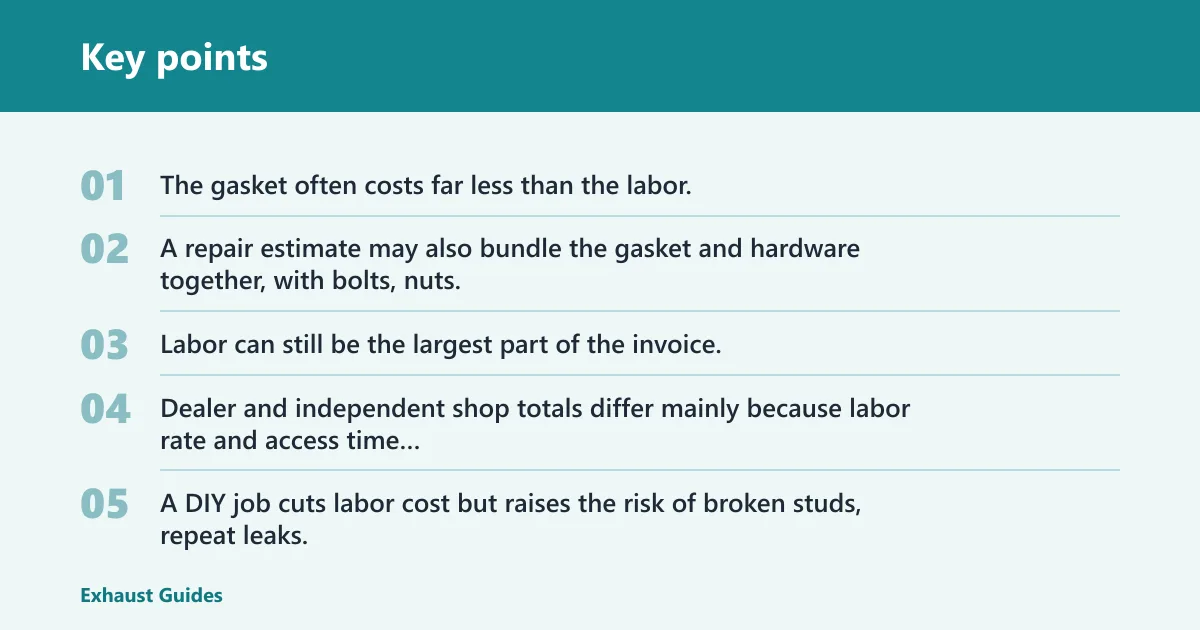
The gasket often costs far less than the labor. A repair estimate may also bundle the gasket and hardware together, with bolts, nuts, clamps, and shop supplies often shown as one line item around $40 to $60 in examples. Labor can still be the largest part of the invoice.
Dealer, independent shop, and DIY tradeoffs
Dealer and independent shop totals differ mainly because labor rate and access time differ. Dealer rates are usually higher. A DIY job cuts labor cost but raises the risk of broken studs, repeat leaks, or a warped manifold being missed before reassembly.
Suppose a transverse V6 has the rear manifold against the firewall. The parts may be ordinary, but the labor climbs because the technician must reach fasteners in a cramped space. The same gasket on a front-mounted manifold can cost much less simply because access is better.
Why quotes vary so much by vehicle
One example shows 4.9 labor hours, manifold machining at $40, gasket and hardware at about $50, and a total of $497. Another example shows 1.3 labor hours, a new manifold at about $95, and a total of $264. Different layouts, different parts, different totals.
Why does an exhaust manifold gasket fail?
An exhaust manifold gasket fails when repeated heat cycles, warped sealing surfaces, or damaged hardware stop it from sealing the manifold to the cylinder head. Once that seal opens up, exhaust can escape under load or at cold start, and the leak often gets worse over time.
Heat cycling and warping
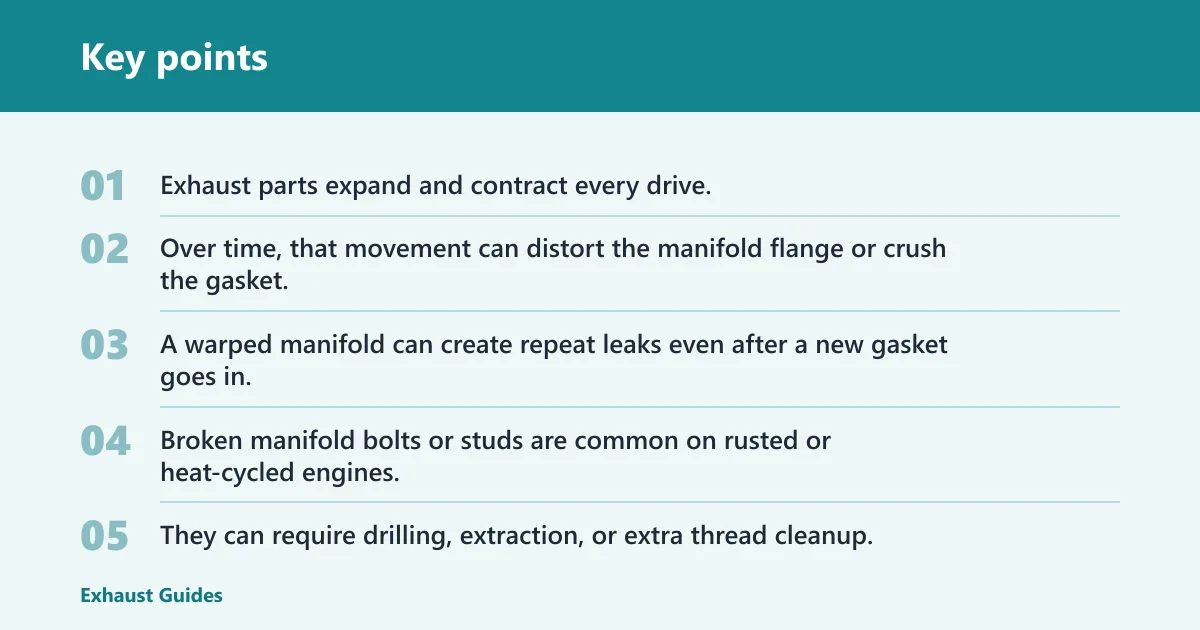
Exhaust parts expand and contract every drive. Over time, that movement can distort the manifold flange or crush the gasket. A warped manifold can create repeat leaks even after a new gasket goes in, which is why the flange should be checked before reassembly.
Broken bolts or studs
Broken manifold bolts or studs are common on rusted or heat-cycled engines. They can require drilling, extraction, or extra thread cleanup. That is why a job that should take a couple of hours can become a half-day repair.
Gasket surface damage and exhaust leaks
Carbon marks, tapping, clicking, whooshing, and low power are common leak signs. The noise is often loudest cold and near the fender well, where exhaust pulses can be easier to hear. On a naturally aspirated engine, a leaking manifold can sound like tapping or clicking.
Picture a cold-start sedan that ticks from one wheel well for the first minute, then quiets down as the metal expands. That pattern often points to a sealing issue rather than an internal engine knock. A visible soot trail around the flange makes the diagnosis easier.
How long does the repair take?
Replacement time can run from about 1.3 hours on an easy-access engine to 7.0 hours on a turbocharged setup with tight packaging. Rust, broken fasteners, and machining work push the job longer. The repair is often shorter on simple inline layouts and longer on transverse or turbo engines.
Easy-access engines versus transverse layouts
Easy-access engines let the technician remove the manifold with less disassembly. A transverse engine can hide the rear bank close to the firewall, and a turbocharger can block manifold fasteners. That is why a similar gasket job may take one afternoon on one vehicle and most of a day on another.
How rust adds time
A common rule of thumb is to soak fasteners with penetrating oil for at least about an hour, and overnight is often better when corrosion is heavy. Even with prep, rusty hardware can seize or snap. Every broken fastener adds cleanup time before the new gasket can go in.
When extraction or machining turns a short job into a long one
A Dodge Ram 2500 example includes 2 hours to drill out and repair two broken bolts and totals $611. A BMW 328i turbo example uses 7.0 hours to remove and reinstall the turbocharger and totals $765. Those examples show how hardware and packaging can dominate the schedule.
Should you replace the manifold and hardware too?
Replace the gasket alone when the manifold is flat, the fasteners are sound, and the leak is isolated to the sealing surface. Replace hardware when bolts, nuts, or clamps are corroded or stretched. Replace or machine the manifold when it is warped, cracked, or keeps leaking after a proper gasket job.
When gasket-only is enough
A gasket-only repair makes sense when the manifold comes off cleanly and the mating surfaces check flat. It is the simplest fix, and it often suits newer vehicles or engines with good fastener access. It is not the right call if the flange is already distorted.
When hardware should be replaced
Many estimates include the gasket plus hardware together because the old fasteners are the weak point. If the bolts have deep rust, rounded heads, or stretch marks, reusing them can make the repair fail early. New hardware is cheap insurance compared with redoing the job.
When the manifold should be repaired or replaced
A warped exhaust manifold may be machinable, or it may need replacement if the surface cannot be restored. A cracked manifold usually does not respond to a gasket swap alone. If the same leak returns soon after a proper install, the manifold itself deserves a closer look.
What to inspect before approving the repair
- Look for soot trails, ticking, or a smell of exhaust near the wheel well or firewall.
- Check whether the fasteners are rusty, rounded, or already broken.
- Ask whether the manifold was checked for flatness before reassembly.
- Confirm whether new hardware, clamps, and studs are included in the quote.
- Ask if machining or manifold replacement is included only if needed.
If the leak is confirmed but the manifold is flat and the fasteners are serviceable, the repair often stays near the lower end of the estimate. If the quote assumes broken studs, machining, or replacement, the total should reflect that before work begins.
Basic repair sequence
The broad sequence is straightforward: soak the fasteners, remove the manifold, clean the mating surfaces, install the new gasket, and torque everything to spec. The details matter, especially on corroded hardware and on engines where access is tight. A torque wrench is not optional here, and the tightening pattern should come from the manufacturer’s service manual or OEM service data for the exact engine.
- Soak manifold fasteners with penetrating oil, then let it sit at least an hour or overnight.
- Remove the manifold and hardware carefully so broken bolts do not become a bigger problem.
- Clean the head and manifold mating surfaces until old gasket material and carbon are gone.
- Check the manifold with a straight edge for warping or damage.
- Install the new gasket and any required hardware.
- Tighten fasteners with a torque wrench and follow the service manual sequence and spec.
- Recheck torque after a heat cycle if the manufacturer calls for it.
Say your 5.3 Vortec has a tick from the passenger-side wheel well and soot at the flange. If the bolts come out clean and the manifold checks flat, the repair may stay near the low end. If the rear fasteners snap, the labor climbs fast even though the gasket part is still cheap.
Frequently asked questions
How much to change exhaust manifold gasket?
A typical exhaust manifold gasket change costs about $250 to $900, but the spread is wide because labor time varies so much. Easy access keeps the bill down. Broken studs, warped flanges, or a turbocharger nearby can push the total much higher than the gasket price suggests.
How much to replace exhaust flange gasket?
An exhaust flange gasket replacement often lands in the same cost band as a manifold gasket job if the flange is easy to reach. The bill depends less on the gasket shape and more on labor time, rust, and whether the flange hardware must be replaced or cleaned up first.
How much does it cost to fix exhaust manifold gasket?
Fixing an exhaust manifold gasket usually means paying for labor, hardware, and sometimes surface repair, not just the gasket itself. A realistic estimate starts near $150 and can reach about $1,000 when broken studs, machining, or manifold replacement enter the job.
How long to replace exhaust manifold gasket?
Replacement can take about 1.3 hours on an easy-access engine and up to 7.0 hours on a turbo or tightly packaged layout. Rust, seized fasteners, and cleanup after broken studs are the main reasons a short job turns into a long one.
How often to replace exhaust manifold gasket?
There is no normal mileage interval for this gasket. It gets replaced when it leaks, the manifold is off for another repair, or the sealing surfaces are damaged. A long-lasting fix depends on flat surfaces, good hardware, and proper torque, not on a routine schedule.
How much to replace a exhaust manifold gasket?
The extra article before “exhaust” does not change the repair. Cost still depends on labor hours, access, and hardware condition. A simple replacement may stay near a few hundred dollars, while broken studs or machining can push the bill much higher.
How to replace exhaust manifold gasket Chevy 350
A Chevy 350 follows the same core process: soak the fasteners, remove the manifold, clean the surfaces, and reinstall with correct torque. The exact difficulty depends on the vehicle, headers or manifolds used, and rust. The cost still tracks more closely with labor than with the gasket price.
How to change exhaust manifold gasket on 5.3 Vortec
A 5.3 Vortec repair often comes down to access on the specific truck or SUV. Many of these engines sit in bays where one bank is easy and the other is tighter. If the fasteners are rusty, expect the labor to rise before the gasket price does.
How to change exhaust manifold gasket on Dodge Ram
On a Dodge Ram, the repair often becomes expensive when bolts are corroded or broken. The Ram 2500 example with 2 hours for drilling and repairing two broken bolts shows why. If the manifold is warped or the head surface is damaged, the bill climbs again.
How long does it take to replace exhaust manifold gasket?
Most jobs are measured in hours, not minutes. A simple replacement can be close to 1.3 hours, while a turbocharged or rust-heavy repair can run to 7.0 hours. The real schedule depends on access, fastener condition, and whether the manifold itself needs attention.