How to Replace a Heat Shield on a Car
Replace a heat shield when it is cracked, missing fasteners, or rusted through. If only the clips are loose and the shield metal is intact, reattach it with new hardware first. Left alone, it can rattle, overheat nearby parts, and, in rare cases, let heat damage floor insulation, wiring, or fuel-system components. This guide shows how to identify the shield, choose repair versus replacement, and estimate the tools, safety steps, cost, and time.
What a heat shield does and where it sits

- Matches stock shield fit and function
- Stamped steel for underhood heat
- Replaces a damaged shield without manifold replacement
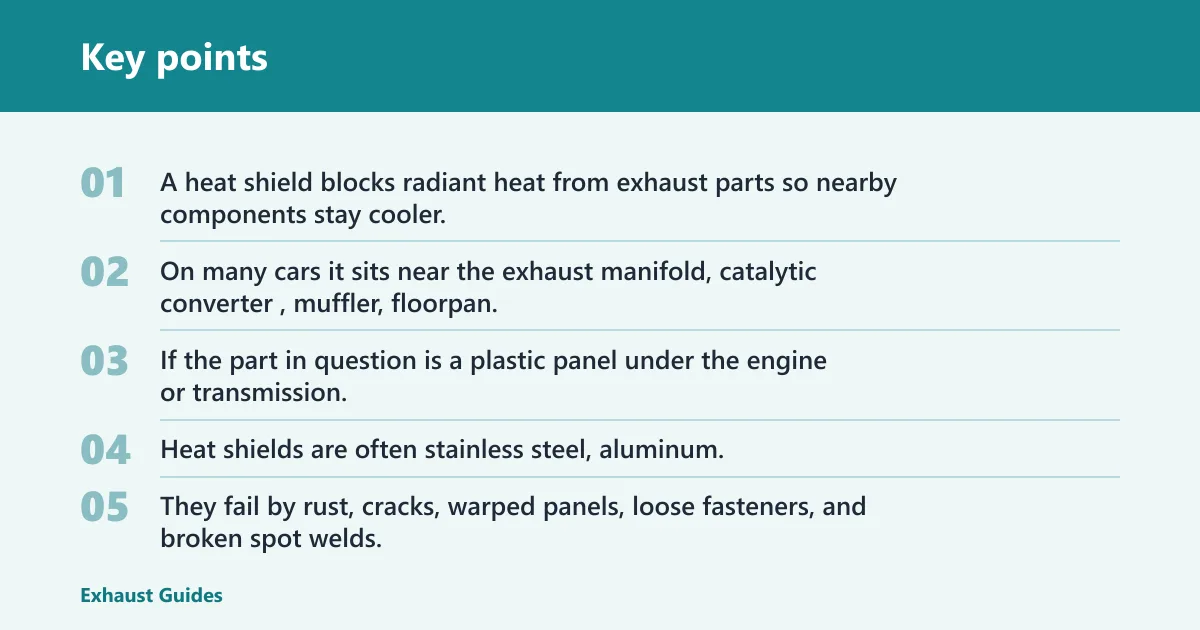
A heat shield blocks radiant heat from exhaust parts so nearby components stay cooler. On many cars it sits near the exhaust manifold, catalytic converter, muffler, floorpan, fuel lines, wiring, or starter motor. If the part in question is a plastic panel under the engine or transmission, you may be looking at a splash shield instead.
Heat shields are often stainless steel, aluminum, or a ceramic-coated or composite variant. They fail by rust, cracks, warped panels, loose fasteners, and broken spot welds. A loose shield can rattle while driving, and one that hangs low can scrape the road.
Heat shield or splash shield?
A true heat shield is there to manage heat. A splash shield is usually a protective cover on the underside of a car that blocks water, mud, rocks, and road salt. Splash shields are described as plastic or metal panels bolted under the engine, transmission, or oil pan, with the under-engine location most common.
What you’ll need
- Wheel chocks
- Jack stands rated for the vehicle’s weight and sized for your car
- Floor jack, if your manual calls for one to lift the car
- Penetrating oil
- Socket set and ratchet
- Screwdrivers and trim tools
- Pliers for clips and clamps
- Wire brush
- Replacement bolts, screws, clips, washers, or clamps
- Repair brackets or large washers, if the tab is still usable
- Replacement heat shield matched to your engine, trim, drivetrain, and mounting points
- Safety glasses and gloves
Check the vehicle manual before starting. Use jack stands before you go under the car, do not rely on a jack alone, never exceed the vehicle’s rated roof/hitch/tow limit, keep items out of airbag zones and the driver’s view, and check local laws.
Is it a heat shield or something else?
Start here because rattles under the car are not always a heat shield. A loose exhaust heat shield often rattles over bumps, while a splash shield or fender liner usually drags or flaps closer to a wheel. If the noise changes with engine speed, look near hot exhaust sections first; if it changes with steering, inspect liners and undertrays.
Visual clues matter. A real heat shield is usually thin metal close to the exhaust. Look for missing clips, cracked tabs, broken spot welds, rusty fasteners, or a warped edge touching another part. If the panel is plastic and covers the underbody farther from exhaust heat, it may be a splash shield, fender liner, or undertray panel instead.
Common locations and what they protect
Heat shields are common around the catalytic converter and muffler, and they may also protect the floorpan, fuel lines, wiring, or the starter motor. A shield in those spots is there because the nearby part can be damaged by heat soak, especially after parking a hot car.
Can you repair it instead of replacing it?
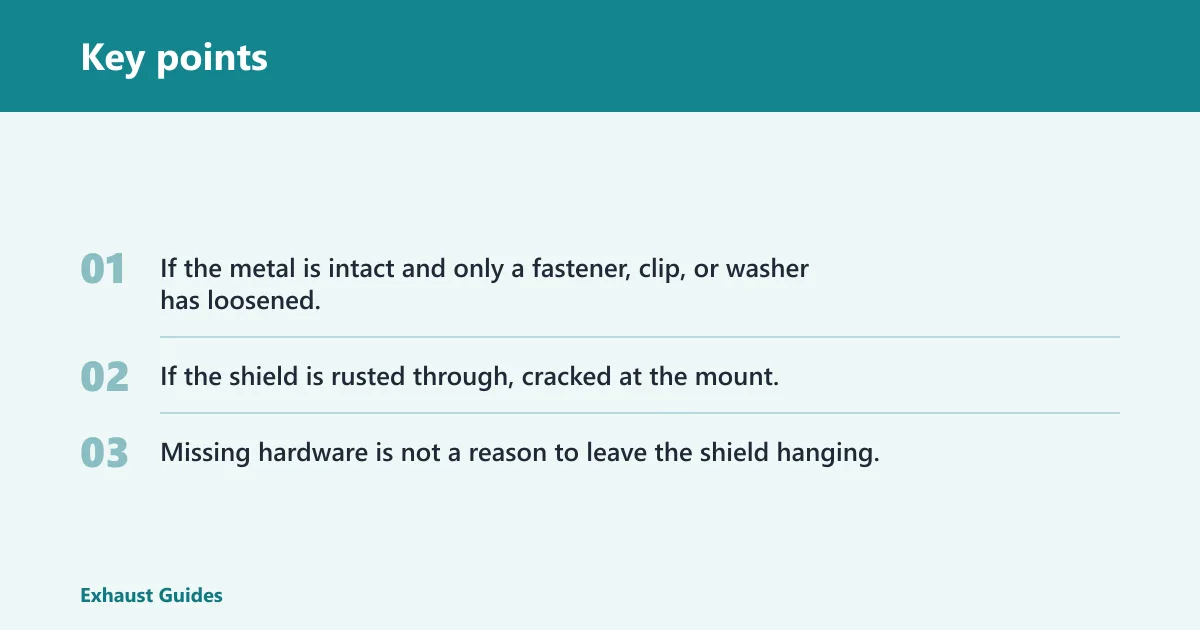
Yes, sometimes. If the metal is intact and only a fastener, clip, or washer has loosened, a repair is often enough. If the shield is rusted through, cracked at the mount, or has repeated rattling from broken spot welds, replacement is usually the safer path. Missing hardware is not a reason to leave the shield hanging.
Decision table
| Shield condition | Recommended fix | Tools | Likely parts | DIY or shop? |
|---|---|---|---|---|
| Loose fastener | Retighten or replace the hardware | Socket, screwdriver, penetrating oil | Bolt, screw, clip, washer | DIY if access is good |
| Cracked shield | Replace if the crack reaches a mount or edge | Socket set, trim tools, penetrating oil | Replacement heat shield, new hardware | DIY if fitment is clear; shop if rust is heavy |
| Rusted mounting tab | Repair bracket only if the tab still holds firm; otherwise replace | Wire brush, pliers, sockets | Repair bracket, washers, clamps, or full shield | Often shop work if the tab is weak |
| Broken spot weld | Replace the shield | Socket set, trim tools | Replacement shield and hardware | Shop if access is poor or rust is widespread |
| Missing shield | Install the correct replacement | Lift gear, sockets, clips | OEM-fit shield, fasteners | DIY only if fitment and mounts are confirmed |
| Repeated rattling | Inspect mounts; replace if the panel is warped or the hardware keeps loosening | Socket set, pry tool, penetrating oil | Hardware kit, possibly a new shield | DIY for simple loosening; shop for repeated failures |
How to fix a rattling heat shield on a car
For a rattle, begin with the simplest fix: tighten or replace the loose fastener, clip, or clamp. If the shield is otherwise sound, that is often enough. If the shield still taps the exhaust or body after reattaching it, the metal may be warped or the mount may be failing, which usually means replacement.
How to remove the damaged shield
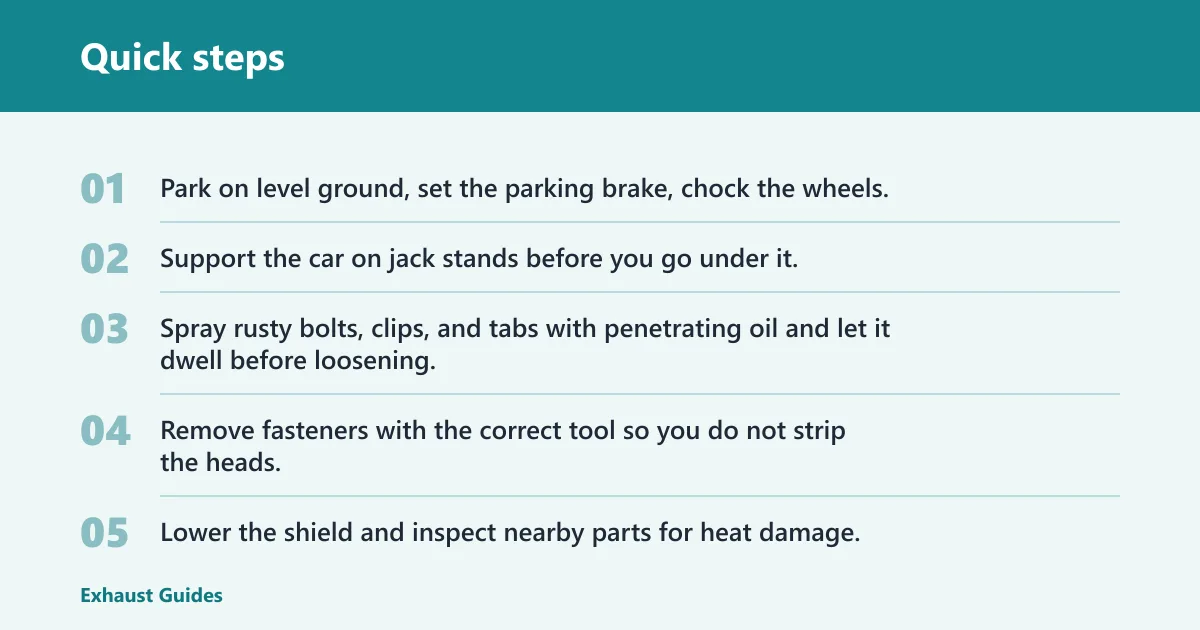
- Park on level ground, set the parking brake, chock the wheels, and raise the car only as directed by the manual.
- Support the car on jack stands before you go under it.
- Spray rusty bolts, clips, and tabs with penetrating oil and let it dwell before loosening.
- Remove fasteners with the correct tool so you do not strip the heads.
- Lower the shield and inspect nearby parts for heat damage.
How to install the replacement shield
- Match the new shield to the vehicle’s engine, trim, drivetrain, catalyst location, and mounting points.
- Install new hardware or repair brackets if the mounting points are still sound.
- Tighten the shield so it is secure without bending it into contact with the exhaust.
- Check clearance by hand before lowering the car.
- After a short drive, recheck for vibration or metal contact.
Say your sedan has a thin aluminum shield near the catalytic converter and one clip has fallen out. If the shield is still flat and the hole is not torn, a new clip and washer may solve the noise. If the same shield keeps rattling after reattachment, the mounting edge is probably too fatigued for a lasting repair.
How much to replace a heat shield on a car
Costs vary by model and region, but the parts-versus-labor split is usually clear. A simple hardware repair may cost about $10 to $60 in clips, washers, clamps, or brackets. A replacement shield often runs about $40 to $250 for the part itself. At a shop, total cost often lands around $120 to $450 when labor is added.
Rust changes the bill fast. A shield with clean fasteners may take little labor, while seized bolts, damaged tabs, or broken spot welds can push the job higher because the mechanic may need extra removal time or a different mounting method.
How long does it take to replace a heat shield on a car?
A straightforward reattachment can take about 20 to 45 minutes. Full replacement often takes 1 to 2 hours. If the fasteners are rusted, the vehicle has tight underbody access, or the shield sits near the catalytic converter or muffler, plan on 2 to 4 hours and the possibility of extra hardware work.
Fitment checks also take time. A replacement shield must match the vehicle’s engine, trim, drivetrain, and mounting points, so expect to spend a few extra minutes confirming the part before installation.
Common mistakes to avoid
Do not force corroded hardware until it snaps. Use penetrating oil first, and stop if the fastener starts twisting badly. Do not drill where the manual does not allow it, especially near exhaust parts or fuel-system components. Avoid universal guesses; the wrong shield can sit too close to hot parts or miss the mounts entirely.
Do not remove a required heat shield near hot exhaust parts and then keep driving normally. That can expose floor insulation, wiring, or fuel-system components to extra heat. If the shield is missing and the area is getting hot, install the correct part before regular use.
A common first-timer mistake is ordering a heat shield because it looks close in a photo, only to discover the mounting tabs and cutouts do not match the car. Two nearly identical parts can differ by engine, trim, drivetrain, or catalyst placement. Confirm the exact fitment before ordering.
Can you remove the heat shield on a car?
Only if the shield is no longer required for that location and the service manual allows removal. Around hot exhaust components, leaving the shield off can let heat soak into nearby parts and may cause damage. If you are unsure, replace the shield rather than deleting it.
Frequently asked questions
How much does it cost to fix a heat shield on a car?
Hardware-only repairs often stay around $10 to $60 if the shield can be reused. Rust, access, and vehicle fitment change the final number.
How to fix a rattling heat shield on a car: find the contact point
Find the contact point, then check for loose clips, cracked tabs, or missing bolts. Retighten or replace the hardware if the shield is still flat. If the rattle comes back, the panel is usually warped or the mount has failed, which points to replacement rather than another temporary bend.
How long does it take to replace a heat shield on a car: plan on 20?
Plan on 20 to 45 minutes for a simple reattach, 1 to 2 hours for a standard replacement, and 2 to 4 hours when rusted hardware or cramped access slows the job. The exact time depends on the shield’s location and whether the fasteners come out cleanly.
Can you remove the heat shield on a car: you should not remove?
You should not remove a required shield near hot exhaust parts and then leave it off for regular driving. If the part is only a splash shield or undertray, removal rules are different, but a true heat shield should be replaced or reattached when it protects nearby wiring, insulation, or fuel-system components.