How to Stop a Loose Heat Shield From Rattling
Fix a loose heat shield by tightening or replacing its fasteners first. If the shield is cracked, rusted through, or touching the exhaust, replace it instead of bending it back. Leaving it alone can overheat nearby parts, create smoke, or let the shield drop onto the road. This guide shows how to find the rattle, inspect the shield, and choose the safest repair from a clip, bolt, washer, clamp, or replacement.
How fastener and shield wear trigger exhaust rattle


A heat shield is a thin metal cover over hot exhaust parts. On many cars it sits around the catalytic converter, muffler, or pipe routing. Its job is simple: keep heat away from the floorpan, wiring, hoses, and the cabin. It also helps lower the chance of igniting dry grass or leaves under a parked car.
Rattle starts when fasteners corrode, mounting tabs crack, or the shield bends and touches the pipe. A loose heat shield can chatter at certain engine speeds because it may reach a resonance point. Rust often makes the problem worse with age and mileage, since thin metal and thin mounting points lose stiffness together.
A shield can be screw-on, welded, or mounted by a mix of clips and bolts. Some failures are just loose hardware. Others are the shield itself. That difference matters, because a tight fastener will not save a shield that is rusted through or split at the mounting ear.
How do I tell if the rattle is actually a loose heat shield?
Start by matching the sound pattern. A loose shield often gives a tinny rattle that changes with RPMs, road vibration, or engine load. If the noise is strongest at idle, fades at cruise, or appears only at one engine speed, resonance is a strong clue. A cold-only rattle that quiets after a few minutes also fits a shield that changes shape as it heats.
Different noise patterns point elsewhere. A cracked exhaust pipe or leaking joint usually sounds more like a puffing, ticking, or sharper blow than a loose sheet-metal buzz. A loose hanger can clunk when the exhaust shifts. A manifold leak may be louder near the front of the car and may leave soot around the joint.
If a sedan rattles only at about 1,800 to 2,000 rpm in drive and then goes quiet when you lift off the throttle, that can point to a resonance-related rattle. That pattern often points to a shield or hanger that vibrates at a specific frequency, not a permanently broken pipe.
Heat shield decision table
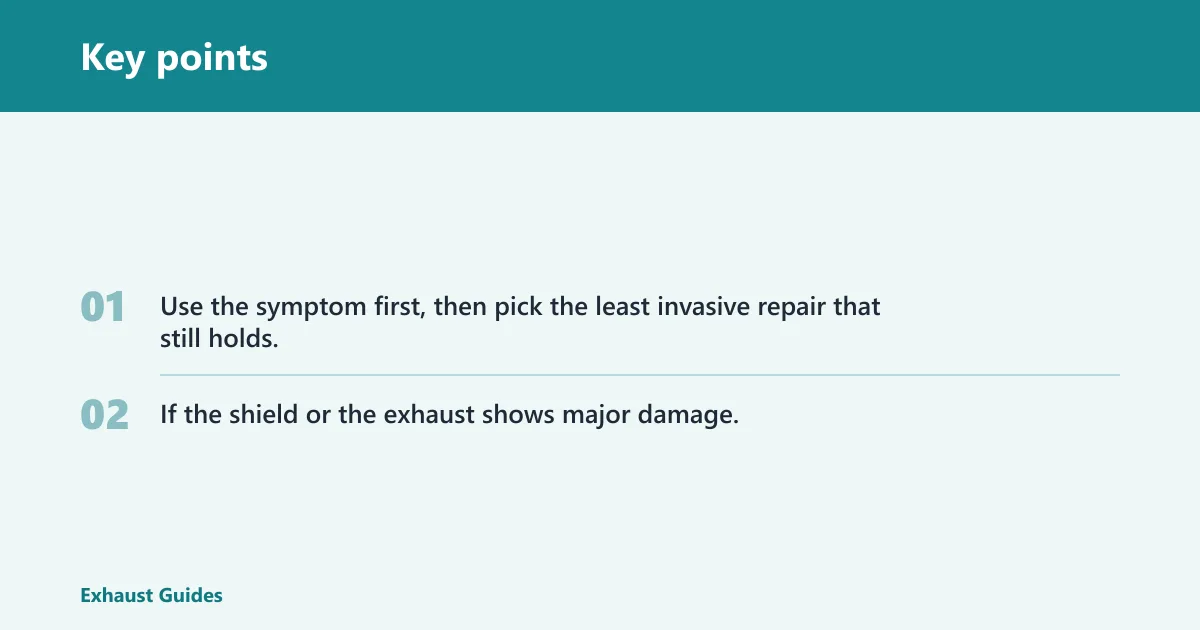
Use the symptom first, then pick the least invasive repair that still holds. If the shield or the exhaust shows major damage, stop at diagnosis and move to replacement or shop inspection.
| Symptom pattern | Likely cause | Best fix |
|---|---|---|
| Cold-start rattle that fades as the car warms up | Shield or fastener expanding, or a loose tab touching the pipe only when cold | Inspect fasteners, tighten or replace hardware, or add a clamp if the shield is intact. Parts-only cost is often about $5 to $25. Stop if the shield is cracked or the mount is torn. |
| Rattle at one engine speed, then quiet at other rpm | Resonance from a loose shield, bent edge, or bracket | Re-seat the shield, tighten hardware, or secure the loose section with a hose clamp. Parts-only cost is often about $5 to $30. Stop if the shield moves enough to strike the pipe. |
| Shield moves but stays in one piece | Loose fasteners, rusted clips, or a mount that has opened up | Replace the fasteners or use one or more hose clamps where the span allows. Parts-only cost is often about $10 to $40. Stop if the shield can slide into the exhaust. |
| Rust holes, missing edges, or thin metal you can flex by hand | Rusted-through shield or failed mounting metal | Replace the shield. Shop labor and parts often push total cost into the $150 to $300 range, and another common estimate is about $300 in total. Stop if the remaining metal is weak enough to tear. |
| Rattle continues after tightening hardware | Wrong source, cracked shield mount, or exhaust pipe movement | Inspect the muffler, pipe, hangers, and joints. If the shield is still the source, clamp or replace it. If not, repair the exhaust fault instead. Stop DIY if soot, holes, or cracks appear. |
| Noise turns out to be a crack in the exhaust pipe | Pipe or joint failure, not the shield | Repair the pipe or joint, often by replacement or welding depending on location. Cost varies by section and labor, but it is a different job than a shield fix. Stop if exhaust fumes are present near the cabin. |
How to inspect the shield safely
Wait for the exhaust to cool before you touch anything. The muffler, catalytic converter, and pipe can stay hot long after shutdown. Then use a jack and safe lift support to reach the underside. Never crawl under a car supported only by a jack.
Look for loose fasteners, rust, bent edges, and torn mounting points. Check whether the shield touches the exhaust pipe, converter, or muffler. A careful wiggle test helps: a shield that taps lightly on its own bracket is different from one that swings freely or scrapes the pipe.
Also inspect the nearby exhaust path. Holes, cracks, rust, or loose hangers can make the shield seem guilty when the pipe is the real source. The Subaru guide notes that the exhaust pipe can fit loose or crack and be mistaken for shield rattle.
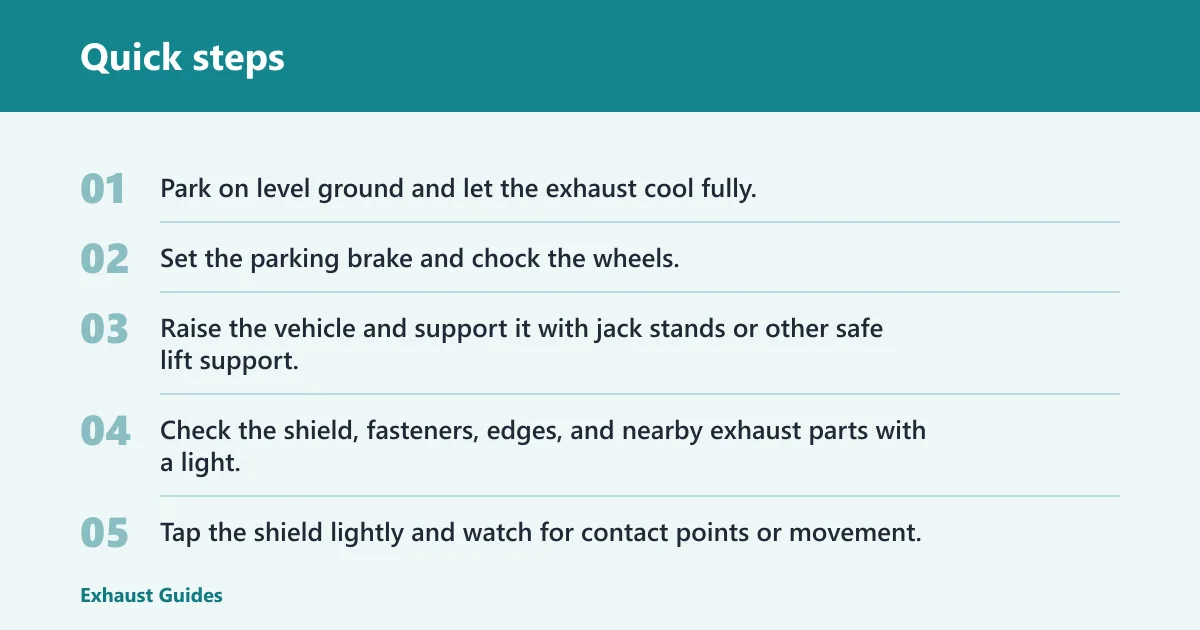
- Park on level ground and let the exhaust cool fully.
- Set the parking brake and chock the wheels.
- Raise the vehicle and support it with jack stands or other safe lift support.
- Check the shield, fasteners, edges, and nearby exhaust parts with a light.
- Tap the shield lightly and watch for contact points or movement.
- Stop if the pipe, muffler, or converter shows cracks, holes, or heavy corrosion.
What is the safest way to fix a loose heat shield rattle?
The safest fix is the least invasive one that still leaves solid coverage over the heat source. Start with loose fasteners. If the shield is intact and only slack, a clamp or replacement clip can be enough. If the shield has small broken areas but good metal elsewhere, a clamp repair may buy time. If the metal is thin, split, or missing, replacement is the safer path.
A hose clamp can be a practical fix when the shield still has enough shape to hold tension. A metal worm-gear style clamp is common for this job. Some shields need more than one clamp if the span is long or the loose section sits on both sides of a pipe. Steel wool can fill a small void, as one Subaru guide suggests, but it should not be used to hide major rust or a broken mount.
Welding is best only when the shield and nearby parts are suitable for it. It can tack a small failure back in place, but it requires welding skill and equipment. Too much heat can damage surrounding parts, and welding a badly rusted shield rarely gives a durable result.
Picture a compact car with a small rear shield that rattles only where one tab has loosened. A single clamp may hold that section well. By contrast, a shield with a hand-sized rust hole near the mount needs replacement, because clamping thin metal will not restore strength.
Can I tighten a heat shield with hose clamps?
Yes, in the right case. Hose clamps are a common fix for an intact but loose heat shield, especially when the metal still wraps cleanly around the pipe or converter. They work best as a restraint, not as a cure for missing metal. If the shield is warped, split, or hanging by rust, clamp repair is only temporary at best.
Use enough clamp width and tension to hold the loose edge without cutting into the shield. One clamp may be enough for a short span. A longer shield or a section that flexes in two places may need more than one. If the clamp slips after a short drive, stop and move to replacement or a different repair.
Should I weld a heat shield back in place?
Welding can be the right fix for a small, localized failure when the shield metal is still sound and the nearby exhaust parts can be protected from heat. It is a targeted repair, not a cure for widespread corrosion. If the shield is paper-thin or the mounting area is gone, welding usually fails sooner rather than later.
Do not weld if the work area is crowded with heat-sensitive parts, fuel lines, or wiring that cannot be shielded from the torch. In that case, a clamp repair or replacement is safer. If the shield around the catalytic converter is badly compromised, replacement is the more durable choice because that area gets very hot.
When should you replace the heat shield instead?
Replace the shield when rust has eaten through the metal, the mounting points are broken, or a section is missing. Replacement is also the better answer when the shield keeps rattling after fastener repair or clamp repair. If the shield no longer covers the converter, muffler, or pipe properly, it is doing too little to justify keeping it.
The shield should not be removed and left off. It protects the cabin from heat and helps keep surrounding parts cooler. It also matters for dry grass and leaf contact under a parked car. A missing shield can increase fire risk in places where vegetation can touch the underside.
Could the noise be an exhaust pipe crack?
Yes. If tightening the shield does nothing, or if the sound has a sharper hiss or tick, inspect the muffler, pipe, and joints closely. Exhaust pipes can crack, rust through, or loosen at a hanger and be mistaken for a shield problem. A cracked pipe is a different repair path and should not be treated as a shield-only issue.
Look for black soot near a seam, a visible split, or movement where the pipe joins the muffler or converter. If the exhaust is leaking, the car may also smell like fumes near the cabin or sound louder under throttle. That is a good point to stop DIY diagnosis and move to a proper exhaust repair.
How much does loose heat shield repair usually cost?
Cost depends on whether the fix is a clamp, a fastener job, welding, or full replacement. Simple DIY parts are usually the cheapest route, while shop work rises with labor time and corrosion. One competitor places repair around 150-300 dollars, and another estimate puts the total near 300 dollars.
As a rough split, a clamp or fastener repair may cost under $40 in parts. Welding or a shop repair can move into the low hundreds once labor is included. Replacement is often the highest bill when the shield and hardware both need work. If the exhaust pipe itself is cracked, the cost can climb because the repair is no longer just a shield job.
What if the noise is not the heat shield but a cracked exhaust pipe?
If the pipe is cracked, the fix changes completely. A shield repair will not stop exhaust leakage, and it will not silence a split pipe. Check for holes, rust flakes, loose hangers, and soot at the muffler, pipe, and joints. If you find a crack, repair the exhaust fault first.
That is also the point where safety matters most. An exhaust leak can send fumes where they do not belong, and a failing pipe can worsen quickly. If the crack is near a welded seam, flange, or catalytic converter connection, a shop repair is often the better choice than a quick clamp or patch.
Frequently asked questions
Is it dangerous to remove a rattling heat shield entirely?
Yes. The shield protects nearby parts from exhaust heat and can help prevent the cabin from getting too hot. It also lowers the chance of igniting dry grass or leaves under the car. Removing it may solve the noise for a moment, but it creates a real heat and fire risk.