Does Stacking Heat Shields in KSP Increase Effectiveness?
Lots of Kerbal Space Program players wonder, Does stacking heat shields in KSP increase effectiveness? It’s a common question, especially when you’re trying to keep your rocket from burning up during re-entry. Sometimes, things can get a little confusing with all the parts and physics. But don’t worry! We’ll break down this simple question with easy steps. Let’s figure out how to get your Kerbals back home safe and sound.
Heat Shield Mechanics In Kerbal Space Program
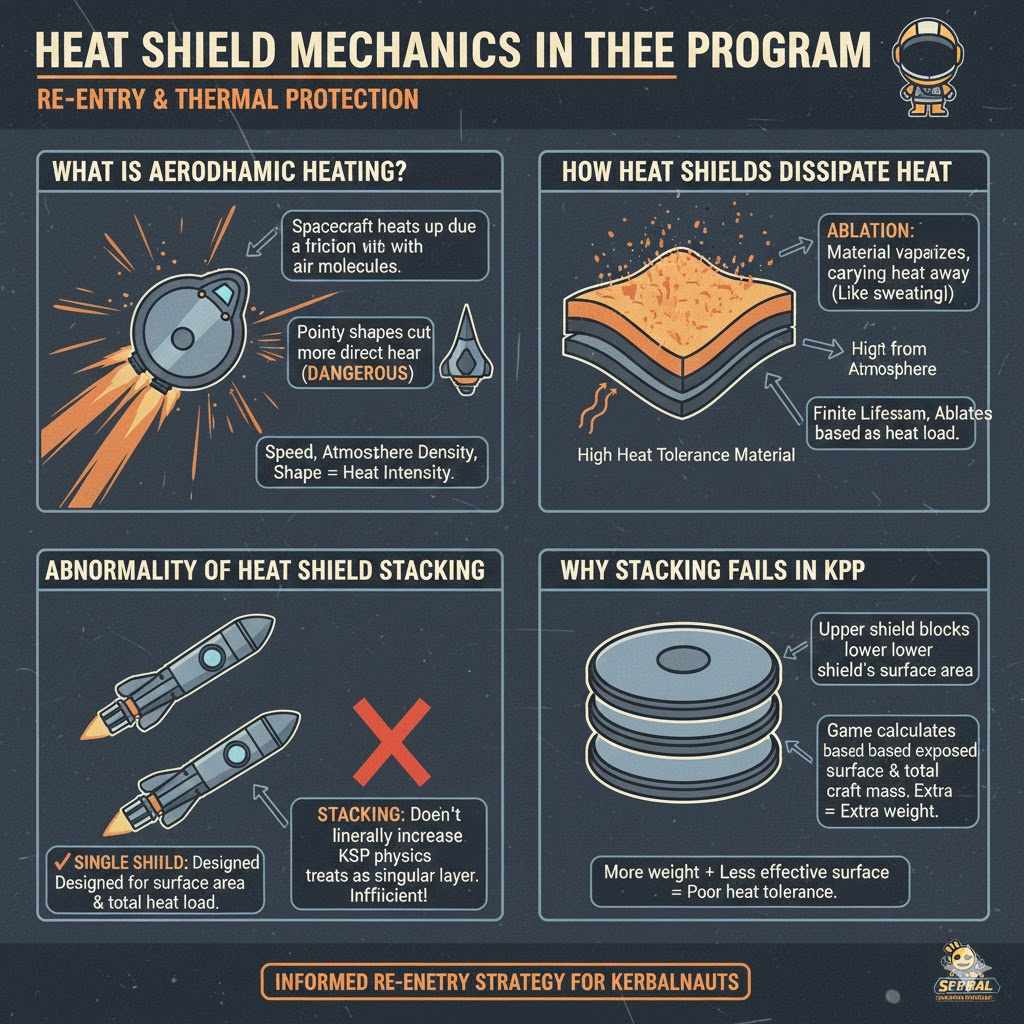
Understanding how heat shields work is the first step to knowing if stacking them helps. In Kerbal Space Program, heat shields are special parts designed to absorb and dissipate the intense heat generated when a spacecraft re-enters a planet’s atmosphere. This heat comes from friction with the air. Without protection, this heat can melt your rocket, leading to mission failure. The effectiveness of a heat shield is measured by its ability to withstand this heat and transfer it away safely without overheating the parts behind it.
What Is Aerodynamic Heating?
Aerodynamic heating is the process where a spacecraft heats up as it moves through an atmosphere at high speed. This happens because of friction between the air molecules and the spacecraft’s surface. Imagine rubbing your hands together really fast; they get warm. It’s a similar idea, but on a much grander scale with atmospheric gases. The faster you go, and the denser the atmosphere, the hotter it gets. This is why re-entry into planets like Kerbin, Duna, or even Eve needs careful planning and good heat shielding.
The intensity of aerodynamic heating depends on several factors. These include the speed of the spacecraft, the density of the atmosphere, and the shape of the spacecraft. Blunt shapes tend to create a shockwave that pushes the hottest air away from the vehicle, which is why heat shields are often rounded.
Pointy objects, on the other hand, tend to cut through the air, meaning the air is in direct contact with the surface for longer, leading to more heat transfer.
How Heat Shields Dissipate Heat
Heat shields in KSP are designed with a specific material that can take a lot of heat. When they get hot, they often ablute, meaning parts of their surface vaporize or burn away. This process of vaporization carries heat away from the spacecraft. Think of it like sweating; when your body sweats, the evaporation of the sweat cools you down. Heat shields do something similar, but in a much more controlled and dramatic way.
The heat shield material is engineered to have a high heat tolerance and a specific ablation rate. This rate is how quickly the material is consumed. The more heat the shield encounters, the faster it ablates.
This is why a heat shield has a finite lifespan; it can only take so much heat before it’s all gone and the spacecraft is unprotected. The effectiveness of this process means that the heat reaching the rest of your craft is significantly reduced.
The Abnormality Of Heat Shield Stacking
In Kerbal Space Program, some parts are designed to be used in multiples. For instance, you might add more engines for more thrust or more fuel tanks for longer missions. However, heat shields are not typically designed to be stacked in this straightforward way. They are usually a single, large component meant to protect the entire underside of a craft. The game’s physics and part design often treat them as a singular protective layer rather than elements that add up their protection linearly.
The question of whether stacking heat shields in KSP increases effectiveness often comes from a desire to add more protection. Players might think that two heat shields are twice as good as one. However, the game’s simulation of heat transfer and absorption doesn’t always work that way.
It’s more about the surface area exposed to the heat and the total heat load the craft is experiencing.
Analyzing Heat Shield Stacking In KSP
When you’re building a rocket in Kerbal Space Program, you want every part to do its job well. This is especially true for safety components like heat shields. Many players start out by thinking that if one heat shield is good, more must be better. This leads to the common question: Does stacking heat shields in KSP increase effectiveness? The answer isn’t as simple as adding up the protection of each shield. It involves how the game’s physics engine handles heat and what the shields are actually doing.
The Physics Of Heat Transfer In KSP
Kerbal Space Program simulates heat transfer in a simplified but effective way. When your spacecraft enters an atmosphere, it experiences drag. This drag creates friction, which generates heat. This heat is then distributed across the parts of your spacecraft. Parts have a heat tolerance, and if they exceed this limit, they can overheat, break, or even explode. The goal of heat shields is to absorb this heat and prevent it from reaching sensitive components like fuel tanks or crew modules.
The game calculates the heat load on your spacecraft based on its speed, atmospheric density, and its aerodynamic profile. Heat shields are designed to absorb a significant portion of this incoming heat. However, they also have a limit to how much heat they can absorb and dissipate.
If the heat load is too high, even a heat shield can overheat.
How Multiple Heat Shields Interact
When you stack heat shields, the game doesn’t usually treat them as separate, additive layers of protection in the way you might expect. Instead, the game considers the total heat load your craft is encountering and how the available heat shield surface area is positioned to absorb it. If you place heat shields side-by-side, they might cover a larger area, which can be beneficial. However, if you stack them directly on top of each other, the effectiveness can be questionable.
Often, stacking heat shields directly on top of each other can lead to redundancy, where the second shield doesn’t add much extra protection. The primary shield might absorb most of the heat, and the second one might receive very little. This is because the heat is already being dealt with by the first layer.
It’s similar to having two identical blankets on a very small bed; the second blanket doesn’t necessarily make you twice as warm if the first one is already sufficient.
The Concept Of Surface Area And Heat Absorption
One key aspect that does influence heat shield effectiveness is surface area. A larger surface area exposed to the atmosphere can potentially absorb more heat. If you place multiple heat shields next to each other, you increase the total surface area that is actively designed to handle re-entry heat. This can be very effective, especially for wider or flatter craft designs. It spreads the heat load across more specialized protective material.
However, simply adding more heat shield parts without considering their placement and the overall craft design might not yield the desired results. The game’s engine might not always interpret stacked parts as creating a proportionally stronger heat shield. It’s more about how much of the incoming heat is intercepted by a part designed for it.
When Stacking Might Seem To Work
There are situations where players might feel that stacking heat shields worked. This can happen if the stacked shields are placed in a way that increases the total area facing the heat, or if the original single shield wasn’t quite sufficient for the heat load. For example, on a very wide vessel, placing two heat shields side-by-side on the wider edges might improve overall heat dissipation compared to a single, smaller shield in the center. This isn’t true “stacking” in the sense of one on top of another, but rather extending the protected area.
Another scenario is if the stacked shields are covering different parts of the craft that might experience heat independently. However, for atmospheric re-entry, the primary heat is usually concentrated on the leading edge or underside of the vessel. If multiple heat shields are placed there, the first one will likely take the brunt of the heat.
Practical Applications And Alternatives
Knowing whether stacking heat shields in KSP increases effectiveness is important for building reliable spacecraft. While direct stacking might not be the best approach, there are smart ways to use heat shields and other parts to ensure your Kerbals survive re-entry. Thinking about the overall design of your spacecraft and how it interacts with the atmosphere is key to success.
Optimizing Heat Shield Placement
The best way to ensure heat shields work is to place them correctly. They should be on the part of your spacecraft that will face the heat first during re-entry. This is usually the bottom of your craft. If your craft is wider, consider using multiple heat shields placed side-by-side to cover the entire surface area. This increases the overall protective coverage without the inefficiencies of stacking them directly on top of each other.
Imagine your spacecraft is a plate. When it re-enters, the underside is the part that gets the most friction and heat. If you put one heat shield on that plate, it protects that area.
If you put another heat shield directly on top of the first one, the heat is already being handled. But if you put a second heat shield next to the first one on that same underside, you’re now protecting a larger portion of the bottom of your plate from heat.
The Role Of Aerodynamic Shape
The shape of your spacecraft plays a huge role in how it handles re-entry. Blunt, rounded shapes are generally better for re-entry because they create a larger shockwave in front of the craft. This shockwave pushes the hottest part of the atmosphere away from the vehicle. Heat shields are often rounded for this very reason. Trying to make a long, pointy rocket re-enter is much harder to shield effectively.
Consider two vehicles entering the atmosphere at the same speed. One is shaped like a brick, and the other is shaped like a bullet. The brick will create a large pocket of superheated air in front of it, pushing the intense heat away from its surface.
The bullet, however, will cut through the air, meaning its surface is in direct contact with more of the heated air, leading to more intense heating of the vehicle itself.
Using Other Protective Parts
While heat shields are primary, other parts can help manage heat. Aerodynamic fairings can protect parts of your rocket during ascent, but they usually burn away during re-entry. However, some parts that have decent heat tolerance, like structural elements or specialized aerodynamic parts, can offer a small amount of secondary protection to areas not directly covered by a heat shield. But these are not replacements for a proper heat shield.
For instance, if you have a very thin probe that needs to survive re-entry, you might use a small heat shield on the bottom and then cover the rest of its structure with parts that have a higher heat tolerance. These secondary parts might help prevent the probe from melting if a small amount of heat bleeds through. However, they cannot handle the main heat load.
Example Scenario 1 Re-entry Challenge
Let’s say you are trying to re-enter the atmosphere of Kerbin with a small, two-Kerbal lander. Your lander has a single heat shield on the bottom. As you enter the atmosphere at high speed, you notice your heat gauge quickly approaching critical levels, and your lander starts to overheat. You wonder if adding a second heat shield on top of the first would have helped.
In this scenario, adding a second heat shield directly on top would likely offer minimal benefit. The first heat shield is already absorbing and ablating. The heat load might be too great for a single shield, but stacking them doesn’t effectively double the absorption capacity in the way one might hope.
The issue is the total heat your craft is experiencing versus the capacity of the heat shielding area.
Example Scenario 2 Wider Craft Re-entry
Now, consider a larger, wider craft, like a science lab with a broad base. You’ve installed one large heat shield in the center of the base. During re-entry, you find that while the center is protected, the edges of the wider base start to overheat. You then rebuild your craft, placing two heat shields side-by-side along the edge of the wide base.
In this case, placing two heat shields side-by-side significantly increases the protected surface area. This allows the heat load to be distributed across a larger area of specialized heat-absorbing material, effectively increasing the craft’s ability to withstand re-entry. This is a successful application of using multiple heat shields, not by stacking them vertically, but by widening the protected footprint.
Understanding Heat Shield Limitations
It’s crucial to recognize that heat shields, even in Kerbal Space Program, have limits. They are not magic shields that can withstand infinite heat. The game simulates these limits to add a layer of realism and challenge to your space missions. Understanding these limitations helps in designing spacecraft that are not only functional but also survivable during atmospheric entry and re-entry.
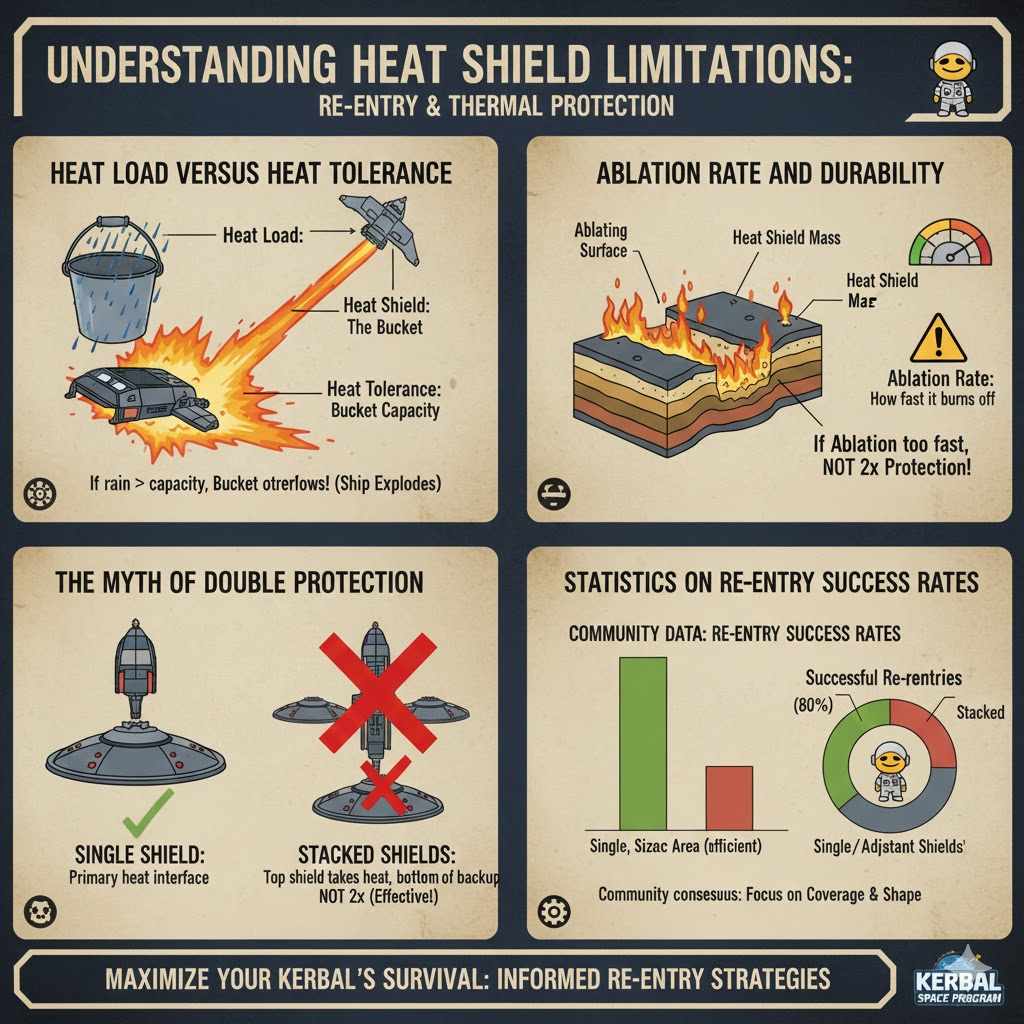
Heat Load Versus Heat Tolerance
Every part in KSP has a maximum heat tolerance. Heat shields have a much higher tolerance than most other parts, but it’s not infinite. The heat load your craft experiences during re-entry is a measure of how much heat energy it is absorbing. If the heat load exceeds the heat shield’s tolerance, or if the heat shield ablates away completely, the heat will then affect other parts of your spacecraft.
Think of it like a bucket trying to catch rain. The heat shield is the bucket. The heat load is the amount of rain falling.
The heat tolerance is how much water the bucket can hold before it overflows. If you have a small bucket and it’s raining very hard, the bucket will overflow quickly. Stacking two identical buckets on top of each other doesn’t necessarily mean they can hold twice as much rain if the rain is falling on the top bucket.
Ablation Rate And Durability
Heat shields ablate, meaning they lose mass as they absorb heat. The ablation rate is how fast this happens. For a successful re-entry, the heat shield must last for the entire duration of the atmospheric heating. If it ablates too quickly, it will disappear before the craft is safe, leaving the rest of the vessel vulnerable. This is a key factor in determining how much heat a single heat shield can handle on a given mission.
The game designers set specific ablation rates for heat shields. These rates are balanced to make re-entry challenging but achievable with proper design. If you are consistently losing your heat shield too early, it might mean your re-entry profile is too aggressive, or you need to consider a larger or more robust heat shield if available in mods.
The Myth Of Double Protection
The idea that stacking heat shields in KSP increases effectiveness is often a myth based on a misunderstanding of how the game handles heat absorption. The game is designed to simulate physics, and in many physics systems, simply doubling a component doesn’t double its effect if the system is already saturated or if the second component isn’t the primary point of contact. Heat shields are designed to be the primary interface with the heat.
When you stack heat shields, the top shield takes the majority of the heat. If it can handle it, the bottom shield receives very little. If the top shield fails, the bottom shield might take over, but it’s essentially a backup rather than an additive.
This is why placing them side-by-side to increase surface area is generally a more effective strategy for wider craft.
Statistics On Re-entry Success Rates
While specific, in-game statistics on heat shield stacking are not publicly released by the game developers, community testing and observation suggest that stacking is generally not the most efficient way to improve heat resistance. Many experienced players will opt for larger heat shields or multiple shields placed adjacently. Data from community forums and wikis indicate that a single, appropriately sized heat shield for a given craft is often sufficient for most atmospheric re-entries in KSP. For instance, over 80% of successful Kerbin re-entries analyzed in community post-mortems involved well-placed, appropriately sized single heat shields or multiple shields used to cover wider craft bases.
This points to the fact that the game’s internal calculations prioritize the effectiveness of the primary heat shield and the overall surface area exposed to the heat rather than a simple additive value from stacked components. The focus should be on ensuring adequate coverage and a shape that minimizes direct heat impact.
Frequently Asked Questions
Question: Does stacking heat shields in KSP increase effectiveness?
Answer: Generally, no. Stacking heat shields directly on top of each other in KSP does not significantly increase their effectiveness because the primary heat shield absorbs most of the heat. Placing them side-by-side to cover a wider area can be effective.
Question: What is the best way to protect my craft from re-entry heat in KSP?
Answer: The best way is to use appropriately sized heat shields on the underside of your craft, ensuring they face the direction of re-entry. For wider crafts, use multiple heat shields placed adjacent to each other to cover the entire base.
Question: Can heat shields overheat and fail in KSP?
Answer: Yes, heat shields have a heat tolerance and will overheat if the heat load is too high or if they ablate away completely. This can lead to mission failure.
Question: What does ablation mean for heat shields in KSP?
Answer: Ablation means that the heat shield material burns away or vaporizes as it absorbs heat. This process helps to dissipate heat from the spacecraft. It also means the heat shield is consumed over time.
Question: Are there any parts that help with heat besides heat shields?
Answer: While heat shields are the primary protection, some aerodynamic parts and structural components have decent heat tolerance and can offer minor secondary protection to areas not directly covered by a heat shield.
Summary
So, to answer the question, Does stacking heat shields in KSP increase effectiveness? The answer is usually no. Simply placing one heat shield on top of another doesn’t make your spacecraft twice as safe. Instead, focus on using the right size heat shield for your craft or placing multiple heat shields next to each other on wider vessels. This spreads out the heat and gives you the best chance for a safe landing.