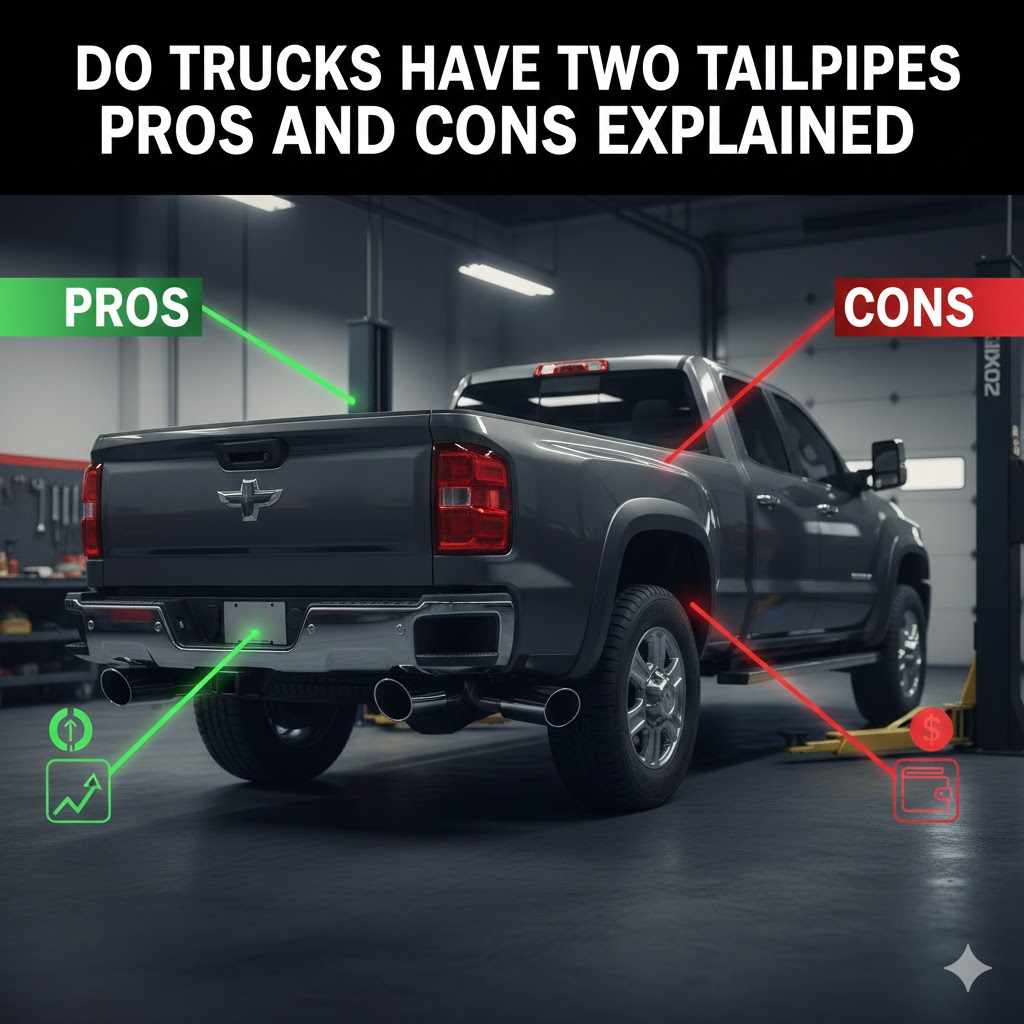
Do Trucks Have Two Tailpipes Pros and Cons Explained
Many people wonder, do trucks have two tailpipes? It’s a common question, especially for those new to the world of trucks. Sometimes, the answer seems tricky because not all trucks are the same.

ELSHINE
Universal Muffler 2.25 with Aggressive Sound,Anti-corrosive Muffler,Dual…
- Please measure the exhaust pipe size and space before purchasing the performance mufflers 2.25 to ensure smooth installation.
- Universal Fitment- ELSHINE 2.25 mufflers universally fit for all types of vehicles, such as cars, trucks and SUVs. Customizable de…
- Built to Last- Engineered with fully welded 16 gauge aluminized steel and coated with durable silver protective layer,ELSHINE muff…
As an Amazon Associate I earn from qualifying purchases.
You might see some with one and some with two. This post will make it super clear. We will go through everything step-by-step so you can understand it easily.
Get ready to learn about the good and bad things about having two tailpipes on your truck.
Why Trucks Have Two Tailpipes
Understanding why trucks might have one or two tailpipes helps us appreciate the engineering and design choices manufacturers make. It’s not just about looks; there are practical reasons behind these decisions. This section breaks down the main factors influencing whether a truck features a single or dual exhaust system.
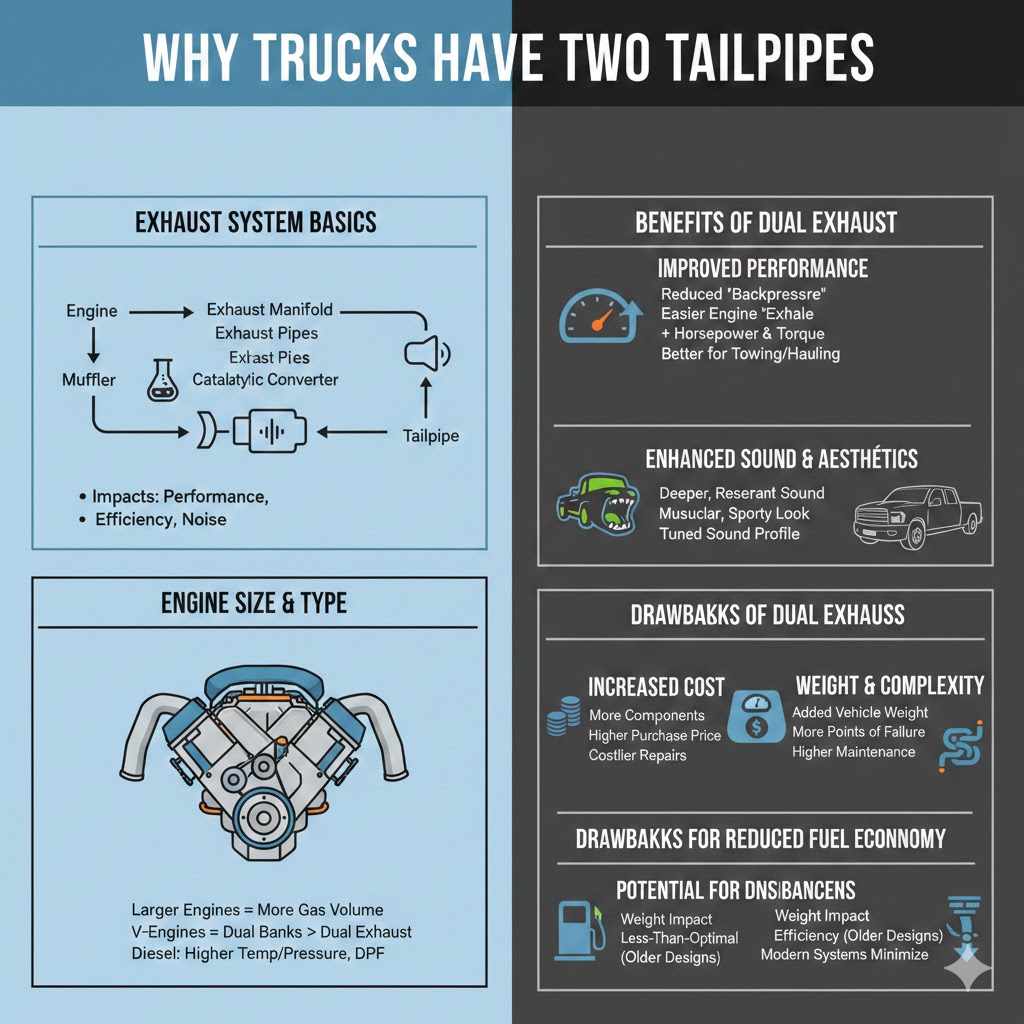
Exhaust System Basics
An exhaust system on any vehicle, including a truck, is designed to carry harmful gases produced during combustion away from the engine and out of the vehicle. This process involves several key components working together.
The journey starts with the exhaust manifold, which collects gases from each cylinder. These gases then flow through the exhaust pipes. Catalytic converters clean these gases by reducing pollutants.
Mufflers reduce the noise from the engine’s explosions. Finally, tailpipes are the visible pipes that let the cleaned exhaust gases exit the vehicle.
The design of the exhaust system impacts engine performance, fuel efficiency, and noise levels. For trucks, which often have larger, more powerful engines, exhaust system design can be particularly critical for managing these factors.
How Exhaust Gases Travel
Exhaust gases are a byproduct of burning fuel in the engine. When fuel and air mix and ignite in the cylinders, they create hot gases under high pressure. These gases need to be expelled efficiently.
The exhaust manifold acts like a funnel, gathering these gases from all the engine cylinders. From there, they travel through a network of pipes.
As the gases move, they pass through a catalytic converter. This device uses chemical reactions to convert harmful pollutants like carbon monoxide and nitrogen oxides into less harmful substances like water vapor and carbon dioxide. After being cleaned, the gases are then directed through a muffler.
The muffler contains baffles or sound-absorbing materials to quiet the loud popping sounds of combustion. The final stage is the tailpipe, which is the exit point for the now relatively clean and quieted exhaust gases.
The Role of Engine Size and Type
Larger engines, like those commonly found in trucks, produce more exhaust gases than smaller car engines. This means the exhaust system needs to be designed to handle a greater volume and flow rate of gases.
Diesel engines, for instance, are known for producing different types of emissions compared to gasoline engines. Their exhaust systems are often built to handle higher temperatures and pressures, and may include components like diesel particulate filters (DPFs) to capture soot.
The configuration of the engine also plays a role. A V-shaped engine, common in many trucks, has two banks of cylinders. This design often lends itself to having exhaust manifolds on each side, which can naturally lead to dual exhaust systems.
Benefits of Dual Exhaust Systems
Dual exhaust systems, featuring two tailpipes, are often seen on trucks for several performance-related reasons. They can contribute to better engine breathing and a more aggressive sound.
Improved Engine Performance
One of the primary advantages of a dual exhaust system is its potential to improve engine performance. By allowing exhaust gases to exit the engine more freely, it can reduce “backpressure.”
Backpressure is the resistance that the exhaust gases encounter as they try to leave the engine. If backpressure is too high, it can make the engine work harder, reducing its power and efficiency. Dual exhaust systems, by providing more pathways for the gases, can help lower this backpressure.
This improved gas flow can lead to a slight increase in horsepower and torque, especially in engines designed to take advantage of it. It’s like giving the engine an easier way to exhale, allowing it to take in more fresh air and fuel for the next combustion cycle.
For trucks used for towing or hauling heavy loads, this improved performance can be a noticeable benefit, providing more power when it’s needed most.
Enhanced Sound and Aesthetics
Beyond performance, dual exhaust systems are often chosen for their distinctive sound and visual appeal. The exhaust note produced by a dual system can be deeper, more resonant, and more satisfying to truck enthusiasts.
The visual aspect is also significant. Two tailpipes can give a truck a more muscular, sporty, and premium look. This aesthetic choice is often part of the styling package designed to appeal to buyers.
Manufacturers often tune the mufflers and pipes in dual exhaust systems to produce a specific sound profile. This can range from a subtle rumble to a more pronounced growl, depending on the truck’s intended purpose and target audience.
For many truck owners, the sound and look of a dual exhaust system are as important as any performance gains, contributing to the overall ownership experience.
Drawbacks of Dual Exhaust Systems
While dual exhaust systems offer advantages, they also come with their own set of downsides. These can affect cost, maintenance, and even fuel economy in some situations.
Increased Cost
Implementing a dual exhaust system is inherently more expensive than a single exhaust system. This is due to the need for more components.
A dual system requires two separate exhaust pipes running from the engine, two mufflers (or one muffler designed to handle two outlets), and two tailpipes. This means more material, more manufacturing labor, and more complex assembly.
This increased cost is often reflected in the truck’s purchase price. For buyers, it might mean choosing a higher trim level or opting for an aftermarket upgrade. The cost of replacement parts also tends to be higher for dual systems compared to single systems.
Weight and Complexity
Having two exhaust systems adds extra weight to the vehicle. While this might seem minor, every bit of weight can affect fuel efficiency and overall performance, especially in a large vehicle like a truck.
The complexity of a dual exhaust system also means more potential points of failure. There are more pipes, joints, and hangers that could develop leaks or rust over time. This can lead to increased maintenance needs and potentially higher repair bills.
For example, if one tailpipe is damaged or becomes loose, it might require repairs to both sides to ensure proper balance and alignment. The sheer number of parts also makes diagnostics and repairs more time-consuming for mechanics.
Potential for Reduced Fuel Economy
While sometimes dual exhaust can improve performance, in certain configurations or for specific driving conditions, it can actually lead to slightly reduced fuel economy. This is primarily due to the increased weight and the potential for less-than-optimal backpressure management if not perfectly engineered.
Engine management systems are designed to optimize fuel delivery based on various factors, including exhaust gas flow. If the dual exhaust system doesn’t precisely match the engine’s needs, it might not provide the expected fuel efficiency benefits, and in some cases, might even be less efficient than a well-designed single exhaust.
However, it’s important to note that advancements in engine technology and exhaust system design have minimized this issue. Many modern dual exhaust systems are engineered to balance performance and fuel economy effectively.
Factors Influencing Tailpipe Configuration
The decision of whether a truck comes with one or two tailpipes is not arbitrary. Several key factors influence this choice, ranging from the truck’s intended use to its engine design and market positioning.
Engine Design and Cylinder Banks
The most significant factor dictating the potential for a dual exhaust system is the engine’s design, particularly its cylinder arrangement. Many trucks are equipped with V-shaped engines, which have cylinders arranged in two distinct banks that form a “V” shape when viewed from the front or back.
With a V-engine, each bank of cylinders typically has its own exhaust manifold. These manifolds collect exhaust gases from their respective banks. From these manifolds, it is a natural and often efficient engineering choice to run separate exhaust pipes from each manifold.
This setup is the foundation for a dual exhaust system.
In contrast, inline engines, where all cylinders are arranged in a single straight line, usually have a single exhaust manifold and therefore naturally lend themselves to a single exhaust system. While it’s possible to split an inline engine’s exhaust, it’s less common and often less beneficial than with a V-engine.
V-Engines vs. Inline Engines
A V-engine has two cylinder banks, usually with an equal number of cylinders in each. For example, a 5.7-liter V8 engine has eight cylinders divided into two banks of four cylinders each. Each bank has its own exhaust manifold.
This makes it straightforward to route exhaust from each manifold into its own exhaust pipe.
An inline engine, such as an inline-4 or inline-6, has all cylinders in a single row. This typically results in a single exhaust manifold that collects gases from all cylinders. Connecting this single manifold to a dual exhaust system would involve splitting the pipe, which can sometimes create imbalances in exhaust flow and may not offer the same benefits as a system originating from two distinct manifolds.
Therefore, the engine configuration is a primary determinant of whether a truck is more likely to feature a dual exhaust setup. V-engines provide a more natural platform for dual exhaust systems.
Exhaust Manifold Configuration
The exhaust manifold is the component that bolts directly to the cylinder head of the engine and collects the exhaust gases from the cylinders. In a V-engine, there are two exhaust manifolds, one for each bank of cylinders.
Each exhaust manifold is connected to an exhaust pipe. These pipes then lead to the rest of the exhaust system, including the catalytic converter(s) and muffler(s). In a dual exhaust system, the gases from the left bank’s manifold flow through one set of components, and the gases from the right bank’s manifold flow through a separate, parallel set of components.
Some performance-oriented dual exhaust systems might even have separate catalytic converters and mufflers for each bank, further optimizing flow and sound. Others might merge into a single catalytic converter and then split again before a dual-outlet muffler, or use a muffler with two separate internal paths.
Performance Goals and Tuning
Manufacturers design exhaust systems not just for emissions and noise, but also to achieve specific performance targets for a given vehicle model. The choice between single and dual exhaust is often a deliberate engineering decision based on these goals.
For trucks aimed at heavy-duty work, towing, or high-performance applications, a dual exhaust system might be chosen to maximize power and torque. This is especially true for engines that are naturally aspirated and benefit significantly from reduced exhaust restriction.
Conversely, for more workaday trucks focused on fuel economy and reliability, a well-designed single exhaust system might be sufficient and more cost-effective. Modern single exhaust systems can be highly efficient and are often tuned to provide a good balance of performance and economy.
Towing and Hauling Capabilities
Trucks designed for serious towing and hauling often benefit from an exhaust system that can efficiently expel large volumes of exhaust gases under heavy load. This is where a dual exhaust system can offer an advantage.
When a truck is towing a heavy trailer, the engine is working harder and producing more heat and exhaust. A dual exhaust system can help dissipate this heat more effectively and allow the engine to breathe more easily. This can translate into better sustained power and reduced engine strain during demanding tasks.
For instance, a truck equipped with a powerful V8 engine and a dual exhaust system might be better suited for towing large RVs or heavy construction equipment compared to a similar truck with a single exhaust. The improved airflow helps prevent the engine from overheating and maintain its performance under sustained stress.
Aftermarket Modifications and Customization
The world of truck customization is vast, and exhaust systems are a popular area for modification. Many truck owners choose to upgrade their exhaust systems to achieve a desired sound, look, or performance gain.
Aftermarket dual exhaust kits are widely available for many truck models. These kits often offer a more aggressive sound than stock systems and can sometimes provide a measurable increase in horsepower and torque. They also allow owners to customize the look of their truck with different tailpipe styles and finishes.
However, it’s important to note that not all aftermarket dual exhaust systems are created equal. Some may be designed primarily for sound, while others focus on performance. It’s crucial to research different brands and types of systems to ensure they meet your specific needs and that they are compatible with your truck’s engine and emissions equipment.
Pros and Cons of Trucks with Two Tailpipes
Now that we understand why some trucks have dual exhaust, let’s summarize the advantages and disadvantages. This will give you a clear picture of what to expect with this type of setup.
Advantages of Dual Tailpipes
The benefits of a dual exhaust system are often related to performance and aesthetics. They are designed to enhance the truck’s capabilities and appearance.
Improved Airflow and Power Potential
As mentioned earlier, dual tailpipes can lead to better exhaust gas flow. This reduction in backpressure allows the engine to expel gases more efficiently. The engine can then draw in more fresh air and fuel, leading to a potential increase in horsepower and torque.
This improved airflow is particularly beneficial for larger engines that produce a significant amount of exhaust. It helps the engine operate at its peak potential, especially under load. For truck owners who frequently tow or haul, this can make a noticeable difference in their vehicle’s capability.
Consider a scenario where a truck is climbing a steep mountain pass while towing a heavy load. An engine with a dual exhaust system might maintain its power more effectively compared to one with a restrictive single exhaust, helping to prevent acceleration loss.
Distinctive Sound and Appearance
Many people are drawn to the sound and look of a dual exhaust system. The exhaust note is often deeper and more pronounced, giving the truck a more aggressive and powerful presence.
Visually, dual tailpipes add to the truck’s aesthetic appeal. They can make the rear of the truck look more substantial and sporty. This visual upgrade is a significant factor for many truck buyers and customizers.
For example, a truck with polished, large-diameter dual tailpipes exiting from each side of the rear bumper presents a powerful image that appeals to truck enthusiasts. The sound often matches this image, providing a satisfying rumble when accelerating.
Disadvantages of Dual Tailpipes
While beneficial, dual exhaust systems also present some drawbacks that potential buyers and owners should consider.
Higher Purchase and Repair Costs
The initial cost of a truck equipped with a dual exhaust system is typically higher than a comparable model with a single exhaust. This is due to the increased complexity and number of parts required.
Repair and maintenance costs can also be higher. If one part of the dual exhaust system needs
A common issue can be uneven wear or damage. If one tailpipe is scraped or damaged during off-roading, the repair might require attention to both sides to ensure symmetry and proper function, potentially increasing the cost.
Increased Weight and Potential for Lower Fuel Economy
A dual exhaust system, with its extra piping, mufflers, and tailpipes, adds more weight to the vehicle. While this might seem minor, it can have a cumulative effect on fuel efficiency, especially in a large vehicle like a truck.
In some cases, if the system is not perfectly engineered for the specific engine, it might lead to slightly lower fuel economy compared to an optimized single exhaust system. The engine might have to work a bit harder to move the extra weight of the dual exhaust components.
Consider the cumulative effect over thousands of miles. A slight reduction in miles per gallon, multiplied by the fuel consumed by a truck, can add up over time. However, this is often offset by the performance gains for those who prioritize them.
Real-Life Examples and Scenarios
Seeing how dual exhaust systems perform in real-world situations helps solidify understanding. Trucks are used for a wide variety of tasks, and their exhaust systems play a role in how well they perform.
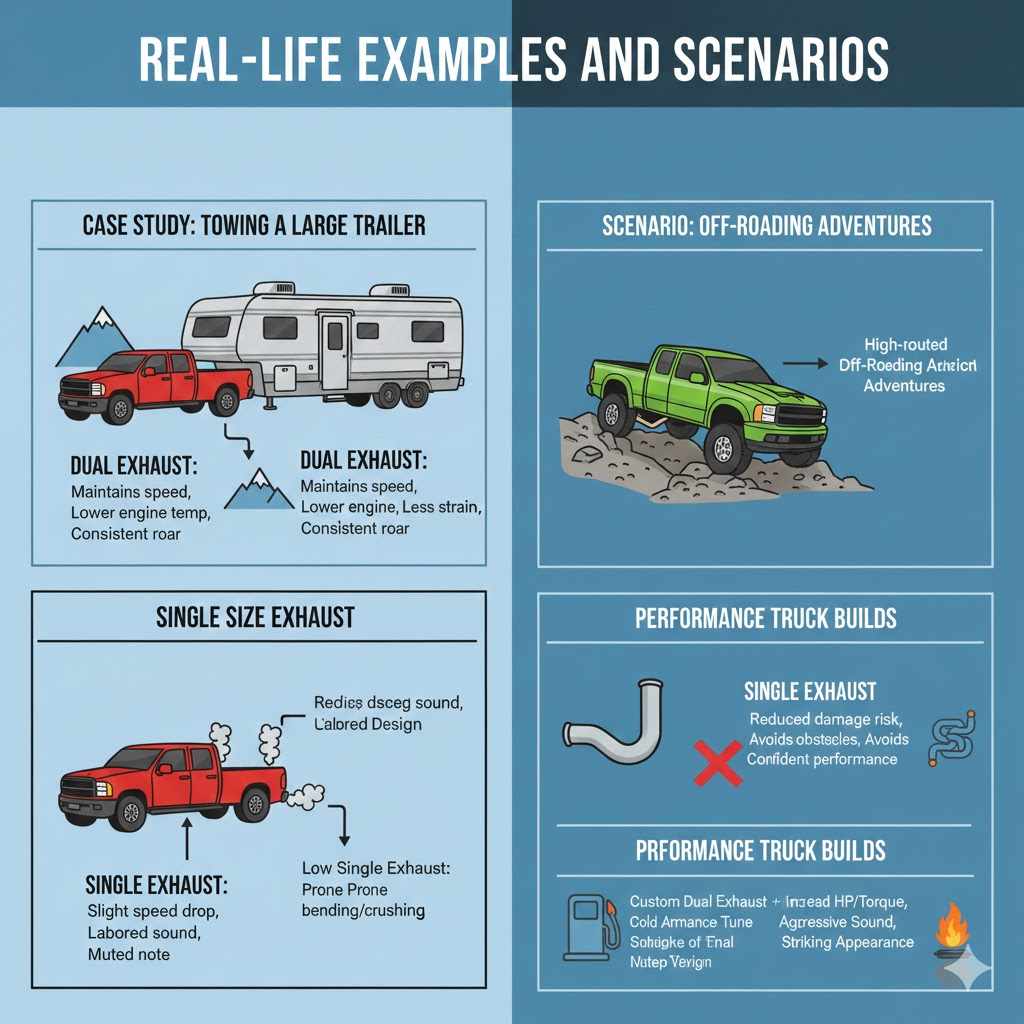
Case Study: Towing a Large Trailer
A common scenario for truck owners is towing large trailers, such as RVs, boats, or heavy equipment. Let’s consider two identical trucks, both equipped with 6.2-liter V8 engines, but one has a single exhaust and the other a dual exhaust.
When towing a 10,000-pound RV up a long, sustained incline, the truck with the dual exhaust system tends to maintain its speed more effectively. The engine operates at a slightly lower temperature, and the driver notices less strain on the engine. The sound of the dual exhaust is a strong, consistent roar, indicating efficient expulsion of gases.
In contrast, the truck with the single exhaust might show a slight drop in speed, and the engine might sound more labored. The exhaust note might be more muted or strained. This real-world difference highlights how dual exhaust can contribute to better performance under heavy load.
Scenario: Off-Roading Adventures
Trucks are often taken off-road, which can expose their undercarriages to hazards like rocks, branches, and uneven terrain. The placement and design of exhaust systems are crucial here.
Imagine a truck venturing onto a rocky trail. A dual exhaust system, especially if it’s routed with the tailpipes exiting before the rear axle or in a high, tucked-away position, can be advantageous. This setup reduces the risk of the tailpipes being damaged by obstacles.
For example, if a single exhaust system has its tailpipe hanging low, it’s more prone to getting bent or crushed.
Some aftermarket dual exhaust systems are specifically designed for off-road use, featuring robust materials and higher routing to avoid damage. This allows the truck to perform confidently on challenging terrain without worrying about exhaust system failure.
Performance Truck Builds
Many truck enthusiasts modify their vehicles to maximize performance. Dual exhaust systems are a very popular modification for these builds.
Consider a truck owner who wants to increase the horsepower and torque of their pickup for drag racing or track days. They might install a custom dual exhaust system, often paired with other performance upgrades like a cold air intake and a performance tune.
These systems are engineered to minimize exhaust restriction and improve engine scavenging. The result is a noticeable increase in power, a more aggressive exhaust note, and a visually striking appearance. A well-executed dual exhaust setup can contribute significantly to the overall performance package of a customized truck.
Frequently Asked Questions
Question: Do all trucks have two tailpipes?
Answer: No, not all trucks have two tailpipes. Many trucks come with a single tailpipe as standard equipment. The number of tailpipes often depends on the truck’s engine, trim level, and intended purpose.
Question: Does a dual exhaust system make a truck faster?
Answer: A dual exhaust system can potentially make a truck faster by improving engine performance. It helps the engine breathe better by reducing exhaust backpressure. However, the actual speed increase depends on many factors, including the specific engine and how the exhaust system is designed.
Question: Are dual tailpipes more expensive?
Answer: Yes, trucks with dual tailpipes are often more expensive than those with single tailpipes. This is because dual exhaust systems require more components, leading to higher manufacturing and purchase costs. Repair and replacement parts for dual systems can also be more costly.
Question: Will a dual exhaust system improve my truck’s gas mileage?
Answer: In some cases, a well-designed dual exhaust system can improve fuel economy by making the engine more efficient. However, in other cases, especially if the system is not perfectly matched to the engine or if it adds significant weight, it might lead to a slight decrease in gas mileage. It is not a guarantee of better fuel economy.
Question: Can I add a second tailpipe to my truck if it only has one?
Answer: Yes, it is possible to add a second tailpipe to a truck that originally came with a single exhaust. This is a common aftermarket modification. However, it’s important to ensure the modification is done correctly to avoid negatively impacting performance or emissions, and it often involves more than just adding a pipe; it might require modifying the muffler or adding a Y-pipe.
Final Thoughts
So, do trucks have two tailpipes? The answer is sometimes yes, sometimes no. It depends on the truck’s design, engine, and what the manufacturer aims for.
Dual tailpipes can offer better performance and look great, but they can also cost more and add weight. Understanding these pros and cons helps you make informed choices.
Related pick: Check today's price on Amazon