Does Buick Encore Have Dual Tailpipes?
Many car owners wonder, Does Buick Encore Have Dual Tailpipes? It might seem like a small detail, but for some, it’s important. If you’re new to looking at car specs, this question can feel a bit confusing. Don’t worry, we’ll make it super simple.

SUPALAND
SUPALAND Flip Key Fob Replacement Fits for…
- HIGH-QUALITY: Every Single Keyless Entry Remote Control Car Key Fob is Fully Pre-tested by Professional Locksmith Tools before Shi…
- COMPATIBILITY: Compatible with FCC ID OHT01060512 / V2T01060512. Please Check Our Product Description and Vehicle Fitment Tool for…
- REPLACEMENT: This Keyless Entry Remote Control Car Key Fob Replacement Is Compatible with Part Numbers: 13504200, 13504205, 135858…
As an Amazon Associate I earn from qualifying purchases.
This guide will walk you through it step by step, so you can find the answer easily. Get ready to find out exactly what you need to know about the Buick Encore’s exhaust system.
Understanding Buick Encore Tailpipe Designs
This section will look at how the exhaust pipes on the Buick Encore are designed. We will explore what “dual tailpipes” means in the automotive world and how it applies to this specific SUV. You’ll learn about the common configurations you might see and why manufacturers choose different setups for their vehicles.
This will help you identify what your Encore or a potential purchase might have.
What Are Dual Tailpipes
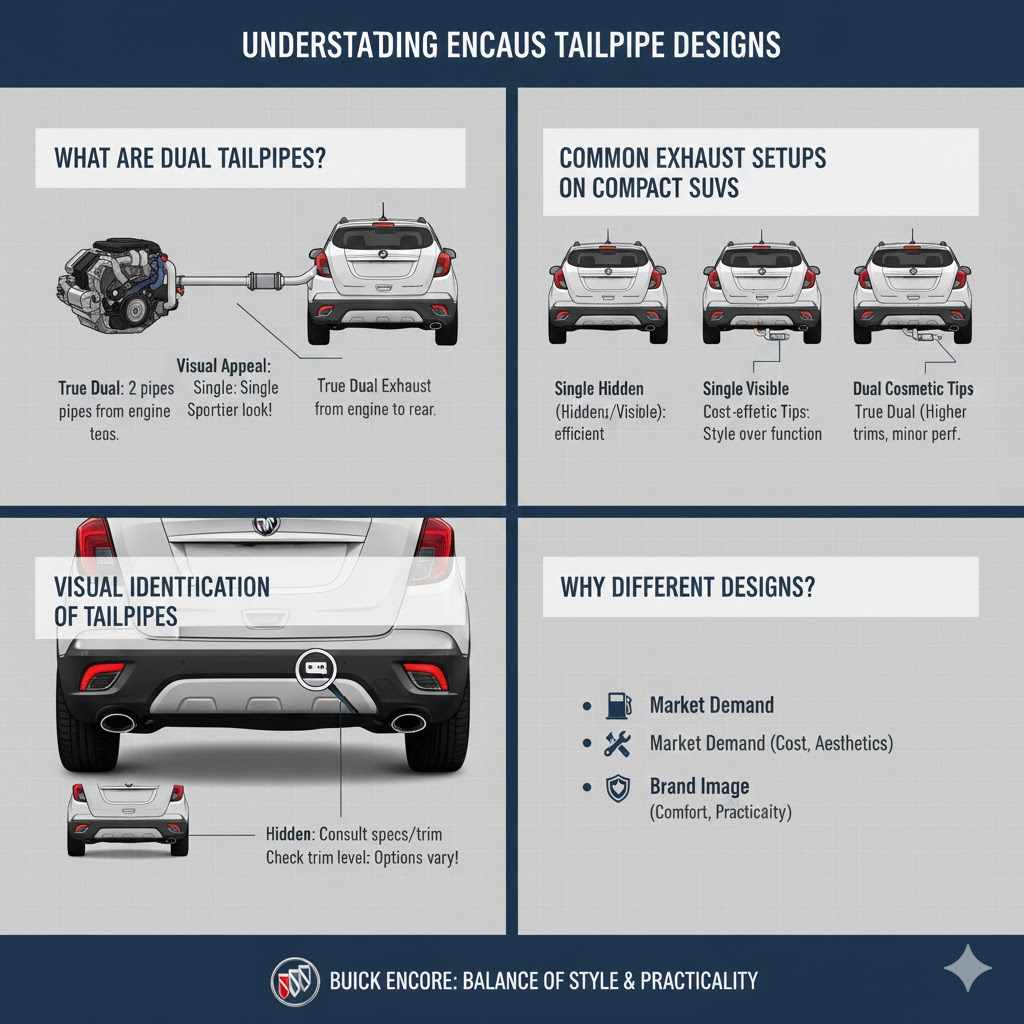
Dual tailpipes refer to a vehicle having two separate exhaust outlets at the rear. These outlets are typically visible on either side of the bumper or centered at the back. The term “dual” doesn’t always mean they are identical in size or shape, though often they are.
Some vehicles might have two pipes on one side, while others have one on each side.
This design choice can affect the car’s appearance, making it look sportier or more powerful. For some drivers, the visual appeal of dual tailpipes is a significant factor in choosing a car. It can give a premium or performance-oriented look.
It’s less about function and more about styling in many cases, especially on smaller SUVs.
It’s important to distinguish between true dual exhaust systems and what are sometimes called “cosmetic” dual tips. A true dual exhaust system means the engine’s exhaust gases are split and routed through two separate pipes from the engine’s manifold all the way to the rear. Cosmetic tips are often just decorative covers added to a single exhaust pipe.
For a vehicle like the Buick Encore, which is a compact SUV, the focus is often on fuel efficiency and comfort rather than aggressive styling. Therefore, manufacturers might opt for simpler exhaust setups. However, some trim levels or special editions could feature more elaborate designs to enhance their appeal to a wider range of buyers.
Common Exhaust Setups on Compact SUVs
Compact SUVs often feature a single exhaust pipe that is either visible or hidden. This approach is common because it is cost-effective and meets the functional requirements for emission control and noise reduction. A single pipe system is generally simpler to manufacture and maintain.
It also tends to be lighter, which can contribute to better fuel economy.
Some compact SUVs might have a single tailpipe that is split into two tips for aesthetic reasons. This gives the appearance of a dual exhaust without the added complexity or cost of a true dual system. These tips are often styled to look sporty, adding visual interest to the rear of the vehicle.
They are essentially decorative elements attached to a single exhaust pipe.
Occasionally, a compact SUV might offer a dual exhaust system, but this is less common. When it is offered, it’s usually on higher trim levels or performance-oriented variants. A true dual exhaust system can sometimes offer slight improvements in engine performance and sound, but these benefits are often minimal on smaller engines.
The primary driver for dual exhaust on these vehicles is typically appearance.
The choice of exhaust system is influenced by market demand, cost of production, and the overall brand image. Buick, as a brand, often focuses on a blend of comfort, style, and practicality. This means their exhaust configurations will likely align with these priorities, balancing aesthetics with efficiency and affordability for the typical buyer.
Visual Identification of Tailpipes
When you’re looking to see if a Buick Encore has dual tailpipes, the easiest way is to visually inspect the rear of the vehicle. Look under the rear bumper, typically on either the left and right sides, or sometimes in the center. You are looking for distinct openings where the exhaust gases exit.
If you see two separate, individual pipe openings that appear to be actual exhaust exits, then it has dual tailpipes. These pipes might be flush with the bumper or slightly protrude. Sometimes, there are chrome tips that can make the tailpipes more noticeable and stylish.
These tips are often a good indicator of the exhaust configuration.
If you only see one opening, or if there are two tips that look like they are attached to a single pipe underneath, it might not be a true dual exhaust system. You might also find that the tailpipes are completely hidden behind the bumper for a cleaner look. In this case, you would need to consult the vehicle’s specifications or look for exhaust cutouts that might be covered.
It’s also helpful to look at the vehicle’s trim. Different trim levels can have different features. A base model might have a simpler exhaust, while a sportier or premium trim might offer dual tailpipes.
Always check the specific vehicle you are interested in, as options can vary.
Does the Buick Encore Have Dual Tailpipes
This section directly addresses the main question about the Buick Encore and its tailpipe configuration. We will break down the answer based on different model years and trim levels, providing a clear and definitive response. You will get a straightforward answer that helps you understand what to expect when looking at a Buick Encore.
Buick Encore Standard Models
For most standard models of the Buick Encore, including popular trim levels like the Preferred and Sport Touring, the answer is generally no, they do not come with dual tailpipes. These vehicles typically feature a single, well-integrated exhaust system. The tailpipe is often designed to be discreet, sometimes tucked away or ending with a single, clean tip.
This design choice is common for this class of vehicle. Compact SUVs like the Encore prioritize practicality, fuel efficiency, and a balanced aesthetic. A single exhaust system is efficient and cost-effective, aligning with these priorities.
It helps to keep the vehicle’s overall design clean and uncluttered at the rear.
The focus for these standard Encore models is on providing a comfortable and reliable driving experience. While some drivers might prefer the look of dual tailpipes, the engineering for these vehicles is geared more towards everyday usability and economy. The exhaust system is designed to perform its function quietly and efficiently without drawing excessive attention.
If you are looking at a base or mid-range Buick Encore, it is highly probable that it will have a single tailpipe configuration. This is the most prevalent setup for these particular models. The absence of dual tailpipes does not diminish the vehicle’s functionality or appeal as a practical compact SUV.
Buick Encore Specific Trim Levels and Years
While most Buick Encore models do not feature dual tailpipes, there might be specific exceptions depending on the model year and trim level. Historically, Buick has offered different packages or special editions that could include upgraded styling features. However, these are not the norm for the Encore.
For instance, some earlier model years or certain sportier-oriented trims might have offered a dual-tip exhaust as an optional feature or standard on higher-end packages. It’s essential to check the specific vehicle’s build sheet or VIN decoder for definitive information. Manufacturer websites and brochures from the relevant model year are also valuable resources.
It’s also worth noting that sometimes, the term “dual tailpipes” can be loosely applied. Some Encores might have a single exhaust pipe that splits into two decorative tips. While this looks like dual exhaust from a distance, it’s not a true dual exhaust system where the engine output is split.
This is a styling element rather than a performance enhancement.
The trend for compact SUVs has often been towards single, cleaner exhaust designs. Therefore, actively seeking out a Buick Encore with dual tailpipes might require looking at very specific configurations or possibly aftermarket modifications. For the most part, the standard Encore is equipped with a single tailpipe.
Aftermarket Modifications for Dual Tailpipes
If you are set on having dual tailpipes on your Buick Encore, but the model you have or are interested in doesn’t come with them, there are aftermarket solutions. Many automotive customization shops can install dual exhaust tips or even a full dual exhaust system. This allows you to achieve the look you desire.
Aftermarket dual exhaust tips are usually bolted or clamped onto the existing single exhaust pipe. They are primarily for cosmetic purposes, offering the visual appeal of dual outlets. These are generally affordable and can be installed relatively quickly.
They come in various styles, materials like chrome or stainless steel, and finishes to match your car.
For a more significant change, a full dual exhaust system can be installed. This involves replacing the factory exhaust piping from the catalytic converter back with a dual-pipe setup. This is a more involved process and can be more expensive.
It might offer a slight change in exhaust sound, but the performance gains on an Encore would likely be minimal.
When considering aftermarket modifications, it’s important to choose reputable installers. They can advise on the best options for your Encore and ensure the installation is done correctly to avoid any issues with performance or vehicle warranty. Always check local regulations regarding exhaust modifications as well.
Factors Influencing Exhaust Pipe Design
This section will explore the reasons behind the different exhaust pipe designs seen on vehicles. We will discuss how cost, performance, emissions, and styling all play a role. Understanding these factors will provide a broader perspective on why certain cars have dual tailpipes while others do not, including the Buick Encore.
Cost of Production
The cost of manufacturing is a significant factor in how vehicle components are designed. A single exhaust system is inherently less expensive to produce than a dual exhaust system. This is because it requires less material, fewer parts, and simpler manufacturing processes.
Fewer bends, less piping, and a single muffler generally translate to lower production costs.
For mass-produced vehicles like the Buick Encore, which aims to be competitive in the compact SUV market, keeping production costs down is crucial. This allows manufacturers to offer vehicles at attractive price points. Therefore, opting for a single exhaust system is a practical choice that helps manage the overall cost of the vehicle for consumers.
Dual exhaust systems require more complex engineering and manufacturing. They involve splitting the exhaust manifold, running two separate pipes, and often using two mufflers or a specially designed dual muffler. This increases the material cost, labor cost, and complexity of the assembly line.
For vehicles where performance or aggressive styling isn’t the primary selling point, this extra cost is often not justified.
Additionally, the research and development required for a dual exhaust system to ensure optimal performance and sound quality also add to the expense. Manufacturers weigh these costs against the potential benefits and market demand. For a vehicle like the Encore, the balance leans towards a more economical single exhaust.
Performance and Engine Output
In some vehicles, dual exhaust systems are implemented to improve engine performance. A dual exhaust system can allow the engine to expel exhaust gases more efficiently. This can lead to better airflow, reduced backpressure, and potentially a slight increase in horsepower and torque.
This benefit is more pronounced in high-performance engines with larger displacements.
However, for smaller, naturally aspirated engines like those typically found in compact SUVs such as the Buick Encore, the performance gains from a dual exhaust system are often minimal, if noticeable at all. The engine is not designed to produce enough exhaust gas volume or pressure to significantly benefit from the increased efficiency of a dual system.
The main purpose of the exhaust system on a standard Encore is to safely channel exhaust gases away from the cabin and to reduce noise levels. A well-designed single exhaust system can effectively achieve these goals. Adding a dual exhaust would likely incur additional cost and weight without providing a tangible improvement in driving dynamics for the average user.
When performance is a key feature, manufacturers often use dual exhaust systems to complement more powerful engines. For a vehicle focused on comfort and economy, the exhaust design prioritizes functionality and efficiency over maximizing engine output. The difference in performance between a single and dual exhaust on a typical Encore would be negligible.
Emissions and Environmental Regulations
Exhaust systems are critical for meeting stringent emissions regulations set by governments worldwide. The catalytic converter, which reduces harmful pollutants, is a key component. While the number of tailpipes doesn’t directly impact the function of the catalytic converter itself, the overall design of the exhaust system can influence its efficiency.
Manufacturers must ensure their exhaust systems are designed to allow the catalytic converter to operate at its optimal temperature and efficiency. This is achieved through careful tuning of pipe diameter, length, and flow characteristics. A well-engineered single exhaust system can effectively facilitate the emissions control process.
In some high-performance or specialty vehicles, a dual exhaust might be part of a larger system designed for specific emission control strategies or to integrate with advanced engine technologies. However, for mainstream vehicles, a single exhaust is typically sufficient to meet all regulatory requirements. The complexity of a dual system could potentially add challenges in meeting emissions standards if not perfectly engineered.
The environmental impact is a growing concern, and manufacturers are constantly refining their technologies to reduce emissions. The choice of an exhaust system is part of this larger effort. For the Buick Encore, the single exhaust system is designed to be compliant with current emissions standards, offering an efficient and environmentally responsible solution.
Aesthetic and Styling Choices
The appearance of a vehicle’s rear end plays a significant role in its overall styling and market appeal. Dual tailpipes can significantly enhance the visual presence of a car, making it look sportier, more aggressive, or more upscale. This is a primary reason why many manufacturers offer them, even if there are no significant performance benefits.
For some buyers, the visual cue of dual tailpipes suggests a higher-performance vehicle or a more premium trim level. This can influence purchasing decisions, as consumers often associate certain design elements with specific qualities. Buick, as a brand that aims for a sophisticated image, might use exhaust styling to convey this.
However, for the Buick Encore, the design philosophy often leans towards a more understated elegance and practicality. A clean, well-integrated single exhaust tip can achieve this aesthetic just as effectively as dual pipes. The focus might be on a polished look rather than overtly sporty cues.
The choice between single or dual tailpipes from a styling perspective is a balance between the brand’s overall design language and the target audience’s preferences. For the Encore, the styling often emphasizes a refined and modern look, where a single, well-designed tailpipe fits this narrative perfectly.
Comparing Tailpipe Configurations
This section provides a direct comparison of different tailpipe setups, highlighting their pros and cons. We will look at single exhaust, cosmetic dual tips, and true dual exhaust systems. This will help you understand the nuances and make informed judgments about what might be best for your needs or preferences.
Single Exhaust System
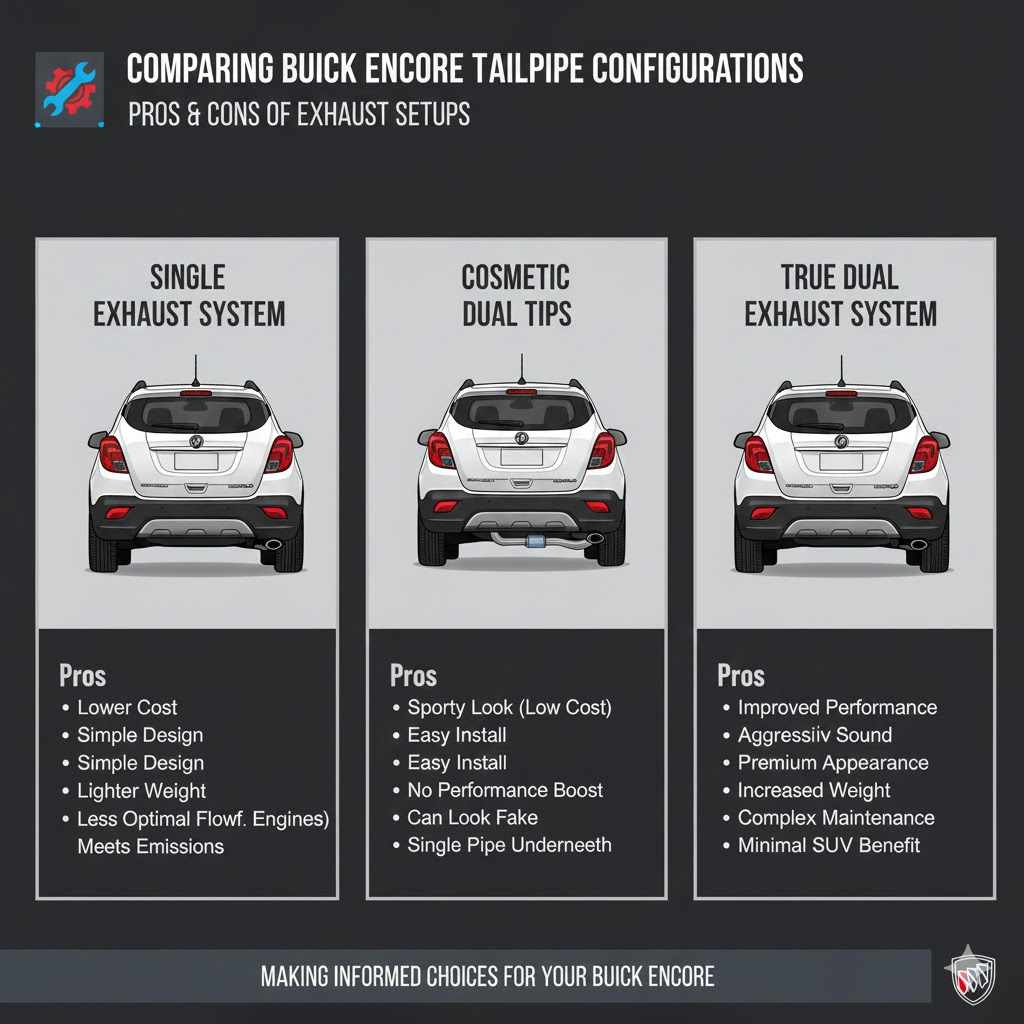
A single exhaust system is the most common configuration found on vehicles. It uses one pipe to carry exhaust gases from the engine to the rear of the vehicle and out through a single tailpipe. This setup is favored for its simplicity, lower cost, and ease of maintenance.
Pros
- Lower manufacturing cost, leading to a more affordable vehicle price.
- Simpler design, reducing potential points of failure and making repairs easier.
- Lighter weight, which can contribute to better fuel efficiency.
- Effective in meeting emissions standards and reducing noise for everyday driving.
Cons
- May not offer the sporty or aggressive aesthetic that some buyers prefer.
- Potential for slightly less optimal exhaust flow compared to a true dual system on high-performance engines.
For the Buick Encore, the single exhaust system is a practical and economical choice that meets all functional requirements for a compact SUV. It provides a clean look and efficient operation without unnecessary complexity or cost.
Cosmetic Dual Exhaust Tips
Cosmetic dual exhaust tips are essentially decorative attachments that are fitted onto a single exhaust pipe. They give the visual impression of a dual exhaust system without altering the underlying pipe configuration. These are purely for styling purposes.
Pros
- Provides a sporty and aggressive look at a lower cost than a true dual exhaust.
- Easy to install as an aftermarket modification.
- Can be chosen in various styles and finishes to match the vehicle’s appearance.
Cons
- Do not offer any performance benefits as they don’t change the exhaust flow.
- Can sometimes look obviously fake if not well-integrated with the bumper design.
- The underlying single pipe still exists.
Some Buick Encore models might feature these cosmetic tips, making the rear look more dynamic without the engineering of a true dual system. It’s a compromise between appearance and cost-effectiveness.
True Dual Exhaust System
A true dual exhaust system involves two separate exhaust pipes running from the engine’s exhaust manifold all the way to the rear of the vehicle, with two distinct tailpipes. This system is typically found on performance-oriented vehicles.
Pros
- Can offer improved engine performance by reducing backpressure and improving exhaust flow.
- Provides a more aggressive and distinct exhaust note.
- Enhances the sporty and premium appearance of a vehicle.
Cons
- Significantly higher manufacturing cost.
- Increased weight due to extra piping and components.
- More complex installation and potential for more maintenance issues.
- Performance benefits are often negligible on smaller, non-performance engines.
While true dual exhaust systems are impressive for sports cars, they are rarely a practical or necessary option for a compact SUV like the Buick Encore, where efficiency and everyday usability are prioritized over extreme performance.
Frequently Asked Questions
Question: Does every Buick Encore have the same tailpipe setup?
Answer: No, not every Buick Encore has the same tailpipe setup. While most standard models feature a single tailpipe for simplicity and cost-effectiveness, some specific trim levels or model years might have cosmetic dual tips, or in very rare cases, a true dual exhaust system might have been an option. It is always best to check the specific vehicle.
Question: What is the main reason for dual tailpipes on a car?
Answer: The main reason for dual tailpipes on many cars is aesthetic. They are often added to make a vehicle look sportier, more powerful, or more upscale. While true dual exhaust systems can offer some performance benefits, this is less common on everyday vehicles and more often associated with sports cars.
Question: Can I add dual tailpipes to my Buick Encore if it only has one?
Answer: Yes, you can add dual tailpipes to your Buick Encore. This is usually done through aftermarket modifications. You can opt for cosmetic dual exhaust tips that attach to your existing single pipe, or you can have a custom dual exhaust system installed.
It’s advisable to consult with a professional installer.
Question: How can I tell if a car has a true dual exhaust system or just fake tips?
Answer: To tell if a car has a true dual exhaust, look at the pipes underneath. If there are two separate pipes running from near the engine to the rear, it’s a true dual system. If you see only one pipe leading to two tips at the back, those are likely cosmetic tips.
Sometimes, you can see the single pipe splitting into the two decorative outlets.
Question: Is a dual exhaust better for fuel economy?
Answer: Generally, a dual exhaust system does not improve fuel economy and can sometimes slightly decrease it due to increased weight and complexity. The primary goals of a dual exhaust are usually aesthetics and performance. For fuel economy, a well-designed single exhaust system is typically more efficient.
Final Thoughts
So, Does Buick Encore Have Dual Tailpipes? Most models do not. The Buick Encore typically comes with a single tailpipe, prioritizing efficiency and a clean look.
This design choice is standard for its class. If you want dual tailpipes, aftermarket options are available for style.
Related pick: Check today's price on Amazon