
Do Teslas Have Tailpipes The Surprising Truth
Many people wonder about electric cars and if they look like regular cars. A common question is Do Teslas Have Tailpipes? Surprising Truth.
This might be confusing if you’re new to electric vehicles. It’s simple to figure out, though. We will explain it step-by-step so you can understand it easily.
Let’s find out what makes Teslas different.
Understanding Electric Cars and Exhaust
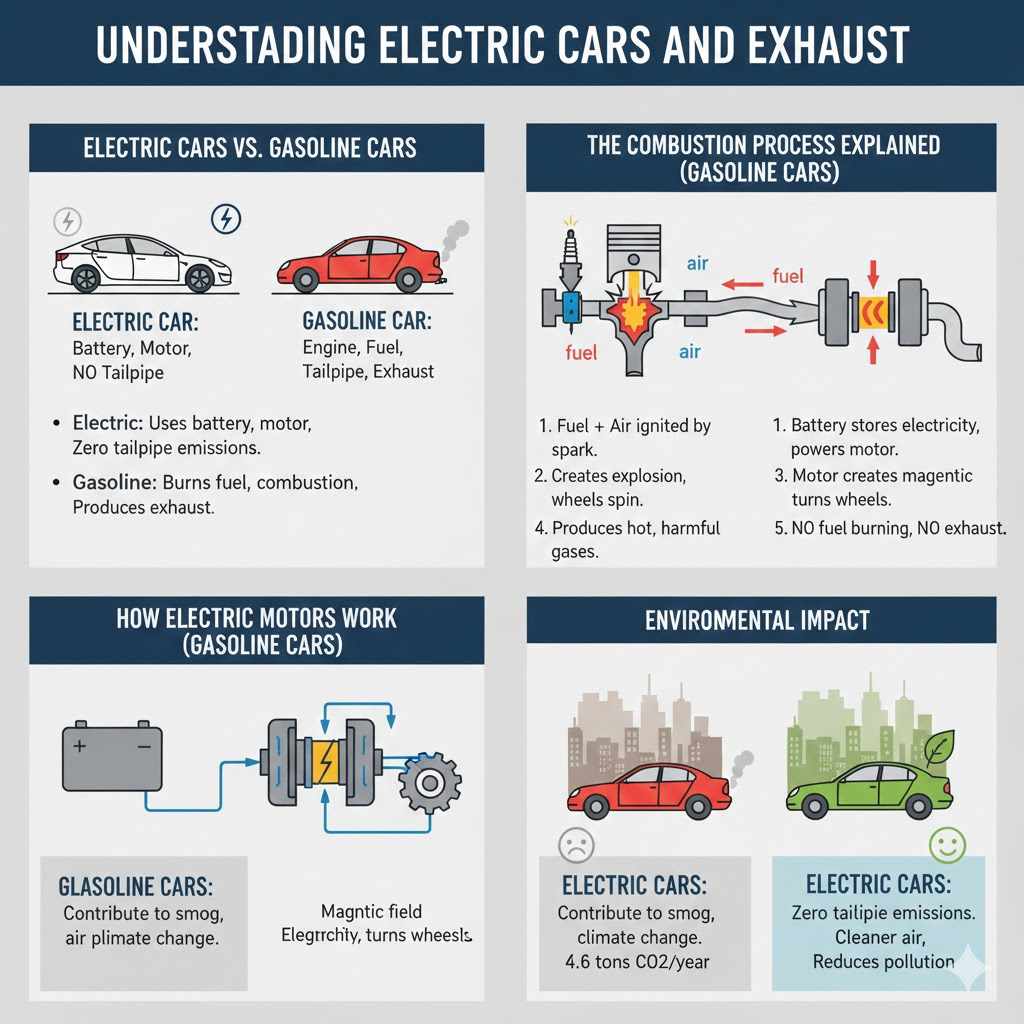
Electric cars are quite different from the gasoline cars most people are used to. The biggest difference is how they get their power. Gasoline cars burn fuel to create energy, and this process creates exhaust.
Tailpipes are the exit points for this exhaust. Electric cars, however, use electricity stored in batteries to power their motors. They don’t burn fuel, so there’s no exhaust to get rid of.
This is a key reason why you won’t find tailpipes on a Tesla or any other fully electric vehicle.
What Is a Tailpipe and Its Function?
A tailpipe is the part of a vehicle’s exhaust system that lets out gases from the engine. When a car’s engine burns gasoline, it creates smoke and other gases. These gases are hot and can be harmful.
The exhaust system directs these gases away from the car’s cabin and out into the air. This process is called combustion. It’s how most traditional cars move.
The tailpipe is usually at the back of the car, and it’s a clear sign that the car uses a combustion engine. For example, a Ford F-150 truck has a large tailpipe because its V8 engine burns a lot of gasoline.
The Combustion Process Explained
Combustion is a chemical reaction that creates heat and light. In a car engine, it happens very quickly. Fuel, like gasoline, mixes with air.
A spark plug then ignites this mixture inside a cylinder. This explosion pushes a piston, which turns a crankshaft. This turning motion eventually makes the car’s wheels spin.
As a result of burning the fuel, waste gases are produced. These include carbon dioxide, nitrogen oxides, and other particles. Without an exhaust system, these gases would build up inside the engine and the car, making it unsafe to drive.
The tailpipe is the final step in releasing these gases.
How Electric Motors Work Differently
Electric motors work on a completely different principle. Instead of burning fuel, they use electricity. Batteries store electrical energy.
This energy is sent to an electric motor. The motor uses this electricity to create a magnetic field. This magnetic field causes parts of the motor to spin.
This spinning motion is then used to turn the car’s wheels. There is no burning of fuel, no exhaust gases, and therefore, no need for a tailpipe. Think of it like a remote-controlled car that runs on batteries.
It has a motor that spins but doesn’t produce smoke or exhaust.
The Environmental Impact of No Tailpipes
Because electric cars like Teslas don’t have tailpipes, they produce zero tailpipe emissions. This means they don’t release harmful gases into the air when they drive. This is a major benefit for air quality, especially in cities.
Traditional cars contribute to smog and can affect people’s health. Electric cars help reduce pollution and combat climate change. For example, a study by the U.S.
Environmental Protection Agency showed that a typical gasoline car can emit over 4.6 metric tons of carbon dioxide per year. Electric cars eliminate this direct source of pollution. This makes them a much cleaner choice for transportation.
Why the Question Do Teslas Have Tailpipes Arises
The question of whether Teslas have tailpipes is common because electric cars are still relatively new to many people. For decades, the presence of a tailpipe was a universal indicator of a car that runs on gasoline or diesel. People are used to seeing them on every car they’ve ever known.
When electric cars entered the market, they looked similar to traditional cars from the outside. This similarity, combined with the long-standing association of tailpipes with cars, leads to confusion. Many simply assume all cars have them until they learn otherwise.
It’s a natural question born from habit and observation.
Familiarity with Traditional Vehicles
Most people grew up seeing cars with tailpipes. From family sedans to trucks and buses, the exhaust pipe at the rear was a constant visual cue. This familiarity created a mental checklist for what a car is.
When electric vehicles like Teslas appeared, they shared many design elements with gasoline cars. They had four wheels, doors, windows, and headlights. However, they lacked one of the most visible and consistent features: the tailpipe.
This absence is what sparks the question for many. It’s like seeing a bird that doesn’t fly; it makes you pause and ask why.
Visual Cues and Expectations
Visual cues play a big role in how we understand things. A tailpipe is a strong visual cue for a combustion engine. When this cue is missing on a vehicle that otherwise looks like a car, it creates an expectation gap.
People expect a car to behave like other cars they know. Since tailpipes were always present, their absence on a Tesla is surprising. It challenges deeply ingrained perceptions about what a car should look like and how it operates.
This is why many beginners ask: Do Teslas have tailpipes? Surprising Truth it is that they don’t.
The Learning Curve for New Technology
Adopting new technology often comes with a learning curve. Electric vehicles represent a significant shift in automotive technology. Understanding how they work, their components, and their differences from older technology takes time.
Questions about basic features like tailpipes are part of this learning process. It’s not a sign of not paying attention, but rather a natural part of becoming familiar with something new. The novelty of battery power, silent operation, and the absence of exhaust is still sinking in for many.
Misconceptions and Information Gaps
Sometimes, information about new technologies isn’t widespread or easily understood. Misconceptions can arise from incomplete information or from people making assumptions based on what they already know. Without clear explanations, it’s easy to believe that electric cars are just like gasoline cars but with a different power source hidden away.
This can lead to the assumption that they must also have tailpipes for some reason, even if it’s not obvious. Bridging these information gaps with clear, simple explanations is key.
The Design Differences: No Need for Exhaust
The fundamental reason Teslas don’t have tailpipes is their design as electric vehicles. They are built from the ground up to run on electricity, not gasoline. This core design choice eliminates the need for an exhaust system entirely.
Instead of an engine that burns fuel, Teslas have an electric motor powered by a large battery pack. This difference in powertrain is the single most important factor explaining why there are no tailpipes. It’s a deliberate engineering decision that defines them as zero-emission vehicles at the point of use.
Tesla’s Powertrain Explained
A Tesla’s powertrain consists of an electric motor, a battery pack, and a sophisticated power electronics system. The battery pack, usually located under the floor of the car, stores a large amount of electrical energy. When the driver presses the accelerator, this energy is sent to the electric motor.
The motor converts electrical energy into mechanical energy, which spins the wheels. There’s no burning of fuel, no combustion, and no exhaust gases produced. This means the car operates silently and cleanly.
The whole system is designed for efficiency and performance without the mess and emissions of a gas engine.
Components of an Electric Drivetrain
The main components of an electric drivetrain include the electric motor, inverter, battery, and onboard charger. The electric motor is the powerhouse that drives the wheels. The inverter converts the direct current (DC) from the battery into alternating current (AC) that the motor uses.
The battery pack is the energy source, storing thousands of small battery cells. The onboard charger converts AC power from a charging station into DC power to recharge the battery. Noticeably absent from this list is any component related to an exhaust system, like a muffler or catalytic converter.
These are only needed for combustion engines.
What Replaces the Tailpipe Function?
Since Teslas don’t produce exhaust, there’s no function for a tailpipe to perform. The entire concept of expelling waste gases is irrelevant to their operation. Instead of an exhaust system, electric cars have ventilation systems to cool the battery and motor, and to keep the cabin comfortable.
These systems are internal and don’t involve expelling gases to the outside. For example, you might see small vents on the side or underneath a Tesla, but these are for air circulation and cooling, not for exhaust gases. They are part of a completely different engineering philosophy.
The Absence of Mufflers and Catalytic Converters
Traditional cars have mufflers to reduce engine noise and catalytic converters to clean up exhaust gases. Mufflers work by using chambers and baffles to quiet the loud explosions happening in the engine. Catalytic converters use special metals to turn harmful pollutants into less harmful ones.
Because electric cars don’t have these combustion processes, they don’t need mufflers or catalytic converters. This is another reason why there are no exhaust components on a Tesla. The silence of Teslas is a direct result of not having these noisy, combustion-related parts.
Visual Cues of Electric Cars
While Teslas lack tailpipes, they often have other visual cues that hint at their electric nature. Many electric cars have a smoother front grille or no grille at all, as they don’t need to cool a large engine. They might have charging ports visible on the exterior.
Some models may have unique badging or aerodynamic designs optimized for battery efficiency. For instance, the Tesla Model 3 has a very clean and minimalist front end without the large grilles seen on many gasoline cars, which are designed to draw in air for engine cooling.
Do All Electric Cars Lack Tailpipes?
Yes, all fully electric vehicles (EVs) manufactured to run solely on battery power do not have tailpipes. This is a defining characteristic of EVs, regardless of the brand. The absence of tailpipes is a direct consequence of their zero-emission operation at the point of use.
Whether it’s a Tesla, a Nissan Leaf, a Chevrolet Bolt, or a Ford Mustang Mach-E, if it’s a pure battery-electric vehicle, it will not have an exhaust system. This applies to all vehicles that have an electric motor as their primary means of propulsion and are charged from an external power source.
Pure Electric Vehicles (BEVs)
Pure electric vehicles, often called Battery Electric Vehicles (BEVs), rely entirely on electricity stored in their batteries. They have no gasoline engine or fuel tank. Examples include the Tesla Model S, Nissan Leaf, and the entire Lucid Air lineup.
These vehicles are designed from the ground up to be electric. Therefore, they have no need for a tailpipe to release combustion byproducts. Their operation is fundamentally different from internal combustion engine vehicles (ICEVs).
Hybrid Vehicles and Their Tailpipes
Hybrid vehicles are a bit different. A hybrid car has both a gasoline engine and an electric motor. The gasoline engine allows it to drive like a traditional car and produce exhaust.
Therefore, most hybrid vehicles do have tailpipes. For example, the Toyota Prius, a popular hybrid, has a small tailpipe at the rear. However, in some driving modes, the hybrid can run on electricity alone.
During these times, the gasoline engine is off, and no exhaust is produced. But the presence of the gasoline engine means an exhaust system and tailpipe are necessary for when it is used.
Plug-In Hybrid Electric Vehicles (PHEVs)
Plug-in hybrid electric vehicles (PHEVs) are similar to regular hybrids but have a larger battery that can be charged from an external source. They can travel a significant distance on electricity alone. However, like regular hybrids, they still have a gasoline engine.
This engine kicks in for longer trips or when the battery is depleted. Because they have a gasoline engine, PHEVs also have tailpipes. A common example is the Chevrolet Volt, which has a tailpipe, although it is often smaller than on a non-hybrid car.
Fuel Cell Electric Vehicles (FCEVs)
Fuel Cell Electric Vehicles (FCEVs) are another type of electric vehicle, but they use hydrogen gas to generate electricity. They have an electric motor and run on electricity, similar to BEVs. However, their “exhaust” is water vapor.
While they produce a byproduct, it’s water, not harmful gases. So, they technically don’t have a traditional tailpipe for exhaust fumes. The Toyota Mirai is an example of an FCEV.
It releases water vapor from a small outlet, which is not considered a tailpipe in the traditional sense.
The Future of Vehicle Propulsion
As the automotive industry moves towards electrification, the absence of tailpipes is becoming more common. Governments worldwide are setting targets to phase out gasoline and diesel vehicles. This means that in the future, most new cars sold will be fully electric or hydrogen-powered.
The visual landscape of our roads will change, with fewer tailpipes and cleaner air. This transition is driven by the need to reduce pollution and combat climate change, making EVs like Teslas a key part of this evolution.
Common Places to Look for a Tailpipe (and Not Find One on a Tesla)
When you’re trying to figure out if a car has a tailpipe, there are certain places you’d typically look. However, when you apply these places to a Tesla, you’ll find they are conspicuously absent. This is a good way to reinforce the understanding that electric cars operate differently.
Knowing where to look helps solidify the knowledge that Teslas are designed without any need for exhaust expulsion. It’s about recognizing what’s missing and why it’s missing.
The Rear of the Vehicle
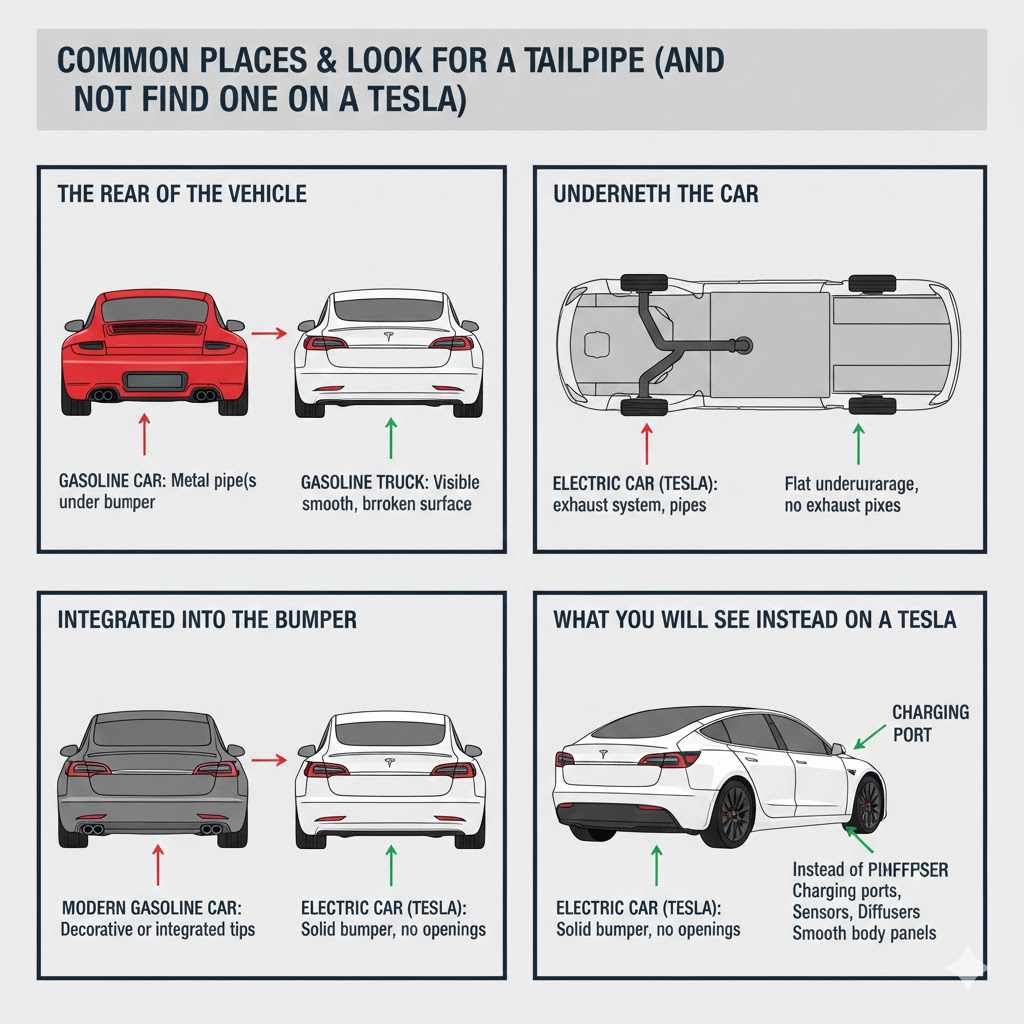
Traditionally, the most obvious place to find a tailpipe is at the rear of the car. It’s usually a metal tube sticking out from under the bumper or integrated into the bumper itself. Many cars have one or even two tailpipes visible here.
For example, a sports car like a Porsche 911 often has prominent exhaust tips at the back, indicating its high-performance engine. On a Tesla, if you look at the rear bumper, you will see a smooth, unbroken surface without any protruding pipes.
Underneath the Car
Sometimes, tailpipes and the rest of the exhaust system are tucked underneath the car, especially on SUVs and trucks. They might extend a short distance before ending. You can often see them by looking under the vehicle from the side or rear.
For a truck like a Ram 1500, the tailpipe might be visible running along the frame. Teslas, on the other hand, have a flat undercarriage due to the battery pack. There are no exhaust pipes running underneath, as there’s no exhaust to route.
Integrated into the Bumper
Some modern cars integrate their exhaust tips directly into the rear bumper design. This can make them less obvious but still present. They might appear as decorative elements or actual exit points for exhaust.
You might see this on luxury sedans. When you examine the rear bumper of a Tesla Model S or Model X, you will find no such openings. The bumper is a solid piece, designed for aerodynamics and aesthetics rather than accommodating an exhaust system.
What You Will See Instead on a Tesla
Instead of tailpipes, you might notice other design elements on a Tesla. These can include charging ports, sensors, diffusers designed for aerodynamics, or simply smooth body panels. For example, the Tesla Model Y has a rear diffuser that helps improve airflow and efficiency, but it’s not an exhaust outlet.
The charging port is typically located on the rear fender or the taillight assembly. These are the visual indicators of a car that runs on electricity and doesn’t need to expel gases.
A Simple Way to Check
The simplest way to check is to look at the very back of the car, low down. If you see a metal pipe that looks like it’s designed to let out smoke or gas, that’s a tailpipe. If you don’t see anything like that, and the underside is smooth or has other components like cooling vents or electrical connections, it’s likely an electric vehicle.
This visual inspection is a quick and easy method for anyone curious about whether a car has a tailpipe. It’s the most direct way to answer the question for yourself.
Frequently Asked Questions
Question: Do Teslas have a gas engine?
Answer: No, Teslas do not have gasoline engines. They are fully electric vehicles, meaning they are powered by electricity stored in batteries.
Question: If Teslas don’t have tailpipes, how do they get rid of waste?
Answer: Teslas do not produce any waste gases from burning fuel, so there is no exhaust to get rid of. Their operation is entirely electric.
Question: Can I add a fake tailpipe to my Tesla?
Answer: While it’s possible to add decorative exhaust tips, they are purely cosmetic and do not serve any functional purpose for an electric vehicle.
Question: Are all cars without tailpipes electric?
Answer: Generally, yes. Cars without tailpipes are almost always fully electric vehicles (BEVs) or, in some cases, fuel cell electric vehicles (FCEVs) that emit water vapor.
Question: Do Teslas make any noise?
Answer: Teslas are very quiet because they lack a combustion engine and exhaust system. They do make some low-level sounds from the electric motor and tires, and regulations often require a low-speed sound for pedestrian safety.
Summary
Teslas do not have tailpipes because they are electric cars. They run on batteries and electric motors, not gasoline. This means no burning of fuel and no exhaust gases.
All fully electric cars are designed this way. It makes them cleaner and quieter than traditional cars. You won’t find any exhaust pipes on a Tesla.