How to Tell If a Heat Shield Is Bad
A heat shield is bad if it rattles over bumps, hangs loose, has rust holes or cracks, or has separated mounting points; if the noise follows engine speed instead, look elsewhere. Ignore it and exhaust heat can reach the floor, wiring, hoses, or nearby trim, and a loose panel can turn into a dropped shield. This guide gives a quick checklist to spot loose, cracked, corroded, or missing shields and separate them from other exhaust problems.
What a heat shield does
A heat shield is a thin metal panel around hot exhaust parts, especially the catalytic converter and muffler. Its job is plain: block heat so it stays near the exhaust and does not soak into the floorboard, wiring, hoses, plastics, or rubber close by.
The upper part helps keep the car’s interior from getting too hot. The lower part can help keep dry grass and leaves from catching fire underneath the vehicle. That matters most around the catalytic converter, which can run hot enough to create a real hazard if shielding is gone or badly damaged.
Where you’ll usually find one
Look along the exhaust tunnel, around the catalytic converter, and near the muffler. Some shields are bolted on. Others are welded in place or attached with clamps or ties. The attachment method matters, because the failure point is often the hardware, not the metal panel itself.
Shield triage table
Use this checklist to separate a bad shield from a hanger, pipe, bracket, or another underbody problem. Start with the symptom, then match what you see and hear to the likely cause.
| Symptom | Likely cause | Next step |
|---|---|---|
| Rattle at idle that softens when the engine speed changes | Loose heat shield, cracked fastener, or broken spot weld | Inspect the shield edges and mounting points first |
| Rattle or scrape over bumps, dips, or rough pavement | Loose shield, bent edge touching the body, or a loose bracket | Check for contact marks and shifted mounting points |
| Noise that follows engine speed, not road input | Exhaust pipe, hanger, clamp, or bracket issue instead of a shield | Look at hangers and pipe clearance before blaming the shield |
| Visible rust, flaking edges, or thin metal around the rim | Corrosion weakening the shield material | Treat it as a repair or replacement candidate |
| Missing bolt, clip, clamp, or retaining tab | Loose mounting hardware | Re-secure only if the shield is otherwise intact |
| Bent edge hanging low near the exhaust | Impact damage or failed attachment point | Check whether the shield still clears the pipe or converter |
| Broken spot welds or cracked attachment ears | Structural shield failure | Plan for replacement if the joint cannot be re-secured safely |
| Burnt smell from the engine or floor area | Excess heat or nearby material overheating; not proof by itself | Inspect the shield, wiring, hoses, and any plastic close to the exhaust |
| Floorboard feels unusually hot | Shield no longer blocking exhaust heat well | Check shield coverage around the catalytic converter and muffler |
| Underhood temperature seems abnormally high | Heat escaping where a shield should contain it | Look for missing or loose shielding near hot exhaust parts |
| Shield is missing altogether | Detached, removed, or fallen off | Do not ignore it; inspect for heat damage and missing hardware |
| Only a faint buzz from a small section | Possible loose edge rather than full failure | Check whether a clamp, screw, or bracket can re-secure it |
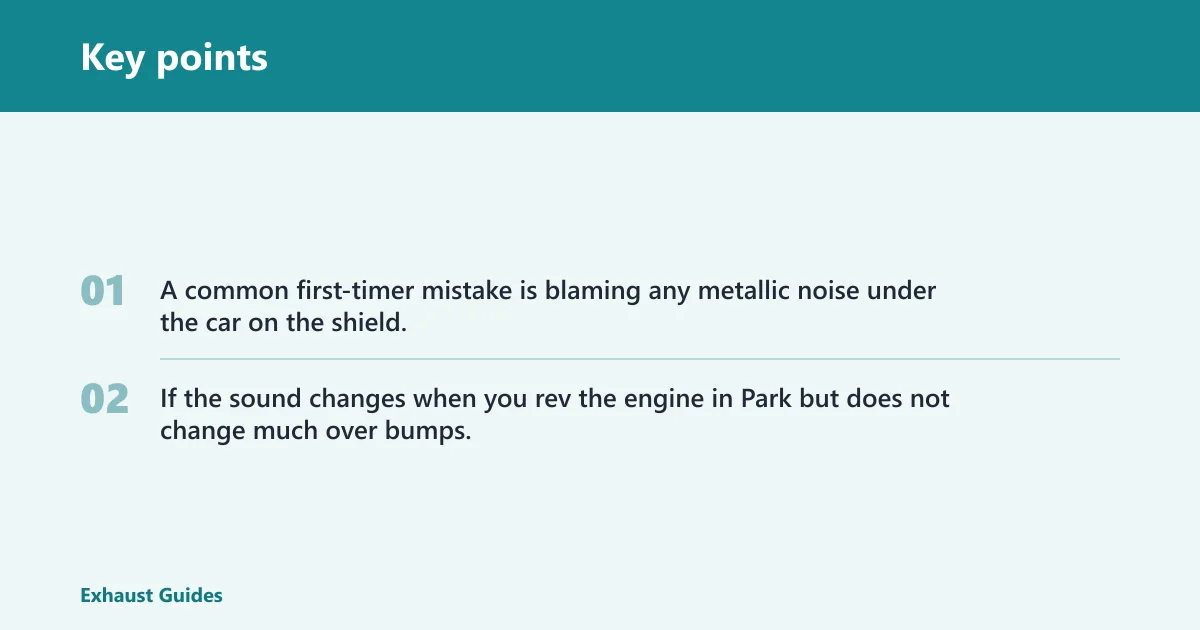
A common first-timer mistake is blaming any metallic noise under the car on the shield. If the sound changes when you rev the engine in Park but does not change much over bumps, the exhaust pipe or a hanger deserves a look first.
Why is the shield rattling?
Yes, a bad heat shield can cause rattling noise, and it is often the first clue. The sound usually comes from loose fasteners, cracked spot welds, bent edges, or a shield that only touches the exhaust or body when vibration starts.
Idle rattle versus bumps
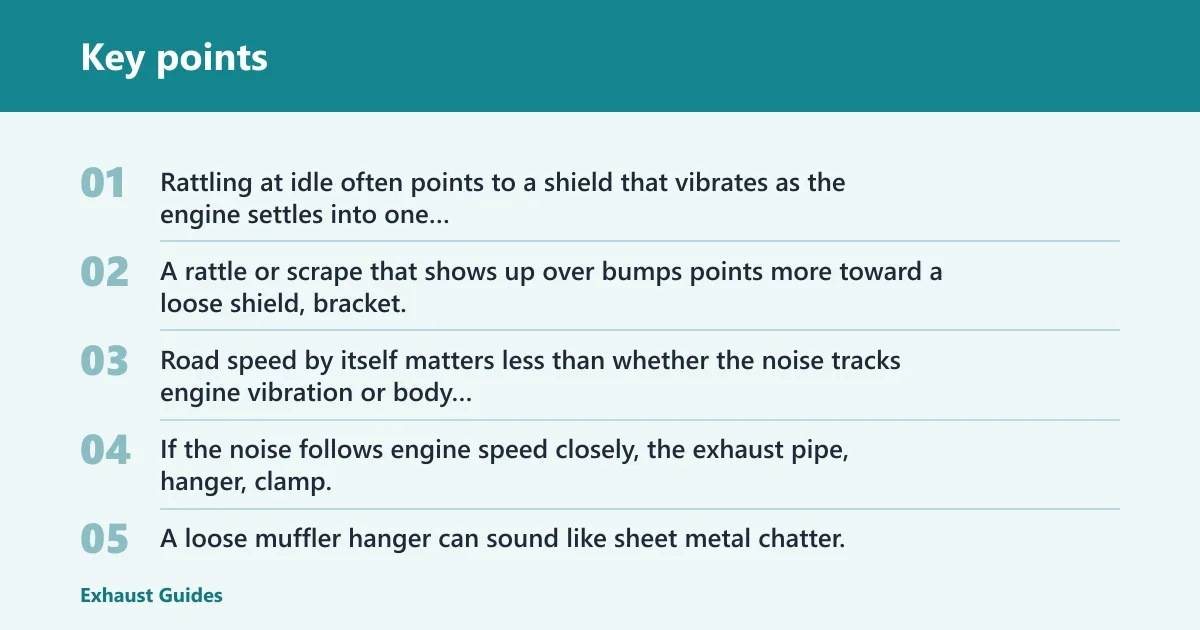
Rattling at idle often points to a shield that vibrates as the engine settles into one speed. A rattle or scrape that shows up over bumps points more toward a loose shield, bracket, or hanger that shifts when the body flexes. Road speed by itself matters less than whether the noise tracks engine vibration or body movement.
When the noise is probably not the shield
If the noise follows engine speed closely, the exhaust pipe, hanger, clamp, or bracket may be the more likely source before the shield. A loose muffler hanger can sound like sheet metal chatter. A pipe that has moved out of position can tap the floor or another bracket and mimic a shield rattle.
What does a failing heat shield look like?
A failing shield usually looks bent, rusted, loose, or partly detached. Look for rust holes, cracked edges, missing fasteners, broken spot welds, and brackets that no longer sit tight against the exhaust or body. If the metal is warped or hanging unevenly, the shield has likely shifted out of place.
Rust and broken attachment points
Surface rust alone does not always mean failure. Rust at a fastener hole, weld point, or folded edge is more serious because those are the spots that hold the shield in position. Missing screws, loose clamps, or separated tabs are strong signs that the shield is no longer secure.
Warped metal and contact marks
Shiny rub marks, flattened corners, or dark scrape lines show that the shield has been touching something it should clear. That can be the exhaust pipe, the body, or a nearby bracket. Contact marks matter because they often explain both the noise and the heat path.
Say your car develops a metallic chatter only when pulling into a driveway ramp. If the shield near the catalytic converter has a bent lower edge and a missing fastener, the problem is probably the shield shifting against the exhaust rather than the muffler itself.
Is the heat problem serious?
It can be. A heat shield is there to control heat around the catalytic converter and muffler, protect the cabin floor, and keep nearby parts from overheating. If shielding is missing or failing, the heat load on wiring, hoses, plastics, and rubber can rise enough to cause damage over time.
Where heat matters most
The catalytic converter is often considered the highest-risk area. It can radiate enough heat to ignite dry grass if unshielded, which is why missing lower shielding deserves attention. Muffler-area shields matter too, especially for cabin comfort and underbody heat that can travel up into the floorboard.
What heat clues to watch
Abnormally high underhood temperature is a sign the shield needs attention. A hot floorboard, a burning smell from the engine area, or unusually warm trim near the tunnel all point toward a heat-management problem. Those clues do not prove the shield is bad on their own, but they raise the urgency.
Suppose the floor on the passenger side becomes noticeably hot after about a 20-minute drive and a burnt smell shows up near the firewall. That combination is worth a closer inspection because it can mean missing shielding, a displaced exhaust part, or heat soaking a nearby hose or wiring run.
How to inspect the shield safely
Check from a cool vehicle on level ground. Look first at the catalytic converter area, then the muffler area, then any shield that sits close to wiring, hoses, or plastic trim. Your goal is to find looseness, damage, or contact points before anything comes apart on its own.
What to look at first
- Check for missing fasteners, bolts, clamps, or clips.
- Look for rust holes, cracked edges, and broken spot welds.
- Press lightly on the shield if access allows; it should not flop or clatter.
- Look for bent sections that touch the pipe, body, or bracket.
- Check for nearby heat damage on wiring, hoses, plastics, and insulation.
- Compare the shield’s position on both sides if there is a paired panel.
How to tell it is the shield and not something else
A shield problem usually shows as thin metal chatter, a loose edge, or a panel that moves with a light tap. A hanger problem usually leaves the exhaust hanging low or knocking against another part. A bracket or pipe issue often leaves clear misalignment, cracked rubber hangers, or a pipe that no longer sits centered in its path.
Repairable looseness versus replace-now damage
Loose mounting hardware can sometimes be corrected with welding, hose clamps, or screws if the shield metal itself is still sound. But if the shield is torn, badly corroded, missing a large section, or separated at more than one attachment point, replacement is often the safer choice. Do not remove the shield unless you are replacing damaged parts.
Can you drive with a loose shield?
Sometimes, but only as a short-term option and only if the shield is still attached well enough that it is not dropping, scraping hard, or heating nearby parts. A loose shield is not an automatic tow, but it should not be ignored if the smell, heat, or noise is getting worse.
When a short drive is usually acceptable
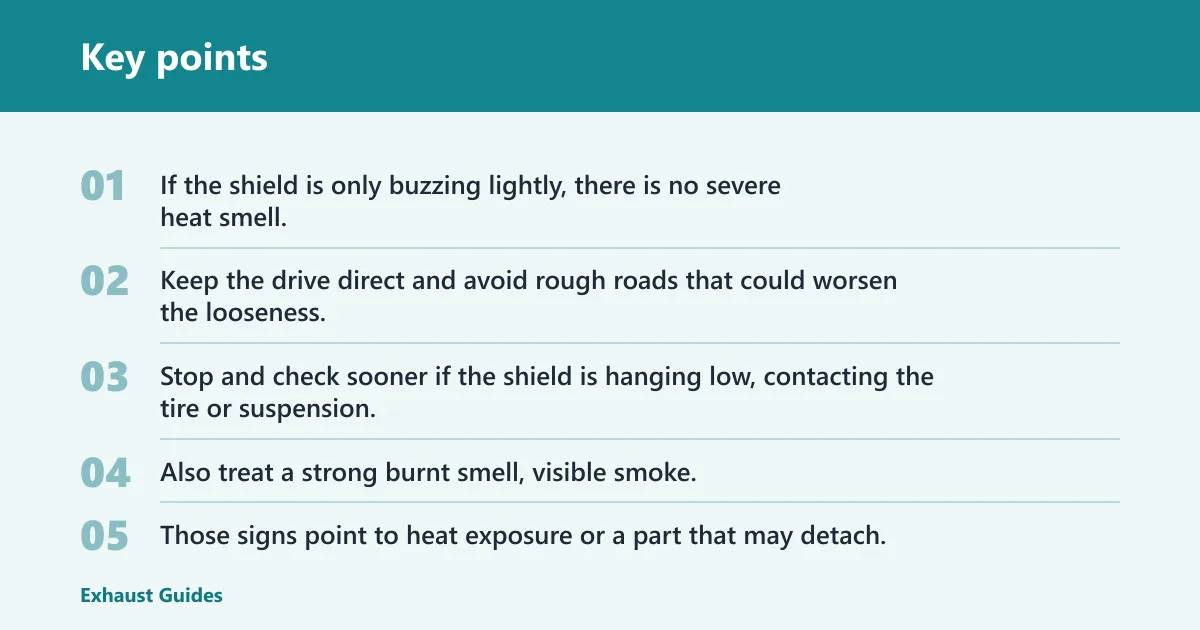
If the shield is only buzzing lightly, there is no severe heat smell, and nothing is touching the exhaust, a short trip to a repair shop is often reasonable. Keep the drive direct and avoid rough roads that could worsen the looseness.
When to stop driving and get it checked
Stop and check sooner if the shield is hanging low, contacting the tire or suspension, or if the floorboard heat is rising fast. Also treat a strong burnt smell, visible smoke, or a shield that has fallen partly free as urgent. Those signs point to heat exposure or a part that may detach.
Cost and repair choice
For a simple re-secure, a repair around 150 to 300 dollars is a realistic frame to keep in mind, depending on access and hardware. If neglect has already damaged nearby parts, repair can become far more expensive, and the article’s warning is that engine replacement can cost as much as 5000 dollars in a worst-case chain of damage.
A common first-timer mistake is buying a clamp kit before checking the attachment point. If the bracket is torn away or the shield has rusted through, a clamp will not solve the real problem. In that case, replacement is usually the better route.
Frequently asked questions
How do I tell if a heat shield is bad?
Look for rattling or scraping, rust holes, cracked edges, missing fasteners, or a shield that hangs loose near the catalytic converter or muffler. If the noise changes more with bumps than with engine speed, or if the floorboard feels hotter than usual, the shield deserves a closer look.
What does a heat shield look like when it’s failing?
It often looks bent, corroded, or partly detached. The most useful clues are broken spot welds, missing bolts or clips, warped metal, and shiny rub marks where the shield has been touching the exhaust or body. A shield that sits crooked is another common sign.
Can a bad heat shield cause rattling noise?
Yes. Rattling or scraping noises are one of the clearest warning signs. The sound usually comes from a loose edge, a failed fastener, or a broken attachment point. If the rattle follows engine speed closely, though, the exhaust pipe or hanger may be the actual source.
What are the signs a heat shield needs replacement?
Replacement makes sense when the shield has rust holes, cracked metal, multiple broken attachment points, or damage that keeps it from being re-secured. If it has already shifted into contact with other parts, or if there is heat damage to nearby wiring or hoses, replacement is usually safer than another patch.
How hot does a heat shield get when it’s failing?
The shield itself gets hot because it sits around hot exhaust parts, especially the catalytic converter and muffler. When it fails, the problem is not a single temperature number but the heat passing where it should not. That can raise underhood temperature and make the floorboard noticeably warm.
Can I drive with a loose heat shield?
Often yes, for a short trip to a shop, if it is only lightly rattling and not contacting the tire, suspension, or exhaust in a dangerous way. Do not keep driving if the shield is hanging low, the burnt smell is strong, or the heat near the cabin is getting worse.
Will a missing heat shield cause damage or fire risk?
It can. A missing shield can let exhaust heat reach wiring, hoses, plastics, rubber, or the floorboard, and the lower shield area helps protect dry grass and leaves under the vehicle. The risk is not the same in every case, but a missing shield should not be treated as harmless.
How do I check if the heat shield is loose or damaged?
Inspect the catalytic converter and muffler areas for missing fasteners, rusted edges, cracked welds, bent metal, and signs of contact. Press lightly on the shield if you can reach it safely. If it moves, chatters, or has obvious gaps around its mounts, it is likely loose or damaged.
When a heat shield is needed
A heat shield is needed anywhere hot exhaust parts sit close to the body, floor, wiring, hoses, or dry debris. That includes the catalytic converter and muffler area on many vehicles. If you can see heat-related wear nearby, the shield is doing real work and should not be removed casually.