
Does Removing Exhaust Baffles Affect Performance?
Many folks getting into modifying their vehicles wonder: Does Removing Exhaust Baffles Affect Performance? It’s a common question, and it can seem a bit tricky at first. You hear all sorts of things, and it’s hard to know what’s true. But don’t worry, figuring this out is simpler than you might think.

amavoler
amavoler Motorcycle Exhaust Silencer Motorbike Muffler Insert…
- Universal muffler removable silencer for motorcycles.
- Effectively reduce noise .Good addition to your bike.
- The products are made of stainless steel, durable and corrosion resistant.
As an Amazon Associate I earn from qualifying purchases.
We’ll walk through it step by step. Let’s get right to the point and see what happens when you change your exhaust baffles.
Understanding Exhaust Baffles And Performance
This section explores what exhaust baffles are and how they relate to your vehicle’s engine performance. We’ll break down the basic mechanics of an exhaust system and the specific role baffles play in it. By understanding these fundamentals, you’ll be better equipped to grasp the effects of their removal or modification.
This knowledge forms the foundation for answering the core question of whether removing exhaust baffles impacts performance. We aim to make the technical aspects easy to grasp for anyone new to car modifications.
What Are Exhaust Baffles?
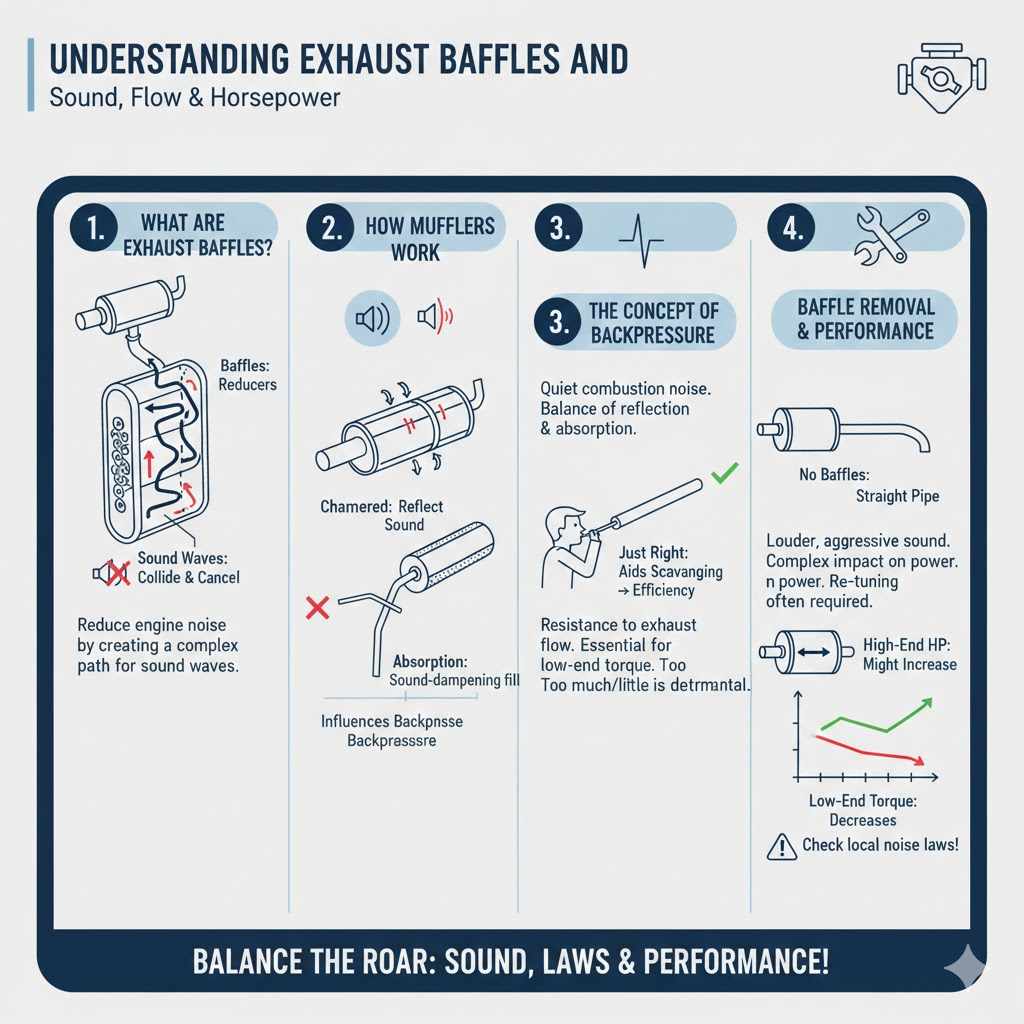
Exhaust baffles are internal components found within a muffler. Their primary function is to reduce the noise produced by the engine. They achieve this by redirecting exhaust gases through a series of chambers, tubes, and perforated plates.
This design creates a labyrinth for the sound waves, causing them to collide and cancel each other out, thereby quieting the exhaust note. Think of them as the sound absorbers in your muffler.
Without baffles, the exhaust gases would flow more directly, leading to a much louder and often harsher sound. The shape and arrangement of baffles are carefully engineered by manufacturers to meet specific noise regulations and desired sound profiles. This is why different vehicles have distinct exhaust sounds.
The internal structure of the muffler is key to this.
The design of baffles can vary significantly. Some mufflers use simple chamber designs, while others employ more complex perforated tube designs. Regardless of the specific layout, their purpose remains the same: noise reduction.
This directly influences the backpressure in the exhaust system.
How Mufflers Work
Mufflers are a vital part of a vehicle’s exhaust system. Their main job is to significantly decrease the loud noise produced by the engine’s combustion process. When fuel burns in the engine’s cylinders, it creates high-pressure exhaust gases.
These gases are then expelled at high speed, which generates a lot of sound. The muffler’s job is to quiet this down before it exits the tailpipe.
Inside a muffler, there are several chambers and passages. These are designed to reflect and absorb sound waves. One common method involves using baffles.
These baffles are essentially plates or tubes that force the exhaust gases to take a longer, more circuitous route. As the gases bounce around, the sound waves collide with each other and the muffler walls, dissipating their energy and reducing the overall volume.
Another technique is called “absorption muffling.” This uses sound-absorbing materials, like fiberglass or steel wool, packed around perforated tubes. As exhaust gases pass through these tubes, sound waves are absorbed by the packing material. This is very effective at muffling higher-frequency sounds.
The combination of these techniques can drastically reduce the noise.
The design of the muffler also affects the exhaust system’s backpressure. Backpressure is the resistance to flow that the exhaust gases encounter as they move through the exhaust system. A more restrictive muffler, often one with many baffles, will create higher backpressure.
A less restrictive muffler will create lower backpressure.
The Concept Of Backpressure
Backpressure is a term you’ll often hear when discussing exhaust systems. It refers to the resistance that exhaust gases face as they exit the engine. Imagine trying to blow air through a narrow straw versus a wide pipe; the narrow straw creates more resistance.
Similarly, a complex exhaust system with many restrictions creates higher backpressure.
This resistance is not always a bad thing. In fact, some level of backpressure is necessary for optimal engine performance, especially in naturally aspirated engines. It helps to scavenge exhaust gases from the cylinders, pulling in the fresh air-fuel mixture more efficiently for the next combustion cycle.
Think of it like a gentle vacuum cleaner effect.
However, too much backpressure can be detrimental. It forces the engine to work harder to push out the exhaust gases. This can lead to reduced power, decreased fuel efficiency, and increased engine temperatures.
Forcing gases out becomes a struggle. On the other hand, too little backpressure, which can happen with a wide-open exhaust, might result in a loss of low-end torque because the scavenging effect is too weak.
The design of exhaust components, including mufflers and their baffles, directly influences backpressure. Mufflers with many baffles and small passages create higher backpressure. Straight-through mufflers or systems with removed baffles create lower backpressure.
Finding the right balance is key to tuning an engine’s performance.
Does Removing Exhaust Baffles Affect Performance?
This is the central question, and the answer is nuanced. We’ll explore how changing exhaust baffles can influence your vehicle’s power and responsiveness. This section delves into the direct impacts on engine output, looking at both potential gains and drawbacks.
We’ll consider the relationship between baffles, backpressure, and how this translates to what you feel when you drive. Get ready to see how this modification can change your car’s behavior.
Impact On Horsepower And Torque
When you remove or alter exhaust baffles, you are directly affecting the exhaust system’s ability to flow gases. By reducing the restrictions within the muffler, you lower the backpressure. This can allow the engine to expel exhaust gases more freely and quickly.
In some cases, especially on engines that are already designed for higher flow or have other performance modifications, a reduction in backpressure can lead to a modest increase in horsepower and torque. This is often more noticeable at higher engine speeds, where the engine is trying to push out a larger volume of exhaust gases rapidly. The engine can “breathe” better.
However, it’s not a universal gain. For many stock, naturally aspirated engines, removing baffles might not result in a significant horsepower increase and could even lead to a decrease in low-end torque. This happens because the reduced backpressure weakens the scavenging effect that helps pull exhaust out and draw in the new air-fuel mixture at lower RPMs.
It’s a delicate balance.
The type of engine and its existing exhaust setup play a huge role. A performance-tuned engine might benefit from reduced backpressure, while a commuter car engine might not see any advantage and could even suffer. It’s about optimizing the system for its intended purpose.
Case Study A Modified Sports Car
Consider a tuner who modified a popular sports car. The stock exhaust system on this car featured a restrictive muffler with multiple baffles. The goal was to improve track performance.
After carefully removing the baffles and replacing them with a perforated straight-through design within the muffler housing, the car was put on a dynamometer.
The results showed an increase of 7 horsepower and 5 lb-ft of torque, primarily in the upper RPM range (from 4,500 RPM upwards). This gain was attributed to the significantly reduced backpressure, allowing the engine to exhale more efficiently at high speeds. The exhaust note also became much more aggressive, which was a desired outcome for the owner.
This case highlights that performance gains are possible, but they often depend on the engine’s inherent characteristics and the extent of other modifications. It wasn’t a massive jump, but it was measurable and felt by the driver. The increased noise was also a significant factor in the perceived performance.
Effects On Fuel Economy
The relationship between removing exhaust baffles and fuel economy is also not straightforward. On one hand, a more efficient exhaust system that allows the engine to breathe easier could theoretically lead to better fuel economy because the engine is working less hard. This is particularly true if the engine management system can adapt to the reduced backpressure.
However, often the desire to remove baffles is linked to achieving a louder, more aggressive exhaust sound. This often encourages drivers to accelerate more forcefully and rev the engine higher, which naturally consumes more fuel. So, while the potential for improved economy exists, the driver’s behavior frequently negates it.
Furthermore, if removing baffles leads to a loss of low-end torque, the driver might need to press the accelerator pedal harder at lower speeds to achieve the same level of acceleration. This increased throttle input directly translates to burning more fuel. It’s a cycle that can easily lead to worse rather than better mileage.
In many practical scenarios, drivers report no significant improvement or even a slight decrease in fuel economy after removing exhaust baffles, especially if the primary motivation was sound. The engine’s computer often tries to compensate for the changes. Sometimes, without proper tuning, this compensation isn’t ideal for fuel efficiency.
Changes In Exhaust Sound
This is arguably the most noticeable and immediate effect of removing or altering exhaust baffles. Baffles are designed to dampen sound, so their removal will almost always result in a louder exhaust note. The character of the sound also changes significantly.
Instead of the muffled, restrained tone produced by a baffled muffler, you’ll likely hear a more raw, aggressive, and resonant sound. The specific tone depends on the engine’s displacement, its firing order, and the remaining exhaust system components. A V8 engine will sound very different from a 4-cylinder engine with the same baffle modification.
Many enthusiasts pursue baffle removal or modification precisely for this audible enhancement. They want their vehicle to sound as powerful as they believe it is or want it to be. However, it’s important to consider local noise ordinances and the potential for drone.
Drone is a persistent, irritating humming sound that can occur at certain RPMs after baffle removal, which can become quite bothersome on longer drives.
The absence of baffles means the exhaust gases are exiting with less obstruction. This allows more of the engine’s natural, louder combustion pulses to escape into the atmosphere. It’s a more direct path for the sound energy.
Scenario 1 A Quiet Commuter Car
Imagine a typical compact sedan driven by someone who primarily uses it for daily commuting. The car is designed for quiet operation and fuel efficiency. The owner decides to remove the internal baffles from the muffler, hoping for a sportier sound and perhaps a slight performance boost.
Upon starting the engine, the sound is significantly louder, with a deeper rumble. During acceleration, the exhaust note is much more pronounced. However, at steady highway speeds, a noticeable drone sets in, making conversation difficult and the ride less comfortable.
The car might feel slightly more responsive in the initial acceleration from a stop, but this is often attributed to the louder sound creating a perception of speed.
Fuel economy might see a slight dip because the driver enjoys the new sound and tends to accelerate more enthusiastically. The car’s computer doesn’t have specific tuning for this exhaust change, so it continues its standard fuel mapping, which may not be optimal for the altered exhaust flow. The primary change felt is the noise level.
Potential Engine Stress And Longevity
While removing baffles can offer perceived performance benefits and a desirable sound, it’s crucial to consider potential long-term effects on the engine and exhaust system. The primary concern is how drastically altering backpressure can impact engine components.
If backpressure is reduced too much, especially without other supporting modifications, it can lead to a leaner fuel-air mixture at certain RPM ranges. This can cause the engine to run hotter, potentially leading to premature wear on components like pistons, valves, and valve seats. Overheating is a silent killer of engine health.
Additionally, exhaust components like catalytic converters and oxygen sensors are designed to work within specific temperature and flow parameters. Significant changes in exhaust flow and temperature due to baffle removal could, in some cases, affect their efficiency or even shorten their lifespan. The catalytic converter, in particular, relies on a certain exhaust gas temperature to function effectively.
It is also worth noting that some exhaust systems are designed with specific backpressure in mind to optimize the performance of other components, such as turbochargers. Removing baffles in such a setup could negatively impact the turbo’s efficiency and spool time. The whole system needs to work in harmony.
Legal And Environmental Considerations
Modifying an exhaust system, including removing baffles, can have legal ramifications. Many regions have strict laws regarding vehicle noise levels. A significantly louder exhaust system can exceed these legal limits, leading to fines or requiring you to revert the modification.
It is always wise to check your local regulations before making such changes.
Furthermore, exhaust systems play a role in emissions control. While removing baffles doesn’t directly alter the catalytic converter’s function, significant changes in exhaust flow can indirectly affect its efficiency. This could potentially lead to increased emissions, though this is less common than noise issues.
A check engine light might come on if emissions sensors detect a problem.
It’s also important to consider the environmental impact. Louder vehicles contribute to noise pollution, which can affect communities and wildlife. While individual modifications might seem minor, widespread such changes can have a cumulative effect on the soundscape of an area.
This is a broader societal concern.
Statistics On Exhaust Noise Regulations
According to a study by the National Highway Traffic Safety Administration (NHTSA), excessive exhaust noise from vehicles is a significant contributor to urban noise pollution. While specific regulations vary by state and municipality, many have noise limits for vehicles, typically ranging from 80 to 95 decibels (dB) at a certain distance from the vehicle.
A survey conducted by the Environmental Protection Agency (EPA) indicated that modifications intended to increase vehicle sound, such as baffle removal, are frequently cited as reasons for traffic stops related to noise violations. For instance, in California, vehicle exhaust systems must comply with the California Vehicle Code, which prohibits modifications that increase noise above a specified level.
One report from the International Noise Conciliation Association noted that in some European countries, exhaust noise limits are even stricter, with specific tests conducted at various engine speeds to ensure compliance. This demonstrates a global trend toward regulating vehicle noise more closely.
Factors Influencing The Outcome
The effect of removing exhaust baffles isn’t a one-size-fits-all scenario. Several factors come into play that determine whether you’ll see a performance gain, a sound change, or something else entirely. We’ll explore these variables to help you understand why your results might differ.
Knowing these factors can help you make more informed decisions about your exhaust system.
Engine Type And Size
The type and size of your vehicle’s engine are primary determinants of how removing baffles will affect performance. Larger engines, such as V8s or V6s, naturally produce more exhaust gas volume and often have more potential to benefit from reduced backpressure. Their larger displacement means they are moving more air and fuel, thus generating more exhaust.
Smaller engines, like those found in economy cars or motorcycles with 4-cylinder or smaller configurations, typically have less exhaust volume. These engines often rely on a specific level of backpressure to function efficiently, particularly at lower RPMs. Removing baffles from these engines may not yield noticeable performance gains and could even cause a loss of low-end torque, making the vehicle feel sluggish from a standstill.
Performance-oriented engines, especially those designed with turbochargers or superchargers, have different exhaust flow requirements. Turbocharged engines, for instance, can sometimes benefit from lower backpressure to allow the turbocharger to spool up faster. However, this needs to be balanced, as excessive flow can sometimes hinder the turbo’s efficiency.
Other Exhaust System Modifications
Removing baffles is rarely done in isolation. Often, it’s part of a larger plan to modify the entire exhaust system. The effect of baffle removal depends heavily on what other changes have been made.
For example, if you’ve installed a performance manifold, high-flow catalytic converter, and a larger diameter piping, removing baffles will contribute to a freer-flowing system.
If you have a stock exhaust system and only remove the baffles, the impact might be less significant or even negative in some aspects. The rest of the system might not be designed to handle the increased flow. Conversely, if you remove baffles from a system that already has a very open design, you might find the sound becomes excessively loud or develops unpleasant drone.
Think of your exhaust system as a chain. Each link contributes to the overall flow. Removing one link (baffles) has a different effect depending on the strength and design of all the other links.
A performance exhaust system is engineered as a complete package.
Comparison Table Exhaust System Components And Their Impact
| Component | Typical Effect On Backpressure | Potential Performance Impact | Sound Impact |
|---|---|---|---|
| Stock Manifold | Moderate | Standard | Quieter |
| Performance Headers | Low | Increased HP/Torque (esp. at high RPM) | Louder, More Aggressive |
| Stock Catalytic Converter | Moderate to High | Standard (can be restrictive) | Moderate |
| High-Flow Catalytic Converter | Low to Moderate | Slight HP/Torque Increase | Slightly Louder |
| Stock Muffler (with baffles) | High | Can restrict performance | Quieter |
| Muffler Delete (No Muffler) | Very Low | Potential HP/Torque Gain, but risk of low-end loss | Very Loud, Raspy |
| Straight-Through Muffler (no baffles) | Low | Moderate HP/Torque Gain | Louder, Deeper Tone |
Vehicle Weight And Aerodynamics
While not directly related to the exhaust system itself, the vehicle’s weight and aerodynamic properties can influence how performance gains from exhaust modifications are perceived. A lighter vehicle will feel more responsive to even small increases in horsepower. The power-to-weight ratio is key here.
Similarly, a vehicle with good aerodynamics will benefit more from increased power because it can maintain higher speeds more efficiently. Aerodynamics helps reduce drag, allowing the engine’s power to translate more directly into speed. Poor aerodynamics can counteract some of the benefits of an improved exhaust.
Imagine pushing a lightweight kart versus a large, heavy truck. The same amount of extra force will have a much more noticeable impact on the kart. Therefore, the overall platform of the vehicle plays a role in whether exhaust modifications feel significant.
This is often overlooked when focusing solely on engine parts.
How To Modify Exhaust Baffles Safely
If you’re considering changing your exhaust baffles, doing it the right way is essential for both safety and effectiveness. This section will guide you through the process, covering what you need to know before, during, and after the modification. We aim to provide practical advice to ensure you achieve the desired results without unintended consequences.
This is where you learn how to proceed with confidence.
DIY Vs. Professional Installation
The decision to tackle exhaust modifications yourself or hire a professional depends on your skill level, tools, and comfort with the task. Removing baffles typically involves cutting into the muffler, removing the internal components, and then welding it back together or replacing it with a straight pipe section. This requires welding skills, metal cutting tools, and safety equipment.
If you’re not experienced with welding and metal fabrication, attempting this as a DIY project can be risky. Mistakes can lead to leaks, poor performance, or an unsafe exhaust system. Hiring a reputable exhaust shop or a mechanic experienced with custom exhaust work is often the safer and more effective route.
They have the specialized tools and expertise to ensure the job is done correctly.
A professional can also advise on the best approach for your specific vehicle and desired outcome, ensuring compliance with local regulations. They can offer solutions like performance mufflers that achieve a similar sound without compromising integrity or legality. The cost of professional installation is often offset by the peace of mind and quality of the work.
Tools And Materials Needed
For a DIY baffle removal, you’ll typically need a set of metal cutting tools, such as an angle grinder with a cutting disc or a reciprocating saw. You’ll also need a welder (MIG, TIG, or stick) and appropriate welding rods or wire, along with welding safety gear (helmet, gloves, fire extinguisher). Safety glasses are crucial for any cutting operation.
You might also need measuring tools, a metal file to smooth edges, and potentially replacement exhaust clamps or bolts if you’re reassembling sections. Some people choose to use exhaust packing material if they’re creating a straight-through muffler design to help manage sound a bit more. Proper ventilation is also extremely important when welding.
If you’re not welding, you might opt for a muffler delete pipe, which is a pre-fabricated pipe that replaces the muffler entirely. This requires tools for unbolting the old muffler and bolting on the new pipe, often including wrenches and socket sets. Exhaust sealant can also be useful to ensure a gas-tight fit.
Sample Scenario 2 Replacing A Muffler With A Straight Pipe
A car owner decides to remove the restrictive baffles by completely replacing the muffler with a straight pipe section.
- The owner purchases a universal muffler delete pipe designed for their vehicle model.
- Using a socket set and a penetrating oil to loosen stubborn bolts, they unbolt the stock muffler from the rest of the exhaust system.
- They then bolt the new straight pipe into place, ensuring a snug fit.
- Exhaust sealant is applied around the connections to prevent any leaks.
- The engine is started to test the sound and check for leaks. The sound is dramatically louder and the exhaust note is much more raw.
Testing And Tuning After Modification
After any exhaust modification, it’s essential to test and, if necessary, tune the system. The first step is a visual inspection for any leaks. Start the engine and listen for any hissing or puffing sounds that aren’t part of the normal exhaust flow.
Use a soap and water mixture to check joints; bubbles will indicate leaks.
Next, listen to the sound at idle, during acceleration, and at cruising speeds. Check for any excessive drone. If the sound is too loud or has an undesirable drone, you might need to consider adding a resonator or a different type of muffler.
Performance gains can be evaluated by how the vehicle feels to drive and, for more precise measurement, by using a dynamometer.
If you’ve removed a significant amount of backpressure, especially on a modern fuel-injected vehicle, it might be beneficial to have the engine’s computer recalibrated (tuned). This ensures the fuel and ignition maps are optimized for the new exhaust flow, maximizing performance and preventing potential issues like running too lean. A custom tune can truly unlock the potential of the modification.

Frequently Asked Questions
Question: Will removing exhaust baffles make my car faster?
Answer: It might, but usually only slightly, and it depends on your car. For some performance-tuned engines, reducing backpressure can allow them to breathe better and gain a bit of horsepower, especially at higher speeds. However, for many regular cars, the effect is minimal or even negative, particularly for low-end power.
Question: Is removing exhaust baffles legal?
Answer: It depends on where you live. Many places have strict laws about vehicle noise levels, and removing baffles usually makes an exhaust much louder. You could face fines or be required to fix it if your car is too loud for local ordinances.
Question: What does “drone” mean in an exhaust system?
Answer: Drone refers to a persistent, irritating humming sound that can occur in the cabin of a vehicle at certain steady engine speeds after modifying the exhaust. It’s caused by resonance within the exhaust system and can make long drives uncomfortable.
Question: Can removing baffles hurt my engine?
Answer: In some cases, yes. If backpressure is reduced too much, the engine might run hotter or leaner, potentially causing increased wear over time. It’s important to ensure the engine is still running with an appropriate fuel-air mixture and temperature.
Question: What’s the easiest way to get a louder exhaust sound?
Answer: One common way is to remove the internal baffles from the muffler. Another option is to
Conclusion
So, Does Removing Exhaust Baffles Affect Performance? Yes, it can. It often makes your exhaust much louder and can sometimes increase horsepower, especially at higher engine speeds. However, it can also lead to less low-end power, fuel economy changes, and potentially engine stress if not done carefully.
Always consider your car, local laws, and the overall system before making modifications.
Related pick: Check today's price on Amazon