
How to Diagnose Exhaust Smell Inside the Cabin
If exhaust smell changes with the HVAC on, check the cowl, blower intake, or rear hatch and body openings; if it appears mainly under acceleration, inspect the exhaust system first. Ignoring it can expose you to carbon monoxide, and a small leak can become a costly repair. This guide shows how to trace the odor by driving condition, airflow path, and leak location.
Is it safe to keep driving?


No, if the smell is strong or any carbon-monoxide symptom appears. Carbon monoxide is colorless and odorless, so headache, dizziness, weakness, upset stomach, vomiting, chest pain, or confusion matter more than smell alone. Stop driving, get fresh air, and do not keep testing the problem on the road. (NASA)
Red flags that mean stop now
A strong exhaust smell inside the vehicle may mean carbon monoxide is entering the cabin. If that happens while sitting with the windows up, take it seriously. Pull over in fresh air, get out of the vehicle, and get help before driving again.
Do not treat a faint odor as harmless if it repeats in the same conditions. A small leak can worsen, and a rear-opening seal, body plug, or tailpipe issue can pull fumes into the cabin even when the exhaust note sounds nearly normal.
When a faint smell still needs immediate attention
Even a light smell deserves prompt diagnosis if it appears at idle, at stoplights, or with the HVAC on. Those patterns often point to a leak or an entry path that changes with pressure and airflow. Confirm the source before more driving spreads the fumes.
- Headache, dizziness, weakness, upset stomach, vomiting, chest pain, or confusion
- Strong odor with windows up
- Odor that appears in stop-and-go traffic or at idle
- Changed exhaust tone, hissing, ticking, or puffing
How the smell behaves
Odor pattern matters because it helps sort exhaust leak from look-alikes. Raw exhaust smell usually points to an exhaust leak or a cabin entry path, while a rotten-egg smell usually points to a catalytic converter problem. Timing then tells you where to inspect first.
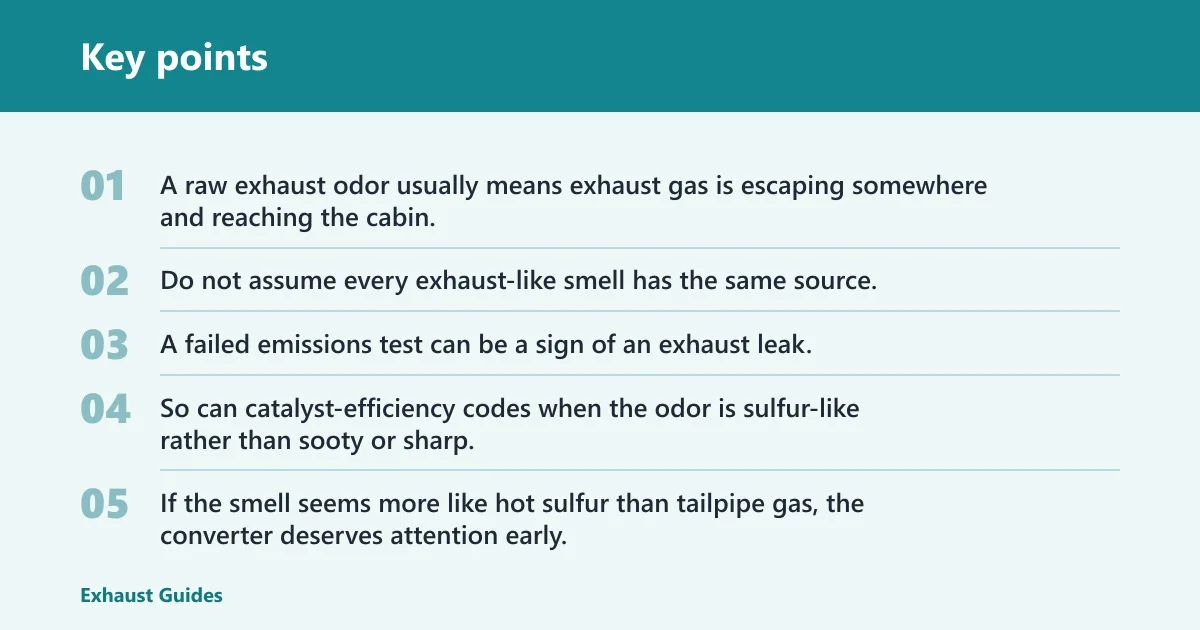
Raw exhaust versus sulfur smell
A raw exhaust odor usually means exhaust gas is escaping somewhere and reaching the cabin. A sulfur or rotten-egg odor is different, and it can come from a catalytic converter problem or, less often, another exhaust issue. Do not assume every exhaust-like smell has the same source.
A failed emissions test can be a sign of an exhaust leak. So can catalyst-efficiency codes when the odor is sulfur-like rather than sooty or sharp. If the smell seems more like hot sulfur than tailpipe gas, the converter deserves attention early.
Idle, acceleration, and stoplight clues
If the smell gets worse at idle or stoplights, look for a leak that opens when engine vacuum, heat, or movement changes. If it shows up under acceleration, inspect underhood joints, clamps, and pipes first. If it appears mainly after highway driving, the rear of the car and cabin entry points move up the list.
Picture a sedan that smells faintly at every red light but not at cruising speed. That pattern fits an entry path that worsens when the car is stationary and exhaust can linger around the body or be drawn into the cabin air path.
Rear-cabin versus engine-bay clues
Smell near the rear area can point to rear sealing, body openings, or exhaust drawn toward the back. Smell near the front with the hood area or blower intake in play points more toward the engine bay, cowl, or underhood leak path. The location of the odor matters as much as the odor itself.
Suppose the smell is strongest beside the rear seat with the windows closed. That makes rear hatch seals, rear glass seals, missing body plugs, or a rear-exit exhaust issue more likely than a manifold leak, although both still remain possible until checked.
Cabin smell triage table
| Smell location | Driving condition | Likely source zone | Safest first check | Stop driving now? | Confidence | Red-flag symptoms |
|---|---|---|---|---|---|---|
| Front of cabin, near dashboard | Idle or stoplight | Manifold, gasket, flange, cowl, blower intake | Look for ticking, soot, loose joints, HVAC change with fresh air versus recirculate | Yes if strong smell or symptoms | Medium | Headache, dizziness, hissing or ticking |
| Rear seat or cargo area | After driving, especially windows up | Rear hatch seal, rear glass seal, body plugs, tailpipe exit | Check rear openings, visible gaps, dust trails, water marks, tailpipe alignment | Yes if strong smell or symptoms | High | Confusion, weakness, smell strongest at rear |
| All around cabin | Idle, acceleration, and cruise | Major exhaust leak or multiple entry paths | Inspect exhaust system from manifold to tailpipe and check body seals | Yes if symptoms appear | High | Chest pain, vomiting, strong odor with windows up |
| Sweet or sulfur-like odor | After hard acceleration or under load | Catalytic converter | Scan for P0420 or P0430 and inspect converter heat, noise, and mounting | Depends on symptoms; stop if strong or dizzy | Medium | Rattle, overheating, failed emissions test |
| Odor changes with HVAC settings | Fresh air versus recirculate | Cowl, blower intake, cabin filter area, rear openings | Compare both settings with the vehicle parked and windows closed | Yes if smell is strong or symptoms appear | Medium | Odor tracks airflow changes, headache or dizziness |
Check the cabin air path
The cabin air path can pull fumes in from the front or rear of the vehicle. Fresh air versus recirculate changes the route, but recirculate is not a universal fix if the cabin is already contaminated. Use the HVAC setting as a clue, not a cure.
Fresh air and recirculate as diagnostic clues
Compare both HVAC settings with the windows closed. If the smell changes sharply, the cowl, blower intake, or another outside-air path may be feeding fumes in. If the smell stays about the same, rear openings or a direct cabin entry point become more likely.
Do not assume outside-air mode will help. If exhaust is entering through the cowl or engine-bay intake, fresh air can bring more of it in. Use the setting change to identify the path, then stop and inspect that zone.
Rear hatch, rear glass, and body seals
Toyota warns that an open or unsealed rear opening can let exhaust gases into the vehicle. That means rear hatch seals, rear glass seals, and missing body plugs matter even when the exhaust system itself looks normal. Dust trails, water marks, and visible gaps are useful clues.
- Inspect rear seals. Look along the hatch or back door seal, rear glass edge, and any large body opening. Check for flattened rubber, torn sections, or places where the seal no longer contacts the body evenly.
- Check body plugs. Find missing plugs, loose grommets, or open holes in the cargo floor, spare-tire well, and rear body panels. These openings can let exhaust or underbody air move into the cabin.
- Look for contamination clues. Dust trails, water marks, and soot around the rear opening often show where air has been moving. That tells you where to focus before you move under the car.
HVAC intake, cabin filter, and air leak paths
An HVAC issue can mimic exhaust odor if the cabin filter is loaded, the evaporator has odor contamination, or the intake draws outside fumes from the cowl area. A dirty filter usually gives stale air, but if the smell tracks engine operation, keep the intake path in the diagnosis.
Where exhaust leaks usually start
An exhaust leak can occur at the manifold, gasket, flange, pipe, muffler, catalytic converter, or tailpipe. It may cause ticking, puffing, hissing, or a changed exhaust tone, and it can leave soot marks where gas escapes. Follow the smell pattern toward the most active zone first.
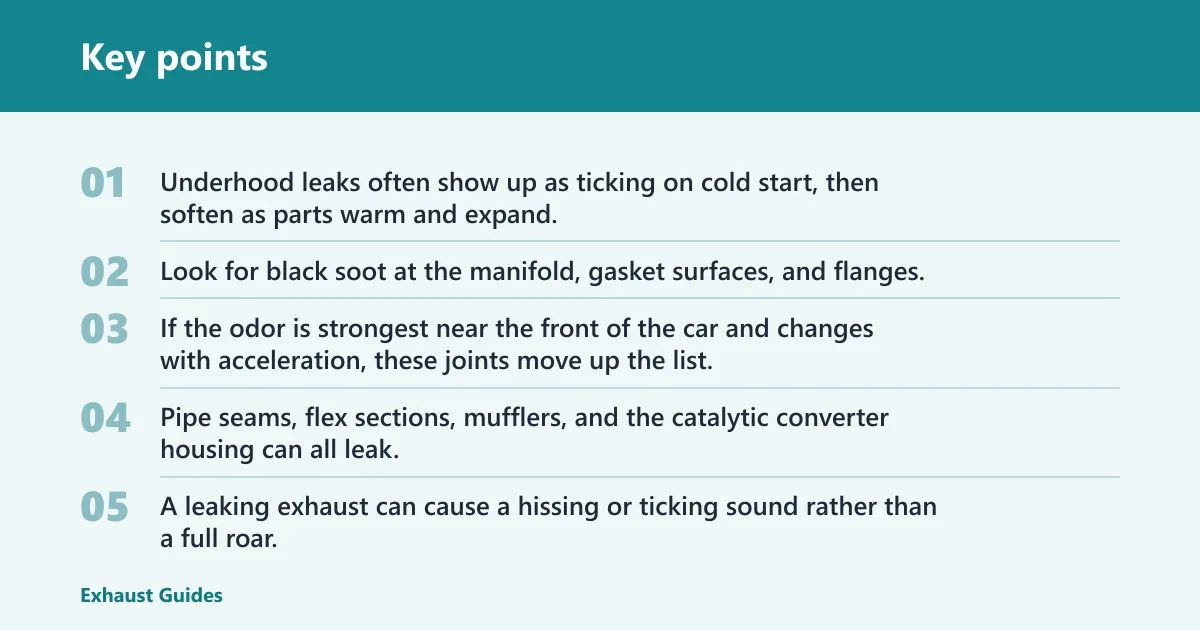
Manifold, gasket, and flange leaks
Underhood leaks often show up as ticking on cold start, then soften as parts warm and expand. That pattern is a clue, not proof. A leak farther downstream can still sound different at idle and under load, so keep the whole front half of the exhaust in play.
Look for black soot at the manifold, gasket surfaces, and flanges. If the odor is strongest near the front of the car and changes with acceleration, these joints move up the list.
Pipe, muffler, and catalytic converter leaks
Pipe seams, flex sections, mufflers, and the catalytic converter housing can all leak. A leaking exhaust can cause a hissing or ticking sound rather than a full roar. If the smell rises after the car moves and settles after it stops, a mid- or rear-system leak may be drawing fumes back.
A sulfur or rotten-egg smell usually points to a catalytic converter problem. It may also be linked to P0420 or P0430, and a failing converter can rattle or overheat. That odor can also come from an exhaust leak, so scan data and visual clues should be checked together.
Tailpipe damage and rear exit issues
Crushed tailpipes, missing hangers, and damaged rear exits can redirect fumes toward the body or into a rear opening. If the odor is strongest around the cargo area, inspect the outlet path and the area around the rear bumper. Exhaust drawn toward the back is a common clue when the rear is the first place you smell it.
What codes and symptoms can help confirm it?
An OBD-II scanner helps narrow the source by checking misfire, fuel-trim, oxygen-sensor, and catalyst-efficiency codes. It cannot replace a visual inspection, but it can tell you whether the engine is running rich, misfiring, or reacting to exhaust changes in a way that fits the smell.
Misfire and fuel-trim codes
P0300-series misfire codes and P0171/P0172 fuel-trim codes can affect exhaust smell and make the diagnosis less straightforward. Modern vehicles can also trigger oxygen-sensor and air-fuel-ratio sensor codes from exhaust leaks. Those clues point you toward where the leak is affecting the system, not just where the smell appears.
Catalyst-efficiency codes and sulfur odor
P0420 or P0430 with a sulfur odor can make the catalytic converter a stronger suspect. If the converter is hot, rattling, or the odor appears after load, that combination deserves attention. A converter issue can exist with or without a cabin smell, so check the rear seals and underbody path at the same time.
What an OBD-II scanner can and cannot confirm
An OBD-II scanner can narrow the zone, but it cannot show every leak. A clean code scan does not rule out a small exhaust leak, and a code by itself does not prove the smell source. Use the scanner with odor location, driving condition, and visible clues.
How to test without guessing
The safest test sequence uses conditions you can compare without crawling under a running vehicle. Start with parked checks, then compare idle and road-speed behavior, and only then move to smoke or pressure testing if the source is still unclear. That keeps the diagnosis controlled and repeatable.
- Compare parked conditions. With the car parked outside, smell the cabin with HVAC on fresh air, then recirculate, and then with the fan off. Note which setting changes the odor, because airflow direction can reveal the entry path.
- Check idle behavior. Let the engine idle and listen for hissing, puffing, ticking, or a changed exhaust tone. If the odor appears at idle or stoplights, inspect the front exhaust joints and the cowl area first.
- Compare road-speed behavior. Drive only if there are no red flags, and compare low-speed stop-and-go with steady cruise. A smell that worsens after acceleration or at stops can point to different zones than one that appears only while moving.
- Inspect visible clues. Look for soot marks, loose clamps, damaged hangers, missing body plugs, rear seal gaps, and water marks. These clues often tell you where fumes are getting out or in before any deeper test.
- Use smoke testing next. If you cannot see the leak or entry path, a professional smoke or pressure test is the right next step. It is especially useful when the odor changes with airflow but the source stays hidden.
One common first-timer mistake is chasing only the exhaust system and skipping the cabin entry path. If the smell is strongest in the rear seat area after the car has been closed up, rear seals and body openings deserve the same attention as the manifold and pipes.
Frequently asked questions
Why does my car smell like exhaust inside the cabin?
A raw exhaust smell usually points to an exhaust leak or a cabin entry path. It can come from the manifold, pipe joints, muffler, tailpipe area, or a rear opening that lets fumes in. Match the smell location and driving condition before you guess at the part.
How do I tell if exhaust fumes are coming from the engine bay or the rear of the car?
Smell near the dashboard or at idle points toward the front, while smell near the rear seat or cargo area points toward rear seals, body openings, or the tailpipe path. Compare fresh air and recirculate, then note whether the odor follows engine load, vehicle motion, or rear-cabin pressure changes.
Can an exhaust leak be dangerous even if the smell is faint?
Yes. Carbon monoxide is colorless and odorless, so a faint smell can still be a health risk. If you get headache, dizziness, weakness, upset stomach, vomiting, chest pain, or confusion, stop driving and get fresh air immediately.
What should I check first if I smell exhaust in my car?
Start with the smell location, then the driving condition, then the cabin airflow path. Check the exhaust system from manifold to tailpipe, look for soot or loose joints, and inspect rear hatch seals, rear glass seals, and body plugs. Then scan for codes that fit the symptom pattern.
What codes or symptoms can help confirm an exhaust leak?
Symptoms like hissing, ticking, changed exhaust tone, sulfur odor, or a failed emissions test add more weight, but none should be used alone.
How do I find the source of exhaust fumes without guessing?
Use a repeatable order: compare fresh air and recirculate, note idle versus acceleration changes, inspect visible soot and seal gaps, and then use an OBD-II scanner. If the path is still unclear, a smoke or pressure test is the cleanest next step.