Exhaust Smell at Idle but Not While Driving
An exhaust smell at idle but not while driving usually points to a small exhaust leak, rich cold-start fueling, or outside fumes entering the cabin; if it vanishes above idle, check the leak first. Ignoring it can let carbon monoxide enter the cabin and turn a cheap gasket or hose fix into a bigger repair. This guide shows why the smell appears at idle, how to separate leak, mixture, and HVAC-intake causes, and which checks to do first.
Why exhaust smell shows up at idle

- Creates visible smoke for leak testing
- Includes smoke fluid and adapters
- Adjustable pressure suits multiple systems
Idle is often a worse time for exhaust odor because exhaust flow is lower, manifold vacuum is higher, and the car may sit still long enough for fumes to collect near the cowl or underbody. That combination makes a small leak more noticeable than it would be at road speed.
When you drive away, exhaust velocity rises and the vehicle moves air past the leak site. That often pushes odor away from the cabin and can hide a problem that is still there.
Cold start matters too. A cold exhaust manifold, flange gasket, or catalytic converter may not seal or clean up odor as well as a hot one. If the smell is strongest right after startup and fades as parts warm up, that pattern can be a useful clue.
Why the smell fades as speed rises
At speed, moving air and higher exhaust flow change where fumes go. A small leak at the exhaust manifold or flange may still exist, but the odor trail no longer hangs around the car. If the smell is inside the cabin, the extra airflow can also dilute it enough that you stop noticing it.
Idle smell diagnostic matrix
Use this table to separate raw exhaust, fuel odor, oil vapor, and cabin-entry fumes before you start replacing parts. The goal is to match the smell character to the place it enters and the conditions that trigger it.
| Smell character | When it appears | Likely source | Quick check | Urgency |
|---|---|---|---|---|
| Pungent exhaust, soot-like, eye-watering | Cold start, idle, stop lights | Exhaust manifold leak, flange gasket, flex pipe leak | Look for black soot, listen for ticking or puffing, inspect both above the engine and beneath the vehicle | High if odor enters cabin; medium if outside only |
| Raw fuel, sharp gasoline smell | Idle, especially after cold start | Rich fuel trim, injector issue, upstream oxygen sensor fault, vacuum leak affecting mixture | Scan codes, idle fuel trims, look for misfire or rich codes | Medium to high |
| Oily, burnt oil, bluish haze odor | Idle after warmup or after sitting | PCV system fault, oil mist, valve cover leak | Inspect PCV hose, valve, and oil residue around intake and exhaust areas | Medium |
| Exhaust smell inside cabin only | At idle, traffic, or with HVAC on fresh air | Cabin air intake draw, cowl seal issue, body seal leak | Switch fresh air to recirculation and compare odor level | High if any carbon monoxide suspicion |
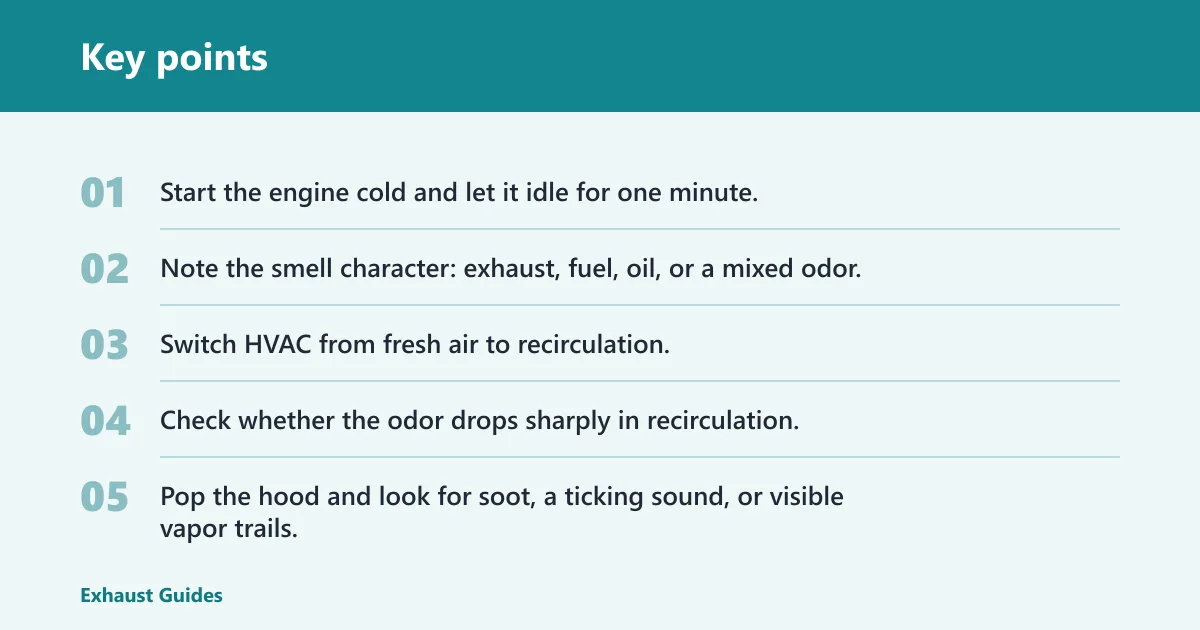
A simple yes/no path helps narrow it fast: do you smell it outside the car at idle, or only inside? If it is outside too, start under the hood and beneath the car. If it is mainly inside, test the HVAC mode and inspect the cowl area first. If the smell is raw fuel, move toward mixture checks. If it is oily, inspect the PCV system.
- Start the engine cold and let it idle for one minute.
- Note the smell character: exhaust, fuel, oil, or a mixed odor.
- Switch HVAC from fresh air to recirculation.
- Check whether the odor drops sharply in recirculation.
- Pop the hood and look for soot, a ticking sound, or visible vapor trails.
- If no leak is obvious, scan for codes and fuel trim data.
- If the smell is inside the cabin or makes you feel unwell, stop and ventilate.
Is the smell coming from an exhaust leak?
An exhaust leak is often a likely cause of an exhaust smell at idle, especially if the odor is strongest when cold and weakens as the engine speed rises. Exhaust manifold leaks are commonly reported leak points. A flange gasket or flex pipe can also leak only under certain engine movement or temperature changes.
Exhaust manifold leak signs
An exhaust manifold leak often makes a ticking or puffing sound near the cylinder head. It may smell worse when cold because metal contracts and small gaps are larger before heat expansion closes them up. Sooty black residue around the manifold, heat shield, or nearby fasteners is a strong clue.
If the leak is close to the firewall, cabin odor can be stronger at idle because the car is stationary and fumes linger near the cowl. That is also where carbon monoxide risk becomes serious if the leak is large enough to enter the cabin.
Exhaust flange gasket and flex pipe checks
An exhaust flange gasket seals the joint between two exhaust sections. It can leak only when the engine rocks at idle or when the pipe shifts slightly with temperature. A flex pipe can do the same if the woven section cracks or separates.
Check the joint visually, then carefully feel for puffing around the leak point with a gloved hand when the engine is cold and idling. Do not touch hot metal. If you can hear a sharp tick or feel pulses, the joint needs attention.
Say your sedan smells like exhaust for the first 30 seconds after start, then quiets down once the idle smooths out. That pattern fits a small manifold or flange leak better than a tailpipe issue, because idle is when exhaust pulses and engine movement make a small gap easiest to notice.
Could it be a rich fuel smell at idle?
Yes. A rich running condition can smell like exhaust even when no exhaust leak is present. Idle is where many rich problems show up first, because the engine spends more time in a steady, low-load state and the fuel control system has less margin to hide an error.
Fuel trim, oxygen sensor, and injector clues
Look at scan data if you can. Short-term and long-term fuel trims that stay unusually negative at idle can point to the engine adding too much fuel. An upstream oxygen sensor is the main feedback sensor for mixture control, so a faulty sensor can push the system rich at idle.
Injectors that drip, a fuel pressure problem, or a vacuum leak that changes idle fueling can also cause a raw fuel odor. A vacuum leak does not create exhaust smell directly. It changes air-fuel ratio, which can lead to rough idle and an odor that people describe as exhaust.
Why a check-engine light may be absent
A check-engine light may not come on if the problem is small, intermittent, or not far enough outside the control range yet. That is common with a mild rich idle, an early oxygen sensor fault, or a leaking injector that shows up only after startup. Scan codes help, but no light does not rule out the issue.
How a catalytic converter changes the odor
The catalytic converter reduces hydrocarbons and odor, but it is less effective when cold. It can also be overloaded by misfires or a rich mixture. In that case, the converter may not be the root cause; it may just be changing the smell profile from raw fuel to a hotter, more pungent exhaust odor.
Suppose a compact car smells strongly of gasoline at idle, yet the tailpipe looks normal. A scan shows fuel trims pulled negative at idle and no light on the dash. That points toward mixture control, not a blocked converter, and the upstream oxygen sensor, injectors, or an air leak near the intake become the first checks.
Can the cabin intake pull fumes inside?
Yes. The cabin air intake, usually near the cowl at the base of the windshield, can draw in outside fumes at idle. Fresh air mode can pull exhaust from the engine bay, underbody, or nearby traffic into the cabin. Recirculation often reduces that entry path and is a useful test.
Fresh air vs recirculation test
Set the HVAC to fresh air and note the smell. Then switch to recirculation. If the odor drops quickly in recirc, the source is often outside the cabin rather than inside the vents themselves. That points you toward cowl seals, the intake screen, or a leak near the firewall.
Heater and defrost settings can change the intake path on some vehicles, so test them too. If defrost makes the odor worse, the cabin intake path is worth a close look.
Cowl and seal checks
Inspect the area at the base of the windshield for damaged seals, missing clips, clogged screens, or debris that could disturb airflow. A compromised cowl seal can let engine-bay fumes enter the HVAC intake. A leaking exhaust manifold near the back of the engine can feed that problem.
A common first-timer mistake is to blame the vents when the real issue is a leak under the hood that only gets pulled in through the fresh-air intake at idle. The cabin system is the path, not always the source.
Could PCV or oil vapor be the source?
Yes. The positive crankcase ventilation system can create an oil or crankcase odor that gets mistaken for exhaust, especially on older or high-mileage engines. A cracked hose, stuck valve, or poor seal can let oil mist escape and burn on hot parts.
PCV hose and valve checks
Inspect the PCV valve and hose for cracks, loose ends, collapse, or heavy oil residue. If the valve sticks open or the hose leaks, crankcase fumes can enter the intake and change the smell at idle. That odor is often oily or burnt, not the sharp raw exhaust smell from a manifold leak.
Because the engine is under higher manifold vacuum at idle, PCV flow is greatest then. That is why this problem often becomes more obvious when the car is sitting still.
How oil mist can mimic exhaust odor
Oil mist can burn on the exhaust manifold, heat shields, or turbo hardware if present. The result can smell like exhaust because the odor comes from hot underhood parts, not from the tailpipe. Look for wet residue, burned oil stains, or smoke after shutdown.
When the smell is a safety risk
Any odor that enters the cabin should be treated as a possible carbon monoxide issue until it is ruled out. Carbon monoxide is odorless, but exhaust leaks can bring other fumes with it. If you feel headache, dizziness, nausea, or unusual fatigue, stop driving, ventilate the cabin, and get help.
If the smell is strong, the windows are fogging in a strange way, or the odor changes when you switch to recirculation, do not assume it is harmless. A small leak can become a bigger one, and a cabin intake issue can turn a mild annoyance into a real exposure risk.
Should you drive the car if it smells like exhaust at idle? Only a short trip to a safe place or repair shop makes sense if the smell is faint and stays outside the cabin. If fumes enter the cabin, or you suspect carbon monoxide, do not continue normal driving.
Frequently asked questions
Why does my car smell like exhaust at idle but not while driving?
Idle creates the right conditions for odor: low exhaust flow, higher manifold vacuum, and less air movement around the car. A small exhaust leak, rich idle mixture, or cabin intake draw can smell stronger at a stop and fade once road speed pushes fumes away.
Is an exhaust smell at idle dangerous?
It can be. The main concern is carbon monoxide if fumes enter the cabin. Even when the smell is mild, treat any odor that reaches the interior as a safety issue. Ventilate the car, check HVAC mode, and repair the leak before the problem worsens.
Can a vacuum leak cause exhaust smell at idle?
Yes, but indirectly. A vacuum leak does not create exhaust odor by itself. It can change air-fuel ratio and cause rough idle or rich running on some vehicles, which changes the smell. That is why scan data and fuel trims matter when the odor is not clearly from the exhaust.
Can a leaking exhaust manifold smell worse at idle?
Yes. Exhaust manifold leaks often smell worse at idle because the leak is closer to the firewall, exhaust pulses are easier to notice, and cold metal can leave a larger gap before it heats up. Ticking, puffing, and soot around the manifold are common clues.
Can a cabin air leak pull exhaust fumes inside at idle?
Yes. The cabin intake near the cowl can draw outside fumes into the HVAC system, especially in fresh air mode. If recirculation reduces the smell quickly, the entry point may be the cowl, a seal, or a leak near the engine bay rather than the vents themselves.
Can a bad oxygen sensor cause exhaust smell at idle?
Yes. The upstream oxygen sensor is the main feedback sensor for air-fuel control, so a fault can contribute to rich idle smell. That said, the sensor is only one possible cause. Injectors, fuel pressure, and vacuum leaks can produce similar odor patterns at idle.