Diesel Exhaust Delete vs Keep Stock: Pros and Cons
Keeping the stock setup is generally the safest choice if the vehicle is used on public roads. A delete is generally limited to off-road or race-only use, since parts, tuning, possible ECM reflash work, and fines can outweigh the power gain. Poorly done deletes can also lead to inspection failure, warranty denial, poor drivability, and costly repeat repairs. This guide compares delete costs, stock repair bills, power gains, legal risk, downtime, and which choice fits towing, work use, and low-mileage trucks.
| Decision factor | Diesel exhaust delete | keep stock | Winner |
|---|---|---|---|
| Upfront cash outlay | Parts, labor, tuning, and possible ECM reflash work can add up fast. | Repair bills can be lower if you only replace one failed part, but a DPF or SCR job can still get expensive. | keep stock |
| Power and response | Can free restriction, cut regen interruptions, and may add measurable horsepower and torque with the right tune. | Factory calibration protects components, but response stays limited by emissions hardware and regen logic. | Diesel exhaust delete |
| Legal, inspection, and warranty exposure | Road-use legality risk, inspection failure risk, warranty denial risk, and resale friction are high. | Much lower exposure if the truck stays compliant and passes state or local checks. | keep stock |
| Downtime risk | High if support is weak for the year, if the controller is locked, or if tuning support is thin. | Moderate to high when emissions parts fail, but repairs are usually easier to justify and source. | keep stock |
| Long-term ownership friction | Can reduce soot buildup and regen cycles, but adds tuning dependence and possible inspection headaches. | More nuisance faults in some trucks, but fewer problems at registration, dealer visits, and resale time. | keep stock |
Delete vs stock at a glance
The trade-off is plain: a diesel exhaust delete can cut exhaust restriction and skip some emissions-system headaches, but keep stock avoids legal exposure, warranty trouble, and the extra support burden that comes with modified calibration. For a road-driven truck, that matters more than the power claim.
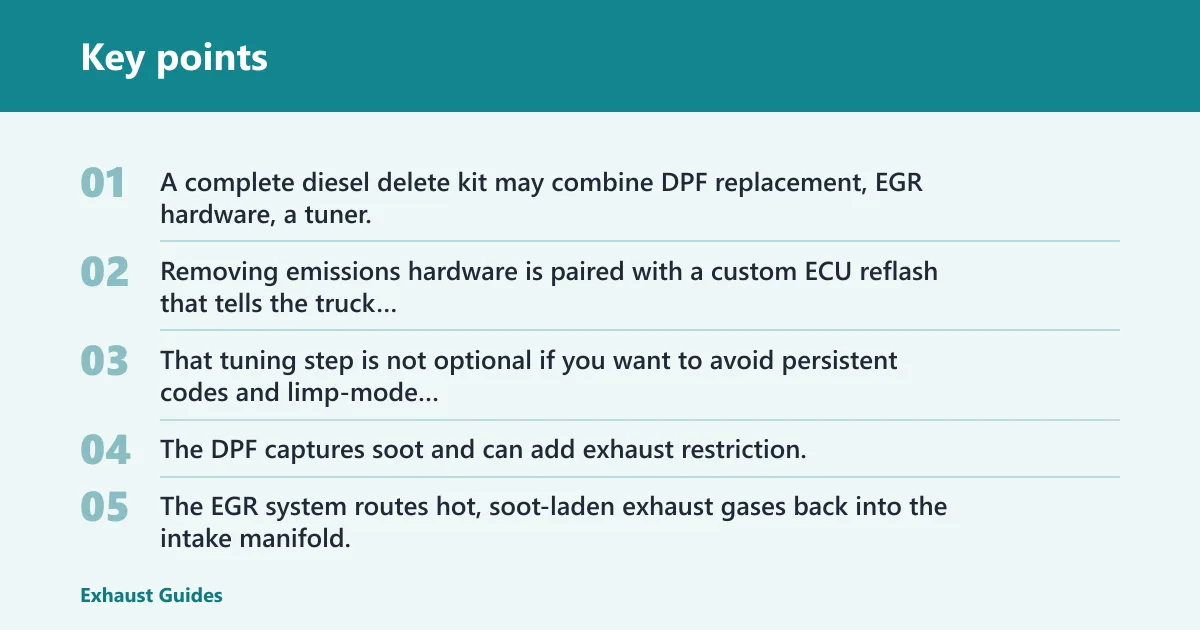
A complete diesel delete kit may combine DPF replacement, EGR hardware, a tuner, and optional CCV or downpipe add-ons. Removing emissions hardware is paired with a custom ECU reflash that tells the truck computer the systems no longer exist. That tuning step is not optional if you want to avoid persistent codes and limp-mode behavior on supported trucks.
What changes when DPF, EGR, and SCR are removed
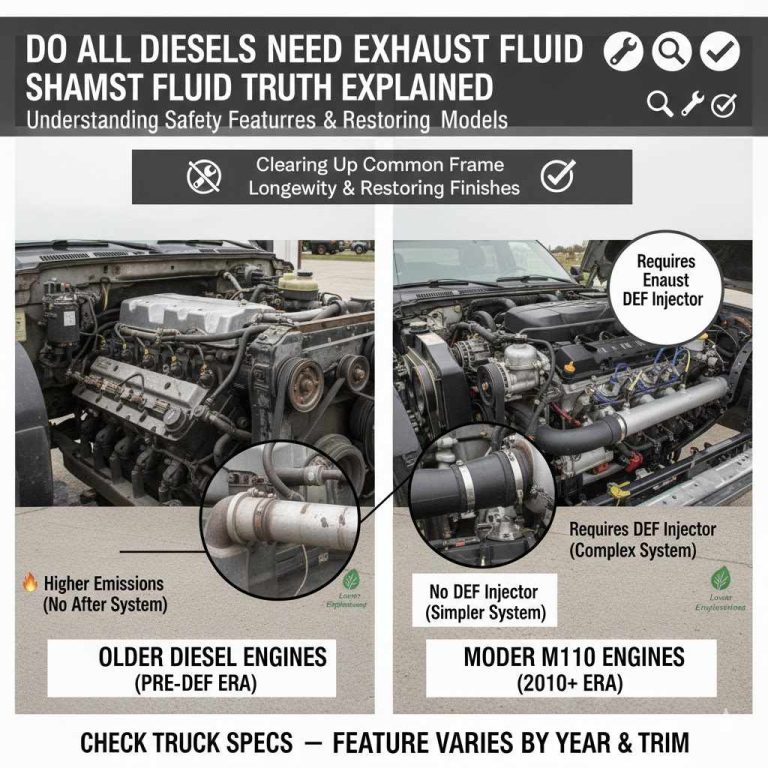
The DPF captures soot and can add exhaust restriction. The EGR system routes hot, soot-laden exhaust gases back into the intake manifold, which can increase carbon buildup in the intake and EGR cooler; coolers can clog and crack, and that can contribute to coolant leaks. SCR uses DEF to reduce NOx, and a full delete removes that aftertreatment path too.
What stays in place with stock emissions hardware
Keep stock and the truck keeps its emissions strategy intact: soot capture, exhaust gas recirculation, and SCR/DEF-based NOx control. That means regens, DEF refills, sensors, and the occasional emissions repair, but it also means the calibration, inspection status, and dealer support remain aligned with the vehicle as sold.
Why the answer depends on use case, not hype
The right answer changes with mileage, climate, local inspection rules, and how often the truck sits idling or towing. A highway tow rig, a cold-climate daily driver, and a high-mileage work truck do not face the same cost pattern. A delete may look attractive on paper and still be the wrong ownership decision.
Diesel exhaust decision matrix
| Scenario | Diesel exhaust delete | keep stock | Winner |
|---|---|---|---|
| Daily driver | Downside: high legality and inspection exposure, plus higher setup cost. | Better for routine use, dealer visits, and resale. | keep stock |
| Tow rig | Can improve throttle response and reduce regen interruptions if the setup is properly supported. | Safer choice if the truck spends time on public roads or must pass inspections. | keep stock |
| Farm or off-road truck | May make sense only if the truck truly stays off-road and the owner accepts support and resale limits. | Better if the truck ever returns to public roads or needs dealer-backed service. | keep stock |
| Cold climate use | Can remove some DEF-related cold-weather complaints, but tuning support and legality remain concerns. | More predictable if the system is healthy and the DEF heater, injector, and sensors are maintained. | keep stock |
| High-mileage work truck | Can cut soot-related maintenance if the platform has strong support, but upfront conversion cost is still real. | Often better if the owner wants low friction, documented repairs, and easier resale. | keep stock |
| Inspection-heavy state | High failure risk at inspection and high enforcement exposure. | Clearly the safer ownership choice. | keep stock |
Say your 2019 tow rig needs a DPF, and the truck also throws DEF quality codes in winter. The delete may look tempting because it removes regeneration and DEF complaints, but the same truck still faces road-use legality, inspection, and resale problems if it ever leaves the trailered-only fantasy.
Suppose a 250,000-mile work truck is going to stay on private property for short, repetitive tasks. Even then, the right answer is not automatic. If the truck still needs public-road travel, the legal and ownership risks stay attached, and a targeted repair may be the cleaner choice.
What a delete changes under the hood
Deleting changes the exhaust path, the fault logic, and the service profile. It can reduce restriction and soot storage, but it also removes hardware that the ECM expects to see. That is why tuning support matters so much.
DPF restriction and soot storage
The Diesel Particulate Filter captures soot and black smoke, then burns off trapped soot during regeneration. That process creates exhaust restriction and backpressure, and it can be the source of repeat service issues when the filter loads up or fails. OEM DPF replacements can run $3,000-$8,000 per unit. (UTI)
EGR soot routing and cooler issues
The EGR path sends exhaust back into the intake to lower combustion NOx, but it also carries soot through hot passages. That soot can build up in the intake and valve area, while the cooler can clog or crack. When that happens, coolant loss or persistent fault codes are common complaints.
SCR, DEF, and emissions fault logic
DEF is 32.5% urea and 67.5% deionized water. SCR systems use that fluid to convert NOx into nitrogen and water vapor, and SCR systems are now standard on most modern diesel vehicles, including pickups. Remove the hardware and the truck still needs the controller strategy changed, or the fault logic will stay active.
ECU tuning and controller support
Fuel and power changes come from the tune, not the empty pipe by itself. Removing emissions hardware is paired with a custom ECU reflash that tells the truck computer the systems no longer exist. Vehicle-specific support varies by year, and newer trucks may need ECM reflash work before the tune can be loaded.
What do you actually gain?
The common claims are real possibilities, but they are not guarantees. Power, economy, and temperature changes depend on the engine family, tune level, load, and driving cycle. A truck that tows hard at steady speed is not the same as one that idles in traffic.
Horsepower and torque ranges
Removing the DPF alone can yield measurable gains in horsepower and torque. Owners report 30–70 hp gains with a proper ECU tune. That range is believable on a supported setup, but it is not a universal promise, and it should not be treated as the only reason to modify a truck.
Fuel economy claims and when they hold up
Fuel economy may improve after delete, but the real-world result depends on calibration and use case. A truck that spends long stretches cruising under load may show a different result than a truck that idles, short-trips, or spends most of its time warming up. The gain can disappear if the tune is poor or the driving cycle is unfavorable.
Backpressure and EGT changes
Deletes can reduce exhaust backpressure and lower exhaust gas temperature. That matters in towing discussions because heat control is part of exhaust-system design, but factory calibrations already manage component protection. Lower EGT is helpful only if the rest of the tune and cooling strategy remain sane.
Throttle response and regen frequency
Delete setups can eliminate DPF regeneration cycles on compatible applications. That removes the extra post-injection events, short-lived fuel penalties, and interrupted drive feel that some owners dislike. It does not erase every emissions-related issue, because the tune and controller behavior still have to be right.
What does stock usually cost to keep running?
Stock systems cost less on day one, but they can become expensive when parts fail. The bill is not just the part itself. It also includes labor, diagnostics, possible reprogramming, and repeat visits if the original cause is not fixed cleanly.
DPF replacement and cleaning costs
A plugged or damaged DPF can trigger repeated regens, reduced power, and scan-tool headaches. If cleaning is not enough, replacement is where the cost jumps. The $3,000-$8,000 replacement range is why many owners start comparing the repair bill with modification costs.
EGR cooler, valve, and gasket failures
EGR coolers, valves, and gaskets can fail from soot loading, heat cycling, and cracking. When that happens, drivability may stay acceptable for a while, then fall apart under load or cold starts. Coolant loss tied to a cracked cooler is one of the more expensive emissions-related repairs.
DEF sensor, injector, and heater problems
DEF creates its own maintenance stream. Common complaints include sensor failure, injector problems, and heater issues in cold weather. The fluid itself is not exotic, but the system around it can strand a truck with reduced-power warnings if one component fails.
Labor, downtime, and repeat fault codes
Stock repairs can still take time because the fault often involves more than one component. A dirty sensor can mimic a bad DPF. A cracked cooler can lead to another code after the first part is replaced. That is why a repair plan should start with diagnosis, not parts-swapping.
Is a diesel exhaust delete worth it?
It is worth it only in narrow cases: a truck that truly stays off-road, has confirmed platform support, and justifies the conversion after parts, labor, tuning, and legal risk are counted. For a public-road diesel, stock repair or cleanup is usually the better ownership decision.
When the math favors repair instead
If the truck already has a failing DPF, EGR cooler, or DEF component, a targeted repair can be cheaper than a full conversion once tuning and controller work are counted. That is especially true when the truck is a daily driver, needs inspection, or must stay eligible for dealer software support.
When stock makes more sense than delete
Keep stock if you need predictable registration, dealer service, and resale value. Keep stock if your state checks emissions equipment, if the truck is financed or under warranty, or if the platform has weak delete support. That is the safer choice for most owners.
How to weigh downtime against repair bills
Down-time has a cost. So does a failed inspection. So does buying parts that do not solve the actual fault. A rational decision starts with how the truck is used, then compares repair economics, legal exposure, and the chance of future code or regen problems.
What are the legal and ownership risks?
Deleting emissions hardware on a road vehicle is illegal in most jurisdictions. That brings practical fallout: inspection failure, fines, warranty denial, resale friction, and sometimes dealer refusal to help with modified calibration. The risk is not abstract; it follows the truck.
Road-use legality and inspection exposure
Even if a truck is described as work-only or private-property use, road legality remains the core issue once it travels on public roads. Inspection-heavy states are the hardest place to own a deleted truck because the hardware is visible, the readiness logic changes, and the failure risk is obvious.
Warranty and dealer support loss
Any emissions delete can jeopardize warranty coverage. Dealers may decline related claims if they detect tampering, and newer trucks can be especially sensitive because the controller and aftertreatment logic are tightly linked. That is one reason stock keeps its value as a serviceable baseline.
Resale and insurance friction
Many buyers avoid modified emissions systems because they know the truck may fail inspection or need a reversal before sale. Insurance questions can follow if a claim involves a heavily modified truck. The resale penalty is often less visible than a repair bill, but it is real.
Choose Diesel exhaust delete if… / Choose keep stock if…
Choose Diesel exhaust delete if… the truck is truly off-road or race-only, the platform has confirmed support, you can budget for tuning and possible ECM reflash work, and you accept the loss of road legality and resale flexibility. It fits narrow, high-control use cases.
Choose keep stock if… the truck is a daily driver, tow rig, cold-climate rig, financed truck, inspection-state truck, or anything that still needs public-road legality. It also fits owners who want simpler resale, dealer support, and lower enforcement risk.
How to choose between delete and repair
- Check whether the truck ever goes on public roads.
- Confirm the exact fault: DPF load, EGR cooler failure, DEF sensor issue, or software-related limp mode.
- Price the repair path, including labor and repeat-diagnosis risk.
- Check whether your year and engine have real tuning support, not just forum claims.
- Count inspection, warranty, and resale risk before counting horsepower.
Frequently asked questions
Is a diesel exhaust delete worth it compared with keeping stock?
For road use, usually no. The delete may add power and reduce regen-related annoyance, but the combined cost of parts, tuning, possible ECM work, legal exposure, and resale friction usually makes keep stock the better ownership choice. Off-road-only trucks are the narrow exception.
What performance gains do people actually get from a diesel delete?
Owners report 30–70 hp gains with a proper ECU tune, and removing the DPF alone can yield measurable gains in horsepower and torque. Results vary by engine, tune, and load, so that range should be treated as plausible, not guaranteed.
How much does a diesel exhaust delete cost versus OEM emissions repairs?
A delete can require hardware, tuning, labor, and sometimes ECM unlock work, so the bill is not just the pipe kit. By contrast, OEM DPF replacement can run $3,000-$8,000 per unit, and EGR or DEF repairs add more. The cheaper choice depends on which part failed.
What are the legal risks of deleting a diesel exhaust system?
Road-use deletion is illegal in most jurisdictions. The practical risks include fines, inspection failure, warranty denial, and possible resale problems. The L5P delete guide cites EPA fines up to $4,819 per violation, but enforcement and penalty exposure can vary by case.
Will a delete hurt warranty coverage or resale value?
Yes, it can hurt both. Dealers may deny related warranty claims if emissions tampering is found, and buyers often discount a truck that may fail inspection or require a reversal. That penalty is especially noticeable on newer, low-mileage trucks.
What problems does the stock emissions system usually cause?
The common complaints are DPF restriction, EGR soot buildup, cooler clogging or cracking, DEF sensor and heater issues, and regen-related downtime. DEF-related cold-weather complaints are common, especially where the truck sees repeated short trips or long idle periods.
What are the best alternatives to deleting if I want fewer regen and DEF issues?
Start with diagnosis, not deletion. Clean or replace the failed DPF, inspect the EGR cooler and valve, fix DEF sensors and heaters, update calibration when appropriate, and keep up with the right oil and drive cycle. Those steps often reduce regen frequency without sacrificing legality.