

Diesel DPF vs Catalytic Converter Differences Explained
A diesel DPF traps soot, a catalytic converter helps speed exhaust cleanup, and SCR uses DEF to reduce NOx; in many trucks, the DPF sits after the oxidation catalyst and before the SCR unit. Confusing them can lead to the wrong fix, repeated derates, and wasted parts. This guide shows how to identify each part by location, function, and warning signs.
Diesel DPF vs catalytic converter differences
The trade-off is direct: a DPF stores soot so it can be burned off later, while a catalytic converter cleans exhaust gases as they pass through. That difference matters when a warning light comes on, because one part may be loaded with soot, another may be failing to light off, and a pressure sensor may be the real problem. (en.wikipedia.org)
| Decision factor | Diesel DPF | Catalytic converter differences | Winner |
|---|---|---|---|
| Main job | Traps diesel soot and particulate matter | Uses catalyst chemistry to reduce or oxidize exhaust pollutants | Depends on the fault |
| Where it sits | Usually downstream of the DOC, often upstream of SCR | Often upstream in the exhaust as a DOC on diesel, or as a three-way catalyst on gasoline engines | Catalytic converter differences |
| Typical failure clue | High differential pressure, soot loading, failed regeneration | Poor conversion, emissions fault codes, temperature or efficiency issues | Diesel DPF |
| Maintenance style | Regenerates soot; ash still accumulates | Does not store soot like a filter | Catalytic converter differences |
| Best-fit use | Diesel exhaust systems that must capture particulate matter | Cleaner exhaust chemistry and NOx/HC/CO control, depending on catalyst type | Depends on engine type |
Main job
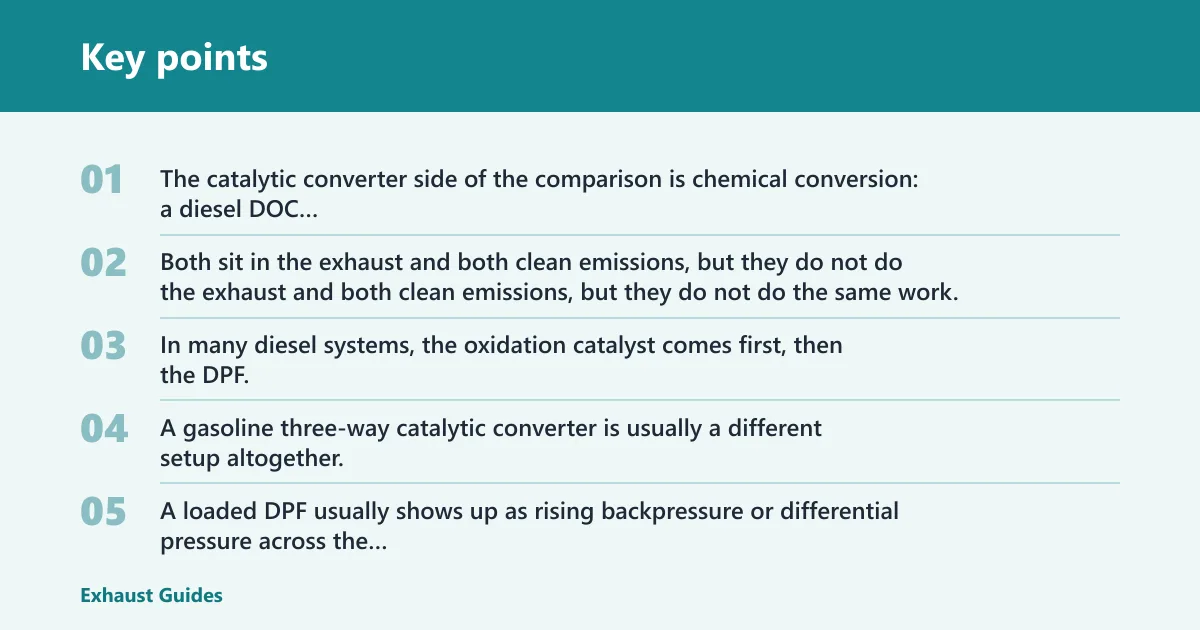
The DPF stores and burns soot. The catalytic converter side of the comparison is chemical conversion: a diesel DOC oxidizes hydrocarbons and carbon monoxide, while a gasoline three-way converter also targets NOx under stoichiometric control.
That is why the terms get mixed up so often. Both sit in the exhaust and both clean emissions, but they do not do the same work.
Where it sits
In many diesel systems, the oxidation catalyst comes first, then the DPF, then SCR hardware. A gasoline three-way catalytic converter is usually a different setup altogether, because it is paired with a gasoline engine and its air-fuel control strategy.
Typical failure clue
A loaded DPF usually shows up as rising backpressure or differential pressure across the filter. A catalyst problem more often points to conversion efficiency faults, temperature issues, or a downstream emissions code rather than soot loading alone.
Maintenance style
A DPF can regenerate when soot burns off, but ash remains. A catalyst does not rely on soot storage, so “cleaning” is not the same issue; the key question is whether the catalyst can still do its chemical job.
Best-fit use
The DPF exists because diesel engines make particulate matter that must be trapped. A catalyst exists because exhaust chemistry still needs cleanup, whether that means oxidation on a diesel DOC or NOx reduction on a gasoline three-way converter.
What does each part do in a diesel exhaust system?
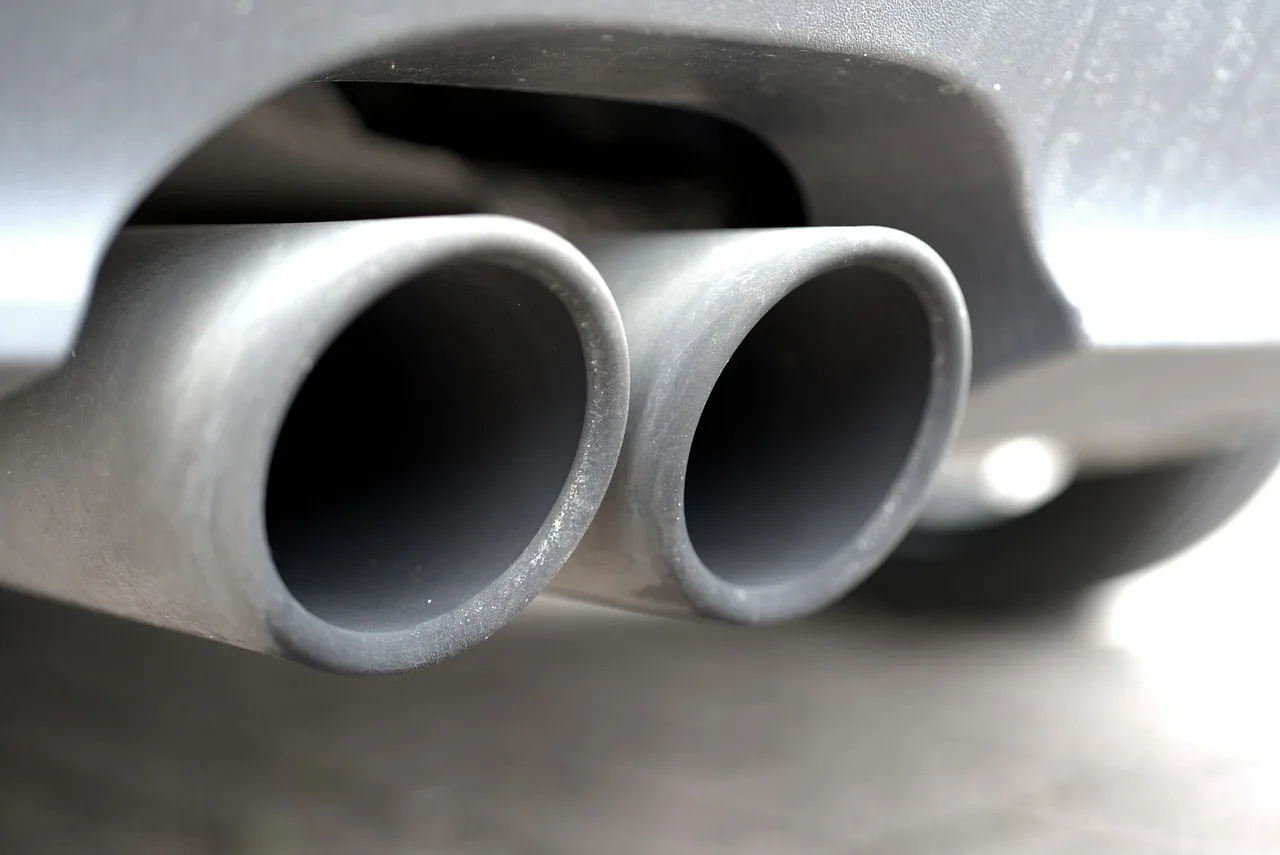
Diesel aftertreatment is a sequence, not a single canister. The usual parts do different jobs at different points in the exhaust stream, so the diagnosis changes depending on whether the fault is soot loading, catalyst performance, or NOx control.
Diesel oxidation catalyst
A diesel oxidation catalyst, or DOC, often sits upstream and helps oxidize hydrocarbons and carbon monoxide. It is not a soot storage device, but it helps raise exhaust temperature so the DPF can regenerate more effectively.
Diesel particulate filter
The DPF captures soot and particulate matter from diesel exhaust. It uses passive regeneration when exhaust heat stays high enough, and active regeneration when the engine control unit commands extra heat through post-injection or a fuel dosing strategy.
SCR system
SCR uses DEF, sometimes called AdBlue, to reduce NOx downstream. The system typically includes NOx sensors and a dosing injector, and it often sits after the DPF in the exhaust stream.
Is a DPF a catalytic converter?
A DPF is a filter that traps soot, while a catalytic converter uses catalyst chemistry to change exhaust gases. A diesel DOC is a catalyst, but it is still not the same thing as a DPF, because it does not mainly store soot.
Why the terms get mixed up
Both parts are part of emissions control, and both are in the exhaust. That is enough to create confusion, especially when a warning light appears and the dashboard does not name the failed component.
Why a DPF is a filter, not a soot-burning catalyst
The DPF’s primary role is collection. It traps soot until the system can burn that soot away during regeneration; the canister itself is not the same as a catalytic converter that simply speeds a chemical reaction as exhaust flows through it.
Where a diesel DOC fits instead
The DOC is the closer diesel equivalent to a catalyst in the everyday sense. It oxidizes HC and CO, and it also helps heat the exhaust enough to support DPF regeneration.
Do diesel engines have a catalytic converter?
Many diesel engines do have a catalytic converter, but the diesel unit is usually a DOC rather than a gasoline-style three-way converter. Some diesel setups also add a DPF and SCR, so the answer depends on the vehicle’s emissions package and model year.
Why many diesels have a DOC
The DOC handles oxidation work on diesel exhaust. It is common because diesel fuel is a liquid fuel specifically designed for use in a diesel engine, and diesel engines ignite fuel by compression, not a spark.
Why a gasoline three-way catalytic converter is different
A three-way catalytic converter is common on gasoline engines and relies on stoichiometric air-fuel control. That operating style is different from diesel exhaust control, which is one reason a diesel catalyst is usually described as a DOC rather than a three-way unit.
Which diesel setups may have DOC plus DPF plus SCR
Many modern diesel vehicles use the full chain: DOC, DPF, then SCR. That layout lets the exhaust stream get oxidized, filtered for soot, and then treated for NOx reduction downstream.
Where do the parts sit in the exhaust?
The usual exhaust order matters because heat and pressure change at each step. In a common layout, exhaust leaves the turbo, passes through the DOC, then the DPF, then SCR hardware if fitted, and finally exits the tailpipe.
- Engine and turbo outlet
- DOC
- DPF
- SCR dosing and catalyst section, if equipped
- Tailpipe
Upstream and downstream sensors to know by location
DPF systems often use differential pressure sensors or exhaust backpressure sensors to measure restriction across the filter. SCR systems typically add NOx sensors and a dosing injector, which means a fault code may point to sensor data rather than the canister itself.
How system order affects heat, pressure, and regeneration
The DOC helps heat the exhaust stream, which supports DPF regeneration. If pressure rises too high across the DPF, the ECU may limit power, request a regen, or set a fault that puts the vehicle into limp mode.
How do DPF regeneration and pressure sensors work?
DPF regeneration burns off soot that has collected in the filter, and pressure sensors tell the ECU how restricted the filter is. When the sensor readings stay high, the system may infer soot loading, request a regen, or limit engine output if the restriction becomes severe.
Passive regeneration on sustained hot driving
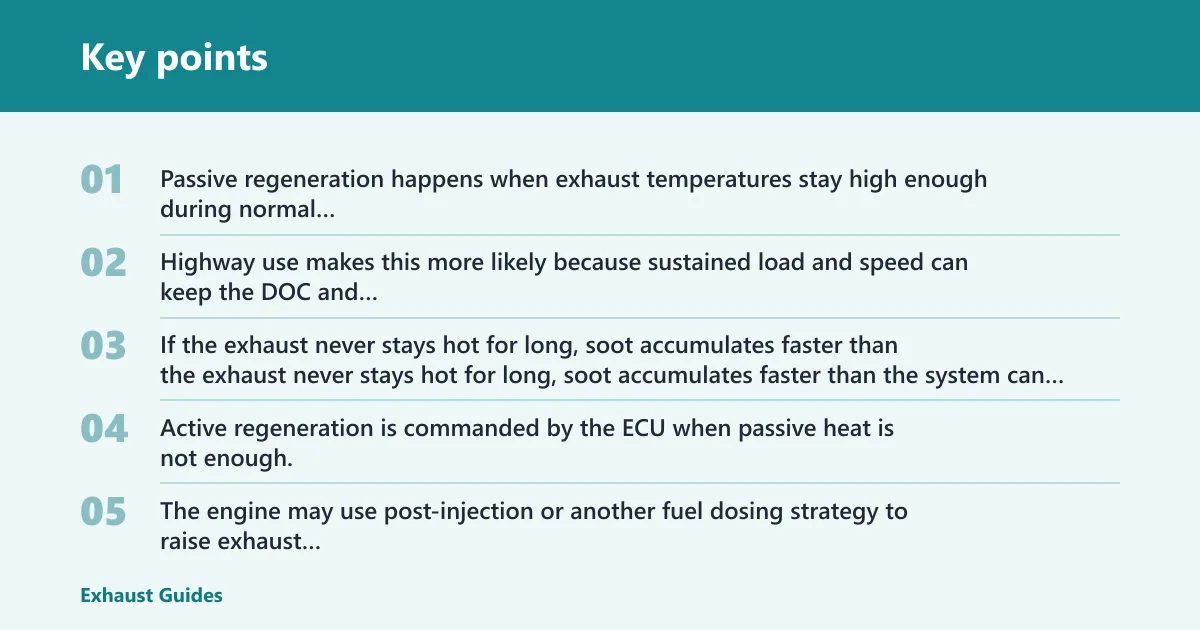
Passive regeneration happens when exhaust temperatures stay high enough during normal driving. Highway use makes this more likely because sustained load and speed can keep the DOC and DPF hot long enough for soot to oxidize.
Short trips work against that process. If the exhaust never stays hot for long, soot accumulates faster than the system can burn it away.
Active regeneration using extra fuel or post-injection
Active regeneration is commanded by the ECU when passive heat is not enough. The engine may use post-injection or another fuel dosing strategy to raise exhaust temperature, but that process can fail if the vehicle is driven in repeated short trips or if a sensor is giving bad data.
Differential pressure readings and limp mode clues
The differential pressure sensor compares pressure before and after the DPF. When that reading climbs too high, the system can set a fault, call for regen, or trigger limp mode; if the sensor itself fails, the vehicle may look like it has a clogged filter even when the real issue is a bad reading.
Say your diesel pickup starts a regen request, but the light returns after a few miles and the scan tool shows high DPF differential pressure. That points more toward soot loading, ash buildup, or a pressure-sensor problem than toward the DOC alone.
Soot vs ash: what can be burned off?
Soot is the combustible load that regeneration is meant to remove. Ash is the non-combustible residue left behind from oil additives, engine wear, and other sources, and it does not burn off during a normal regen.
Soot as the combustible load
When the DPF gets hot enough, soot can oxidize and leave the filter. That is why a vehicle with a healthy driving cycle may recover from soot loading without parts replacement.
Ash as the non-combustible residue
Ash remains in the filter and gradually takes up space. Over time, ash accumulation limits DPF life even if the filter has been regenerated many times, so some DPF problems are not fixable by another regen.
Choose Diesel DPF if… / Choose catalytic converter differences if…
Choose the Diesel DPF diagnosis if the main clues are high differential pressure, repeated regen requests, limp mode, or a vehicle that does mostly short-trip driving. Choose the catalytic converter side of the comparison if the fault points to oxidation or NOx-control hardware such as a DOC, SCR injector, or NOx sensor.
Choose Diesel DPF if…
Your scan tool shows a rising pressure reading across the filter. The vehicle keeps asking for regeneration. The engine has been doing short trips, or the filter is likely loaded with soot and possibly ash.
Choose catalytic converter differences if…
You are trying to tell whether the diesel has a DOC, a gasoline-style three-way converter, or SCR hardware. The problem follows catalyst efficiency codes, NOx faults, or a reduction in conversion performance rather than a soot-restriction symptom.
A common first-timer mistake is replacing the wrong exhaust part because the dash says “emissions” without naming the system. A scan tool matters here, because pressure data, regen status, and fault codes separate a DPF restriction from a DOC or SCR issue.
Can a diesel have both a DPF and a catalytic converter
Yes. Many diesel vehicles have both, and on modern systems the catalyst is usually a DOC, with the DPF and sometimes SCR following downstream. That setup is common because one part cleans gases chemically while the other traps soot.
What that combination usually means
If a diesel has both, the DOC is not replacing the DPF. The DOC supports oxidation and regeneration, while the DPF handles particulate capture and soot loading.
Older or different-market vehicles
Not all diesels have the same emissions layout. Some older or different-market vehicles may have a catalyst but no DPF, while others may use a different combination of aftertreatment parts depending on emissions rules and engine design.
Frequently asked questions
What is the difference between a DPF and a catalytic converter?
A DPF traps soot and particulate matter, then regenerates that soot away when conditions allow. A catalytic converter changes exhaust gases through catalyst chemistry. On diesels, the catalyst is often a DOC, while gasoline engines commonly use a three-way catalytic converter.
Do all diesels have a DPF?
No. Many modern diesel vehicles do, but older or different-market models may use different emissions hardware. If you are diagnosing a specific vehicle, the build year, market, and engine family matter more than the word “diesel” alone.
Do diesel engines have a catalytic converter?
Many do, but usually as a DOC rather than a gasoline-style three-way converter. The DOC oxidizes hydrocarbons and carbon monoxide, and on many systems it sits upstream of the DPF to help support regeneration.
Can a diesel have both a DPF and a catalytic converter?
Yes. That is common on many diesel systems. The DOC handles oxidation, the DPF traps soot, and SCR may follow downstream to reduce NOx with DEF or AdBlue.
How do I know whether the problem is the DPF or the SCR system?
Look at the fault codes and live data. High differential pressure points toward DPF restriction or a bad pressure sensor, while NOx sensor faults, dosing issues, or DEF-related codes point more toward SCR hardware.
Should I keep driving if the DPF light comes on?
Only if the owner’s manual says the vehicle is still in a regen request state and not in a derate condition. If the warning returns, power is reduced, or the scan tool shows repeated regen failure, professional diagnosis is the safer next step.


