
Catalytic converter vs resonator: key differences
A catalytic converter cleans exhaust for emissions. A resonator shapes exhaust sound. Use symptoms to tell them apart: check-engine light, rotten-egg smell, or failed emissions point to the converter, while drone or tone changes point to the resonator. Guessing wrong can waste money and, if you remove the converter, can make the car illegal for road use. This guide shows how to identify each part, compare symptoms, and choose the right replacement or repair before you buy anything.
Catalytic converter vs resonator: the core difference in one sentence


The catalytic converter is an emissions-control device with a chemical catalyst substrate that reduces hydrocarbons, carbon monoxide, and nitrogen oxides. The resonator is an exhaust tone-tuning part that targets specific sound frequencies, mainly to cut rasp and drone, and it does not clean exhaust gases.
They often sit near each other in the exhaust path, which is why drivers mix them up. They do different jobs. One affects legal emissions compliance; the other affects sound quality.
| Decision factor | Catalytic converter | Resonator | Winner |
|---|---|---|---|
| Primary job | Cleans exhaust gases for emissions | Tunes exhaust tone and reduces drone or rasp | Catalytic converter |
| Legal role | Required for street use on most vehicles | Can be omitted on some vehicles without affecting emissions equipment legality | Catalytic converter |
| Sound effect | Usually only a small sound change unless the unit is damaged or restricted | Directly changes tone; often the first part to address drone or rasp | Resonator |
| Emissions effect | Directly tied to emissions testing and ECU catalyst monitoring | No chemical emissions function | Catalytic converter |
| Best-fit repair goal | Fix check-engine lights, sulfur smell, and emissions failure | Fix harsh exhaust tone or cabin boom | Tie |
Primary job
The converter wins this category because it changes exhaust chemistry. The resonator only shapes sound waves in the pipe. If your complaint is smoke, smell, or a catalyst code, a resonator will not solve it.
Legal role
This is where the converter matters most. Most gasoline-powered vehicles starting with the 1975 model year are equipped with catalytic converters, and street-use rules usually require a functioning converter. A resonator is usually a sound part, not an emissions part. (en.wikipedia.org)
Sound effect
The resonator wins here because it is built to attack specific frequencies that create drone or rasp. A converter may change exhaust tone a little, especially if it is damaged or clogged, but that is not its purpose. Mufflers still do the heavy lifting for overall loudness.
Emissions effect
The converter wins by a wide margin. The engine computer uses oxygen sensor data before and after the converter to monitor efficiency, and low efficiency can trigger P0420 on Bank 1 or P0430 on Bank 2. A resonator does not chemically change or reduce harmful pollutants.
Best-fit repair goal
This row is a tie only because the right answer depends on the symptom. If the car fails emissions or sets catalyst efficiency codes, start with the converter system. If the complaint is boom, rasp, or cabin resonance, start with the resonator or muffler path.
📊 Three-way converters were first commercialized by Volvo on California-specification 1977 240 cars. Source: Catalytic converter.
What a catalytic converter does
A catalytic converter is an exhaust emission control device. It uses a chemical catalyst substrate to convert toxic gases and pollutants into less-toxic pollutants through redox reactions. That is why it matters for both road legality and emissions testing.
How upstream and downstream oxygen sensors monitor it
The engine computer compares oxygen sensor signals before and after the converter. Upstream sensor activity reflects what the engine is sending into the exhaust, while downstream sensor behavior helps the ECU judge whether the catalyst is actually storing and cleaning exhaust gases. When those signal patterns look too similar, efficiency can be flagged as low.
That is why P0420 and P0430 matter. P0420 means Catalyst System Efficiency Below Threshold for Bank 1, and P0430 is the same kind of code for Bank 2. Those codes often point to converter trouble rather than a resonator problem.
Why the converter matters for emissions testing and street legality
Emissions testing is about pollutant control, not just noise. A vehicle can be quiet and still fail if catalyst efficiency is low. Removing or gutting the converter can create legal or inspection issues, and it may also trigger a check-engine light, even if the exhaust tone sounds acceptable.
What a resonator does
A resonator is an exhaust tone-tuning component. It is typically used to target certain frequencies and help reduce rasp, buzz, and low-frequency drone. It does not chemically clean exhaust gases, so it is not an emissions substitute.
How it targets drone and rasp
Think of it as a filter for unwanted sound character rather than volume alone. Some resonators are tuned chambers; others use an internal design that cancels or softens specific frequencies. That is why removing one can make an exhaust sound harsher even if the car is not much louder overall.
Why it changes tone more than volume
The muffler is the main part that reduces overall exhaust loudness. A resonator usually works on tone quality first. On some vehicles it can be omitted, but doing so may leave the car with the same basic legal emissions equipment while making the cabin more tiring at steady speeds.
What is the difference between a catalytic converter and a resonator?
The catalytic converter changes exhaust chemistry and is tied to emissions legality, oxygen sensor monitoring, and inspection results. The resonator changes sound frequency, not emissions, and is used to improve exhaust tone or reduce drone. If the car smells bad, sets catalyst codes, or fails emissions, the converter is the suspect.
Emissions effect
Only the catalytic converter treats harmful gases. It helps reduce harmful exhaust emissions, including hydrocarbons, carbon monoxide, and nitrogen oxides. A resonator cannot trigger lower tailpipe emissions because it does not clean exhaust at all.
Sound effect
The resonator is the part you replace when the complaint is too much rasp or a steady-speed boom. The converter can change the sound a little, especially if clogged or broken internally, but that is a side effect. If you want a major loudness drop, the muffler matters more.
Inspection and legal effect
A converter problem can fail emissions testing and can create road-use issues. A resonator change usually does not affect emissions legality by itself. That difference is the whole reason these parts should not be treated as substitutes.
Which exhaust part changes sound the most?
The muffler often has the biggest effect on overall exhaust volume. The resonator changes tone and frequency, which can make the exhaust seem calmer without cutting loudness as much. The catalytic converter can change sound only indirectly, and usually less than the other two parts.
Converter replacement and sound changes
If a converter is clogged, melted, or broken internally, replacing it can restore lost flow and remove odd rattles or restriction noise. That is not the same as tuning the exhaust note. Sound improvement from converter replacement usually comes from fixing a fault, not from choosing a louder or quieter design.
Resonator removal and tone changes
Removing the resonator often sharpens the exhaust note and can bring back high-frequency rasp. It may also add drone at highway speed. That is why resonator deletes are a sound decision, not an emissions decision.
Muffler role as the main volume reducer
Mufflers use chambers, perforated tubes, packing material, or a combination of designs. Their job is to reduce overall exhaust volume. If the car is simply too loud, the muffler is usually the first part to inspect before you blame the converter or resonator.
Symptom-to-part decision matrix
Use symptoms first, then inspect the right part. That keeps you from buying a converter for a drone complaint or a resonator for a catalyst code. Start with the symptom pattern, then confirm with the simplest visible check.
| Complaint | Most likely component | First inspection step | Type of issue |
|---|---|---|---|
| Drone or low-frequency boom | Resonator, sometimes muffler | Check for resonator delete, leaks, crushed piping, or a missing internal baffle | Sound-only |
| Rasp, tinny tone, or cabin buzz | Resonator | Inspect for cracked welds, empty canisters, or a previous exhaust modification | Sound-only |
| Rotten-egg smell, P0420, P0430, or failed emissions | Catalytic converter | Scan codes, compare upstream and downstream oxygen sensor behavior, then inspect for damage or overheating | Emissions-related |
| Rattle, heat shield noise, or power loss | Catalytic converter, heat shield, or muffler internals | Tap test for loose substrate or shields, then check for exhaust restriction | Both |
Say your sedan develops a 2,000 rpm boom on the highway after a prior exhaust repair. The converter is probably not the first suspect. The resonator, mid-pipe length, or a leak near a joint is more likely to change that specific complaint.
Suppose a crossover sets P0430 and fails emissions two weeks after a cold-start sulfur smell appears. That is a converter-path problem until proven otherwise. A resonator swap would not change the code, the smell, or the inspection result.
What to inspect first
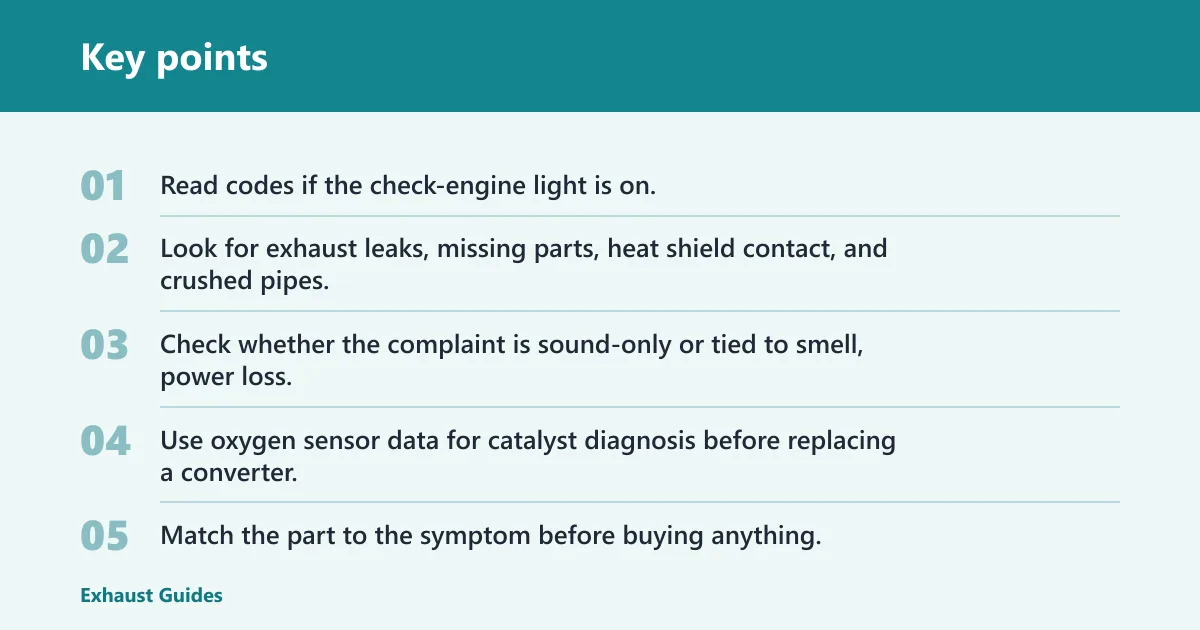
- Read codes if the check-engine light is on.
- Look for exhaust leaks, missing parts, heat shield contact, and crushed pipes.
- Check whether the complaint is sound-only or tied to smell, power loss, or emissions failure.
- Use oxygen sensor data for catalyst diagnosis before replacing a converter.
- Match the part to the symptom before buying anything.
Can I replace a catalytic converter with a resonator?
No. A resonator cannot replace a catalytic converter because it does not clean exhaust gases or satisfy catalyst monitoring. Swapping in a resonator where a converter belongs can create a check-engine light, fail emissions testing, and leave the vehicle illegal for street use where catalyst equipment is required.
Why the swap does not work
The converter contains the chemical catalyst substrate that does the emissions work. The resonator has no such function. Even if the exhaust fits physically, the car still needs a catalyst to satisfy the ECU and the inspection process.
When a legal issue is most likely
Risk increases when you delete a converter on a street-driven vehicle. CARB compliance can matter in states that require approved replacement converters and an EO number. If you are buying a replacement converter, fitment and compliance matter more than a cheap part number that only bolts up.
Will removing the resonator cause a check engine light?
Usually, no. Removing a resonator does not normally trigger a check-engine light because it is not typically part of catalyst monitoring. You may get more drone, rasp, or cabin boom, but the ECU is not looking at the resonator the way it watches the converter through oxygen sensors.
When a light could still appear
If the exhaust job introduces a leak, damages an oxygen sensor, or changes sensor readings indirectly, a light can appear. That light would be about the sensor or leak condition, not the resonator itself. A proper diagnosis starts with the codes and the sensor data, not the deleted part alone.
Why would my car have both a catalytic converter and resonator?
Because they solve different problems. The converter handles emissions compliance, while the resonator fine-tunes sound. Many vehicles use both so they can meet legal pollutant limits and still sound acceptable at idle, acceleration, and steady cruise.
What each part contributes in the same exhaust system
The converter comes first in the chain of legal necessity. The resonator follows as part of the sound-control strategy, often paired with a muffler farther back. That combination lets the manufacturer control emissions, drone, and total loudness without over-restricting the exhaust on a stock daily driver.
Backpressure and flow tradeoff
All three parts affect exhaust flow and backpressure, but on stock daily drivers the difference is usually modest. A common mistake is assuming a delete will add a large power gain. In practice, the bigger gain is often in sound, while the legal and inspection downside can be much larger.
Which part is required for emissions testing?
The catalytic converter is the part tied to emissions testing. Test procedures care about catalyst performance and whether the vehicle still has the emissions equipment it was built to use. A muffler or resonator change can affect noise, but noise alone is not the same as an emissions pass or fail.
What inspectors and scanners are looking for
Inspectors and diagnostic tools focus on catalyst efficiency, codes like P0420 and P0430, and visible emissions equipment presence where required. Oxygen sensor behavior matters because it helps confirm whether the converter is storing and cleaning exhaust as it should. A missing resonator usually does not matter to the emissions test outcome.
Is a catalytic converter the same as a muffler?
No. The catalytic converter treats exhaust gases chemically. The muffler reduces noise with chambers, perforated tubes, packing, or a combination of those designs. They can sit near each other, but their jobs are different and neither one is a substitute for the other.
Why people confuse them
Both are large canisters in the exhaust line, and both can fail. A broken converter can rattle or restrict flow, while a damaged muffler can make the car loud. Those overlaps confuse owners, but a noise complaint is not the same as an emissions fault.
Can a resonator help with drone or rasp?
Yes. That is the resonator’s main job. It targets specific sound frequencies that create drone or rasp, which can make a car feel less harsh at cruise and less metallic under throttle without changing emissions performance.
When a resonator is the right fix
If the car passed emissions, has no catalyst codes, and the complaint is mainly highway boom or tinny exhaust note, the resonator is the part to investigate first. If the muffler is already too aggressive, a resonator can only do so much. It is a tone fix, not a cure for every loud exhaust.
Choose catalytic converter if… / Choose resonator if…
Choose the catalytic converter if the problem involves smell, codes, or inspection failure. Choose the resonator if the problem is drone, rasp, or a tone you want to smooth out. The muffler becomes the better answer when the car is simply too loud overall.
Choose catalytic converter if…
You have P0420 or P0430. You smell rotten eggs or a strong sulfur odor. The car fails emissions testing. The vehicle has a missing, gutted, or damaged converter. Any of those point to an emissions fault, not a tone-tuning problem.
Choose resonator if…
You want less cabin boom at steady speed. You hear rasp or a tinny edge under acceleration. The car is still compliant on emissions and has no catalyst-related codes. In those cases, a resonator change can solve the complaint without touching the emissions system.
Choose muffler if…
The whole exhaust is too loud. The sound change you want is broader than drone control. The system already has a healthy converter and resonator, but the car still sounds too aggressive. That is usually a muffler decision, not a converter decision.
Frequently asked questions
Does a resonator affect emissions like a catalytic converter?
No. A resonator does not chemically change exhaust gases, so it does not reduce hydrocarbons, carbon monoxide, or nitrogen oxides. It changes tone only. If emissions are the problem, the converter and oxygen sensor data are the places to check.
Which exhaust part changes sound the most?
The muffler usually changes overall loudness the most. The resonator mainly changes tone, rasp, and drone. The catalytic converter can affect sound if it is damaged or clogged, but that is a fault effect rather than its normal job.
Which part is required for emissions testing?
The catalytic converter is the key part for emissions testing. Test results depend on catalyst performance, oxygen sensor signals, and the presence of the emissions equipment the vehicle was designed to use. A resonator does not decide pass or fail.


