Resonator Delete vs Muffler Delete: Key Differences
A resonator delete is often said to change tone and drone more than volume. A muffler delete makes the exhaust much louder and usually worse for daily comfort. Done poorly, either change can trigger drone, legal trouble, and unwanted cabin noise. This guide compares sound, drone, legality, and drivability so you can choose the right exhaust change.
| Factor | Resonator delete | muffler delete | Winner |
|---|---|---|---|
| Cabin drone | More likely to shift or expose a low-frequency boom at steady cruise | Can create drone too, but the larger change is usually overall loudness | Resonator delete |
| Exterior loudness | Moderate increase, often smaller than a full muffler removal | Large increase at idle, cruise, and wide-open throttle | muffler delete |
| Highway comfort | Often better than a muffler delete if the rest of the system stays stock | Usually worse, especially on long steady-speed drives | Resonator delete |
| Inspection and street-use risk | Can still fail where a missing exhaust part is not allowed | Higher risk, since the final noise-control part is gone | Resonator delete |
| Likely cost | Usually lower if the section is short and easy to replace | Often higher because the muffler is larger and may need more fabrication | Resonator delete |
| Best-fit use case | Driver who wants a sharper tone with some restraint | Driver who wants maximum volume and accepts the tradeoff | Tie |
What each part does in the exhaust path
Where the resonator usually sits
On many factory layouts, the resonator sits before the muffler. CurateView says the resonator receives exhaust noise first, and Wicked Wrench describes it as a hollow chamber with perforated tubes or materials that target specific frequencies. Its job is to change engine noise before it reaches the muffler. (Thedrive)
Where the muffler usually sits
The muffler is usually the final major noise-reduction component at the end of the exhaust system. Wicked Wrench describes mufflers as chambers and baffles, and CurateView says they use reflected sound waves to cancel noise. That is why a muffler usually has the larger effect on total loudness and on how civil the car sounds.
How factory layout changes the result
Factory exhaust design matters as much as the delete itself. Some cars rely on the resonator for drone control, while others use it mainly to clean up a rough frequency before the muffler finishes the job. Aftermarket layouts can change the balance, so the same delete can sound mild on one model and harsh on another.
How does a resonator delete change sound?
A resonator delete mainly changes exhaust character. It removes a component that targets specific frequencies, so the tone often becomes sharper or more raw without the same jump in total volume that a muffler delete creates. On some cars, that means a better bark; on others, it means more boom at cruising speed.
Frequency shaping and harmonic control
The same source says resonators eliminate specific frequencies causing drone, and CurateView says they can remove specific frequencies and help the muffler. That makes the resonator a tone-shaping part, not just a noise plug. If the stock system sounds boomy at 2,000 to 2,500 rpm, removing the resonator can make that range more noticeable rather than less.
Cabin drone at steady highway speeds
Exhaust drone is the low-frequency cabin resonance that shows up during steady cruising. It is most noticeable on the highway, which is why a resonator question often comes up after a driver hears boom at 60 to 75 mph. A resonator delete can make that problem worse if the factory resonator was doing real drone control.
When a resonator delete barely changes volume
The Drive says a vehicle may work without a resonator, and that matters because the change is often about sound quality more than loudness. On some systems, the resonator only trims a narrow band of frequencies, so the outside volume changes less than people expect. The cabin tone can still become less polished.
Say your car has a long factory resonator and a separate rear muffler. Removing only the resonator may add a sharper note without turning the car into a straight-piped build, but it can still introduce a steady-speed boom that was not there before.
How does a muffler delete change sound?
A muffler delete usually changes total loudness more than tone. Because the muffler is the main noise-reduction piece at the end of the system, removing it raises idle, cruise, and wide-open-throttle volume all at once. The result is often the loudest option short of a straight pipe.
Overall loudness at idle, cruise, and wide-open throttle
The same source says mufflers reduce overall exhaust noise, and that is the effect most drivers notice first. At idle, the car can become more present outside the vehicle. Under load, the sound can get much louder and less filtered, especially if the rest of the system is still stock.
Why the car can sound harsher or less polished
Because mufflers use chambers, baffles, or perforated tubes to smooth the note, deleting one removes that smoothing step. The sound may become raspy, metallic, or uneven depending on engine layout and pipe length. A straight-through aftermarket muffler can often keep the volume increase while avoiding the roughest edge.
Why some vehicles become tiring on long drives
A muffler delete can make a car tiring on long drives because the noise increase is constant, not just a brief throttle burst. The effect is strongest in the cabin when the engine sits at a fixed rpm for long stretches. That is why this change usually has the bigger impact on day-to-day livability.
Resonator delete decision matrix
| Option | Cabin drone | Exterior loudness | Highway comfort | Inspection risk | Likely cost | Best-fit use case |
|---|---|---|---|---|---|---|
| No delete | Lowest | Lowest | Best | Lowest, though rules still vary | None | Daily driver, resale-sensitive car, strict noise area |
| Resonator delete | Moderate to high, depending on factory tuning | Moderate | Mixed | Moderate | Usually lower | Driver who wants more tone without maximum volume |
| muffler delete | Moderate to high | High | Poor to mixed | High | Usually higher | Weekend car, track-focused build, loudness-first setup |
| Both deletes | Highest risk of drone | Highest | Poor | Highest | Varies, often highest if custom work is needed | Race-only or off-road-only use where noise is not a concern |
| If your goal is a sharper tone with fewer complaints | Choose resonator delete only if the factory resonator is not the main drone-control part | Keep the muffler | Usually better than a muffler delete | Lower than a full delete | Usually the lowest delete cost | Daily driver with some sound tolerance |
Will either delete hurt performance?
Performance gains are usually small and situation-dependent. Backpressure claims need caution, because a restrictive muffler can add flow resistance, but deleting parts does not guarantee usable power gains. The result depends on engine type, turbo or naturally aspirated layout, and the factory exhaust design.
Why backpressure talk needs caution
Backpressure is often used loosely in exhaust discussions. A restrictive muffler can raise flow resistance, but too little exhaust tuning can also hurt drivability, sound quality, or low-speed response on some setups. A delete label alone does not tell you whether the change will help or hurt the way the engine breathes.
Why turbo and naturally aspirated engines can respond differently
Turbocharged engines often react differently from naturally aspirated engines because the turbo itself changes exhaust flow and sound. On many turbo setups, a muffler or resonator change may mostly alter tone. On some naturally aspirated V6 and V8 cars, the same delete can create more obvious drone because the exhaust pulses are less masked.
Picture an older V6 sedan with a long cabin and a rear muffler mounted close to the bumper. A muffler delete may add a loud drone band right where the car cruises on the highway, while a resonator delete alone may be easier to live with if the rear muffler stays in place.
Why the factory muffler design matters more than the delete label
Some factory mufflers are very restrictive, while others are already tuned to flow well. An aftermarket muffler can be a better middle path because it can preserve drivability while changing tone. Chambered and straight-through designs behave differently, so the actual part design matters more than the simple word “muffler.”
What are the legal and inspection risks?
Noise regulations vary by state, province, and country, and a delete can be illegal for street use in one place but tolerated in another. The Drive warns that a missing exhaust part may fail annual emissions inspection, and DNA Mufflers notes that noise ordinances and emissions regulations matter. Inspection failure and ticket risk are real concerns.
Examples that matter in practice
In California, noise and emissions enforcement can make a deleted exhaust a problem on a street car, especially if the modification changes the car beyond legal limits. In Ontario, street-use noise rules can also matter during inspection or roadside enforcement. In the UK, modified exhaust noise can draw attention under roadworthiness rules and local enforcement.
Resale and neighborhood concerns
A loud delete can also affect resale because some buyers want a quiet car, not an exhaust project. Neighborhood noise limits matter too. A setup that sounds exciting at full throttle may become a daily nuisance at 6 a.m. or on late-night returns.
Choose resonator delete if… / Choose muffler delete if…
Choose Resonator delete if you want a noticeable tone change without the biggest jump in total volume. It fits better when the car is a daily driver, highway commuter, or neighborhood-sensitive build, and when you want to reduce the chance of turning every cruise into drone. It is also the better first move if you are trying to preserve some drivability before going louder.
Choose muffler delete if loudness is the goal and daily comfort matters less. It fits track-only, weekend-only, or sound-first builds, especially when the owner accepts that the car may sound harsher and may draw more legal attention. If the plan is maximum volume, a muffler delete usually gets there faster than a resonator delete.
Choose neither if the car must pass strict inspection, stay quiet in a dense neighborhood, or hold resale appeal. In that case, an aftermarket muffler with a chambered or straight-through design is often the better middle option. Straight pipes make the least sense for daily driving because they are usually the loudest and least refined result.
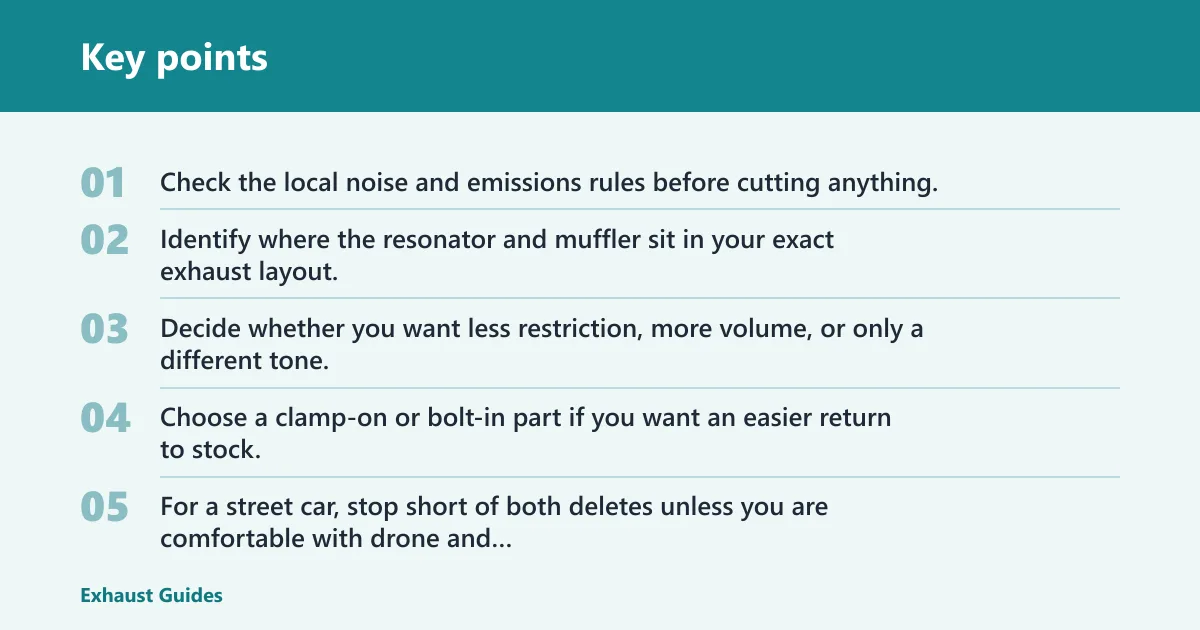
- Check the local noise and emissions rules before cutting anything.
- Identify where the resonator and muffler sit in your exact exhaust layout.
- Decide whether you want less restriction, more volume, or only a different tone.
- Choose a clamp-on or bolt-in part if you want an easier return to stock.
- For a street car, stop short of both deletes unless you are comfortable with drone and inspection risk.


Frequently asked questions
What is the difference between a resonator delete and a muffler delete?
A resonator delete removes the part that targets specific frequencies, so it changes tone and drone behavior more than total volume. A muffler delete removes the final major noise-control component, so it usually makes the car much louder overall and less comfortable for regular street use.
Does a resonator delete make your car louder than a muffler delete?
No. A muffler delete usually increases total loudness more because the muffler is the main noise-reduction part at the end of the exhaust. A resonator delete can still make the car sound sharper or boomier, but the louder result usually comes from removing the muffler.
Will deleting the resonator cause drone on the highway?
It can. Exhaust drone is most noticeable during steady highway cruising, and the resonator often exists to cancel specific frequencies in that range. If the factory resonator was doing real drone control, deleting it may leave a low-frequency boom that becomes annoying on longer drives.
Will a muffler delete affect performance?
Sometimes, but the effect is usually small and depends on the engine and exhaust design. A less restrictive path can reduce flow resistance, yet that does not guarantee better drivability or power. Turbo and naturally aspirated engines can react differently, so broad claims are unreliable.
Is a resonator delete legal on a street car?
It depends on where you live. Noise regulations and emissions rules vary by state, province, and country, and The Drive warns that a missing exhaust part may fail annual emissions inspection. A resonator delete can be legal in one area and a problem in another.
What parts do you remove for a resonator delete?
You remove the resonator section and replace it with a straight pipe, a welded-in section, or a bolt-in replacement where the layout allows it. The exact piece depends on the car, since some systems have a long resonator, while others use a short mid-pipe resonator tucked before the muffler.
What parts do you remove for a muffler delete?
You remove the muffler, which is usually the final major noise-control component. In many systems that means cutting out the rear section and fitting a straight pipe or delete pipe in its place. Clamp-on options exist on some cars, but custom welding is common.