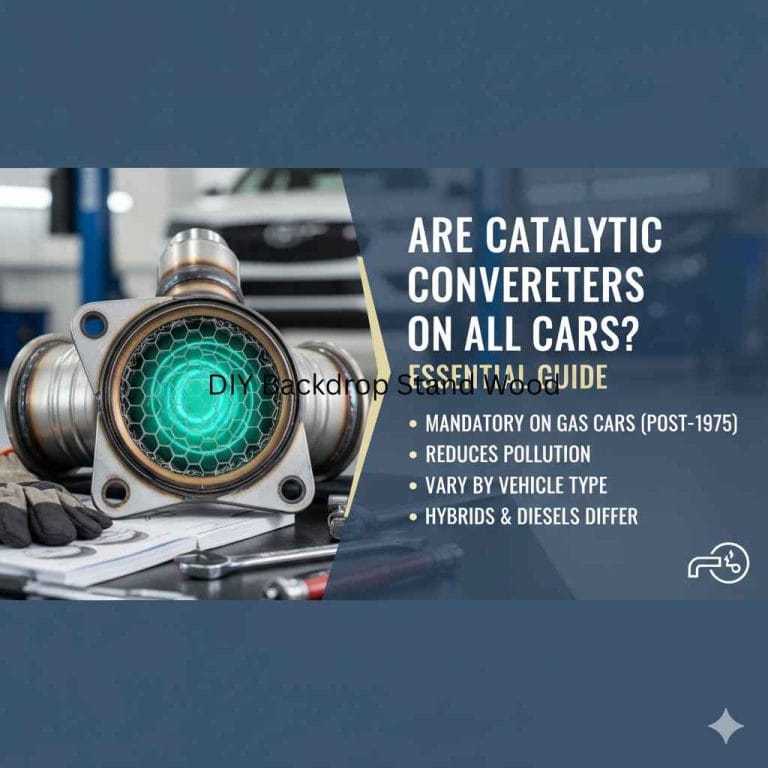
Are Catalytic Converters Mandatory in Montana? Essential Guide
Yes, catalytic converters are generally mandatory for most vehicles operating in Montana. While Montana doesn’t have statewide emissions testing for all vehicles, federal clean air laws and specific local regulations may still require your vehicle to have a functioning catalytic converter for it to be legally considered roadworthy and to reduce harmful pollutants.
Wondering if your car in Montana needs a catalytic converter? It’s a common question, and understanding the rules can feel a bit confusing. You want to make sure your vehicle is legal, safe, and kind to our beautiful Montana air. Don’t worry, we’ll break down exactly what you need to know about catalytic converters and Montana’s laws. Let’s get your car running right and keep our environment clean!
Understanding Catalytic Converters: The Basics
Think of your catalytic converter as a vital part of your car’s exhaust system. Its main job is to take the harmful gases produced by your engine’s combustion and convert them into less harmful substances before they’re released into the atmosphere. It’s like a chemical filter for your exhaust!
Inside the converter are precious metals like platinum, palladium, and rhodium. These metals act as catalysts, which means they help chemical reactions happen without being used up themselves. These reactions transform pollutants like carbon monoxide (CO), unburned hydrocarbons (HC), and nitrogen oxides (NOx) into carbon dioxide (CO2), water (H2O), and nitrogen (N2).
These pollutants are not only bad for the environment, contributing to smog and acid rain, but they can also be harmful to human health. That’s why catalytic converters are such important components for modern vehicles.
Are Catalytic Converters Mandatory in Montana? The Law Explained
This is the big question, and the answer isn’t a simple yes or no that applies to every single vehicle, everywhere in Montana, all the time. However, for the vast majority of vehicle owners, the answer leans towards “yes, they are mandatory.”
Here’s a breakdown of why:
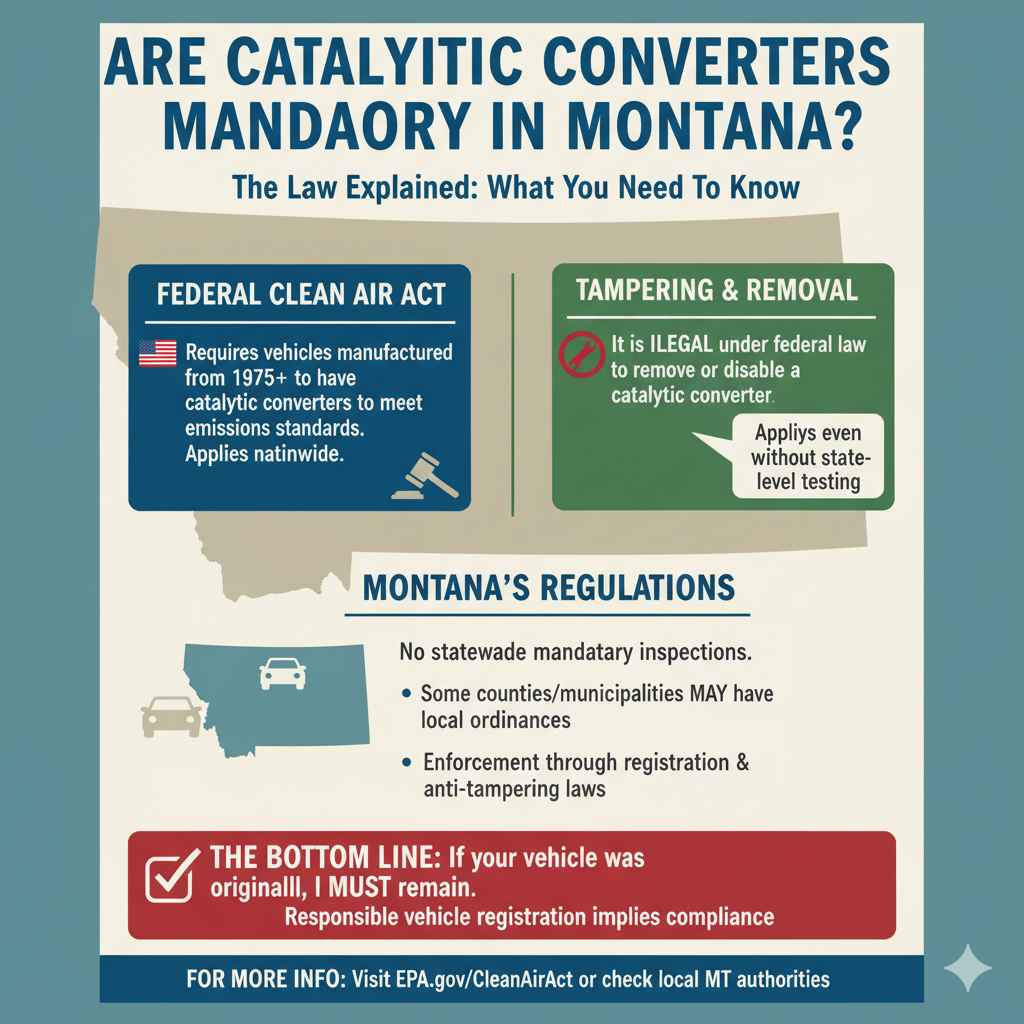
- Federal Clean Air Act: The United States has a federal law called the Clean Air Act. This law requires that vehicles manufactured after a certain date (depending on the model year) be equipped with a catalytic converter to meet emissions standards. Even if a state doesn’t have its own specific enforcement program for emissions testing, the federal law still applies to prevent tampering and removal. You can learn more about the Clean Air Act’s impact on vehicle emissions on the U.S. Environmental Protection Agency (EPA) website.
- Vehicle Age and Emissions Standards: Generally, vehicles manufactured from 1975 onwards in the U.S. are required to have catalytic converters. Montana, like all states, follows these federal guidelines. If your vehicle was originally equipped with a catalytic converter by the manufacturer, it legally must remain on the vehicle.
- Tampering and Removal Prohibitions: It is illegal under federal law to remove or disable a catalytic converter on a vehicle that was originally equipped with one. This is true even if there isn’t a specific state-level emissions inspection program that checks for them.
- Montana’s Specific Regulations: Montana does not have statewide mandatory emissions inspections for all passenger vehicles. However, this doesn’t mean catalytic converters are optional. Some counties or municipalities, particularly those with larger populations or specific environmental concerns, could implement local ordinances or emissions testing requirements. As of now, these are limited, but it’s always wise to check with your local authorities if you live in a more populated area. The primary enforcement often comes through registration and anti-tampering laws rather than routine testing.
- State Vehicle Registration: When you register your vehicle in Montana, you are essentially attesting that your vehicle is in safe and legal operating condition. This includes having all required emissions control equipment, such as the catalytic converter, in place and functioning.
In essence, while you might not get a sticker shock from a mandatory annual emissions test like in some other states, the underlying federal regulations and the principle of maintaining your vehicle’s original emissions control system mean that removing your catalytic converter is generally not permissible in Montana.
Why You Shouldn’t Remove or Tamper with Your Catalytic Converter
You might be tempted to remove your catalytic converter, perhaps because it’s damaged, or you’ve heard it can improve performance. However, there are significant reasons why this is a bad idea:
- Environmental Impact: This is the most crucial reason. Catalytic converters play a massive role in reducing air pollution. Removing one means your car will release substantially more toxins into the air, harming local air quality and contributing to global environmental issues.
- Legality: As discussed, it’s illegal under federal law to remove or tamper with a catalytic converter on any vehicle that was originally manufactured with one. This can lead to fines and legal trouble.
- Vehicle Performance Issues: Modern cars are designed to work with a catalytic converter. Removing it can sometimes lead to unexpected performance problems. The engine’s computer (ECU) relies on readings from oxygen sensors before and after the converter. Without the converter, these readings will change drastically, which can confuse the ECU, leading to poor fuel economy, rough idling, and the “Check Engine” light illuminating the dashboard.
- Noise Pollution: Catalytic converters also help to muffle exhaust noise. Removing one will likely make your vehicle significantly louder, which can be annoying to others and may even violate local noise ordinances.
- Resale Value and Resale Problems: A car without a catalytic converter is difficult to sell legally and may have a lower resale value, especially if a buyer is aware of the legal implications and environmental impact.
When a Catalytic Converter Might Be Replaced
The most common reason to interact with your catalytic converter is when it needs to be replaced. Catalytic converters don’t last forever. Over time, they can become clogged, damaged, or simply wear out. Here are common reasons for replacement:
- Clogging: The catalyst materials inside can degrade or become coated with soot and contaminants from burning oil or antifreeze, leading to a blockage. A clogged converter can severely restrict exhaust flow, causing significant power loss, overheating, and poor engine performance.
- Physical Damage: Catalytic converters are located underneath the vehicle and can be susceptible to damage from road debris or impacts. This can cause cracks in the casing or internal damage.
- Contamination: Using leaded gasoline (rare nowadays), coolant leaks into the combustion chamber, or excessive oil consumption can contaminate the catalyst, rendering it ineffective.
- Age and Mileage: Like any part of a car, catalytic converters have a lifespan. After many years and miles, the catalytic materials can lose their effectiveness even without specific damage.
If you suspect your catalytic converter is failing, you’ll likely notice symptoms such as:
- Reduced engine power and acceleration.
- Poor fuel economy.
- A rotten egg smell from the exhaust (often due to unburned fuel entering the converter).
- The “Check Engine” light coming on.
- Difficulty starting or stalling.
How to Replace a Catalytic Converter in Montana (DIY vs. Professional)
Replacing a catalytic converter is a more involved task than changing your oil, but it’s something many DIYers with good mechanical skills can tackle. However, it often requires specific tools and knowledge, and sometimes it really is best left to the professionals.
DIY Replacement Steps (General Guidance)
This is a simplified overview. Always consult your vehicle’s specific repair manual for exact instructions.
- Gather Your Parts and Tools: You’ll need a new, compatible catalytic converter (ensure it’s the correct one for your car’s make, model, year, and engine size, and that it’s EPA-certified if required by local laws). You’ll also need new gaskets, any necessary nuts and bolts, anti-seize lubricant, and safety gear (gloves, eye protection). Tools typically include a socket set, wrenches, a torque wrench, a jack and jack stands, a wire brush, and possibly a cutting tool (like an angle grinder or reciprocating saw) if the old converter is rusted or difficult to remove.
- Safety First! Park your car on a level surface. Engage the parking brake. Use sturdy jack stands to safely lift and support the vehicle. Never work under a car supported only by a jack.
- Locate the Old Converter: It’s usually found in the exhaust system pipe between the exhaust manifold and the muffler.
- Disconnect Oxygen Sensors: Carefully disconnect any oxygen sensors that are attached to or near the catalytic converter.
- Remove the Old Converter: This is often the trickiest part. Bolts can rust and seize. You may need to apply a penetrating lubricant and let it soak. If the bolts are too corroded, you might need to cut the exhaust pipe on either side of the converter’s mounting brackets.
- Clean Mounting Surfaces: Once the old converter is out, thoroughly clean the mating surfaces on the exhaust pipes where the new converter will attach.
- Install the New Converter: Position the new catalytic converter. Install new gaskets and loosely attach the bolts.
- Tighten Securely: Gradually tighten the bolts, using a torque wrench to precise specifications if available. This ensures a good seal and prevents leaks.
- Reconnect Oxygen Sensors: Reinstall the oxygen sensors.
- Lower Vehicle and Start Up: Carefully lower the vehicle. Start the engine and listen for any exhaust leaks. Check that the “Check Engine” light is off (it may take a few driving cycles for it to reset completely if the battery was disconnected).
When to Call a Professional
- Lack of Tools or Space: If you don’t have a well-equipped garage, reliable tools, or a safe place to lift your vehicle, it’s safer to go to a professional.
- Rusted Exhaust System: If your car’s exhaust system is heavily rusted, removing the old converter can be extremely difficult and may cause further damage. Professional shops have specialized tools and techniques for this.
- Complexity: Some exhaust systems are complex, with multiple converters or integrated components. A professional mechanic will have the expertise to handle these situations.
- Warranty Concerns: If your vehicle is still under warranty, having a professional perform the repair can ensure warranty compliance.
- Emissions Testing Requirements: If you live in an area that does have emissions testing (even if not statewide in Montana), a professional installer can ensure the replacement meets all specifications.
A reputable exhaust shop or mechanic will also ensure they install an EPA-certified converter or one that meets all applicable federal and state regulations. You can often find good resources for parts and installation services through organizations like the Muffler Man or similar national chains that operate locally.
Cost of Catalytic Converters in Montana
The cost of a catalytic converter can vary significantly based on several factors. This is one reason why some people are tempted to remove them, but remember the legal and environmental consequences.
Factors Affecting Cost:
- Vehicle Make and Model: Luxury vehicles, SUVs, and trucks often have larger or more complex converters, which are more expensive.
- Type of Converter: Universal converters are generally cheaper than direct-fit converters that are specifically designed for your vehicle.
- Material Quality: Converters with higher concentrations of precious metals (platinum, palladium, rhodium) are more expensive but can be more effective and last longer.
- Brand: Reputable brands like MagnaFlow, Walker, or Direct-Fit tend to cost more but offer better quality and warranties.
- Labor Costs: If you have it installed by a professional, labor costs will be added on top of the part price.
Price Ranges (Estimates for Montana):
It’s important to note that prices are estimates and can change. It’s always best to get a quote for your specific vehicle.
| Type of Catalytic Converter | Estimated Price (Part Only) | Estimated Installation Cost (Professionally) |
|---|---|---|
| Universal Aftermarket | $100 – $300 | $100 – $250 |
| Direct-Fit Aftermarket | $200 – $600 | $100 – $250 |
| OEM (Original Equipment Manufacturer) | $500 – $2,000+ | $100 – $250 |
Note: The price of precious metals used in catalytic converters has fluctuated, which can impact the cost of replacement parts. Always verify current pricing.
Montana’s Environmental Goals and Your Vehicle
Montana boasts some of the most stunning natural landscapes in the country. From the Rocky Mountains to vast plains, preserving this beauty is a priority for many residents. Your vehicle’s emissions system, including the catalytic converter, plays a role in this effort.
By ensuring your catalytic converter is present and functioning, you are actively participating in protecting Montana’s air quality. This helps to:
- Reduce smog, which can affect visibility and respiratory health.
- Minimize acid rain, which can harm forests, lakes, and wildlife.
- Lessen the impact of greenhouse gases contributing to climate change.
- Maintain the pristine beauty of our state for future generations.
Even without mandatory statewide testing, responsible vehicle ownership means ensuring your car isn’t unnecessarily polluting our environment. You can find more information about Montana’s environmental initiatives and air quality efforts on the Montana Department of Environmental Quality (DEQ) Air Quality Bureau website.