Exhaust Smoke on Startup vs While Driving: Key Differences
Smoke at startup usually points to oil draining into cylinders or to condensation. Smoke only while driving points more toward load-related oil, fuel, or coolant faults. Miss the timing, and you can chase the wrong repair while a minor leak turns into engine damage. This guide separates startup, idle, acceleration, cruise, and deceleration smoke patterns so you can narrow the cause quickly.
| Decision factor | Exhaust smoke on startup | while driving | Winner |
|---|---|---|---|
| Best diagnostic value | Best for faults that show after the car sits, especially a cold start puff or warm restart smoke. | Best for faults that appear only under load, boost, cruise, or deceleration. | tie |
| Most likely oil-smoke paths | Valve stem seals, PCV oil pull, and sometimes turbo seals that bleed down after shutdown. | Piston rings, turbo seals, and PCV faults that worsen as pressure rises. | tie |
| Urgency pattern | Often less urgent if it is a brief puff that clears quickly and fluid levels stay steady. | More urgent if smoke grows with acceleration, appears at highway load, or comes with drivability issues. | while driving |
| First check | Oil level, coolant level, and recent service history such as oil change or spark plug replacement. | Oil level, coolant level, OBD scan, and whether boost, cruise, or decel changes the smoke. | while driving |
Timing-first comparison
Exhaust smoke on startup usually wins the first diagnosis step when the smoke appears only after sitting, then clears as the engine warms. while driving takes over when smoke shows up under acceleration, steady cruise, or deceleration, because load changes can expose pressure-driven leaks that idle testing misses.
Best diagnostic value
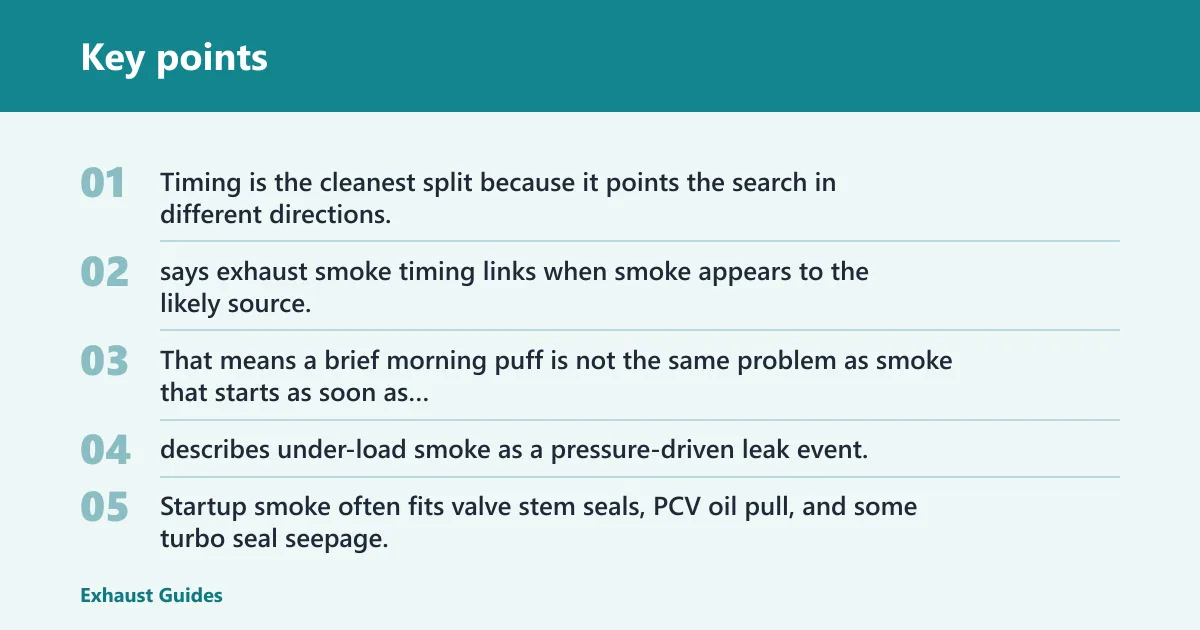
Timing is the cleanest split because it points the search in different directions. Exhaust smoke timing links when smoke appears to the likely source, and a cold-start puff most often points to oil that seeped in while the car sat.
That means a brief morning puff is not the same problem as smoke that starts as soon as you ask for power. Under-load smoke as a pressure-driven leak event, so the engine state matters as much as the smoke color.
Most likely oil-smoke paths
Startup smoke often fits valve stem seals, PCV oil pull, and some turbo seal seepage. Valve stem seals is commonly listed as one of four main startup-only smoke causes, and cold start as a stored-oil burn-off event.
Smoke while driving more often points to piston rings, turbo seals, or a PCV fault that becomes obvious when crankcase pressure rises. Smoke that grows under load usually tracks oil pushed past worn seals or rings.
Urgency pattern
A brief puff at startup May be less urgent than smoke that appears while driving, especially if the startup smoke clears quickly and the fluid levels stay stable.
Smoke under load can signal an active leak path that worsens with acceleration, boost, or crankcase pressure. If that smoke is heavy, persistent, or tied to drivability symptoms, the risk is higher than a short cold-start haze.
First check
For startup smoke, begin with oil level, coolant level, recent service history, and, if driving smoke is present, an OBD scan. There are 7 main clues to log before diagnosis, and smoke color, timing window, duration, engine temperature, driving trigger, fluid trends, and misfire/odor are commonly listed among them.
For smoke while driving, add an OBD scan and note exactly which driving condition triggers it. Acceleration, steady cruise, and deceleration do not point to the same fault path.
Smoke timing decision matrix
| Timing | Color | Smell and duration | Likely source | Urgency | First check |
|---|---|---|---|---|---|
| Cold start | Blue or blue-gray, or thin white vapor | Oil smell with a brief puff; thin white vapor that disappears quickly can be normal on a cold morning | Stored oil burn-off, valve stem seals, PCV oil pull, or condensation | Low if brief and clearing; higher if continuous | Check oil level, coolant level, and outside temperature |
| Warm restart | Blue or blue-gray | Brief puff after a short stop; smoke should fade quickly | Valve stem seals or turbo seal seepage after shutdown | Low to moderate | Inspect recent oil loss and spark plugs |
| Idle | Blue, white, or black | Persistent smoke at idle is more concerning than a momentary haze | PCV fault, coolant leak, rich running, or worn seals | Moderate | Scan for codes and watch fluid trends |
| Acceleration | Blue or black | Smoke that worsens as throttle opens; fuel smell can point to rich running | Piston rings, turbo seals, PCV faults, or rich mixture | High if heavy or repeatable | Check boost behavior, OBD codes, and oil level |
| Steady cruise | Blue or white | Smoke that continues at a steady speed is not a condensation-only pattern | Oil control issue, coolant leak, or fuel control problem | High | Check coolant loss and scan for codes |
| Decel | Blue | Smoke on closed throttle or after lift-off often tracks oil control issues | Valve stem seals, turbo seals, or ring wear | Moderate to high | Inspect plugs, intake tract, and PCV system |
Cold start
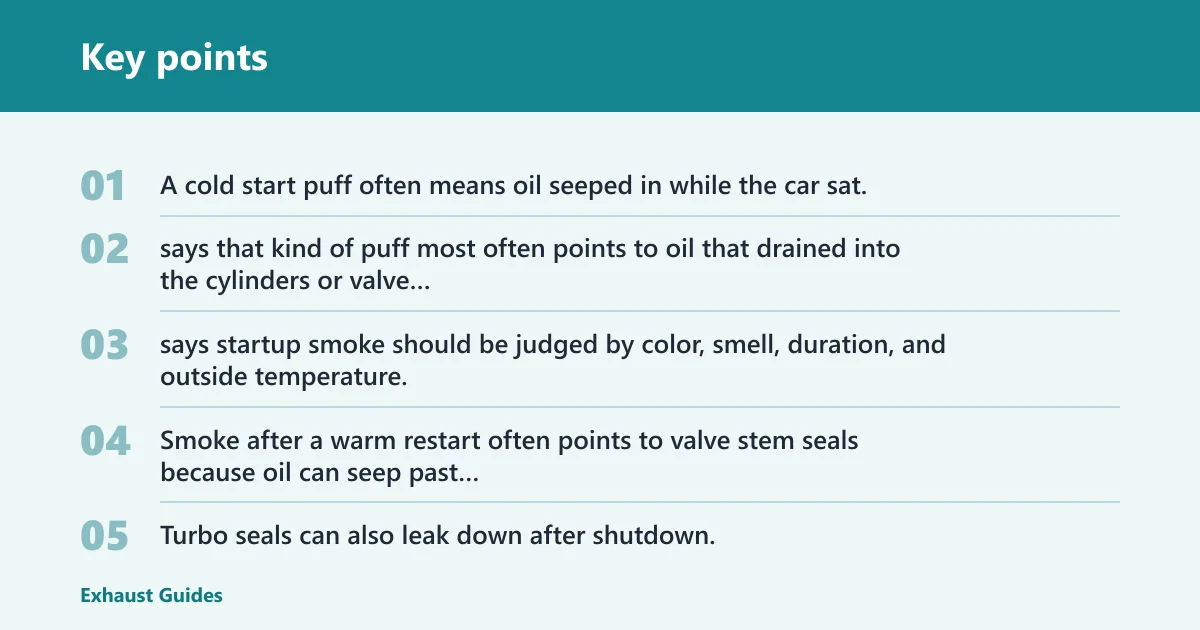
A cold start puff often means oil seeped in while the car sat. Kind of puff most often points to oil that drained into the cylinders or valve area overnight, while thin white vapor that disappears quickly is often normal condensation.
Do not judge it by color alone. Startup smoke should be judged by color, smell, duration, and outside temperature, because a cold morning can create harmless vapor that vanishes within seconds.
Warm restart
Smoke after a warm restart often points to valve stem seals because oil can seep past them while the engine sits briefly. Turbo seals can also leak down after shutdown, which is why the smoke may appear only after a stop and then clear.
If the puff is short and then disappears, the pattern is less urgent than smoke that keeps going after the engine is fully warm. Continuous smoke means the leak is not just a sit-and-drain event.
Idle
Smoke at idle can come from PCV oil pull, coolant entry, rich fueling, or worn seals that become visible when airflow and load are low. White smoke at idle needs a smell check; a sweet odor raises coolant suspicion, while an oily odor points toward oil burn.
If the smoke grows while the car idles longer, do not assume condensation. Condensation should fade, not build.
Acceleration
Smoke that gets worse when you accelerate usually points to a pressure problem. Smoke that grows under load usually tracks oil pushed past worn seals or rings, and calls under-load smoke a pressure-driven leak event.
This is where piston rings and turbo seals rise on the list. Boost and crankcase pressure can both change the symptoms, which is why a car can look fine at idle and smoke as soon as the throttle opens.
Steady cruise
Smoke at a steady road speed is usually more concerning than a brief startup puff because it suggests the fault may persist after warm-up. That pattern can fit oil control problems, coolant burning, or a fuel issue depending on color and smell.
Black smoke at cruise usually points to too much fuel or not enough air. Black smoke usually means too much fuel or not enough air, so look at mixture control if the smoke is dark and sooty.
Decel
Smoke on deceleration often points to oil being drawn where it should not go when vacuum changes. Valve stem seals and turbo seals are common suspects, especially if the smoke appears after a throttle lift and then clears.
If the smoke is blue and only shows up on lift-off, that pattern is different from acceleration smoke. It usually argues against a simple cold-start condensation explanation.
Why does my exhaust smoke on startup but clear when I drive?
That pattern usually means a small amount of oil or condensation is present at startup, then gets burned off once the engine warms and airflow increases. A cold-start puff most often points to oil that seeped in while the car sat, and thin white vapor that disappears quickly is often normal condensation.
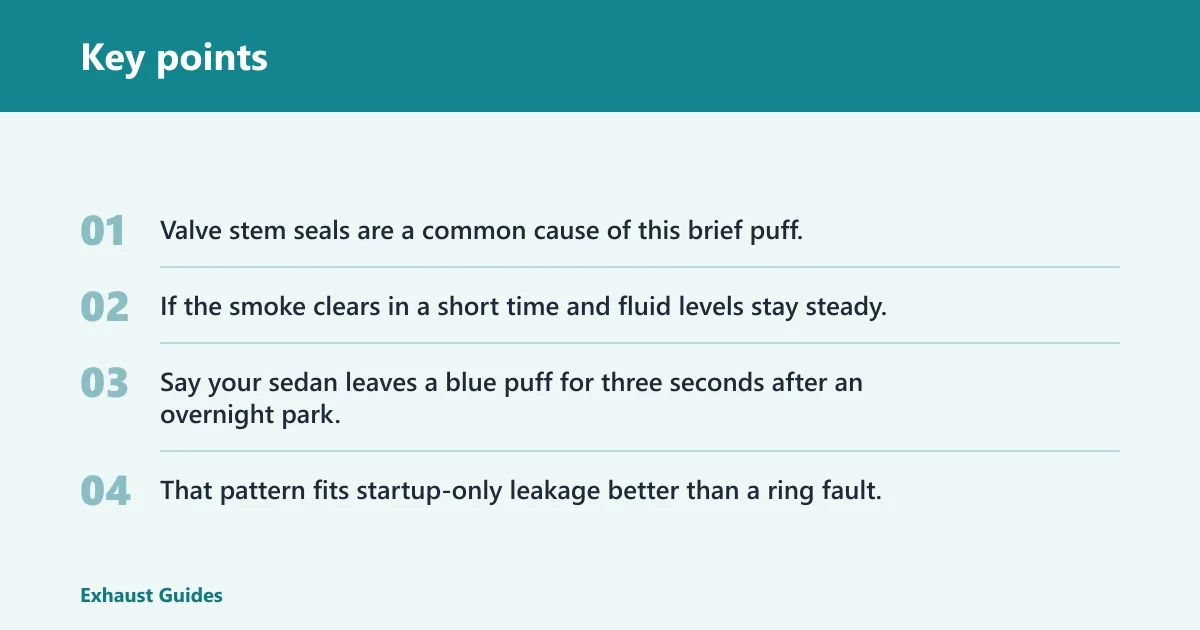
Valve stem seals are a common cause of this brief puff, especially after an overnight sit or a warm restart. If the smoke clears in a short time and fluid levels stay steady, the problem is often less urgent than smoke that remains under load.
Say your sedan leaves a blue puff for three seconds after an overnight park, then shows no smoke on the road. That pattern fits startup-only leakage better than a ring fault, because the symptom disappears once the engine starts moving air and oil control stabilizes.
What does smoke while driving point to?
Smoke while driving usually points to a fault that appears under load, not a simple startup seep. calls under-load smoke a pressure-driven leak event, so acceleration, cruise, and deceleration can each expose a different path.
If the smoke gets worse when you accelerate, look first at piston rings, turbo seals, and PCV faults. Highway load can raise boost and crankcase pressure, which can turn a small leak into visible smoke.
A common first-timer mistake is to ignore smoke that only shows up at 60 mph because the car idles cleanly in the driveway. That pattern is often more meaningful than startup smoke, because the engine is failing under the condition that matters most.
Startup smoke color clues
Blue smoke Usually means oil burning. Blue or blue-gray smoke is usually oil burning, and the main sources are valve stem seals, piston rings, turbo seals, or PCV faults.
White smoke Can be harmless condensation if it is thin and disappears quickly, especially on a cold morning. Thick white smoke with a sweet smell can point to coolant burning.
Black smoke usually means too much fuel or not enough air, so a rich mixture or incomplete combustion belongs on the list when the smoke is sooty and dark.
Blue smoke and oil burning
Blue smoke points toward oil, not coolant. The key question is timing: a brief puff at startup leans toward valve stem seals or oil seepage after shutdown, while blue smoke that worsens with acceleration leans toward rings, turbo seals, or PCV problems.
Do not treat all blue smoke as the same fault. A startup puff and a load-related cloud are different patterns.
White smoke, condensation, and coolant loss
Thin white vapor on a cold morning can be normal condensation, especially if it disappears quickly. Persistent thick white smoke with a sweet smell is not the same thing and should raise concern for coolant burning.
If coolant level drops along with the smoke, the problem is more urgent. That pattern deserves prompt inspection.
Black smoke and rich running
Black smoke means the engine is likely running rich or not burning the fuel completely. Under acceleration, that can point to a fuel control issue rather than an oil leak.
If the smoke is black and the engine feels sluggish, the next step is an OBD scan and a look at air supply and fuel control before parts replacement.
Could valve seals, rings, or turbo seals be the cause?
Yes, but the timing helps separate them. Valve stem seals usually fit a brief startup puff, piston rings usually fit smoke that worsens under acceleration, and turbocharger seals often fit boost-related smoke that can appear during driving or sometimes at startup.
The PCV system should be checked before major repairs because it can pull oil into the intake and mimic larger failures. A clogged or faulty PCV setup can create smoke at startup, idle, or under load.
Valve stem seals
Valve stem seals are a commonly reported cause of brief startup smoke. They allow oil seepage while the engine sits, so the smoke often shows up after an overnight park or a warm restart and then clears.
If the smoke is short-lived and mostly blue, that pattern fits valve seals better than a deeper internal wear problem.
Piston rings
Piston rings tend to show up as pressure-driven oil leakage under load. Smoke that worsens with acceleration, steady climb, or hard throttle raises suspicion for ring wear or cylinder wear.
That pattern is more concerning than a brief puff because it often means the engine is burning oil while pressure is highest.
Turbocharger seals
Turbocharger seals can leak oil into the intake or exhaust side. The smoke may be more noticeable under boost or acceleration, but turbo seals can also leave smoke at startup if oil drains into the housing after shutdown.
If the smoke changes with boost, pay attention to turbo behavior, intake oil residue, and whether the smoke appears after a long decel or hard pull.
First checks before you replace parts
- Check the oil level and coolant level with the car on level ground.
- Note the smoke color, smell, duration, and whether it happens cold, warm, at idle, on acceleration, at cruise, or on decel.
- Look for recent service history, including an oil change or spark plug replacement.
- Inspect the PCV system for stuck valves, broken hoses, or oil in the intake tract.
- Scan for OBD codes if the car has drivability symptoms, a check engine light, or repeat smoke under load.
If the smoke is startup-only, the oil and coolant checks come first. If it appears while driving, move the OBD scan and driving-condition notes higher on the list because the fault may depend on load, boost, or mixture control.
Suppose a turbo car starts clean but smokes blue only during a long uphill merge. That points away from simple condensation and toward a load-related path such as turbo seals, rings, or PCV oil pull.
When is exhaust smoke urgent enough to stop driving?
Stop driving if the smoke is persistent thick white with coolant loss, heavy under load, or paired with misfire, overheating, or major drivability problems. Those patterns can signal active coolant burning, severe oil consumption, or a fault that is getting worse in real time.
Startup-only smoke is often less urgent if it is brief and clears quickly, but it still needs attention if it grows over time or fluid levels drop. Smoke that changes from a short puff to constant haze is a warning sign.
Verdict: Exhaust smoke on startup or while driving?
Choose Exhaust smoke on startup if the smoke appears only after the car has sat, like a cold start puff or a warm restart smoke that clears quickly; that pattern points to oil draining into cylinders, valve stem seals, PCV oil pull, or condensation.
Choose while driving if the smoke shows up under acceleration, steady cruise, or deceleration; that pattern points to load-related faults like piston rings, turbo seals, or PCV issues that worsen as pressure rises.

Frequently asked questions
What does it mean if smoke gets worse when I accelerate?
Smoke that worsens with acceleration usually points to a pressure-related fault. Piston rings, turbo seals, and some PCV problems can let oil into the combustion path under load, and black smoke under throttle can also mean too much fuel or not enough air.
Is a brief puff of white smoke on startup normal?
Sometimes, yes. Thin white vapor that disappears quickly is often condensation on a cold morning. If the smoke is thick, stays visible after warm-up, or comes with a sweet smell and coolant loss, it is no longer in the normal range.
Does blue smoke on startup mean valve stem seals or piston rings?
Blue smoke on startup leans first toward valve stem seals because they can allow oil to seep in while the engine sits. If the blue smoke gets worse under acceleration or load, piston rings and turbo seals move higher on the list than simple startup seepage.
Can turbo seals cause smoke only when driving under load?
Yes. Turbocharger seals can leak oil into the intake or exhaust side, and the symptom often shows up more clearly under boost or acceleration. Some turbo faults also smoke at startup if oil drains into the housing while the engine is off.
How do I tell condensation from a real exhaust smoke problem?
Condensation is usually thin white vapor that disappears quickly, especially on a cold morning. A real problem tends to linger, repeat at the same driving condition, or come with oil smell, sweet coolant smell, fluid loss, or drivability symptoms.