How Exhaust Gas Flows Through a Modern Exhaust System
Exhaust gas leaves the cylinder during blowdown, pushes through the manifold and catalytic converters under remaining pressure, then passes the muffler and tailpipe as temperature and pressure drop. If that path is restricted or a sensor gives an inaccurate reading, it can lead to back pressure, power loss, overheating, and fault codes. This guide maps each stage of modern exhaust flow, including aftertreatment and the main monitoring points.
Exhaust flow map
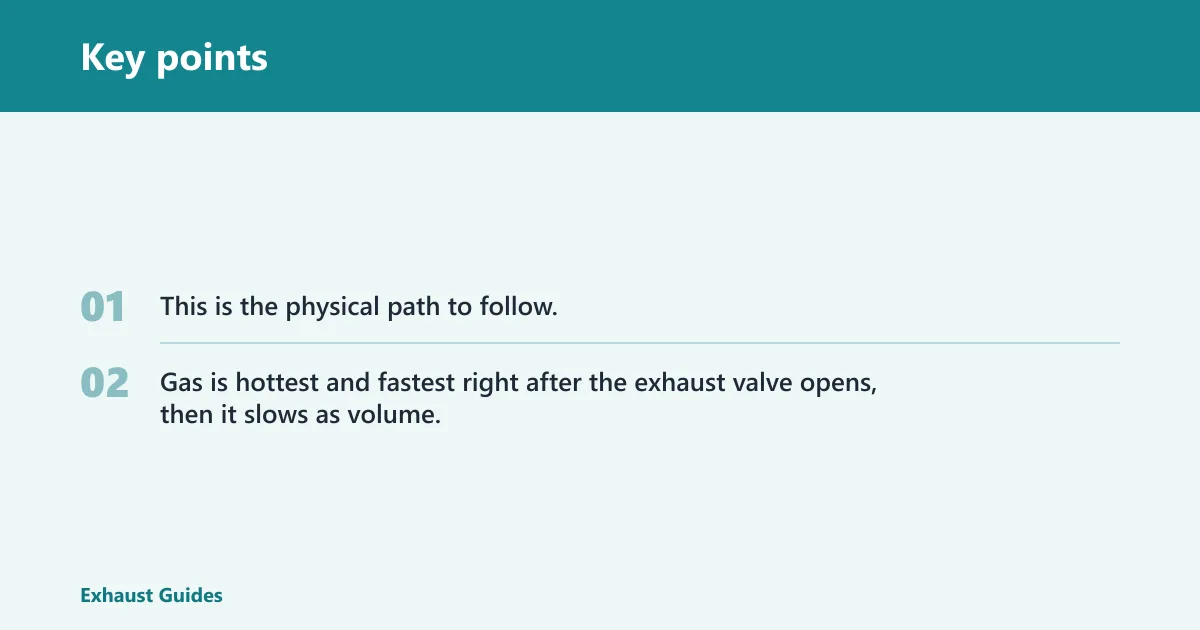
This is the physical path to follow. Gas is hottest and fastest right after the exhaust valve opens, then it slows as volume, bends, treatment devices, and pipe sizing shape the flow toward the tailpipe.
| Component | What the gas is doing | What changes pressure, temperature, velocity | Restriction symptom |
|---|---|---|---|
| Exhaust valve and port | High-pressure blowdown begins; gas exits the cylinder in pulses | Rapid pressure drop at the cylinder, extreme heat, very high velocity | Misfire-like noise, poor scavenging, hot exhaust valve damage |
| Exhaust manifold | First collection point for gases leaving the combustion chamber; pulses combine and move downstream | Pulse timing, runner length, and bends shape pressure waves and average flow | Noise change, cracked manifold, loss of low-speed torque, exhaust leak smell |
| Flex section | Allows engine movement while gas continues downstream | Flexible braid adds slight flow resistance; heat and pulse energy remain high | Rattle, leak, drone, visible soot at the joint |
| Pipes and bends | Gas travels in a long channel toward treatment parts | Smaller diameter raises velocity; sharp bends and rough joints increase pressure loss | Raised back pressure, sluggish throttle response, louder exhaust note |
| Catalytic converter | Pollutants are converted in the substrate while gas still flows through the core | Heat soak and reaction activity rise at 400-800°C; the brick adds flow resistance | Rattling core, sulfur smell, power loss, efficiency fault codes |
| Oxygen sensors | Read oxygen content in the exhaust gas stream before and after the catalyst | Sensor location samples gas composition, not flow speed directly | Incorrect fuel control, catalyst monitoring faults, poor emissions behavior |
| Diesel particulate filter | Soot is trapped in porous ceramic walls while cleaned gas continues through | Loading raises back pressure; regeneration needs 600-650°C to burn soot | High differential pressure, poor regeneration, limp mode, soot accumulation faults |
| Muffler and resonator | Pressure pulses are damped before the gas exits | Chambers and perforated tubes trade pulse energy for lower noise | Drone, rattles, restricted flow if baffles collapse or pack with debris |
| Tailpipe | Final discharge to atmosphere | Remaining pressure and temperature are lowest here | Weak outlet flow, soot staining, unusual smoke pattern |
How does exhaust gas leave the engine?
Exhaust gas leaves the cylinder during blowdown, when the exhaust valve opens and the remaining cylinder pressure forces gas out in a fast pulse. The manifold is usually the first collection point, carrying exhaust gas into downstream exhaust components while heat and pressure are still high.
Cylinder blowdown and pulse flow
That first release is not smooth. It is a series of pressure pulses timed by the firing order, so the manifold sees alternating bursts rather than a steady stream. Turbocharged engines add another layer, because the turbine sits in this hot, high-energy path and takes work from the flow before the rest of the exhaust system.
Where pressure remains high, gas speed stays high too. As the pipe volume increases and the gas expands, velocity falls and pressure drops, but every restriction delays that change.
Where heat and pressure are highest
The first section after the cylinder sees the hardest conditions: the highest temperature, the strongest pulses, and the steepest pressure drop. A cracked manifold, leaking gasket, or warped flange can disturb that flow before the gas ever reaches aftertreatment.
Picture a 4-cylinder petrol engine with a small crack at the manifold flange. The driver may hear a sharp tick on cold start, then a hiss under load. That leak sits before the catalyst, so it can also distort oxygen sensor readings and confuse fuel control.
What happens after the exhaust manifold?
After the manifold, gas moves through pipes, bends, flex sections, resonators, mufflers, and then the tailpipe. These parts do more than quiet the exhaust. They set velocity, shift pressure loss, and shape how the system breathes. A small change in diameter or bend radius can change flow enough to matter.
Pipes, bends, and flex sections
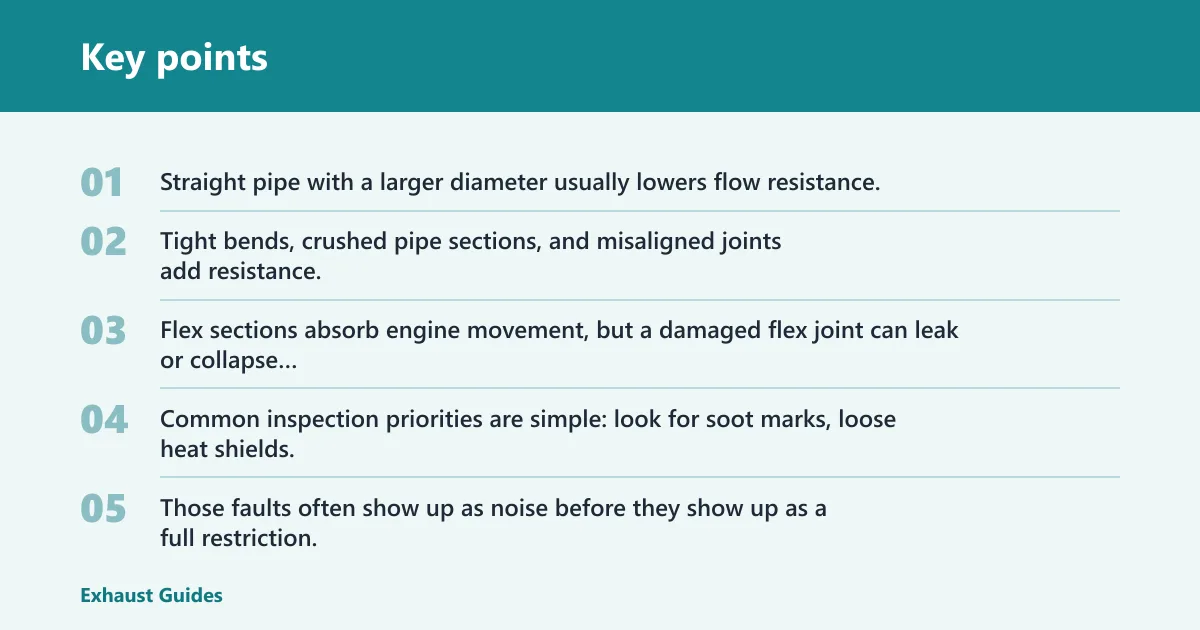
Straight pipe with a larger diameter usually lowers flow resistance, but too large a pipe can slow gas speed and weaken pulse energy. Tight bends, crushed pipe sections, and misaligned joints add resistance. Flex sections absorb engine movement, but a damaged flex joint can leak or collapse internally.
Common inspection priorities are simple: look for soot marks, loose heat shields, flattened pipe sections, and cracked welds. Those faults often show up as noise before they show up as a full restriction.
Resonators and mufflers in the flow path
Resonators and mufflers sit downstream to tame pulse noise. They use chambers, perforated tubes, and packing to reduce sound energy, which also means they create some pressure loss. A failed internal baffle can rattle; a collapsed internal tube can restrict flow and raise back pressure.
How pipe diameter changes velocity and pressure loss
Pipe size affects gas speed in a direct way. Narrower pipe raises velocity but also raises friction loss. Larger pipe reduces friction loss but can weaken pulse scavenging in some layouts, especially on naturally aspirated engines. The right size depends on the engine, the turbo, and the downstream treatment hardware.
How does the catalytic converter change exhaust flow?
The catalytic converter is a three-way unit in petrol engines that converts CO, HC and NOx into nitrogen, carbon dioxide and water. It sits in the flow path, so it affects both chemistry and pressure. The honeycomb substrate and washcoat add some resistance, but the main role is exhaust gas aftertreatment.
Three-way converter function in petrol engines
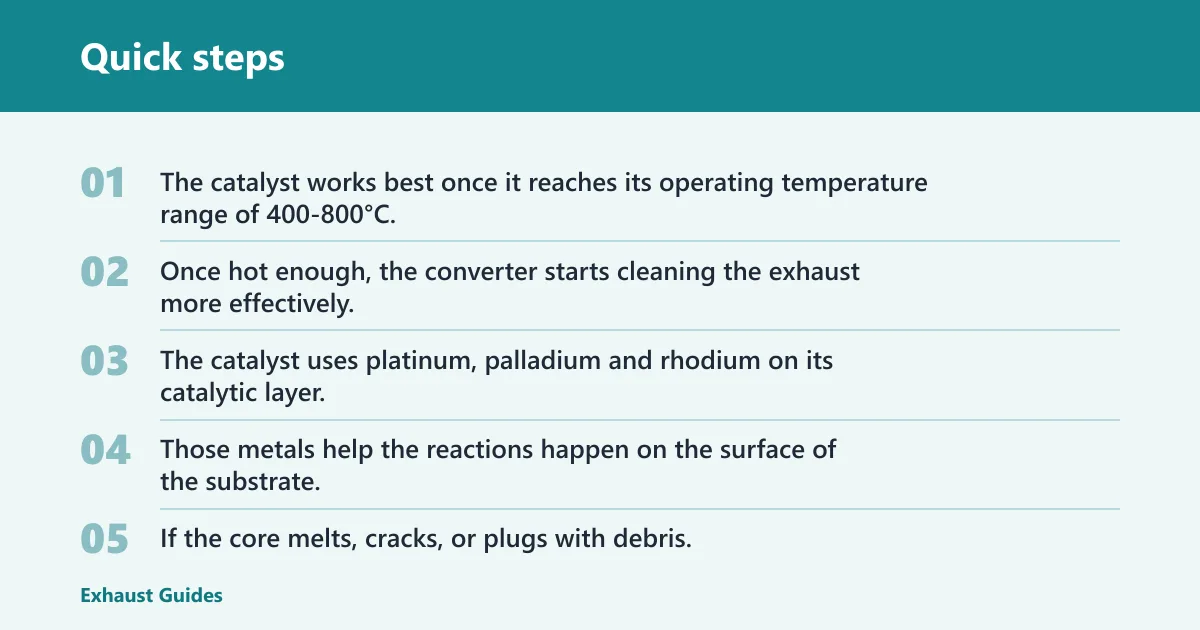
The catalyst works best once it reaches its operating temperature range of 400-800°C. Before that, conversion is limited. Once hot enough, the converter starts cleaning the exhaust more effectively, and the ECU uses sensor feedback to judge how well it is working.
Platinum, palladium, and rhodium in the substrate
The catalyst uses platinum, palladium and rhodium on its catalytic layer. Those metals help the reactions happen on the surface of the substrate. If the core melts, cracks, or plugs with debris, flow falls and the engine can lose power even before a full blockage forms.
Operating temperature and light-off behavior
When the converter reaches operating temperature, it moves from low activity to strong conversion. That transition is often called light-off. The upstream exhaust gas may still be hot enough to heat nearby components, but the converter itself is where the chemical cleaning becomes effective.
Suppose a small petrol hatchback begins to smell unusually sulfur-like after short trips, and the exhaust note turns dull at the same time. That can point to a catalyst that is overheating, contaminated, or partly blocked, especially if acceleration feels flat above 2,500 rpm.
Where do the oxygen sensors sit?
The oxygen sensor before the catalyst sits upstream in the exhaust stream, and the sensor behind the catalyst sits downstream. The upstream pre-cat sensor helps the ECU control air-fuel ratio, while the downstream post-cat sensor lets the ECU compare converter performance and spot poor storage or conversion.
Upstream sensor before the catalyst
The upstream sensor reads oxygen content in the exhaust gas stream before the converter. Because it sees raw exhaust, its signal changes quickly. The ECU uses that fast feedback to adjust mixture control on petrol engines.
Downstream sensor after the catalyst
The downstream sensor measures oxygen content after the catalytic converter. Its signal should be steadier if the catalyst is storing and converting gases properly. If the downstream pattern starts to mimic the upstream signal too closely, the ECU can log a catalyst-efficiency fault.
How the ECU compares both readings
Hella says the control unit compares upstream and downstream catalytic converter sensor values. That comparison does not measure flow velocity directly. It checks whether the converter is changing the exhaust composition the way it should.
How do upstream and downstream sensors read exhaust flow? They do not measure flow rate in a direct sense. They read oxygen content at two points in the stream, and the ECU compares those values to judge converter function and fuel control behavior.
How does a diesel particulate filter affect flow?
A diesel particulate filter stores solid particles that cannot be completely burnt in the engine. It uses porous ceramic filter walls, so exhaust gas passes through the wall while soot remains trapped. That design keeps soot out of the tailpipe, but it also raises back pressure as loading increases.
Soot storage in porous ceramic walls
The filter does not act like a straight pipe. Gas is forced through the porous wall structure, which traps soot in the channels. As soot builds, the usable cross-section shrinks and the exhaust has to push harder through the filter.
Back pressure as loading increases
DPF soot loading increases back pressure in the exhaust system. That extra resistance can hurt turbo response, raise exhaust temperatures upstream, and trigger drivability complaints. The driver may notice a richer smell, poor acceleration, or a warning lamp tied to the emissions system.
Regeneration temperature and sensor monitoring
DPF regeneration needs exhaust gas temperature of 600-650°C. The ECU initiates regeneration when the pressure difference is too high, using the differential pressure sensor to track loading and flow resistance. If the filter cannot reach the needed temperature, soot stays in place and the restriction grows.
Why does a clogged DPF increase back pressure? The soot narrows the flow paths through the porous walls, so the engine must work against higher resistance to move the same amount of gas. That extra resistance shows up as pressure before the filter, not as a neat drop at the tailpipe.
Where does EGR fit in the system?
EGR is part of the exhaust system because it takes some exhaust gas from the exhaust side and routes it back toward the intake. It includes an EGR valve and cooler. Its job is to recirculate exhaust gas, reduce combustion temperature, and lower NOx formation.
EGR valve and cooler layout
The EGR valve meters how much exhaust gas returns. The cooler lowers the temperature of that gas before it is mixed into the incoming air stream. Because the flow is routed away from the main tailpipe path, EGR changes combustion conditions rather than final discharge flow.
How recirculated gas lowers combustion temperature
EGR systems recirculate some exhaust gas and mix it with the incoming air and fuel charge. That dilutes the fresh charge and lowers peak combustion temperature. Lower peak temperature means less NOx formation, but too much EGR can make the engine sluggish or unstable at idle.
Why EGR lowers NOx formation
NOx forms more readily at high combustion temperatures. By cutting that peak temperature, EGR reduces the conditions that drive NOx creation. A sticking valve or blocked cooler can upset that balance and may create rough running, smoke, or an emissions fault code.
Frequently asked questions
How does exhaust gas flow through a modern exhaust system?
It starts as a high-pressure pulse in the cylinder, passes through the exhaust manifold, then moves through pipes, aftertreatment, mufflers, and the tailpipe. Along the way, pressure and temperature fall, sensors monitor gas behavior, and restrictions can raise back pressure or change noise.
What is the order of parts in an exhaust system?
A common order is exhaust valve, exhaust manifold, flex section, pipework, catalytic converter, oxygen sensors, DPF where fitted, resonator, muffler, and tailpipe. Layout varies by engine and emissions package, but the flow always moves from the engine toward the outlet.
What does the catalytic converter do in the exhaust flow?
It converts CO, HC and NOx into nitrogen, carbon dioxide and water in a petrol engine’s exhaust stream. It also adds some flow resistance, especially if the core is damaged, contaminated, or melted. The ECU watches sensor behavior to judge its performance.
Where do the oxygen sensors sit in the exhaust system?
The upstream sensor sits before the catalytic converter and reads raw exhaust oxygen. The downstream sensor sits after the converter and checks how much the exhaust composition changes across the catalyst. The ECU compares those signals to judge converter function and fuel control.
How does a diesel particulate filter affect exhaust flow?
A DPF traps soot in porous ceramic walls, so gas must pass through a filter structure rather than a plain pipe. As soot loading rises, back pressure rises too. The ECU watches differential pressure and may start regeneration when loading becomes too high.
Does exhaust gas recirculation count as part of the exhaust system?
Yes. EGR takes exhaust gas from the exhaust side and routes part of it back to the intake side through a valve and cooler. It is tied to the exhaust system because it uses exhaust gas flow to reduce combustion temperature and NOx formation.
What happens when the catalytic converter reaches operating temperature?
Once the converter reaches 400-800°C, its conversion efficiency rises sharply. That is when light-off occurs and the catalyst can more effectively clean CO, HC and NOx. If the converter is still cold, it may pass more pollutants and behave like a freer-flowing but less active unit.