Single Exhaust vs Dual Exhaust Components
Single exhaust uses one pipe, one muffler, and one tailpipe path; dual exhaust adds a second branch, which can move more exhaust on higher-output engines, but it also adds cost, weight, and fitment demands. Choose the wrong layout and you can create drone, clearance problems, uneven backpressure, or extra repair cost without a real gain. This guide compares routing, catalytic converters, resonators, mufflers, hangers, sensors, sound, maintenance, and when dual components are worth the extra complexity.
This guide is part of our Exhaust system components guide series.
| Decision factor | Single exhaust | dual exhaust | Winner |
|---|---|---|---|
| Routing complexity | One exhaust path; simpler underbody routing | Two exhaust paths; more bends, hangers, and joints | Single exhaust |
| Service cost | Fewer parts and fewer leak points | More pipe, more hardware, more replacement points | Single exhaust |
| Sound potential | Usually quieter and easier to keep restrained | Can be deeper, louder, or more aggressive | dual exhaust |
| Flow potential on high-output engines | Can be enough when the engine is modest or the system is sized well | Can reduce restriction when the engine can use the extra cross-section | dual exhaust |
| Packaging flexibility | Usually easier to fit around the spare tire, axle, and floorpan | Needs more room for split routing and rear exit space | Single exhaust |
| Retrofit difficulty | Usually easier to keep or repair as built | Often difficult to add after the fact | Single exhaust |
Single exhaust routing works
Single exhaust sends all exhaust gasses through one exhaust path and one muffler path to the rear. On a four-cylinder, that often means a straight run from the manifold or catalytic converter section to the muffler and tailpipe. On a V6 or V8, a single layout may use a merge point, such as a Y-pipe, before the gases travel out one path.
Where the Y-pipe fits
A Y-pipe combines exhaust from multiple cylinder banks into one route. That makes it relevant when two banks feed a shared exhaust, which is common on single-exhaust layouts for V6 and V8 engines. It is a merge component, not a true-dual part.
Many four-cylinder and smaller passenger vehicles stay single-exit because the underbody is tighter, the exhaust demand is lower, and the packaging is easier. That usually means fewer clamps, fewer hangers, and fewer chances for leaks or corrosion.
Dual exhaust routing works
Dual exhaust distributes engine exhaust between two separate exit routes. A true dual system keeps two paths going rearward, usually with two mufflers or dual-inlet variants, and it often uses an X-pipe or H-pipe to connect those paths in the middle. That layout can change tone and pulse behavior, but it also takes more room.
True dual exhaust vs split single-exit dual-tip
True dual exhaust has two functional paths for exhaust gas. A split single-exit dual-tip setup may end in two tips, but it can still share one upstream pipe, one midsection, or one muffler body. Two tips do not automatically mean two full exhaust paths.
Say your V6 sedan has one muffler and one rear pipe, then the aftermarket adds a second tip behind a shared muffler. The car may look more like a dual system from the rear, but the routing, catalyst count, and service load can still resemble a single-exit design.
Where X-pipes and H-pipes fit
X-pipes and H-pipes belong in dual exhaust layouts. An X-pipe blends pulses between banks and often aims for smoother flow and a sharper tone. An H-pipe keeps a more direct cross-connection and often produces a deeper sound. Both are balancing links, not merge parts for one-pipe systems.
What changes in emissions hardware?
Dual exhaust does not automatically mean more catalysts or more oxygen sensors, but the count can rise because the engine has multiple banks and the emissions strategy may monitor each bank separately. Modern cars can use several catalysts in either layout. The right question is not “single or dual,” but “how many banks, where are the catalysts placed, and how is the engine computer monitoring them?”
Catalytic converter count and placement
Single exhaust systems can still carry more than one catalytic converter, especially when packaging, warm-up strategy, or emissions rules require it. Dual layouts may use separate catalysts on each bank, or they may combine sections before the rear. So the converter count depends on the engine and calibration more than the number of tailpipes.
Oxygen sensor placement
Oxygen sensor count is also driven by bank count, catalyst layout, and emissions control logic. A V-engine often needs bank-specific sensing upstream, and many systems add downstream sensors for catalyst monitoring. Do not assume dual exhaust means a fixed sensor count; the sensor map follows the emissions design.
What changes in sound and backpressure?
Muffler count, casing size, pipe diameter, and routing all change sound. A single system usually keeps one muffler in the shared path, while dual systems often use two mufflers or one dual-inlet unit. Dual layouts can sound deeper or more aggressive, but the tone depends on pipe length, crossover choice, and muffler design.
Backpressure and flow
Lower backpressure is a claimed benefit of dual exhaust because two paths can reduce restriction. That can matter on engines that move a lot of exhaust volume, especially when the factory system is the bottleneck. On a mild engine, the gain may be too small to feel, and a badly sized dual setup can hurt low-speed drivability or create drone.
Caratoz frames dual exhaust as improving exhaust flow and reducing backpressure. Midas says it can improve performance and fuel efficiency by lowering backpressure. Those claims can be true in the right setup, but they are not universal, and they depend on engine output, pipe diameter, and how restrictive the original system is.
Choose single exhaust if… / Choose dual exhaust if…
Choose single exhaust if your priority is lower cost, easier service, and easier packaging. Choose dual exhaust if the engine can use the extra flow, the body has room for it, and you want a sound change or a performance-oriented build. The best choice follows the engine and the floorpan, not the badge on the trunk.
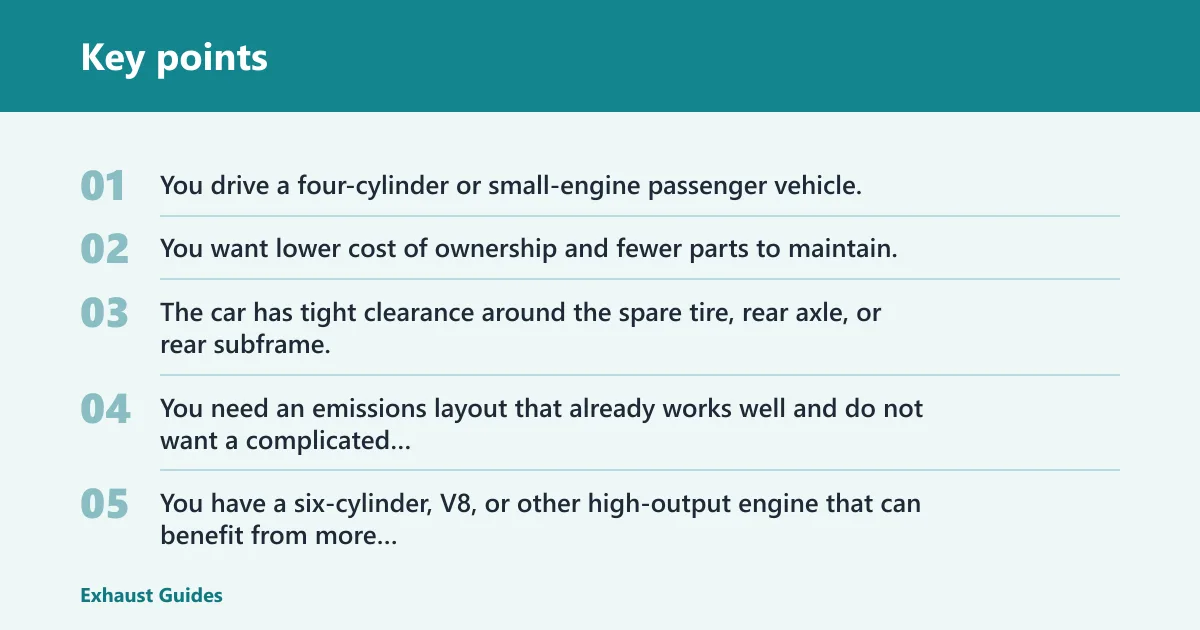
Choose single exhaust if…
- You drive a four-cylinder or small-engine passenger vehicle.
- You want lower cost of ownership and fewer parts to maintain.
- The car has tight clearance around the spare tire, rear axle, or rear subframe.
- You need an emissions layout that already works well and do not want a complicated retrofit.
Choose dual exhaust if…
- You have a six-cylinder, V8, or other high-output engine that can benefit from more exhaust area.
- You want a deeper, throatier sound or a higher-pitched, more aggressive tone.
- The vehicle has room for two paths, two mufflers, and the required hangers.
- You are willing to accept higher installation cost and more service complexity.
Vehicles with a V8 and enough underbody space may be candidates for dual exhaust. A dual layout may be worth considering if the factory system is restrictive and the owner wants a better exhaust note. By contrast, a compact commuter with a transverse four-cylinder usually gets more value from a well-sized single system.

Exhaust component decision table
This table separates three common layouts that people often mix together. The fitment notes are the real decision point: the parts count matters, but the body shape, axle routing, and emissions package decide whether the swap makes sense.
| Layout | Pipe count | Muffler count | Catalyst count | Oxygen sensor count | Typical fitment notes |
|---|---|---|---|---|---|
| Single exhaust | One main exhaust path | Usually one | Varies by engine and emissions package | Varies by engine and emissions package | Best fit for four-cylinder cars and many smaller passenger vehicles; easier around the spare tire and rear suspension |
| Split single-exit dual-tip | One main path with a split rear outlet | Usually one, or one dual-inlet unit | Usually unchanged from the original system | Usually unchanged from the original system | Common on styling-focused four-cylinder, V6, and some V8 vehicles when the rear fascia wants two outlets without full dual routing |
| True dual exhaust | Two separate exhaust paths | Usually two, or dual-inlet variants | May be duplicated by bank or kept in shared sections | May increase with bank-based monitoring | Most realistic on V6 and V8 vehicles with room for two paths, crossovers, and rear exits; harder on compact floors and beam-axle packaging |
This table shows why the upgrade is often harder than the marketing copy suggests. A split rear outlet changes appearance more easily than it changes the actual exhaust path. True dual exhaust is a routing change first, a sound change second, and a service decision every time a pipe, hanger, or clamp needs replacement.
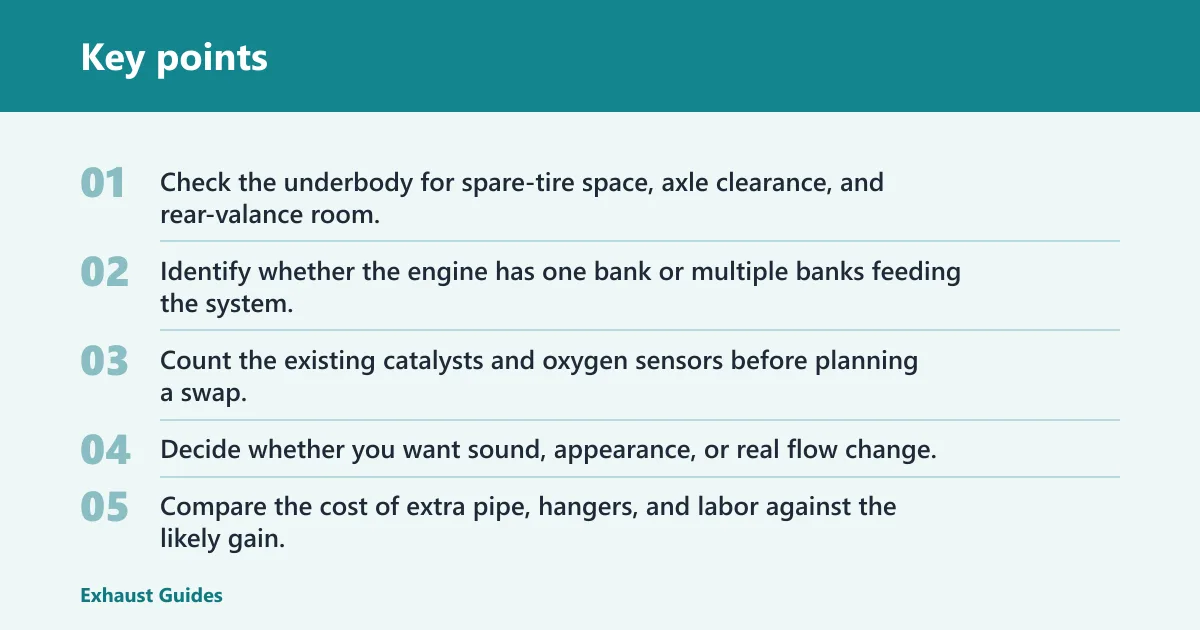
- Check the underbody for spare-tire space, axle clearance, and rear-valance room.
- Identify whether the engine has one bank or multiple banks feeding the system.
- Count the existing catalysts and oxygen sensors before planning a swap.
- Decide whether you want sound, appearance, or real flow change.
- Compare the cost of extra pipe, hangers, and labor against the likely gain.
Can you convert a single exhaust to dual?
Yes, sometimes, but only when the floorpan, axle routing, and emissions layout leave enough room for a second path. The swap may require a new muffler arrangement, extra pipe, hangers, clamps, and sometimes changes to catalyst and sensor placement. If the car was not designed for it, the job can become expensive quickly.
When the swap is feasible
Aftermarket dual exhaust upgrade kits are available for certain vehicles. That is usually the cleanest path because the kit is shaped around the chassis, mounting points, and exit location. Vehicles with large underbody tunnels, wide rear suspension clearance, or factory provisions for dual outlets are much easier candidates.
When it is not worth it
Packaging can stop the project before performance does. A spare tire well, a beam axle, low ground clearance, or limited room near the fuel tank can make a true dual layout impractical. If the engine is modest and the original system already flows well, the cost and complexity may buy sound and appearance more than measurable output.
A common first-timer mistake is to assume a dual-tip rear bumper means the car can accept true dual exhaust with only a second tailpipe. That often ignores the mid-pipe, crossover, catalyst, sensor, and hanger changes that make the difference between a cosmetic outlet and a real second exhaust path.
Frequently asked questions
Single vs dual exhaust system
Single exhaust uses one exhaust path and one muffler path; dual exhaust distributes exhaust into two separate exit routes. The practical difference is not only the number of tips. It also changes routing, hardware count, service effort, and how much room the system needs under the car.
Single pipe exhaust vs dual
Single pipe exhaust is simpler to route and usually easier to service. Dual can move more gas when the engine needs it, and it can change tone and appearance. The best choice depends on engine output, available space, and whether you want real flow change or only a different look.
Which is better single or dual exhaust?
Neither is better in every case. Single exhaust is better for cost, simplicity, and packaging. Dual exhaust is better when the engine can benefit from less restriction and the chassis can fit the extra hardware. The right answer depends on the vehicle, not the label.
Does a dual exhaust system improve performance?
It can, but only when the engine and original system are restrictive enough for the extra flow to matter. That is more likely on larger or higher-output engines than on small commuter engines. Without the right tuning and pipe sizing, the gain may be small or absent.
Is single exhaust cheaper to maintain than dual exhaust?
Yes, usually. Single exhaust has fewer pipes, fewer joints, fewer hangers, and fewer places for corrosion or leaks to start. Dual exhaust adds parts and labor, so routine repair and replacement often cost more over time.
Can I upgrade my single exhaust vehicle to dual exhaust?
Sometimes, but not always cleanly. You need room for the second path, room for the exits, and a plan for catalysts and oxygen sensors if the emissions layout changes. On many cars, a split rear outlet is easier than a full true-dual conversion.
Will dual exhaust make my car louder?
Often, yes, but the result depends on muffler choice, pipe diameter, crossover type, and whether the system is true dual or only dual-tip. Dual exhaust can sound deeper, more forceful, or sharper. It can also create drone if the system is poorly tuned.
What vehicles actually benefit from dual exhaust?
Vehicles with six or more cylinders are the usual candidates, especially when the engine makes enough exhaust volume to justify two paths. Large SUVs, trucks, muscle cars, and some performance sedans can benefit. Many smaller four-cylinder cars do not gain enough to justify the cost.
What’s the difference between true dual exhaust and a split single-exit setup?
True dual exhaust has two separate exhaust paths for gas flow. A split single-exit setup may only split at the rear, after most of the routing and emissions hardware has already been shared. That means the sound and appearance can change more than the actual flow path.