What Do Exhaust Hangers Do in a Vehicle?
Exhaust hangers are commonly described as supporting the exhaust, limiting movement, and isolating vibration with three parts: a metal bracket, a rubber isolator, and the body or frame mount. If they fail, the system can sag, rattle, hit the body, or crack pipes and flanges. This guide shows how to identify the failed part before you replace anything.
What is an exhaust hanger?
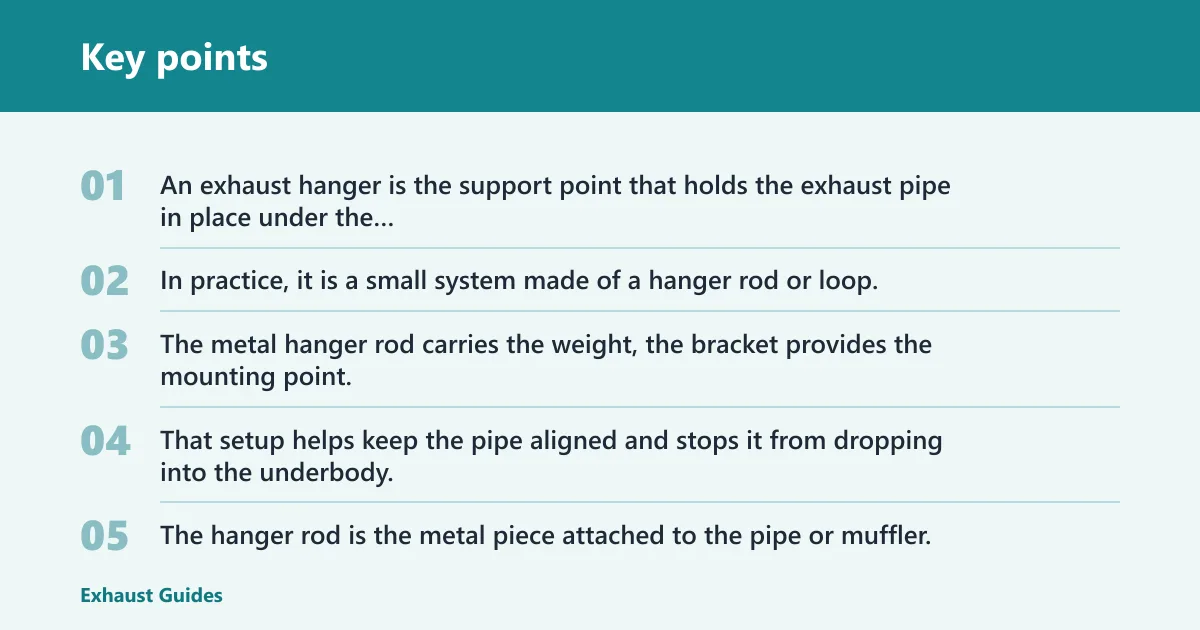


An exhaust hanger is the support point that holds the exhaust pipe in place under the vehicle. In practice, it is a small system made of a hanger rod or loop, a bracket fixed to the body or chassis, and a rubber isolator that lets the exhaust move a little without clanging against metal.
The parts work together. The metal hanger rod carries the weight, the bracket provides the mounting point, and the rubber piece cushions motion. That setup helps keep the pipe aligned and stops it from dropping into the underbody, suspension, or ground.
Hanger, bracket, and rubber isolator
The hanger rod is the metal piece attached to the pipe or muffler. The bracket is the fixed mount on the body or chassis. The rubber isolator sits between them and allows controlled movement. On many OEM-style hangers, the rubber can dry out, crack, or tear over time.
Some designs use a steel cable inside the rubber, which adds strength while still allowing flex. That matters because exhaust movement is constant: engine torque, road bumps, and heat cycles all load the support points.
How the hanger keeps exhaust height stable
The hanger does more than “hold it up.” It keeps exhaust pipe clearance stable so the pipe stays away from the underbody and suspension during acceleration, bumps, and engine movement. That clearance helps prevent rattles, clunks, and contact marks.
When the support point shifts, the pipe can twist slightly, hang lower than usual, or press against another component. Even a small change in height can create a noise that only shows up over bumps or at idle.
How do exhaust hangers reduce vibration and noise?
Exhaust hangers are commonly used to reduce vibration and noise by letting the system move on a rubber isolator instead of sending engine pulses into the body. The rubber flexes with engine movement, which helps absorb harsh motion and reduces cabin noise from the exhaust.
That isolation is why a healthy hanger can seem uneventful. It should not clunk, scrape, or let the pipe bang around. If you hear new noise, the failure may be in the rubber, the bracket, or the hanger rod itself.
Why clearance matters for rattles and clunks
Clearance matters because the exhaust is close to the floor, fuel tank area, suspension links, and heat shields. If the hanger loses height or lets the pipe swing too far, the system can touch one of those parts and create a rattle under the car or a sharp bump clunk.
A common mistake is assuming a rattling exhaust pipe means the whole exhaust system needs replacement. A loose bracket or torn isolator can create the same sound while the muffler itself is still fine.
What happens when a hanger or isolator fails?
When a hanger or isolator fails, the exhaust can drop, shift, or twist enough to change clearance and load nearby joints. That can stress flex pipes, hang the exhaust lower than usual, and create contact marks where the pipe or heat shield touches the body or suspension.
Failure is not always total. A rubber isolator may tear on one side and still hold the pipe for a while. A bracket may bend just enough to misalign the system. A hanger rod may slip out of position and let the pipe move more than it should.
How failure can stress joints and flex pipes
Once the support is weak, the exhaust has to absorb more motion at the joints. That extra movement can strain a flex pipe, open a flange gasket leak, or let a section separate slightly at the clamp. The result may be louder exhaust, a hot smell, or a hiss under load.
Heat shield contact can also follow hanger failure. If the pipe rides lower, it may touch a shield that normally has space around it. That contact often sounds like a thin metallic buzz rather than a deep clunk.
Common symptom patterns
Say your sedan makes a sharp clunk only when backing out of a driveway. If the noise appears with suspension movement, the rubber isolator or bracket alignment is a stronger suspect than the muffler shell.
Suppose the exhaust looks fine on flat ground, but the tailpipe touches the bumper cutout after a hard acceleration. That points toward a hanger rod or bracket that lets the system shift under torque.
Exhaust hanger symptom table
This table maps common symptoms to the most likely failed part and the quickest confirmation check. Start here before you buy parts. It can save you from replacing a full hanger assembly when only one piece is worn.

| Symptom | Likely failed part | Quick confirmation test |
|---|---|---|
| Exhaust hangs low under the vehicle | Rubber isolator | Look for a torn or stretched rubber loop and compare pipe height to nearby hangers. |
| Rattling under the car at idle | Rubber isolator | Shake the pipe by hand; a loose hanger will let the exhaust tap the body or shield. |
| Bump clunk over speed bumps | Bracket | Check whether the bracket is bent, shifted, or sitting at an angle that changes clearance. |
| Pipe twists after throttle input | Hanger rod | Watch the rod while a helper blips the throttle; excessive rotation points to a poor seat or slip. |
| Torn rubber visible at the hanger | Rubber isolator | Inspect for cracks, dry edges, or separation where the rubber loop meets the metal rod. |
| Bent or shifted mounting point | Bracket | Compare the bracket angle to the matching side or adjacent mount and look for fresh metal deformation. |
| Rod slips out of the rubber loop | Hanger rod | Check for worn or polished contact points and test whether the rod stays centered under light lift. |
| Contact marks on the underbody | Rubber isolator or bracket | Look for witness marks on the body, suspension, or heat shield where the exhaust has touched. |
| Loud exhaust after a hanger failure | Rubber isolator | Inspect for a dropped pipe that opened a joint or let the exhaust move enough to leak at a clamp. |
| Broken hanger makes pipes bang against the undercarriage | Rubber isolator or bracket | Move the exhaust gently by hand and listen for hard contact with the floor or shield. |
How do you remove exhaust hangers safely?
Remove exhaust hangers only after the vehicle is supported on level ground with a jack and jack stands at the proper jack points. The exhaust may be hot, heavy, and awkward, so undercar access should be planned before you touch the hanger or pipe.
For stuck rubber hangers, needle-nose pliers or hanger removal pliers are the common DIY tools. A small amount of lubricant can help free the rubber from the hanger rod, but use it sparingly so you do not create a mess or damage nearby parts.
Safe removal steps
- Park on level ground and set the parking brake.
- Let the exhaust cool fully before you reach under the vehicle.
- Raise the car with a jack at the proper jack points.
- Support the vehicle with jack stands before any removal work.
- Inspect the hanger, bracket, and rod so you know which part is actually stuck or damaged.
- Apply a small amount of lubricant only where the rubber grips the metal rod.
- Use needle-nose pliers or hanger removal pliers to peel the rubber off the rod.
- Lower the exhaust in a controlled way so it does not drop or twist nearby joints.
If the hanger is held by a steel cable inside the rubber, expect more resistance than a simple loop. Work slowly and support the pipe as you remove the last connection.
Should you replace the hanger, bracket, or both?
Replace the failed part, not the whole exhaust, unless the pipe or flange has also been damaged. The right choice depends on where the failure is: torn rubber points to the isolator, bent steel points to the bracket, and a slipped or worn rod points to the hanger side of the support.
OEM-style rubber hangers often use a separate isolator that can be replaced on its own. Universal aftermarket hangers may combine pieces differently, so the part you buy should match the mounting style and the pipe height you need to restore.
Inspection checklist before replacement
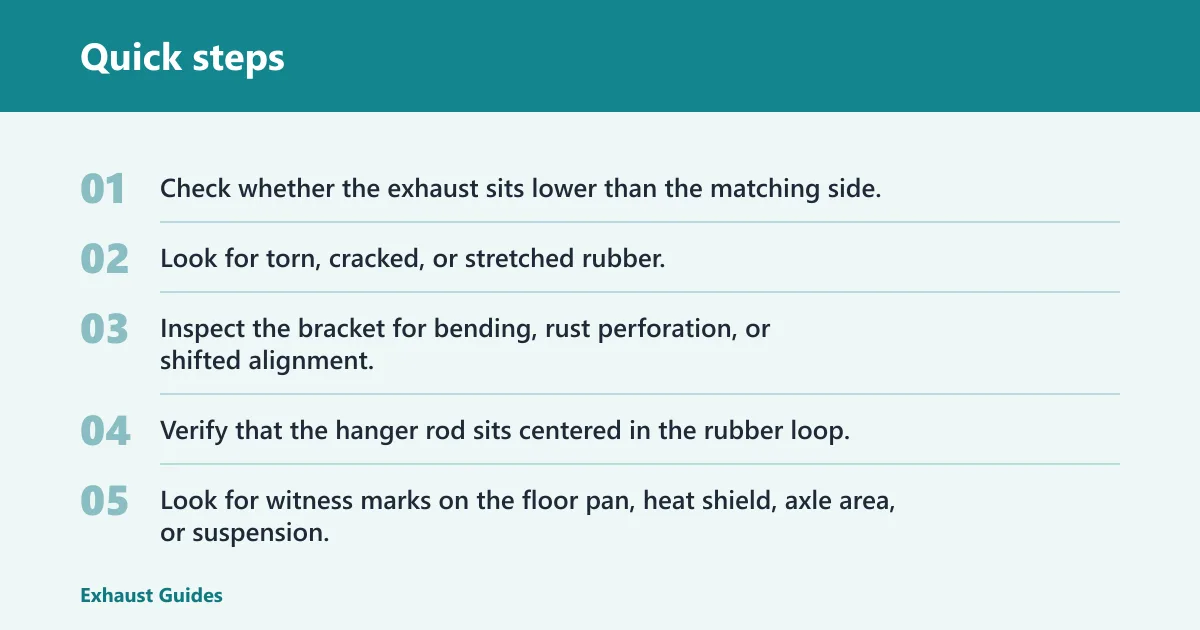
- Check whether the exhaust sits lower than the matching side.
- Look for torn, cracked, or stretched rubber.
- Inspect the bracket for bending, rust perforation, or shifted alignment.
- Verify that the hanger rod sits centered in the rubber loop.
- Look for witness marks on the floor pan, heat shield, axle area, or suspension.
- Shake the exhaust by hand and listen for metal-to-metal contact.
- Check nearby joints and the flex pipe for extra stress or leakage.
A common mistake is replacing the rubber and ignoring a bent bracket. That can leave the pipe hanging in the wrong spot even after new parts go in.
OEM-style rubber versus universal hangers
OEM-style hangers usually separate the mounting bracket from the rubber isolator, so diagnosis is easier and replacement can be more targeted. Universal hangers may work, but they can change exhaust height if the rod angle or rubber stiffness does not match the original setup.
If the vehicle has multiple hangers, compare one side to the other. The intact side gives you a useful reference for height, angle, and clearance.
Frequently asked questions
What do exhaust hangers do in a vehicle?
Exhaust hangers hold the exhaust pipes in place, keep the system aligned, and prevent the pipe from contacting the ground or body. They also reduce vibration transfer into the cabin by letting the exhaust move on rubber instead of metal alone.
How do I know if an exhaust hanger is broken?
Look for torn rubber, a bent bracket, a slipped hanger rod, or fresh contact marks under the vehicle. Common symptoms include rattling under the car, a loud exhaust note, and a section that hangs lower than the rest of the system.
Can a broken exhaust hanger make the exhaust hang low?
Yes. A failed hanger can let the exhaust sag, shift, or twist until the pipe sits lower than usual. That loss of support can also reduce clearance and cause contact with the body, suspension, or heat shields.