5 Best Hangers for Lowered Cars (2026): We Compared
For lowered cars, choose exhaust hangers that keep about 10–15 mm of suspension travel margin, control sag with the shortest safe durometer, and only go stiffer when the pipe still touches or bangs. Bad hanger choice leads to contact, broken brackets, drone, and heat damage. This guide compares hanger types, fitment checks, stiffness tradeoffs, and NVH-friendly picks for low ride height.
Quick picks
For mild drops, rubber is commonly a safe starting point because it keeps the cabin quieter and gives the exhaust room to move. For moderate or heavy drops, look harder at polyurethane, better rod alignment, or a weld-on or clamp-on correction before you jump to the stiffest isolator.
- Mild drop, OEM-style replacement: Rubber hanger with the closest factory length and hole spacing.
- Moderate drop, more control: Medium-durometer polyurethane if the pipe clears but sways into the subframe under load.
- Custom exhaust, relocated mount: Universal hanger or weld-on hardware when you need to change length or angle.
- Low-budget correction: Adjustable rubber hanger with multiple holes when you only need a small height change.
Exhaust hanger decision matrix
Lowered cars need a different decision process because drop height changes both static clearance and how far the drivetrain moves on acceleration and deceleration. A hanger that looks fine at rest can still hit the axle, subframe, or tunnel on compression.
| Hanger type | Clearance gain | Noise isolation | Slip resistance | Install complexity | Best suspension drop level | Choose this if |
|---|---|---|---|---|---|---|
| Rubber exhaust hanger | Low to moderate | High | Moderate when holes are sized correctly | Low | Mild | You want OEM-like comfort and the pipe only needs a small height correction. |
| Polyurethane exhaust hanger | Moderate | Medium to low | Moderate to high | Low to moderate | Mild to moderate | You need firmer support without jumping straight to hard-mounted hardware. |
| Universal exhaust hanger | Moderate to high | Depends on material | Varies by slot style and hole fit | Moderate | Moderate | Your exhaust was shortened, relocated, or no longer matches factory hole spacing. |
| Clamp-on hanger | Moderate | Depends on isolator used | Moderate, with recheck required | Moderate | Moderate | You need a no-weld bracket and can torque-check it after the first drive. |
| Bolt-on hanger | Moderate | Depends on isolator used | High if the bracket stays tight | Moderate | Mild to moderate | You have a solid mounting point and want a serviceable, repeatable install. |
| Weld-on hanger | High | Depends on isolator used | High | High | Moderate to heavy | You need exact positioning on a custom exhaust and can protect the weld from corrosion. |
How we chose
This guide weights fitment before stiffness. Clearance gain matters, but only if the mount still centers the exhaust and avoids side-loading the rod or peg.
Noise isolation matters next, because a lowered car often carries more road harshness into the cabin already. A hanger that fixes contact but adds constant drone is the wrong trade for many street cars.
Slip resistance and installation security matter because shortened or relocated exhausts see more rotation under throttle and over bumps. A hanger that creeps a few millimeters can reintroduce contact after a week.
Finally, install complexity matters because the right choice depends on whether you can weld, drill, or only swap an isolator on stands.
Rubber exhaust hangers: best for mild drops
Rubber hangers are usually the first choice for mild lowering because they isolate vibration well, keep the cabin quieter, and still allow some movement as the exhaust warms and the drivetrain rotates. They work best when the existing rod length and bracket angle are already close.
Why rubber keeps the cabin quieter
Rubber flexes more than harder materials, so it transmits less exhaust vibration into the body. That helps when the car already rides lower and every bump sends more motion into the chassis. It is also the usual OEM replacement choice because it balances support with movement.
Heat, age, and fitment length limits
Rubber can harden, crack, or stretch from heat and age, especially near the rear muffler or over a hot axle tunnel. Fitment length matters too: if the hanger is too long, the pipe sags; if it is too short, the rubber tears sooner and can pull the exhaust out of alignment.
When an OEM-style replacement makes sense
An OEM-style rubber hanger makes sense when the exhaust is otherwise straight, the rod sits centered in the isolator, and the only problem is reduced ride height. It is a good answer for mild drops where the goal is to keep factory-like NVH while restoring a little clearance.
Polyurethane exhaust hangers: best for firmer support
Polyurethane hangers sit firmer than rubber and resist sag better, which helps when a lowered car lets the exhaust swing too close to the subframe, axle, or rear bumper cutout. They are a stronger fit when the pipe clears at rest but shifts into contact under load.
Durometer choices and vibration transfer
Polyurethane comes in different durometer ranges, and harder versions transfer more vibration into the body. Softer polyurethane reduces that penalty, but it also gives up some control. For lowered cars, a mid-range durometer is often the best compromise unless the exhaust is moving a lot.
Where stiffer support helps a lowered car
Stiffer support helps when acceleration twists the drivetrain enough to make the tailpipe kiss the axle, or when the rear section sags after a drop. It can also help if the original rubber was stretched from heat and the muffler now hangs lower than intended.
Where polyurethane is too harsh
Polyurethane is too harsh when the car already has a short wheelbase, firm mounts, or a thin floor that passes more vibration into the cabin. If the issue is only a few millimeters of clearance, going harder can solve contact and create constant buzz at idle.
Universal exhaust hangers: best for custom fitment
Universal hangers work when the exhaust no longer lines up with stock hardware, which is common after lowering, muffler relocation, or custom piping. They are not one-size-fits-all, though; the hole pattern, rod diameter, and trim length still have to match the actual layout.
Trim-to-fit and slot-style variants
Trim-to-fit styles let you shorten the hanger to set ride height, while slot-style pieces give some vertical adjustment without moving the bracket as far. Both can solve small alignment errors, but the cut or slot position must still keep the exhaust centered so it does not pull sideways under load.
Compatibility limits on shortened or relocated exhausts
Universal hangers are limited when the exhaust rod has already been bent, shortened, or moved to clear aftermarket suspension parts. In those cases, the isolator may fit, but the rod angle can load one side of the rubber and make it tear sooner.
How to tune clearance without creating slip
To tune clearance safely, keep the rod seated fully in the isolator and avoid using so much slot travel that the bracket can walk. A universal hanger should set height, not fight a misrouted pipe. If the mount slips after a few heat cycles, the setup is too loose for the load.
Which exhaust hanger should you buy?
Choose by drop severity first, then by how much cabin noise you are willing to accept. Mild drops usually do best with rubber or a close OEM replacement. Moderate drops often need firmer support or a universal mount with better height control. Heavy drops usually need a mount correction, not just a stiffer isolator.
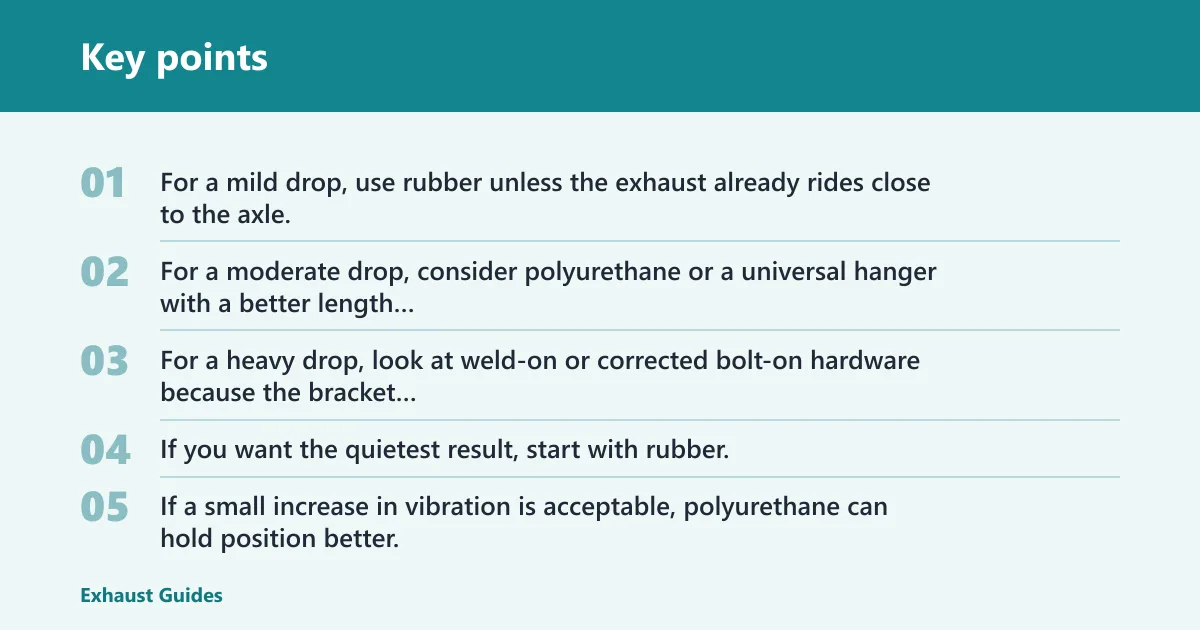
Choose by drop severity
For a mild drop, use rubber unless the exhaust already rides close to the axle. For a moderate drop, consider polyurethane or a universal hanger with a better length match. For a heavy drop, look at weld-on or corrected bolt-on hardware because the bracket location may need to move.
Choose by noise tolerance
If you want the quietest result, start with rubber. If a small increase in vibration is acceptable, polyurethane can hold position better. If the exhaust is already booming or touching under load, do not solve it with the stiffest part first; solve the misfit first.
Choose by whether you can weld or drill
If you cannot weld, bolt-on or clamp-on hardware is the practical path. If you can weld, a weld-on hanger gives the most exact placement and the cleanest correction for a custom exhaust. Just remember that weld-on work needs corrosion protection after the weld cools.
Choose by how often the exhaust shifts under load
If the exhaust only taps on big dips, a better rubber or polyurethane hanger may be enough. If it moves enough to hit during throttle changes, braking, or axle articulation, the real issue may be rod angle, bracket thickness, or a rear section that hangs too low.
Clamp-on, bolt-on, or weld-on hanger?
Use a clamp-on hanger when you need a no-weld fix and can inspect the clamp torque after the first drive. Use a bolt-on hanger when you have a solid bracket or mounting point and want a repeatable serviceable setup. Use a weld-on hanger when the exhaust needs exact positioning and you can fabricate safely.
Clamp-on hangers
Clamp-on hangers are useful where welding is not practical, but slip risk is real if the bracket is too thin, the pipe is oily, or the clamp never gets rechecked. They work best on straight sections with enough tube length for even clamping and enough space to reach the fastener later.
Bolt-on hangers
Bolt-on hangers avoid welding and can be very secure if the bracket thickness is appropriate and the hardware is torqued correctly. They are a good fit for factory-style mounting points near the rear section, but they should be checked again after the first heat cycle.
Weld-on hangers
Weld-on hangers are permanent and accurate, which is why they fit custom exhaust systems so well. They also require fabrication skill, careful positioning, and corrosion protection after welding so the new mount does not rust at the heat-affected area.
How low can an exhaust hang before it scrapes?
An exhaust should keep enough ground clearance to survive suspension compression, driveway approach angles, and speed bumps without becoming the lowest point. For lowered cars, that means measuring the lowest point at rest and leaving extra margin for drivetrain movement, not just static clearance.
Ground clearance checks
Measure from the ground to the lowest exhaust point, then look at how much travel remains before the tire or suspension hits the bump stop. A common rule of thumb is to keep about 10–15 mm of travel margin at the exhaust, with a larger buffer often safer when the car is very low or the rear section runs near the axle.
Compression margin and contact risk
Static clearance is only part of the story. On a driveway or speed bump, the rear suspension compresses and the drivetrain rotates, which can swing the pipe upward or sideways. If the exhaust is already close to the chassis, that movement can turn a quiet ride into repeated tapping.
Why drivetrain alignment matters after lowering
Lowering can change the angle between the engine, mid-pipe, rear section, and axle. If that alignment shifts, even a new hanger may not stop contact because the exhaust is trying to sit in the wrong path. In that case, the hanger is not the fix; the bracket or pipe route is.
How do you install or remove hangers safely?
Use hanger removal pliers, rubber lubricant, jack stands, rust penetrant, and a torque wrench where fasteners are involved. The goal is to free the isolator without tearing it and then restore the exhaust to a centered, non-rubbing position after installation.
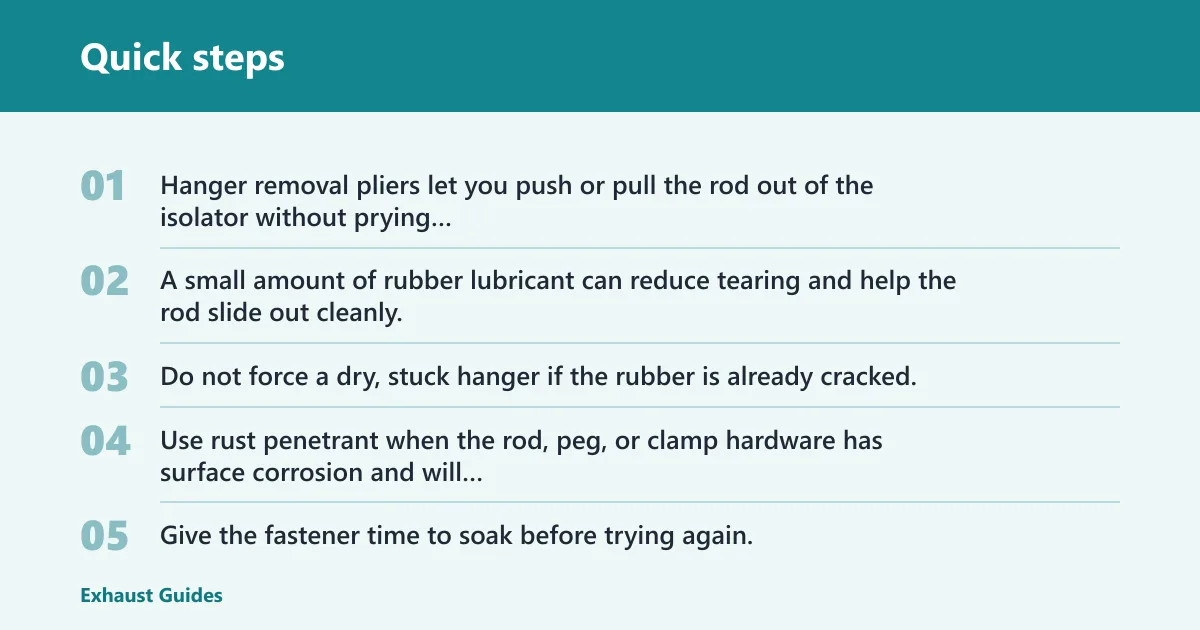
Using hanger removal pliers and rubber lubricant
Hanger removal pliers let you push or pull the rod out of the isolator without prying against the muffler shell. A small amount of rubber lubricant can reduce tearing and help the rod slide out cleanly. Do not force a dry, stuck hanger if the rubber is already cracked.
When to use rust penetrant
Use rust penetrant when the rod, peg, or clamp hardware has surface corrosion and will not move by hand. Give the fastener time to soak before trying again. This matters on lowered cars because cramped space often tempts people to twist the exhaust and damage the bracket instead.
When to use jack stands and a torque wrench
Jack stands are required any time you need access under the car, especially if the exhaust must be aligned by hand. A torque wrench matters for clamp-on and bolt-on mounts because a slightly loose bracket can slip after heat cycles and put the pipe right back into contact.
What to recheck after the first drive
After the first drive, recheck the hanger centering, clamp torque, and any fresh witness marks on the pipe or axle. Listen for new rattles over small bumps. If the exhaust moved, the mount may be too soft, too short, or clamped at the wrong angle.
How do I remove exhaust hangers without damaging them?
Support the exhaust first, then use rubber lubricant, hanger removal pliers, and controlled motion instead of sharp prying. If the rubber is aged or heat-cycled, expect more resistance and stop before the material tears. If the rod is corroded, use rust penetrant and work it back and forth.
For stubborn mounts, separate the hanger from the vehicle with the exhaust supported on a stand so the rubber is not carrying the full weight. That reduces tear risk and keeps the pipe from dropping onto the chassis or axle.
What size exhaust hanger do I need?
You need a hanger that matches three things: rod diameter, isolator hole size, and effective length. Common aftermarket rods are often 3/8 inch, while many rubber isolators use holes around 0.47 inch or a 2-hole or 4-hole pattern for height adjustment. Match the rod bend angle too, or the mount can load the rubber unevenly.
Measure the rod where it enters the isolator, then compare that to the hanger opening and the bracket thickness. If the rod is loose, the exhaust can rattle; if it is too tight or too short, the mount can pull the pipe off center.
What exhaust hanger options work best for lowered cars?
The best hanger depends on how far the car is lowered and whether the exhaust already sits near the body or axle. Mild drops usually favor rubber or OEM-style replacement hangers. Moderate drops often need polyurethane or universal adjustment. Heavy drops may need a weld-on or corrected bolt-on mount because the support point itself is wrong.
Say your car drops 25 mm and the muffler only taps on steep driveway exits. A rubber hanger with the right length may solve it without adding noticeable vibration. Suppose the same car has a rear section that shifts 8 to 10 mm under throttle; a firmer polyurethane or a universal slot-style mount is the better next step.
How do I stop my exhaust from hitting the chassis after lowering?
Start by checking whether the hanger is the real problem or whether the exhaust is misaligned, the bracket is bent, or the rear section hangs at the wrong angle. If the rod is centered but the pipe still contacts the chassis, you likely need to correct the pipe path, not just change material hardness.
Then inspect the lowest point, the compression margin, and any witness marks on the tunnel, subframe, or axle. If the exhaust moves under load, use a hanger with more control or a better bracket location. If it contacts only on compression, clearance is the issue and the mount may need to sit higher.
What tools do I need to install exhaust hangers safely?
Use hanger removal pliers, rubber lubricant, jack stands, rust penetrant, and a torque wrench for clamp-on or bolt-on hardware. Basic hand tools are fine for many rubber swaps, but lowered cars benefit from more careful support because access is tighter and alignment is more sensitive.
If the exhaust needs welding, the job moves beyond hand tools. At that point, accuracy, corrosion protection, and safe vehicle support matter more than speed.
What is an exhaust hanger?
An exhaust hanger is the support point that carries part of the exhaust’s weight and holds the pipe in position while still allowing some movement. On lowered cars, that movement has to be controlled more carefully because reduced ride height leaves less margin before the system hits the body, axle, or road surface.

That is why hanger condition and hanger geometry matter as much as material choice. A good mount holds the exhaust centered and quiet. A poor one lets the system sag, rattle, or shift into contact.
What is an exhaust hanger? how to remove exhaust hangers?
For fitment-first buyers, the answer is simple: the hanger is only part of the system, and the right removal method matters because a torn isolator or bent rod can create the next clearance problem. If the hanger is being replaced because the exhaust sagged, inspect the rod, bracket, and pipe angle before reinstalling anything.
That check is especially important on lowered cars, where drivetrain movement under load can make a borderline setup scrape even when it looks fine on the lift. A hanger swap should restore alignment, not hide a misrouted exhaust.
MetVot Rubber Exhaust Hanger 4 Pack: best for mild drops

- Reduces exhaust system rattling and vibration effectively
- Universal fit with multiple holes for height adjustment
- Made of durable, weather-proof EPDM rubber material
This is a fit-first pick for owners who want a simple rubber replacement with multiple hole positions. The EPDM material and 4-hole layout make it a sensible option when the exhaust only needs a small height correction and you want to keep vibration down.
What stands out: the multiple holes give you some clearance tuning without moving to a harsher material, and the weather-proof rubber should suit daily use.
Drawback: rubber is still rubber; if your exhaust is already close to the axle or subframe, this may not add enough control for a heavier drop.
HAOXAOON heavy duty exhaust hanger rod: best for custom rod fitment

- Heavy-duty mild steel rods resist rust with zinc coating
- Includes isolation rubber bushing for vibration dampening
- Flexible installation options via welding or manual bending
This set fits best when the rod itself needs replacement or reshaping, not just the isolator. The 10-inch, 3/8-inch mild steel rod gives you a more fabrication-friendly starting point for a custom exhaust or a relocated hanger position.
What stands out: the zinc coating helps resist rust, and the option to weld or bend by hand gives more freedom when the stock angle no longer matches the lowered suspension.
Drawback: it is less of a plug-in fix, so fitment depends on accurate rod length, bend angle, and bracket location.
Msuhettu Rubber Exhaust Hangers: best for budget OEM-style replacement

- Absorbs vibration and reduces rattling and shaking noise
- High-density EPDM rubber offers heat and weather resistance
- Four mounting holes provide multiple positioning options
This is a low-cost rubber option for drivers who need quieter support and a few fitment choices without moving up to stiffer hardware. The 0.47-inch holes and four-position layout make it useful for mild lowering or for replacing a worn hanger that has stretched.
What stands out: the EPDM rubber should handle heat and weather better than cheap generic material, and the multi-hole layout can help with small clearance changes.
Drawback: like most rubber pieces, it will not correct a poor rear section angle or a bent bracket.
SKYMIRO 304 stainless steel exhaust hangers set: best for mixed custom installs

- Premium 304 stainless steel resists rust and corrosion
- Includes both straight and bent rods for custom installs
- Two-hole and four-hole insulators allow adjustable height
This set suits custom work where you need different rod shapes and a more corrosion-resistant starting point. The mixed straight and bent rods, along with two-hole and four-hole insulators, make it a better fit for builders adjusting a lowered car’s rear section.
What stands out: stainless steel resists rust well, and the assortment helps when rod angle or hanger length is the issue rather than just stiffness.
Drawback: the kit can be more than a simple replacement needs, and the extra options still require careful match-up to avoid side-loading the isolator.
SINGARO Rubber Exhaust Hanger: best for quiet support

- High-density rubber reduces sound from pipe shaking
- Wear-resistant material ages well in different climates
- Universal fit for cars, trucks, and SUVs
This is a straightforward rubber hanger for owners who want to reduce shaking and keep the exhaust quiet. The 2-hole design makes it simple, and the high-density rubber should suit daily-driven lowered cars where comfort matters more than chasing the firmest mount.
What stands out: it favors noise reduction and wear resistance, which makes it a practical choice for common OEM-style replacement work.
Drawback: with only two holes, it offers less height tuning than a 4-hole option, so it may not solve a clearance problem that needs finer adjustment.
How to choose
Start with the car’s drop, not the hanger catalog. Mild lowering often needs a better rubber or a gentle universal correction. Moderate lowering often needs firmer support and better rod alignment. Heavy lowering often needs the mount relocated, not merely stiffened.
Then check the exhaust at its lowest point, the rod diameter, and the bend angle before you buy anything. If the rod is centered and the only complaint is contact over bumps, pick more support. If the system is crooked, fix the geometry first.
A common first-timer mistake is choosing a harder hanger to stop one tap, then discovering that the exhaust now drones because it is transmitting every drivetrain movement into the body. A softer but correctly placed mount often solves more problems than a stiff one installed in the wrong spot.
Frequently asked questions
Are rubber or polyurethane exhaust hangers better for lowered cars?
Rubber is better when you want quiet support and only need a small correction. Polyurethane is better when sag and movement are causing contact and you can accept more vibration. If the exhaust is misaligned, neither material alone will fix the root problem.
Should I use a clamp-on, weld-on, or bolt-on hanger?
Use clamp-on when you need no-weld installation and can recheck torque. Use bolt-on when you have a sturdy mounting point and want serviceability. Use weld-on when the exhaust needs exact placement and you can protect the weld and fabricate accurately.