What Is the Best Exhaust Wrap?
The best exhaust wrap is basalt or quality fiberglass sized to cover each pipe with 25% overlap; choose basalt for higher failure resistance, fiberglass for lower cost, and skip thin no-name wrap for daily heat cycles. Wrong wrap can fray, soak up moisture, trap corrosion, and waste money on a fix that fails early. This guide compares materials, widths, thicknesses, and installation choices by exhaust use case.
What exhaust wrap does and does not do
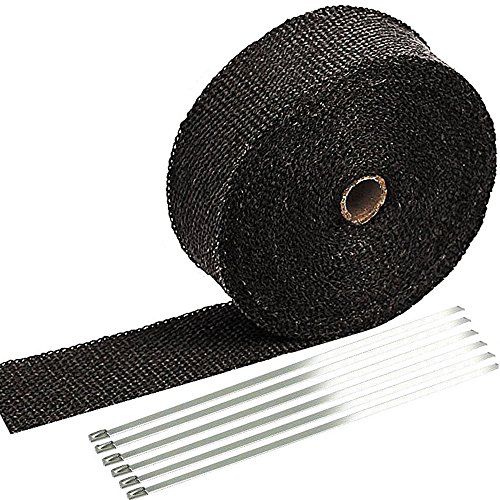


Exhaust wrap manages heat near hot tubing. It does not fix a poor exhaust layout. It can lower radiant heat around headers, downpipes, hoses, wiring, and fairings. That is why you see it on turbo builds, street headers, and motorcycles. It may also improve exhaust flow and scavenging, but that is a secondary claim, not the main buying reason.
The practical win is heat control near parts that dislike heat soak. Thermotec says wrap can reduce under-hood temperatures, cut heat transfer to nearby engine-bay parts, improve exhaust flow, and help prevent heat soak. Those outcomes matter when space is tight and the pipe runs close to wiring, brake lines, bodywork, or rider contact points.
What it is used for on headers and downpipes
Exhaust headers are the classic use case because they sit close to the firewall, plug wires, hoses, and other engine-bay parts. Downpipes on turbo setups face similar constraints, especially where turbine outlet heat sits near a radiator fan, steering shaft, or firewall. Motorcycle exhausts are another major use case because rider-leg burn reduction matters.
Wrap makes less sense when the pipe already has room, when airflow around it is good, or when rerouting is the real fix. Heat shields can be better for localized protection. Ceramic coating can be a better fit when you want less moisture retention and less maintenance on a street-driven mild-steel system.
Where ceramic coating, heat shields, or rerouting makes more sense
If the pipe is old, crack-prone, or already heavily rusted, wrap adds risk without solving the underlying problem. Mild steel is the most moisture-sensitive choice because trapped water can speed corrosion. For a daily driver, a shield or reroute is often the safer answer if the part is exposed, accessible, and still in decent shape.
Exhaust wrap decision table
Use this table to match the wrap to the job, not just the heat number on the box. Fitment, moisture exposure, and failure risk decide the real result. A more heat-tolerant wrap is not always the right wrap if the pipe sees road salt, long rain exposure, or frequent short trips.
| Build type | Recommended material | Width | Roll length | Install method | Main failure risk |
|---|---|---|---|---|---|
| Daily-driven street car | High-quality fiberglass or basalt, with ceramic coating preferred if corrosion risk is high | 2-inch | 50-foot for a short four-cylinder header; 100-foot for longer V6/V8 layouts | Dry fit, then wrap with even tension and stainless steel locking ties | Moisture retention on street trips, especially on mild steel |
| Turbo build | Basalt or premium titanium-labeled wrap | 2-inch for most exhaust sections; 1-inch for tight bends | 50-foot for a compact downpipe; 100-foot for full turbo-back coverage | Pre-plan overlap at bends, then secure every few inches with stainless steel locking ties | Hot-spot failure near turbine outlet and uneven overlap on tight bends |
| Motorcycle | Fiberglass for budget builds, basalt or premium wrap for better service life | 1-inch | 16-foot for a short single; 50-foot for duals or long headers | Pre-wet fiberglass, wrap tightly from the head end outward, then tie ends securely | Loose wrap ends, fraying, and poor fit around tight bends |
| Budget mild-steel header | Fiberglass only if the header is sound and you accept maintenance | 2-inch | 16-foot or 50-foot depending on cylinder count and tube length | Use pre-wetting, close overlap, and careful drying after installation | Corrosion from trapped moisture on already vulnerable steel |
Fiberglass vs titanium wrap
Fiberglass wrap is the common budget choice. Titanium wrap is the premium label, but some products sold as titanium are not actually titanium. The trade-off is simple: fiberglass saves money, while basalt or other premium wraps usually target higher heat, better durability, and less early failure risk.
Heat resistance ratings and what they actually mean
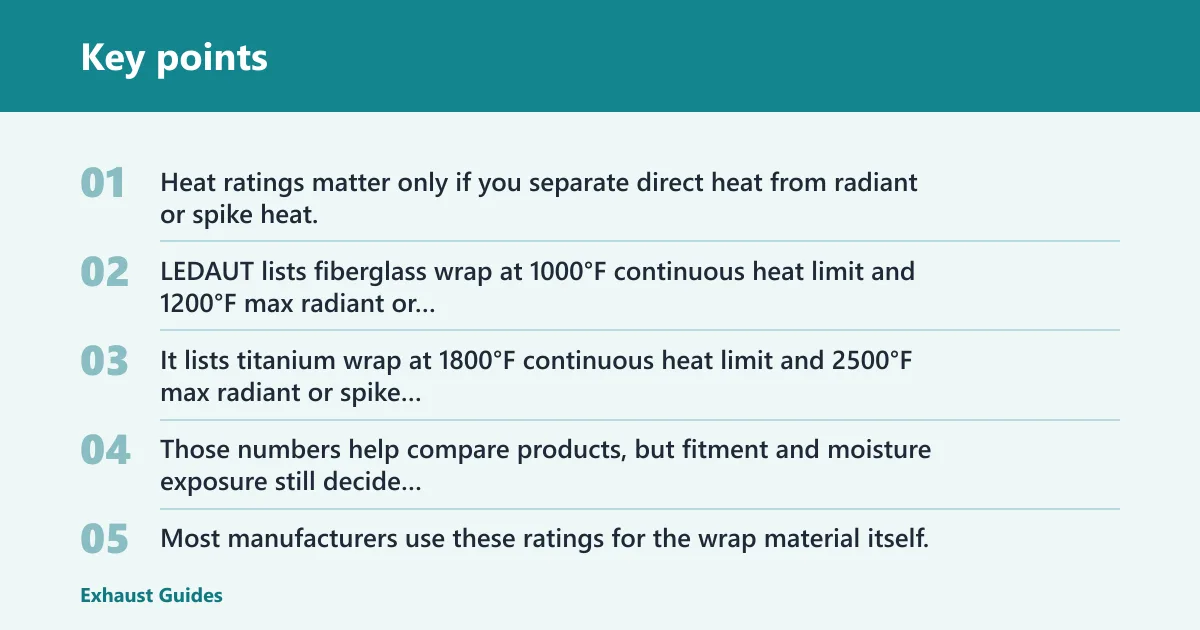
Heat ratings matter only if you separate direct heat from radiant or spike heat. LEDAUT lists fiberglass wrap at 1000°F continuous heat limit and 1200°F max radiant or spike temp. It lists titanium wrap at 1800°F continuous heat limit and 2500°F max radiant or spike temp. Those numbers help compare products, but fitment and moisture exposure still decide real-world life.
Most manufacturers use these ratings for the wrap material itself, not as a promise that the full installed system will survive every environment. A tight turbo area with poor airflow can still punish a wrap that looks strong on paper. A cooler street header can still fail early if the wrap holds water against rusty steel.
Moisture and corrosion risk
Fiberglass wrap usually needs pre-wetting before install. The same source states fiberglass wrap is the material that requires pre-wetting. That step helps keep fiberglass dust down during handling, but it also means the wrap must dry out after installation. On a mild-steel exhaust system, repeated water retention is a serious downside.
Mild steel exhaust systems are more vulnerable to trapped moisture than stainless steel or coated parts. That is why wrap on a budget header can shorten service life if the car sees rain, short trips, or storage before full drying. The risk is higher when the pipe is already pitted or thin.
Best use case for each material
Fiberglass fits budget thermal management, short-term projects, and parts that are already stainless or otherwise corrosion-resistant. It is common on motorcycle exhausts too. The Drive says most motorcycle exhaust wraps are made of fiberglass composite, and it notes some wraps come in stainless steel layer versions.
Basalt or premium titanium-labeled wrap is the better pick when you want more failure resistance near high heat, especially on turbo hardware and tight underbody routes. A higher heat number does not cancel poor installation or a rust-prone base metal.
What size exhaust wrap do you need?
Most buyers should start with width, then calculate length from pipe diameter, bend count, and the amount of overlap you want. The Drive says common wrap widths are one inch and two inch. The same source recommends 1-inch width for motorcycles and 2-inch width as standard automotive size. That split is a good starting point. (Thedrive)
Width choices for tight bends and standard pipes
Use 1-inch wrap for motorcycles and tight bends where a wider strip bunches up. Use 2-inch wrap for standard automotive headers and downpipes because it covers faster and keeps seam count lower. Narrow wrap gives more control around collectors, but it takes longer to install.
For a 2-inch strip, a 25% overlap means each new pass covers a little more than half of the last pass. That helps heat control, but it also means you need more total length than the bare pipe length suggests. More bends mean more waste, because each bend consumes extra wrap as the strip angles and tightens.
How bend count changes roll length
A straight 4-cylinder header may fit in a 16-foot roll if the tubes are short and the overlap is modest. A V6 or V8 header often needs about 50 feet or more. Long turbo downpipes, collector sections, and dual exhausts can require roughly 100-foot bulk rolls.
Picture a turbo four-cylinder with a short downpipe, one sharp bend, and a catalyst tucked close to the firewall. A 16-foot roll may seem enough on paper, but the bend density eats material quickly. That is why many builders overbuy slightly rather than run short mid-install.
How do you install exhaust wrap without early failure?
Good installation matters as much as material choice. Loose overlap, uneven tension, and poor tie placement are common reasons wrap fails early. The goal is even coverage, tight contact, and secure ends without crushing the strip or leaving gaps that let heat and moisture work underneath.
- Clean the pipe and remove loose rust, soot, and oil before wrapping.
- Pre-soak fiberglass wrap in water to cut dust during installation.
- Start at the header flange or hot end and keep a steady overlap.
- Keep tension even so the wrap lies flat instead of twisting.
- Secure the ends and key junctions with stainless steel locking ties.
- Let the wrap dry fully before hard use on a street-driven vehicle.
Pre-wetting, overlap, and tie spacing
Pre-soaking fiberglass wrap before install is recommended because it reduces fiberglass dust during handling. Use gloves and basic eye protection either way. Keep overlap consistent. A loose spiral leaves gaps that can flap, fray, and hold heat unevenly. Too much tension can thin the strip at edges and make it tear sooner.
Stainless steel locking ties are the standard way to secure wrap. Some kits are reported to include stainless steel layer versions, and tie lengths are commonly around 12 inches. Use ties at the start, end, and key transitions, then add more where the pipe changes direction sharply.
Two common failure patterns
A common first-timer mistake is wrapping a daily-driven mild-steel header and then parking the car wet. The wrap dries slowly, moisture sits against the steel, and rust starts where you cannot see it. That failure is about use pattern as much as material choice.
Another common mistake is uneven tension on a turbo downpipe. The pipe gets hottest closest to the turbine, so a loose section there can shift, fray, and open seams. Tight but even coverage matters more than chasing the highest stated heat rating.
Choose fiberglass wrap if… / Choose titanium wrap if…
Choose fiberglass wrap if your priority is lower cost, the pipe is in decent condition, and the build sees limited moisture. Choose titanium or basalt-style wrap if you want better durability on higher heat sections, especially where a turbo or tight engine bay puts the wrap under more stress.
Choose fiberglass wrap
Choose fiberglass wrap if you are building on a budget, wrapping a motorcycle header, or covering a short section that is already stainless and easier to keep dry. It is also the simpler answer when the goal is heat control near nearby parts, not maximum service life.
Choose it if the roll needs to be affordable in 16-foot or 50-foot lengths and you are prepared to pre-wet, dry, and inspect it later. Do not choose it as a set-and-forget solution on rusty mild steel.
Choose titanium wrap
Choose titanium wrap if the pipe sees higher sustained heat, the wrap sits close to a turbo, or you want a better margin against early wear. It is a stronger fit when the exhaust section is difficult to reach and replacement would be annoying. It also makes more sense when the build already has corrosion-resistant tubing.
Can you wrap titanium exhausts? Yes, but the real question is whether you should. A titanium or premium wrap can be used on hot sections, yet the base metal still matters. If the exhaust is old, already thinning, or mild steel, the wrap can hide trouble while moisture keeps working.
What is exhaust wrap?
Exhaust wrap cuts radiant heat from hot exhaust parts so nearby components see less thermal load. It is commonly used on headers, downpipes, and motorcycle exhausts. The goal is better heat management near wiring, hoses, fairings, and rider legs, not a guaranteed power gain.
Does exhaust wrap work?
Yes, it can work for heat control when it is installed correctly and used on the right substrate. It can reduce under-hood temperatures, cut heat transfer to nearby parts, and help prevent heat soak. The effect is most useful where space is tight and heat radiation is the problem you are actually trying to solve.
How do you use exhaust wrap?
Use exhaust wrap by cleaning the pipe, pre-wetting fiberglass if that is the material, wrapping with steady overlap, and locking the ends with stainless steel ties. The simplest rule is to match the wrap to the pipe condition and heat exposure first, then size the roll so you do not run short midway through a bend.
How do you wrap exhaust with heat wrap?
Start at one end, keep the strip aligned, and work toward the outlet with even tension. Overlap consistently, especially around bends and collectors. If the pipe is a motorcycle header or a tight turbo section, narrower width can help you keep the wrap flat and avoid bunching.
Should you soak exhaust wrap before installing it?
Yes, for fiberglass wrap. Pre-wetting helps reduce fiberglass dust during installation and makes the strip easier to handle while you keep tension even. Let the wrap dry fully afterward, especially on a street-driven car, because trapped water is one of the main reasons wrapped mild steel fails early.