How Much Does Exhaust Fabrication Cost by Job Type?
Exhaust fabrication usually costs roughly $300 to $1,500 for a basic custom section, and about $1,500 to $3,500+ for full custom systems. Vehicle type, material choice, labor time, rust, tight packaging, and emissions hardware all push the price up or down. Bad quotes can lead to rework, leaks, drone, or a system that fails inspection and costs more to correct. This guide breaks down parts, labor, material choices, and vehicle-condition factors so you can estimate a fair shop price before you approve the work.
How much does exhaust work cost?
Exhaust work can range from a simple repair section to a full custom build, so the price follows scope more than a single average. A clamp-on fix may stay near the low end. Custom bending, welding, and fitment on a rusted vehicle can push the bill into four figures.
Parts versus labor
The quote usually splits into parts and labor. Parts can include pipe, bends, hangers, gaskets, clamps, and sometimes mufflers or resonators. Labor covers cutting, bending, welding, clamping, hanger placement, fitment checks, and leak checks. If the job needs mockup time or rework, labor climbs fast.
Why vehicle condition changes the quote
Rust, broken hangers, seized bolts, and previous repairs add time before any new pipe goes in. Tight access around the axle, frame, fuel tank, or suspension also slows the job. A clean, newer vehicle can need little more than layout and install. A corroded truck can need disassembly first.
How material choice affects the total
Material choice changes both the upfront cost and the long-term corrosion picture. Custom exhaust fabrication can use stainless steel, aluminum, and sheet metal. Aluminized steel is usually the lower upfront-cost option. Stainless steel costs more at the start, but it brings better corrosion resistance, especially where salt and moisture are common.
Exhaust fabrication quote calculator
This table is a planning tool, not a replacement for a shop quote. If one line item is far outside the range, ask why. The best quotes name the material, bend count, labor hours, hardware, and any rust or fitment surcharge before work starts.
| Line item | Low | Typical | High |
|---|---|---|---|
| Material | $40 | $120 | $300 |
| Bends | $40 | $150 | $400 |
| Weld time | $120 | $300 | $900 |
| Hanger/gasket hardware | $25 | $75 | $200 |
| Rust/fitment surcharge | $0 | $125 | $500 |
A quote should be flagged if the total is far below the parts and labor implied by the build, or if it is much higher without a reason tied to rust, emissions hardware, custom bends, or vehicle-specific access. Very cheap quotes often leave out hanger work, leak checks, or fitment correction. Very high quotes should show exactly what adds time.
What does a custom exhaust quote include?
A proper custom exhaust quote should list cutting, bending, welding or clamping, hanger placement, and leak checks. It should also say whether the shop is building around existing components or replacing a full section. If the job touches emissions equipment or sensor locations, that needs to be explicit before the work begins.
Cutting, bending, and mockup
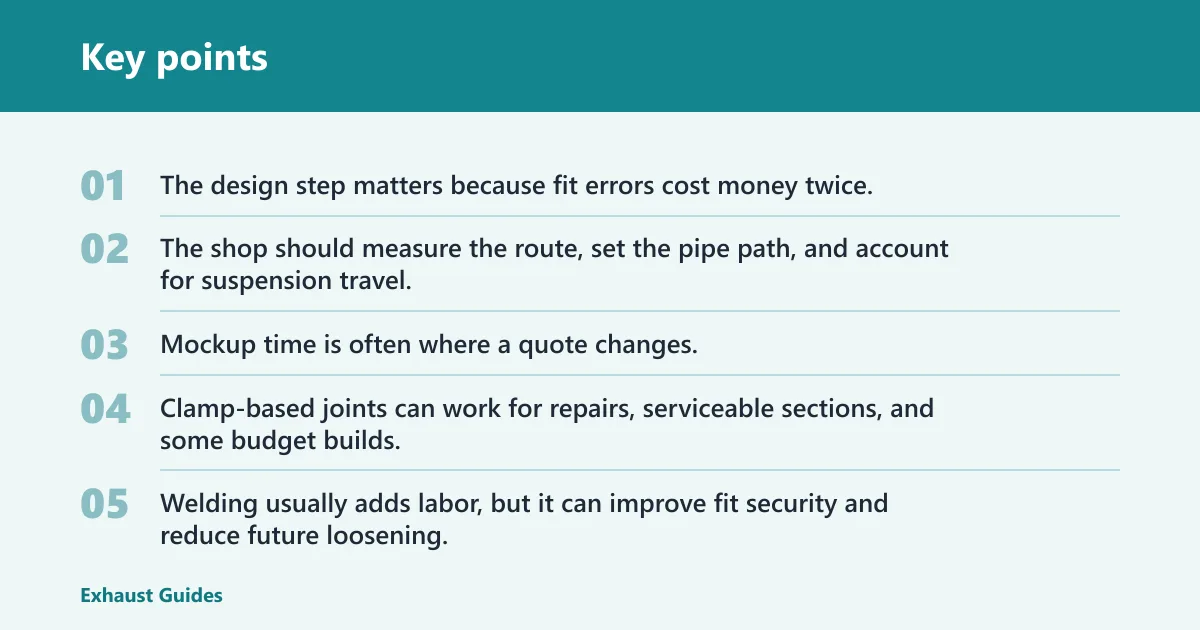
The design step matters because fit errors cost money twice. The shop should measure the route, set the pipe path, and account for suspension travel, ground clearance, and heat-sensitive nearby parts. Mockup time is often where a quote changes, especially on vehicles with nonstandard repairs or aftermarket parts already installed.
Welding versus clamped joints
Not every exhaust job needs welding. Clamp-based joints can work for repairs, serviceable sections, and some budget builds. Welding usually adds labor, but it can improve fit security and reduce future loosening. A quote should state whether joints are welded, clamped, or mixed, because that choice affects both labor and future serviceability.
Hanger placement and leak checks
Exhaust hangers support alignment and help prevent rattle and ground contact. They are a required additional part in many quotes. Gaskets and clamps matter too, because they seal joints and reduce leaks at serviceable connections. Leak checks should be included, not treated as an optional extra, because a small leak can sound like a major failure.
Suppose a 2.5-inch cat-back on a sedan needs one new hanger and two welded joints. That is a different bill than a full dual system on a truck with rusted flanges and misaligned previous repairs. The first job may be a straightforward fabrication piece. The second can spend time on removal before fabrication even starts.
Is stainless more expensive than aluminized steel?
Yes. Stainless exhaust fabrication is usually more expensive than aluminized steel because the raw material costs more and the corrosion resistance is better. Aluminized steel is the lower upfront-cost choice. Stainless is often worth the added cost when the vehicle sees road salt, wet climate use, or a long ownership horizon.
Corrosion resistance
Stainless steel resists rust better, which can help in harsh climates and reduce future replacement risk. That matters on trucks, daily drivers, and vehicles kept for years. Aluminized steel can still be a sensible choice for lower-cost repairs, shorter ownership periods, or vehicles that live in milder conditions.
Upfront material cost
Material choice changes the quote before labor even starts. Stainless sections, bends, and hardware usually cost more at purchase. Aluminized steel keeps the bill lower, but it may not last as long when water and salt stay on the system. A good shop should explain that tradeoff instead of assuming one material fits every job.
Best use cases by climate and vehicle type
Stainless makes more sense for long-term ownership, harsh winters, and trucks that see salted roads. Aluminized steel can make sense for an older car, a budget repair, or a short-term fix. If a vehicle already has severe corrosion, spending extra on stainless for only one small section may not be the best use of money.
How do labor rates change the price?
Labor rates shift with region, shop type, and how hard the vehicle is to work on. A general repair shop may charge less per hour than a stainless specialist or fabrication-focused shop, but the specialist may also finish a complex job with less rework. Rust and tight access can double the time even when the rate stays the same.
Regional shop rates
Local labor markets matter. A shop in a high-cost metro area may quote a higher hourly rate than one in a smaller market. Even within the same city, price can vary by reputation, workload, and whether the shop handles custom work every day or only occasionally.
Specialist shops versus general repair shops
General shops often price routine repairs more simply. Fabrication-focused shops may charge more for design time, welding skill, and custom fitment, but that can reduce errors on difficult jobs. If the quote includes multiple bends, section fabrication, or sensor relocation, specialty experience matters more than the lowest hourly rate.
Rust, seized fasteners, and tight access
Rusty bolts slow removal. Seized flanges can turn a one-hour replacement into a longer repair. Tight access around a truck’s frame or over-axle routing can add mockup and weld time. These are the reasons a quote for the same pipe diameter can vary so much from one vehicle to another.
When does repair cost less than fabrication?
Repair usually costs less when you only need a short section fixed, a hanger replaced, or a single leak sealed. Full fabrication makes more sense when the system is badly corroded, previous repairs are failing, or you are changing layout, sound, or emissions-related hardware. The cheaper choice depends on how much pipe is still worth keeping.

Section repair versus full replacement
If the damage is limited to one pipe segment, a muffler section, or a flange area, repair can be the better financial move. Once corrosion reaches multiple joints, hangers, and adjacent pipe, patchwork may become false economy. At that point, full fabrication can cost less than repeated fixes.
Broken hangers and minor leaks
A broken hanger or a small leak near a clamp can often be handled without a full custom build. That may mean replacing hardware, re-clamping a joint, or welding a short repair section. If the pipe is still structurally sound, you do not need to pay for a complete redesign.
When custom work is the better call
Custom fabrication becomes the better call when the route must change, the old system no longer fits, or the parts are too rusted to reuse safely. It also makes sense if you want a specific sound level, a different muffler layout, or a cleaner repair than piecing together old sections.
Picture a truck with a rusted rear section, one broken hanger, and a hanging tailpipe. If the front half is solid, a repair section may be enough. If the pipes behind the axle are thin, pitted, and misaligned from earlier work, a custom section can be the cleaner long-term fix.
Emissions and noise rules can change the bill

Rules matter because they can change both parts and labor. Catalytic converters, DPF, SCR, and required sensors are not optional decorations on street vehicles. Muffler delete and straight pipe requests may cost less in parts, but they can raise noise-law risk and create inspection problems that cost more later.
Catalytic converters, DPF, and SCR
Street-use compliance is a separate issue from fabrication skill. Removing or altering catalytic converters, diesel particulate filters, or selective catalytic reduction hardware can create legal and inspection problems. If the job must keep emissions equipment intact, the quote may need more design time to work around those parts correctly.
Required sensors and fitment limits
Modern exhaust systems may need oxygen sensors, temperature sensors, or other monitoring hardware to stay functional. Sensor placement affects pipe routing and can limit where bends go. A quote should note whether sensor bungs, extensions, or relocations are part of the work, because those items add labor and risk.
Muffler delete and straight pipe risk
Muffler delete and straight pipe requests are often cheaper because they use fewer parts, but the result can be much louder and may run afoul of local noise rules. A lower price does not mean a better value if the vehicle becomes unpleasant to drive or fails inspection. Ask whether the shop is quoting legal street-use work or off-road-only configuration.
Frequently asked questions
How much does exhaust work cost: exhaust work can cost roughly?
Exhaust work can cost roughly under $200 for a small clamp-on repair or well over about $1,500 for custom fabrication, depending on what is replaced. The biggest drivers are labor time, material choice, rust, and whether the job needs welding, hanger replacement, or emissions-related fitment.
How much does an average exhaust cost?
There is no single average that fits every vehicle. A basic custom section is often lower than a full system, while trucks and rusted vehicles trend higher. A quote is more useful than an average because pipe length, bend count, and access can change the total quickly.
How much does it cost to get your exhaust done?
If “done” means a repair section, the bill can stay modest. If it means a full custom system with fitment correction, welding, and hardware, the total moves up fast. Ask the shop to separate parts, labor, and any surcharge for rust or difficult access.
How much does exhaust fabrication cost for a truck?
Truck exhaust fabrication often lands higher than a simple car repair because of longer pipe runs, more bends, and tight routing around the frame and axle. Straight-pipe-style truck jobs can run about $200 to $1,000, while complex stainless or dual-exhaust fabrication can exceed $1,000.
How much does a custom exhaust system cost?
A custom exhaust system often starts around the low hundreds for a simple section and moves into the thousands for a full build. The price depends on pipe material, number of bends, welding time, hangers, gaskets, and whether the vehicle needs emissions hardware retained or relocated.
Is stainless exhaust fabrication more expensive than aluminized steel?
Yes. Stainless usually costs more upfront than aluminized steel, but it also offers better corrosion resistance. Stainless makes more sense for winter driving, coastal climates, and long-term ownership. Aluminized steel is often the lower-cost choice when the goal is to keep the job affordable.
What drives exhaust fabrication labor costs up
Rust, seized fasteners, broken hangers, tight access, and prior repairs are the biggest labor multipliers. Add design time, mockup, welding, leak checks, and any sensor work, and the hours rise. Specialist shops may also quote higher rates for custom fabrication and difficult fitment.
How much should a muffler delete or straight pipe cost?
These jobs can be less expensive than a full custom system because they use fewer parts, but the price still depends on labor and pipe changes. The real issue is not only cost. Muffler delete and straight pipe requests can create noise-law and inspection problems that may cost more later.
What is included in a custom exhaust fabrication quote?
A proper quote should include the material, bends, labor, hanger and gasket hardware, and any rust or fitment surcharge. It should also say whether the work is welded or clamped, whether sensor relocation is needed, and whether the result is intended for street use or off-road only.