Exhaust Manifold Weight by Material and Engine Type
Cast-iron exhaust manifolds are commonly around 18–35 lb per bank, tubular steel about 8–20 lb, and stainless about 7–18 lb; add about 2–8 lb for gaskets, studs, heat shields, and sensors. If you ignore that extra mass, you can misjudge header load, mount stress, and clearance in the engine bay. This guide compares manifold weight by material and engine layout, then adds the hardware that changes installed mass.
What counts in manifold weight?

Bare manifold versus installed mass
Published part weights often cover the bare casting or tube assembly, not the complete installed unit. The number you handle in a garage can run higher once heat shields, crossover sections, turbo flanges, studs, gasket material, and sensor bosses are included.
That difference matters in tight engine bays. A 12 lb bare stainless manifold can feel much heavier once shielded, bolted, and paired with a thick outlet flange or turbo support bracket.
Parts that add weight
- Heat shields: Thin stamped shields can add a few pounds, especially on V engines where each bank has its own cover.
- Studs and nuts: Do not weigh much individually, but a full bank adds up.
- Gaskets: Usually small in mass, though layered multi-piece gaskets can be more than expected.
- Crossover sections: Common on V engines and marine systems; these can add several pounds by themselves.
- Turbo hardware: Turbo flanges, support ears, and riser blocks often change the installed total more than the material swap does.
Why published part weights often differ
Two listings for the same engine can differ because one seller lists the bare manifold and another includes shields or attached crossover pieces. Port count, runner count, flange thickness, and wall thickness also change the number enough to matter when you compare replacement parts.
Exhaust manifold weight table
This table estimates the weight a reader usually handles, not only the bare casting. The ranges assume typical production dimensions, then widen for thicker flanges, more runners, turbo risers, or added shielding.
| Engine / manifold type | Bare manifold | Heat-shielded manifold | Turbo-capable manifold | Notes on what adds mass |
|---|---|---|---|---|
| Single-cylinder small engine | 2–6 lb | 3–8 lb | 4–10 lb | Short runners, small flange area, little or no crossover; turbo-capable versions add a thicker outlet and support points. |
| V-type twin-cylinder | 4–10 lb | 5–13 lb | 7–16 lb | Two ports, more flange width, and extra shielding around a compact bank layout. |
| Inline 4-cylinder gasoline | 8–18 lb | 10–22 lb | 12–26 lb | Runner length and flange thickness rise with port spacing; shielded versions add stamped covers and clips. |
| V6 gasoline or diesel bank | 10–22 lb | 13–28 lb | 16–34 lb | More runners, wider flange, and common heat shields; turbo versions often need a heavier outlet and thicker mounting pad. |
| V8 gasoline bank | 12–28 lb | 15–35 lb | 18–42 lb | Runner count and casting volume are the main drivers; crossover sections and turbo flanges push the upper end higher. |
| Diesel multi-cylinder bank | 15–35 lb | 18–42 lb | 22–50 lb | Diesel parts often use thicker walls for heat fatigue and durability, which adds mass fast. |
| Marine V8 manifold | 18–40 lb | 22–48 lb | 26–58 lb | Risers, cooling jackets, corrosion protection, and outlet hardware can outweigh a plain automotive casting. |
How much does a cast iron exhaust manifold weigh compared with stainless steel?
Cast iron usually weighs more than a fabricated stainless steel manifold for the same engine because the casting needs more material for heat resistance and durability. Stainless can be lighter, especially in tube form, but the weight advantage shrinks when thick flanges, turbo provisions, or heat shields are added.
Cast iron exhaust manifold
Cast iron is the standard OEM material for many gasoline and diesel applications. It handles heat well and resists thermal fatigue better than many thin fabricated parts, but that strength comes with higher mass. On a V6 or V8 bank, the weight difference versus stainless can be several pounds before any shield goes on.
Stainless steel fabricated exhaust manifold
Fabricated stainless steel exhaust manifolds are often lighter in many builds, especially when made with thin-wall tubing and compact runner routing. They also resist oxidation well, which makes them common in performance and custom applications. The tradeoff is packaging: more bends, welds, and support structure can add back some of the saved weight.
Cast alloy manifold
Cast alloy exhaust manifolds sit between the two in practice. Wall thickness, alloy choice, and runner shape can move the total a lot, so a cast alloy part may be close to cast iron on one engine and noticeably lighter on another. Treat the casting design as part of the weight equation, not just the material name.
Does exhaust manifold weight change on V engines vs inline engines?
Yes. V engines usually carry more manifold weight per engine because they have two banks, more total runners, and more flange area. Inline engines can still be heavy, but they often need only one manifold, so the installed total is lower for the same cylinder count and material.
Single-cylinder and twin-cylinder layouts
Single-cylinder and V-type twin-cylinder engines use short, compact manifolds. They are the lightest examples in the table because there is little runner length, fewer ports, and less flange width. Even so, a turbo outlet or marine riser can quickly change the total.
Inline and multi-cylinder engines
Inline 4-cylinder and other multi-cylinder engines add mass through runner count and port spacing. The more cylinders on one bank, the longer and wider the manifold tends to be. That raises both bare weight and the weight of a complete installed unit with shields and fasteners.
V-type gasoline and diesel engines
V-type gasoline and diesel engines usually need the heaviest bank-by-bank comparison because each side carries its own casting or tube set. Diesel parts are often thicker because they live with higher heat load and thermal fatigue demands. Gasoline parts can be lighter, but the difference depends on flange size and outlet design.
Say your V8 replacement listing says “18 lb.” If that number is for the bare casting, the complete bank with heat shield, gaskets, and studs may land closer to the mid-20s. The same engine family can feel very different during installation when the outlet is a turbo flange instead of a plain collector.
What makes one manifold heavier than another?
Material matters, but geometry often decides the final number. Runner count, runner length, flange thickness, wall thickness, port count, and support hardware can shift the weight enough to change how you replace, support, or package the part.
Runner count and runner length
More runners mean more material. Longer runners add length, more bends, and usually more welds or casting volume. On a V engine, one bank with compact runners can weigh less than a bank with long, tuned runners even if both use the same material.
Flange thickness and port count
Thicker flanges are common on turbo-capable and high-heat parts because they help with sealing and support. More ports also require more flange area. A 6-port diesel bank can weigh more than a 4-port gasoline bank even when the material is the same.
Wall thickness, risers, and collector design
Wall thickness is a major driver on cast manifolds. Marine risers and crossover sections add even more metal, since they must route exhaust and cooling flow in a small space. Collector shape also matters because a larger collector uses more material than a compact outlet.
Heat shields and support brackets
Heat shields and brackets can add a noticeable amount to the installed total. The effect is small on a single-cylinder part and much larger on a V8 bank with a full stamped shield. Turbo support brackets matter because they carry load, not only heat.
Do turbo and marine manifolds weigh more?
Often yes. Turbocharger-mounted manifolds usually weigh more than naturally aspirated versions of the same engine because they need a stronger flange, a tighter support structure, and extra material around the turbine mount. Marine exhaust manifolds are often heavier still because risers, cooling jackets, and corrosion protection add mass.
Turbocharger-mounted manifolds
A turbo manifold faces higher thermal load and more packaging stress than a plain manifold. It must handle exhaust gas temperature in the 900°C to 1100°C range, and one source notes manifold heat can reach 1,200°F or 650°C. That heat load pushes designers toward thicker flanges and better thermal fatigue strength.
Marine exhaust manifolds with risers
Marine exhaust manifolds are commonly heavier than automotive ones because they pair the manifold with risers and cooling features. The added sections help manage exhaust temperature and water routing, but they also add cast volume, brackets, and sealing surfaces. In a V8 marine setup, the installed total can rise fast.
Cooling and corrosion parts that change total mass
Marine systems often need extra corrosion-resistant material, hose connections, and coolant passages. Those parts do not just change durability. They also change the weight a person handles during service, especially when the manifold comes off as a larger assembly rather than a bare casting.
How do you estimate the right weight for your engine?
Start with the engine family and cylinder count, then separate bare part weight from installed weight. The fastest estimate comes from matching the replacement to the original casting shape, outlet style, and hardware package. A part for a 5.3L V8 bank will not weigh like a small inline four, even if both are cast iron.
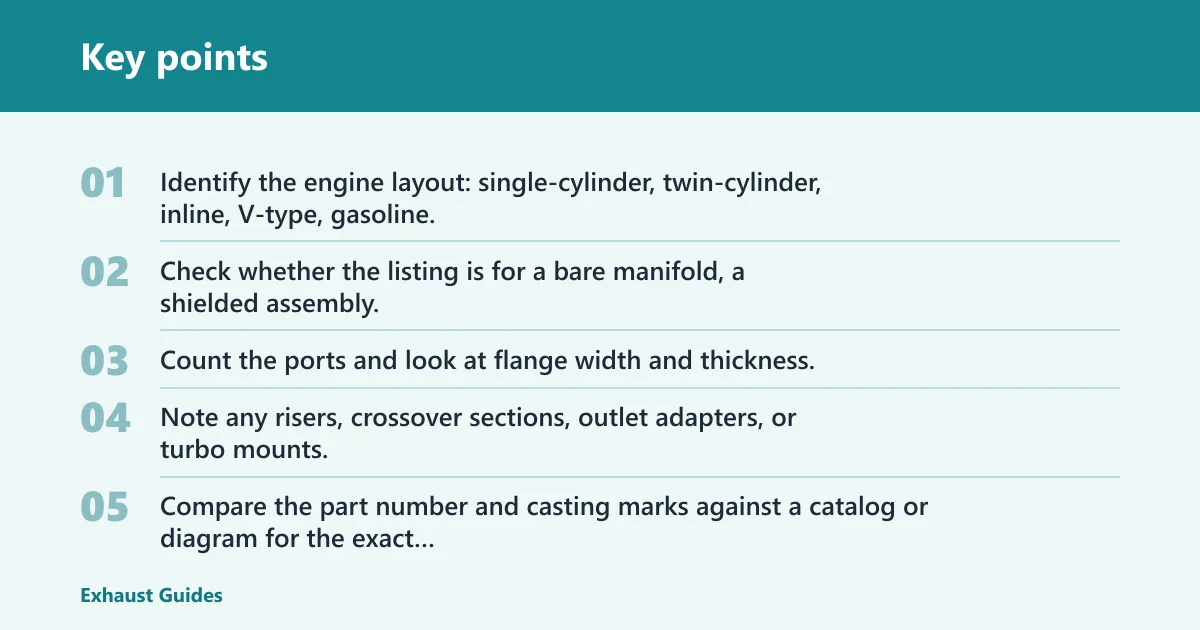
- Identify the engine layout: single-cylinder, twin-cylinder, inline, V-type, gasoline, diesel, or marine.
- Check whether the listing is for a bare manifold, a shielded assembly, or a turbo-capable part.
- Count the ports and look at flange width and thickness.
- Note any risers, crossover sections, outlet adapters, or turbo mounts.
- Compare the part number and casting marks against a catalog or diagram for the exact engine family.
Check casting marks, flange count, and outlet style
These details tell you whether the manifold is a plain OEM cast piece, a fabricated stainless replacement, or a turbo-ready design. Outlet style matters because a turbo flange or marine riser adds more metal than a simple downward outlet.
Verify against replacement catalogs and part diagrams
Marine Engine Depot groups parts by 5.3L 325ci DI V8, 5.7L 350ci V8, 6.2L 376ci DI V8, and 7.4L 454ci V8. That kind of grouping is useful because manifold size and total weight change with engine family, not only with material. A catalog image often reveals whether the number includes shields or risers.
Suppose a diesel V6 needs replacement in a tight engine bay. If the catalog lists a cast iron bank at 24 lb and the same part with a shielded heat cover at 29 lb, the extra 5 lb can matter for bracket load and clearance to nearby wiring.
Frequently asked questions
How much does an exhaust manifold weigh by material?
For common passenger and light-duty engines, cast iron often falls in the 18–35 lb per bank range, tubular steel in the 8–20 lb range, and stainless in the 7–18 lb range. Those are bare-part numbers; shields, studs, and turbo hardware can move the installed total higher.
What material is best for an exhaust manifold if I want lower weight?
Stainless steel fabricated manifolds are often the lightest practical choice for a performance or custom build, especially when thin-wall tubing is used. For OEM-style replacement parts, a lighter cast alloy design may still be heavier than stainless, but it can offer better fit and heat durability.
Does a turbo manifold weigh more than a naturally aspirated manifold?
Usually yes. Turbo manifolds need a stronger flange, more support, and extra metal around the turbine mount, so the installed mass is often higher than a naturally aspirated manifold on the same engine. The difference is larger when the turbo part includes risers or support brackets.
Are marine exhaust manifolds heavier than automotive ones?
Often yes. Marine manifolds usually include risers, cooling passages, and corrosion-protection features that raise the total weight. The hardware can add enough mass that a marine assembly feels much heavier than a plain automotive cast manifold of similar cylinder count.
What should I check before replacing an exhaust manifold by engine type?
Match the engine family, cylinder count, bank side, outlet style, and whether the part is bare, shielded, or turbo-capable. Then compare port count, flange thickness, and any risers or crossover sections. That prevents ordering a part that fits the engine but not the installed package.
How do I estimate exhaust manifold weight for a specific engine?
Start with the engine configuration and material, then add weight for shields, studs, gaskets, and any turbo or marine hardware. If the part is a V8 bank, expect more mass than an inline four; if it is diesel or marine, expect thicker walls and extra accessories.