Exhaust System Repair Cost Estimate
A fair exhaust system repair estimate usually stays under $300 for a clamp, gasket, or hanger fix; $400-$1,200 is common for a muffler, pipe, or catalytic-converter section, and a full-system quote should justify every part. Bad quotes can turn a small leak into a four-figure bill, or leave you paying for parts that were never the problem. This guide shows how to read each line item, compare labor and parts, and spot inflated replacement recommendations before you approve work.
Exhaust repair costs at a glance
Start by separating repair from replacement. A small leak at a gasket or weld is usually a short job. A rusted section, flex pipe, or converter can push the quote much higher. If the estimate blends those together, ask for a line-by-line split before you sign.
Typical price ranges by repair type
A simple exhaust leak weld or gasket replacement runs $75 to $250. A leaking flex-pipe section runs $200 to $600. A full exhaust system replacement can cost $500 to $1,500, while a full cat-back system replacement runs $400 to $2,500. Dealer quotes are typically 2 to 3 times muffler-shop prices.
Those ranges are not interchangeable. A muffler-shop repair on a rear section may be far cheaper than a dealer quote for the same symptom, especially when the dealer prices in factory parts and higher labor rates.
What a basic quote usually includes
A useful estimate names the failed part, the labor time, and the hardware needed to finish the job. For a small repair, that often means a gasket, clamp, weld repair, or short pipe section, plus any hangers or brackets that are broken or rusted thin.
It should also show diagnostic time if the leak has not been located yet. Some shops charge a minimum diagnostic fee before they cut or weld anything. That fee is normal when the source is not obvious.
When a quote is missing key items
If the estimate lists only “exhaust repair” or “replace exhaust” with one lump sum, ask for more detail. Missing items often include shop supplies, disposal, clamps, gaskets, O2 sensor hardware, and welding time. Those omissions can make a cheap estimate look better than it is.
Be careful when one quote includes a full section replacement and another assumes a repairable leak. The final bill should match the actual failure point, not the most expensive interpretation.
Exhaust system parts on an estimate
Exhaust estimates usually mention pipes, resonator, muffler, hangers, gaskets, clamps, O2 sensors, and sometimes the catalytic converter. Those parts do different jobs, and the location of the failure matters as much as the part name. A rear muffler issue is not the same as a front pipe or converter problem.
Pipes, resonator, muffler, and hangers
Pipes carry exhaust through the system. The resonator reduces certain tones. The muffler lowers sound more directly. Hangers support the system and isolate vibration from the body. If a hanger tears loose, the pipe can shift and crack a nearby seam or weld.
A muffler replacement is a narrower job than a full exhaust repair. If the rest of the system is solid, the estimate should stay focused on that single component rather than turning into a larger section swap.
Gaskets, clamps, and welds
Gaskets seal flange joints. Clamps join sections without welding. Welds close cracks or repair broken seams. A leak at a flange or gasket can be cheap if the surrounding metal is still sound. Once the flange face, pipe seam, or weld area is too corroded, the repair may stop being economical.
That corrosion point matters. Rust at a hanger mount, seam, or flange can make a simple seal impossible, even if the hole itself looks small.
O2 sensors and catalytic converter mentions
An estimate may mention O2 sensors if the shop has to remove them for access or if the sensor threads are seized. A catalytic converter is a separate, high-cost component. A noisy exhaust does not automatically mean the converter failed, so the diagnosis should explain why that part is in the quote.
Current Cost lists catalytic converter replacement at $900 to $2,500. That is a very different job from a small leak repair, so the estimate should say whether the converter is actually damaged, clogged, stolen, or only being removed for access.
What makes exhaust quotes vary?
Exhaust quotes vary because access, rust, labor rate, and vehicle layout change the work required. Two cars with the same symptom can produce very different totals if one has easy access and the other has corroded fasteners, tight packaging, or emissions hardware in the way.
Labor rate and diagnostic fee
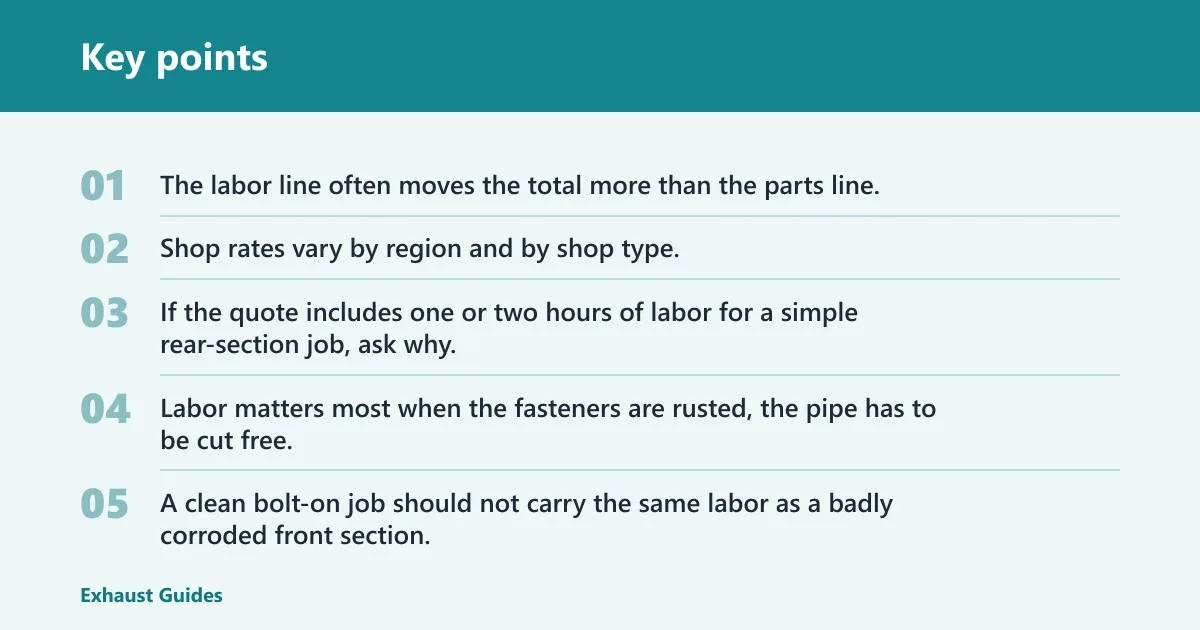
The labor line often moves the total more than the parts line. Shop rates vary by region and by shop type, and a minimum diagnostic fee may appear before any repair. If the quote includes one or two hours of labor for a simple rear-section job, ask why.
Labor matters most when the fasteners are rusted, the pipe has to be cut free, or the technician has to separate a one-piece assembly. A clean bolt-on job should not carry the same labor as a badly corroded front section.
Rust, access, and vehicle layout
Rust raises cost when it attacks flanges, hanger mounts, pipe seams, or welds. Access also matters. A flex pipe near the front of the system may take much longer than a rear muffler because the technician has less room to work and may have to remove shields or nearby parts.
Suppose a 10-year-old sedan has a leaking rear muffler seam but clean bolts. That estimate should look very different from a compact crossover with a rusted mid-pipe flange and seized hangers, even if both are loud at idle.
Dealer pricing versus muffler-shop pricing
Dealer quotes are typically 2 to 3 times muffler-shop prices. That gap usually reflects parts choice, labor rate, and how much of the factory assembly the dealer wants to replace. A dealer may push OEM sections, while a muffler shop may repair or replace only the failed part.
A higher dealer price is not always wrong, but it should come with a reason. If the dealer is replacing a full assembly and the local exhaust shop is quoting a patch or section swap, compare the actual scope before judging the price alone.
Exhaust estimate checklist
This checklist shows how to compare a shop quote against the likely scope. The useful question is not “Is this expensive?” but “Does the line item match the failed part, the labor time, and the hardware that the job actually needs?”
| Scenario | Expected parts | Labor hours | Hardware and add-ons | Red-flag add-ons |
|---|---|---|---|---|
| Small leak at gasket or weld | Gasket, clamp, or weld repair; short pipe section if needed | 0.5-1.5 | Shop supplies, rust penetrant, disposal, minor bracket repair | Full rear assembly, converter replacement without diagnosis, unnecessary sensor replacement |
| Flex pipe replacement | Flex pipe section, possibly adjoining pipe sections | 1.5-3.0 | Gaskets, clamps, weld consumables, heat shields if removed | Complete cat-back quote when only the flex joint failed |
| Muffler-only replacement | Muffler, inlet or outlet pipe as needed | 1.0-2.0 | Hangers, clamps, gaskets, tailpipe hardware | Front pipe, resonator, or converter replacement unless corrosion reaches those parts |
| Cat-back replacement | Pipe from catalyst outlet back, resonator, muffler, tailpipe | 1.5-4.0 | Full set of clamps, hangers, gaskets, sometimes new hardware clips | OEM full-system pricing when only the rear section is included |
| Full system replacement | Pipes, resonator, muffler, hangers, and related hardware from front to rear | 2.0-6.0 | Gaskets, clamps, brackets, shield hardware, disposal | Converter included without a clear failure reason, duplicate labor for the same section |
This table is a comparison tool, not a fixed bill. The same repair can move up or down with rust, access, emissions equipment, and whether the shop welds a section or replaces it whole.
What does it cost to fix an exhaust leak?
A typical exhaust leak repair runs $75 to $250 when the problem is a gasket, weld, or short pipe section. That range fits many small repairs where the damaged area is isolated and the surrounding pipe still has enough metal left to seal properly.
Common leak sources: gasket, weld, pipe section
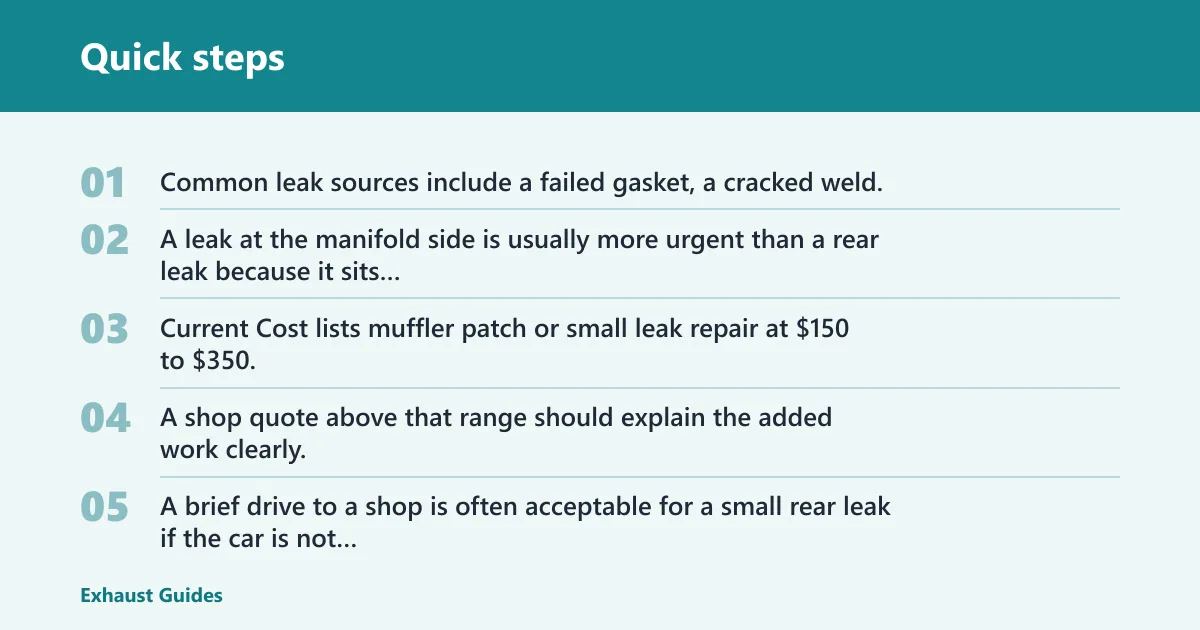
Common leak sources include a failed gasket, a cracked weld, a rust hole in a pipe section, or a broken flange. A leak at the manifold side is usually more urgent than a rear leak because it sits closer to the engine and can expose the cabin to more noise and fumes.
The same source lists muffler patch or small leak repair at $150 to $350, which fits a more involved small repair or one that needs extra removal time. A shop quote above that range should explain the added work clearly.
Safe driving window and carbon monoxide risk
A brief drive to a shop is often acceptable for a small rear leak if the car is not filling the cabin with fumes and the sound is manageable. Do not treat that as a free pass. Exhaust leaks can be a carbon monoxide risk, and any smell in the cabin means you should stop and get it checked sooner.
A common first-timer mistake is assuming a loud tailpipe means the car is fine as long as it still starts. If the leak is near the front of the system, the risk is higher than a simple rear muffler noise.
Upstream leak problems
Upstream leaks can create more than sound. They can alter sensor readings, trigger a check-engine light, or make the engine computer react to false air readings. If the estimate includes O2 sensor work, ask whether the sensor itself failed or whether the leak is skewing the reading.
If the leak is at a flange or manifold-side joint, the quote should explain whether the fix is a gasket, a new flange, or a section replacement. That detail separates a reasonable repair from a parts swap that may not solve the symptom.
How much is a flex pipe replacement?
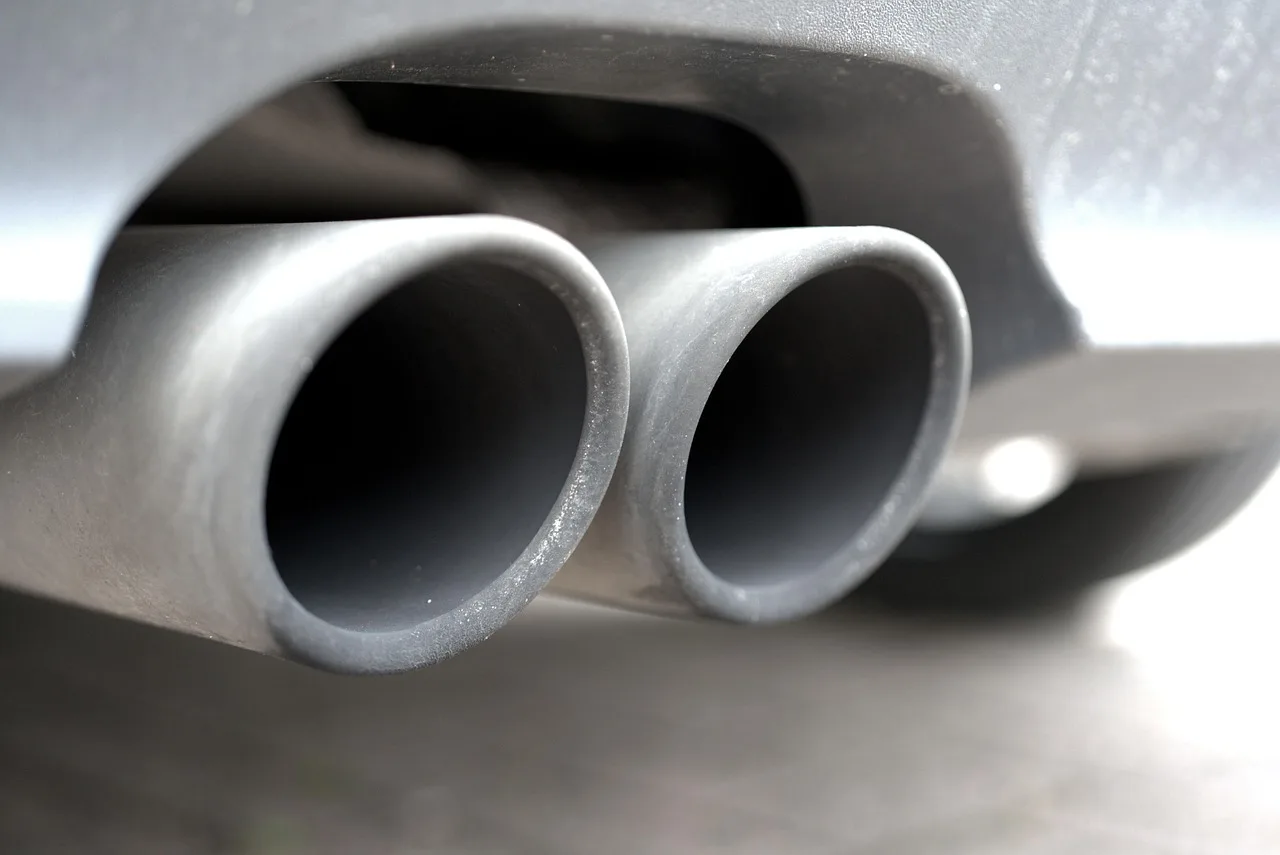
A leaking flex-pipe section runs $200 to $600, and a flex-pipe section repair is priced at $200 to $450 for aluminized steel. Flex sections cost more than a simple weld because they sit in a high-motion area, often require more labor, and may need a larger cut-and-fit repair.
Why flex sections cost more than a simple weld
The braided flexible joint absorbs engine movement. That location sees heat, vibration, and movement all the time, so a failed flex section usually cannot be fixed with a tiny patch. The shop may need to remove the old section, fit a new one, and weld or clamp both ends.
That extra labor is why a flex pipe quote should be higher than a basic gasket job. The part itself is only part of the bill; access and fabrication time usually drive the total.
Braided joint location and labor time
The braided joint is usually near the front half of the exhaust, close to the engine. That makes access tighter than a rear muffler repair. Shields, rusted bolts, and seized flanges can all add time, which is why the labor line should be specific rather than vague.
For aluminized steel, a leak weld or patch is priced at $75 to $180, and a hanger or bracket repair is priced at $50 to $150. If the shop jumps from those figures straight to a full assembly, ask why the flex section cannot be repaired or isolated.
When the whole section gets replaced
If the flex pipe is welded into a larger front section, the shop may need to replace the whole section instead of patching a single spot. That is more likely when the pipe is rusted around the joint, the flange is damaged, or the metal around the leak is too thin to hold a new weld.
Picture a compact car with a loud front-end hiss and a rusted flex joint beside the transmission tunnel. If the flange is crumbling too, the estimate may justifiably move from repair to section replacement.
When does a muffler or full system need replacement?
A muffler replacement is narrower than a full exhaust job. A full system quote should only appear when multiple sections are rusted, the pipe routing is damaged, or the system is so corroded that a piecemeal repair would not last. Cat-back, axle-back, and full-system quotes are not the same thing.
Muffler-only repair versus full exhaust scope
A muffler-only repair usually covers the rear sound-damping unit and the pieces needed to attach it. A full exhaust repair may reach farther forward and include pipes, resonator, hangers, and hardware. If the estimate lists only one bad muffler, the quote should stay focused there.
The muffler is a common failure point because it sits low, catches moisture, and rusts from the inside out. Even so, a bad muffler does not mean the entire system is done.
Cat-back and axle-back pricing
A cat-back system starts after the catalytic converter and can include the mid-pipe, resonator, muffler, tailpipe, hangers, and clamps. An axle-back system starts farther rearward and usually covers only the sections behind the axle. Cat-back pricing is generally higher because it includes more parts and labor.
A full cat-back system replacement runs $400 to $2,500. A full exhaust system replacement can cost $500 to $1,500. Those ranges overlap, but the included parts do not always match, so the quote should specify where the system starts and ends.
Catalytic converter replacement as a separate cost
Catalytic converter replacement is a separate, high-cost line item. The same source lists it at $900 to $2,500, which is far above a routine leak repair. A converter quote should appear only when diagnostics, codes, theft damage, clogging, or physical damage justify it.
Car Talk says the price does not include catalytic converters or manifolds when discussing a full exhaust replacement. That matters because some shops present a base exhaust price that leaves out the expensive components most readers worry about.
Frequently asked questions
How much does an exhaust repair cost?
Most small exhaust repairs fall between $75 and $250 when the issue is a gasket, weld, clamp, or short pipe section. If the flex pipe is damaged, the cost rises quickly because the part is more labor-intensive and often sits in a tighter, hotter part of the system.
How much is exhaust repair?
That depends on whether the shop is repairing a leak or replacing a section. Always ask what exact part the estimate covers.
How much to replace an exhaust system?
A full exhaust system replacement can cost $500 to $1,500. The total changes with vehicle layout, rust, parts access, and whether the quote includes the converter, resonator, muffler, hangers, and hardware. Dealer pricing is usually higher than muffler-shop pricing.
Is it cheaper to repair a leak or replace the whole exhaust?
Repair is cheaper when the failure is isolated to one gasket, weld, hanger, or short pipe section. Replacement makes more sense when corrosion has spread through flanges, seams, or multiple hangers, or when the system is too thin to seal well after repair.
What drives exhaust repair cost up or down?
Labor rate, diagnostic fee, rust, access, and vehicle layout drive the price more than many drivers expect. Front-section leaks, flex pipe failures, and seized hardware usually cost more than rear-section work because they take longer and need more hardware replacement.