How Much Should Exhaust Pipe Bending Cost?
Exhaust pipe bending is often reported at about $40 to $150 per bend, and full jobs may land around $150 to $600. Mandrel bends, stainless, tight packaging, and custom flanges push the price higher. A cheap quote can sometimes lead to poor fitment, crushed pipe, leaks, drone, and another labor bill. This guide breaks down what changes the price, how shops price bends, and when a low quote is a bad bend.
What drives exhaust bending cost
Exhaust pipe bending cost is usually driven by labor, setup, and fit-up time, not bend angle alone. Shops may quote per bend, per job, or as fabrication work that includes measuring, fixture setup, test fit, and correction time. Diameter, wall thickness, material, and access all move the price.
Labor-only versus fabrication pricing
A labor-only quote covers bending the tube you bring in. Fabrication pricing usually includes measurement, layout, cut length, alignment, tack-weld planning, and sometimes final fit checks. If the shop has to solve routing, hanger placement, or flange location, the number should be higher than a simple bend charge.
Per-bend, per-foot, and per-job quotes
Per-bend pricing works best for simple, repeatable bends. Per-foot pricing shows up more often in custom exhaust work where the shop is shaping long sections. Per-job pricing is common when the part needs layout, trimming, and installation guidance. Ask which method is being used before comparing quotes.
Why setup and fit-up time change the bill
The same tube can cost very different amounts to bend if the shop must measure from your vehicle, build a fixture, or remake a section after a trial fit. Minimum shop charges often absorb this time on small jobs. If the quote looks unusually low, ask whether setup, measuring, and one rework pass are included.
How much exhaust pipe table
This table turns the usual quote variables into a quick pricing check. Use it to compare labor-only and fabrication quotes, and to spot when a low number may hide rework, poor fit, or the wrong bending method for the tube.
| Job type | Pipe size and wall | Material | CLR and bend count | Likely pricing tier | Quote red flags |
|---|---|---|---|---|---|
| Single bend in a straight repair section | 2.0-2.5 in OD, standard wall | Carbon steel | Large CLR, 1 bend | Low to moderate; often per-bend labor | No mention of straight end length, fit-up, or minimum charge |
| Two-bend tailpipe segment | 2.25-3.0 in OD, standard wall | Carbon steel or aluminized steel | Moderate CLR, 2 bends | Moderate; may shift to per-job pricing | Quote ignores measurement time or trim allowance |
| Underbody clearance correction | 2.5-3.0 in OD, thin wall | Stainless steel | Tight CLR, 2-4 bends | Higher; often mandrel work | Compression bend quoted where collapse risk is high |
| Truck or diesel exhaust section | 3.0-4.0 in OD, heavier wall | Carbon steel or stainless steel | Long section, multiple bends | Higher; setup and material handling matter more | Price does not mention larger tooling or access limits |
| Performance exhaust with tight packaging | 2.5-3.5 in OD, thin wall | Stainless steel | Tight CLR, compound bends | High; fabricator pricing is common | Only angle is quoted, not radius, end length, or orientation |
| Large or thick-wall pipe repair | 3.5-5.0 in OD or thick wall | Carbon steel or stainless steel | Any CLR, difficult bend count | Highest; may require heat bending | No mention of heat process, cooling control, or distortion risk |
Say your passenger car needs one 2.25-inch stainless bend to clear a suspension arm. A shop that quotes a single bend with mandrel tooling and a fit check is pricing the job by precision. A shop that quotes the same price as a 2.25-inch carbon-steel repair is likely leaving out setup or post-bend adjustment.
Which bending method should you expect?
Mandrel bending is often chosen for smooth, accurate bends, and it is best for precision and smooth bends. Compression bending is less expensive and fits simpler jobs. Heat bending is the best technique for large or thick-wall pipe, especially when the tube size or stiffness pushes standard tooling too far.
Mandrel bending for smoother, tighter control
Mandrel bending is often used for pipe diameters in a range that depends on the machine and shop setup. It uses internal support to reduce collapse and keep the bend shape closer to the target centerline radius. That extra control costs more because the tooling and setup are more involved than a basic press bend.
Compression or press bending for simpler jobs
Compression bending is a more affordable method than mandrel bending, and it works across a range that depends on the machine and setup. It is often fine for gentler bends, simple routing, or pipe that has more tolerance for shape change. It is usually the cheaper path, but it can leave more flattening on tight bends.
Heat bending for large or thick-wall pipe
Heat bending is positioned as the best technique for large or thick-wall pipe. It uses controlled heat, which lets the shop form sections that are hard to move cold. The price tends to rise because the process needs more control, more handling time, and more care around distortion.
How do size and material change the price?
Outside diameter, wall thickness, and material grade all change both cost and bendability. Larger OD usually means bigger tooling and lower machine capacity. Thicker walls resist collapse but can be harder to shape. Stainless steel and aluminum usually need different handling than carbon steel, and the quote should reflect that.
Outside diameter and machine capacity
OD is not just a fitment number. It also signals what the shop can physically bend on its machine. A pipe bender has limits on maximum tube size, and a larger diameter can require different dies, more force, or a different machine class. If the shop only gives a bend angle without asking OD, the quote is incomplete.
Wall thickness and collapse risk
Wall thickness affects how well the pipe survives the bend. Thin-wall tube is more likely to wrinkle or flatten, which is why mandrel support costs more on those jobs. Thick-wall tube resists collapse better, but it can need more force or heat. Either way, thickness changes the process, not just the price.
Carbon steel, stainless steel, and aluminum
Carbon steel is usually the easiest and least costly of the three to form. Stainless steel often costs more because it is less forgiving and more sensitive to process control. Aluminum bends differently again, so the shop needs the correct tooling and a clear plan for support. Material grade should always be named in the quote.
What should a shop quote include?
A useful quote should name the process, the pipe size, the bend count, the radius target, and the work scope. For custom exhaust bending, the quote should also cover measuring, fit-up, any fixture work, and whether the job is weld-in or clamp-on. Those details decide whether the quote is real or just a starting number.
Minimum shop charge and tooling setup
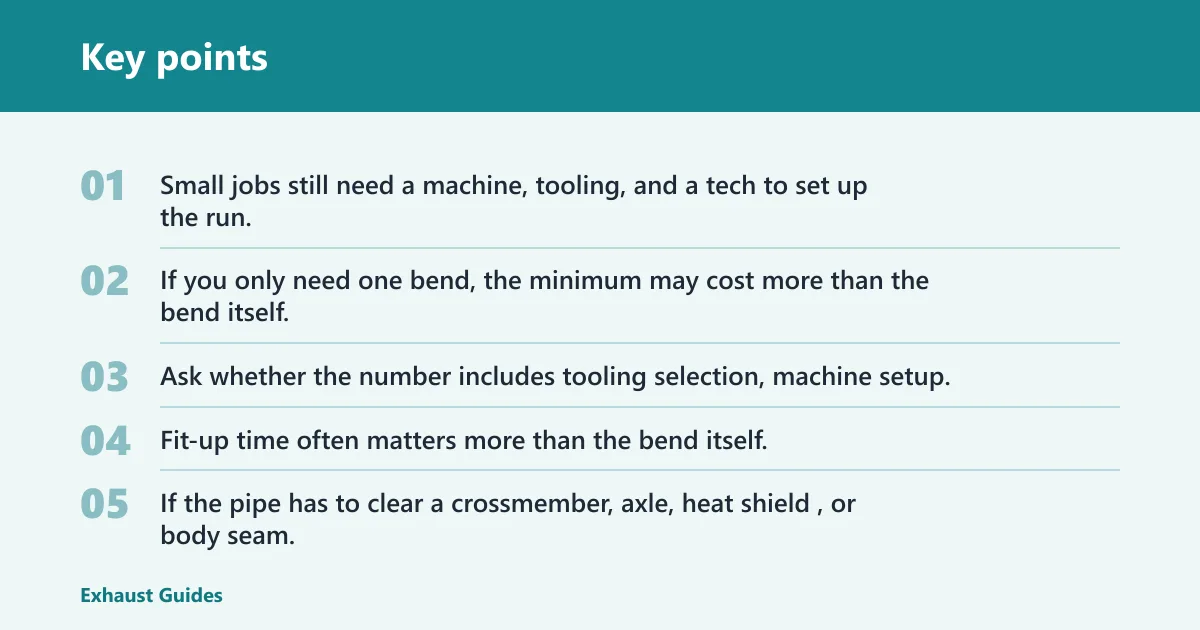
Small jobs still need a machine, tooling, and a tech to set up the run. That is why minimum shop charges exist. If you only need one bend, the minimum may cost more than the bend itself. Ask whether the number includes tooling selection, machine setup, and a basic verification pass.
Measuring, fit-up, and rework time
Fit-up time often matters more than the bend itself. If the pipe has to clear a crossmember, axle, heat shield, or body seam, the shop may need photos, measurements, or a sample part. A cheap quote that excludes rework can become expensive if the first bend misses the needed clearance and the tube has to be redone.
Weld-in versus clamp-on routing changes
Weld-in routing changes usually cost more than clamp-on changes because the shop may need to trim, align, and finish the joint. Clamp-on or bolt-up work can be faster if the pipe section already fits the system. If the quote does not say how the new section will connect, compare it to a wrong-scope bid rather than a fair price.
Picture a diesel truck with a 4-inch stainless section and a tight bend around a frame bracket. A quote for only the bend angle misses the larger pipe, the longer section, and the extra setup time. In that case, the low number often means the shop has not priced the actual job.
How much is a pipe bender?
A pipe bender can range from a modest manual machine to a higher-cost CNC unit. The machine price depends on axis count, tooling package, automation level, delivery scope, commissioning, and training. Tube size alone cannot price a CNC pipe bending machine, because the whole system matters.
Manual versus CNC machines
Manual benders cost less because they do less automatically. CNC machines cost more because they control repeatability, angle, rotation, and, on more advanced systems, multiple axes of motion. For a shop, the machine price is only part of the spend; installation and operator training can be part of the purchase quote too.
Axis count, tooling, and tube size limits
More axes usually mean more control over complex bends. Tooling packages also change the price because dies and supports are matched to the tube range and the bend style. A machine quoted for one tube size may not be enough if the shop wants to cover multiple OD ranges or different bend radii.
Commissioning, training, and delivery scope
Quoted scope can include packaging, freight, commissioning, training, and spare parts. Those items can materially change the total cost of ownership. If a seller quotes only the base machine, compare that with a full landed and installed price before treating it as the cheaper option.
When is custom bending the wrong buy?
Custom bending is the wrong buy when a pre-bent section already matches the routing, when the radius and end lengths are standard, or when the shop would spend more on fit-up than the part is worth. It is also the wrong buy if a low quote risks a second labor charge after a bad fit or a damaged tube.
Pre-bent sections versus shop bending
Is exhaust pipe bending cheaper than buying pre-bent exhaust pipe and bends? Often yes for one-off routing changes, but not when the job needs a common radius, standard diameter, and a known offset. Pre-bent sections can cost less in total because they remove setup time and reduce the chance of rework.
Cheap quotes that lead to bad fit
A cheap quote can turn into wrinkling, collapse, leaks, or a second labor bill if the shop uses the wrong process for the pipe. Tight radius work on thin-wall tube is where this shows up fast. Ask whether the shop is planning mandrel bending, compression bending, or heat bending before you approve the job.
Replacement costs for damaged pipe
How much does it cost to replace a bent or damaged exhaust pipe? The answer depends on whether the pipe can be straightened, sectioned, or must be replaced. A simple repair may stay near the lower bend range, roughly $40 to $150 per bend, while a new stainless section with fit-up and welding can move into the higher fabrication range, roughly $150 to $600 per job, quickly.
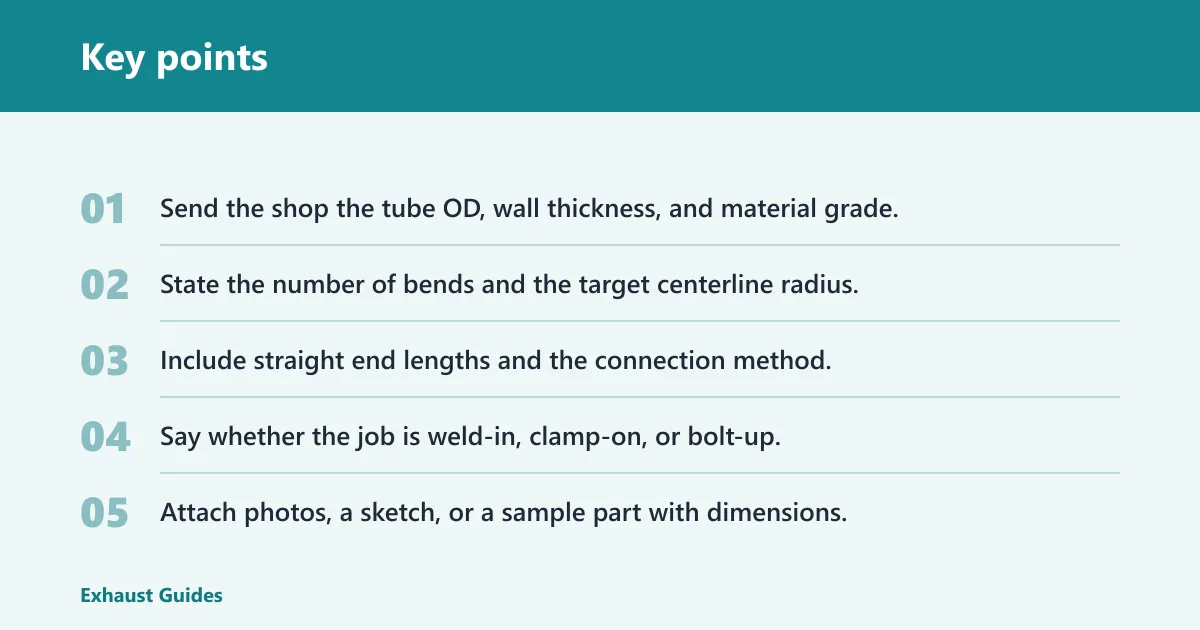
- Send the shop the tube OD, wall thickness, and material grade.
- State the number of bends and the target centerline radius.
- Include straight end lengths and the connection method.
- Say whether the job is weld-in, clamp-on, or bolt-up.
- Attach photos, a sketch, or a sample part with dimensions.
- Ask what the quote includes: setup, measuring, and rework.
Frequently asked questions
How much should exhaust pipe bending cost?
Mandrel bends, stainless, tight clearances, and custom connections push the price higher. A quote should also say whether measuring and rework are included.
How do shops price exhaust pipe bending?
Shops price exhaust pipe bending per bend, per foot, or per job. The quote should reflect labor-only work versus full fabrication, plus setup, measuring, and fit checks. Diameter, wall thickness, material, and bend radius matter more than angle alone, especially on tight or compound routing.
What affects custom exhaust bending near me cost
The cost changes with OD, wall thickness, material grade, bend count, and clearance around the chassis. Weld-in routing costs more than clamp-on changes, and a tight centerline radius usually raises the price. A low quote that ignores these details often leaves out labor later.
Is exhaust pipe bending cheaper than buying pre-bent exhaust pipe and bends?
Sometimes, but not always. Custom bending can be cheaper for one unusual route, while pre-bent sections can be cheaper when the size, radius, and orientation are standard. If a shop must do layout, trimming, and a second fit, the custom option can pass the pre-bent cost fast.
What should I ask before paying for pipe bending services near me?
Ask what process will be used, what OD and wall thickness the quote covers, whether the price is per bend or per job, and whether setup and rework are included. Also ask for the target CLR, straight end lengths, and the connection method. Those answers tell you whether the quote is complete.
Can exhaust pipe bending be done without a bender?
Yes, but it is risky for precision work. Heat-based forming, hand shaping, and cut-and-weld methods can work for some large or thick-wall pipe, but they increase the chance of distortion, leaks, and uneven fit. For repeatable exhaust routing, a proper bender is the safer choice.